Methods of Radiation Protection Module 2 Lecture 2
 Call Kai
 Learn
Learn Practice Test
 Spaced Repetition
 Match
Match Flashcards
 Knowt Play
1/25

There's no tags or description
Looks like no tags are added yet.
Name | Mastery | Learn | Test | Matching | Spaced | Call with Kai | Chat |
|---|
No analytics yet
Send a link to your students to track their progress
26 Terms
Radiation Safety in the workplace
It is the responsibility of an employer to provide the resources to ensure radiation levels for patients and workers are kept as low as possible.
The employer must have a written policy outlining their commitment to reducing radiation exposure levels.
As Low As Reasonably Achievable (ALARA)
Synonymous with the term optimization for radiation protection (ORP)
Radiation Protection Guidelines are rooted in the philosophy of the ALARA Principle:
Keep radiation exposure and consequent dose as low as possible
ALARA principles should be incorporated into every health care facilities personnel radiation control program
No safe dose levels exist for radiation-induced malignant disease so ALARA principles should always be enforced and should be the guide for therapists selecting technical exposure factors
The three Cardinal Rules of Radiation Protection under the Principles of ALARA are:
Time
Distance
Shielding
______is the most effective way to increase radiation protection in radiation therapy
Distance
Reduce the amount of time the beam is on by:
Rad Therapy - Limiting the amount of repeat films on treatment machine, use appropriate techniques in CT sim.
Use as much distance as possible from the source of radiation
Rad Therapy – therapist should keep as much distance from a radioactive source (brachytherapy)
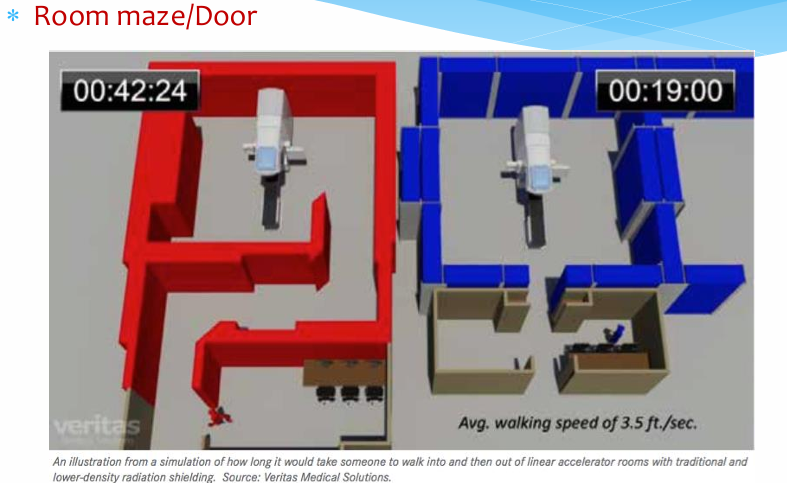
*Treatment Room Maze- takes more time to get in the room, increases the distance from the treatment machine and contains shielding in the walls (decreasing scatter radiation)
Always use shielding when possible
Rad Therapy - Brachytherapy – lead shield
Rad Therapy - Testicular shields when treating seminoma, concrete & lead lined walls, proper door and/or *maze
X-ray (only) – lead apron
*Treatment Room Maze- takes more time to get in the room, increases the distance from the treatment machine and contains shielding in the walls (decreasing scatter radiation)
Applying the 3 Cardinal Rules to ourselves:
Keep distance from patients receiving brachytherapy and minimizing time spent with them
Always remain outside the room during simulations and treatments
Maze to room
Walls as barriers
Doors
Health care facilities usually adopt investigation levels, defined as level I and level II
These levels are traditionally one tenth to three tenths the applicable regulatory limits, so way below allowable limits
See NCRP Report 184 overview – overall reduction in medical radiation doses
An effective radiation safety program must include:
Employer’s responsibility:
Necessary resources to implement ALARA
Appropriate environment for ALARA program
Written ALARA policy statement identifying commitment to keep all employees within ALARA standards
Perform periodic exposure audits to determine how to lower radiation exposure in the workplace
Radiation Workers Responsibility:
Beware of rules governing the workplace
Perform duties consistent with ALARA principles
RSO
Radiation Safety Officer
Every hospital will have one
RSOs are directly responsible for the ALARA program and with regards to that program will be in charge of:
Execution
Enforcement
Maintenance
Co60
radioactive source used for treatment – either in a Co60 unit (rarely used for treatment in the US) or a Gamma knife unit.
Brachytherapy
the treatment of cancer by the insertion of radioactive materials or implants either temporarily or permanently directly into the cancerous tissue and its immediate vicinity
Primalert
will alert us when there is radioactivity in the room in the form of a radioactive source in the room or still in the patient
CO60 room, if the source has failed to retract back into its housing
In the case of HDR when the system has failed to retract the source
Rooms that house sources will be secure
Locked and badge entry
When entering a CO60 room or a brachytherapy suite, individuals should check the _____ to make sure the flashing has ceased.
These are located on the walls of the room.
Primalerts should be checked daily to make sure they are operating properly (use a GM check source)
primalert
*GM check source
The GM survey meter is the most common device used for the detection of radioactive contamination. Check source is "a radioactive source, not necessarily calibrated, which is used to confirm the continuing functionality of an instrument"
When using CO60
Have an individual that has been deemed trustworthy and reliable remove the patient from the room and follow procedures for manual retraction of the source, will usually be the physicist.
When using Brachytherapy source
When treatment is complete the room should always be surveyed with a GM counter. If primalert is still flashing, the room and the patient should be surveyed, if the patient is clean, they should be removed from the room as soon as possible. The physicist usually will do the room surveys.
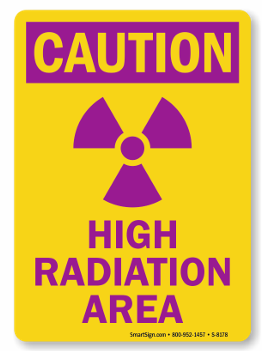
Warning signs:
Entrance doors to therapy rooms must have posted signs
For radiation levels in the room that can exceed 1 mSv in 1 hour the sign should read “Caution, High Radiation Area” (most radiation therapy rooms)
For radiation levels in the room that can exceed 5 mSv in a 1 hour the sign should read “Grave Danger, Very High Radiation Area”
For rooms with a radiation SOURCE – a room where a person could receive 5 Gy in 1 hour within 1 meter of the source would have a “Caution: Radioactive materials” sign.
Warning lights:
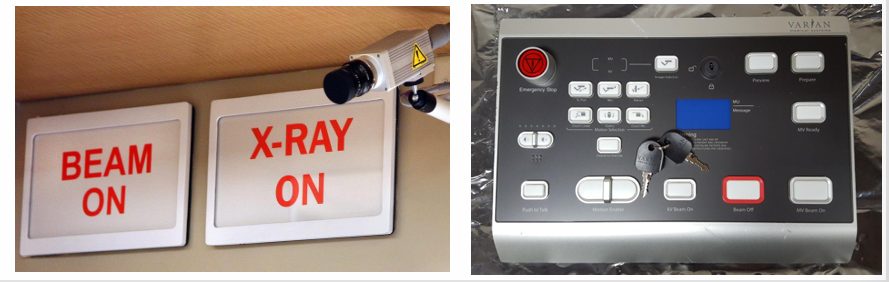
Beam-on indicators are required on
Control panel
Entrance door
On the treatment unit
Is to be illuminated when the unit is on (energized)
Door interlocks:
Entrance door must have an interlock that will shut off the machine if the door is opened during treatment
Also the unit must not produce radiation when the door is closed unless the operator turns the unit on
If the treatment beam is on and the door opens, the beam should turn off. In this case, when the door closes again, the beam will stay off until the radiation therapist turns the beam on again.
Visual and Audio communication:
Visual monitoring of the patient in the room is required at all times (by regulation)
Closed circuit TV system is generally used, with two systems active in case one system fails
Audio monitoring between the therapist and patient is also required by regulation
Emergency Power-Off Switches:
Emergency power-off switches are located at various points in the treatment room to shut power off to the machine
To restart, the start procedure at the controls must be initiated
For Co-60 units, mechanical means of returning the source to the head are provided
Therapist must be concerned with the patient first (removing them from the room), and his\her welfare next

Emergency handling Procedures for Linear Accelerator

Quality Assurance
Frequent testing of safety devices to insure that they are working
These tests are required either by regulation or by standard protocols