lecture 10 (copy) (copy)
 Call Kai
 Learn
Learn Practice Test
 Spaced Repetition
 Match
Match Flashcards
 Knowt Play
1/57

There's no tags or description
Looks like no tags are added yet.
Name | Mastery | Learn | Test | Matching | Spaced | Call with Kai | Chat |
|---|
No analytics yet
Send a link to your students to track their progress
58 Terms
Define "Base metals and alloys for casting."
Alloys that contain no precious elements like gold, silver, platinum, or palladium.
Front: What is a base metal? Back:
An element with a metallic character prone to oxide formation and corrosion under normal conditions.
base = lowest of low = prone to corrison and oxide formation
Front: What is corrosion? Back:
Physical destruction of a metal or alloy in oral cavity conditions.
cOrrOsion = o, in oral cavity
Front: Define tarnish in the context of dental alloys. Back:
A surface layer formed on a metal surface, most often by oxides, causing the metal to lose its luster and often darken without penetrating in depth.
Front: List important base metals used in dentistry. Back:
Nickel
Cobalt
Iron
Titanium
Chromium
Front: Classification of alloys according to mechanical properties. Back:
Type 1: Soft - Inlay, VHN 60-90
Type 2: Medium-Hard - Onlay, Overlay, Crown, VHN 90-120
Type 3: Hard - Crowns, FPD up to three units, VHN 120-150
Type 4: Extremely Rigid - Multi-unit bridges, Partial denture frameworks, VHN >150
Front: Applications of base-metal casting alloys. Back:
All-metal fixed restorations (rare)
Frameworks of partial dentures
Metal-ceramic constructions
Casted post and core restorations
Front: Technological features related to base casting alloys. Back:
Casting conditions
Castability
Finishing procedures
Oxide layer
Front: Define castability. Back:
The ability of molten metal to accurately fill fine details in a mold during the casting process, crucial for creating precise dental prosthetics like crowns and bridges.
ront: Base metals vs. Noble alloys
. Back:
Base metals have favorable castability and lower density compared to noble alloys.
Front: Function and construction of casting pins. Back:
Secure wax pattern in the investment material before casting.
Withstands high casting temperatures of base metal alloys
Role and purpose of the suction chamber in casting.
Creates a vacuum during casting.
Eliminates air bubbles, ensures accurate replication.
Designed for base metal alloys' higher melting points and fluidity.
Casting conditions/requirements for base metal alloys.
High melting point at 1150-1500 degrees.
Two methods: Acetylene oxygen flame or high-frequency current for melting.
Investment materials: Ethyl silicate bonded or phosphate bonded.
Finishing procedures for non-noble alloys
Require careful consideration due to high hardness.
Use of veneering materials for effective bonding.
Attention to health and safety due to potential hazards from released dust.
Formation of the oxide layer in base metal casting alloys.
Occurs when molten metal is exposed to oxygen during casting.
High temperatures lead to rapid oxidation of the metal's surface, forming an oxide layer.
Connection of the oxide layer to veneering materials
Essential for bonding with veneering materials like porcelain.
Ensures integrity and longevity of the restoration.
Porcelain sandblasting and oxide baking may be required to modify and strengthen the oxide layer.
Common base metal casting alloys used in dentistry.
Nickel chromium alloys
Cobalt chromium alloys
Uses of cobalt-chromium and nickel-chromium alloys.
Cobalt-chromium: Larger restorations requiring high modulus of elasticity and durability.
Nickel-chromium: Smaller restorations, good corrosion resistance, and biocompatibility.
Beryllium in dental alloys
Increases alloy thinness and improves structure.
Forms a finer-grained crystalline structure.
Vapors are extremely dangerous, causing berylliosis on chronic exposure.
Should be handled in well-ventilated areas.
Mechanical properties of base metal alloys.
Modulus of elasticity at least two times higher than noble alloys.
Stiffness influenced by the elastic modulus and width of the connector area.
WIDTH OF THE CONNECTOR AREA IS DIRECTLY proportional to the height
Allows for reduction in connector diameter by 20.6%.
high noble alloys/cobalt chromium alloys/nickel, chromium beryllium alloys
biocompatibility, density, elastic modulus, sag resistance, bond with porcelain, value
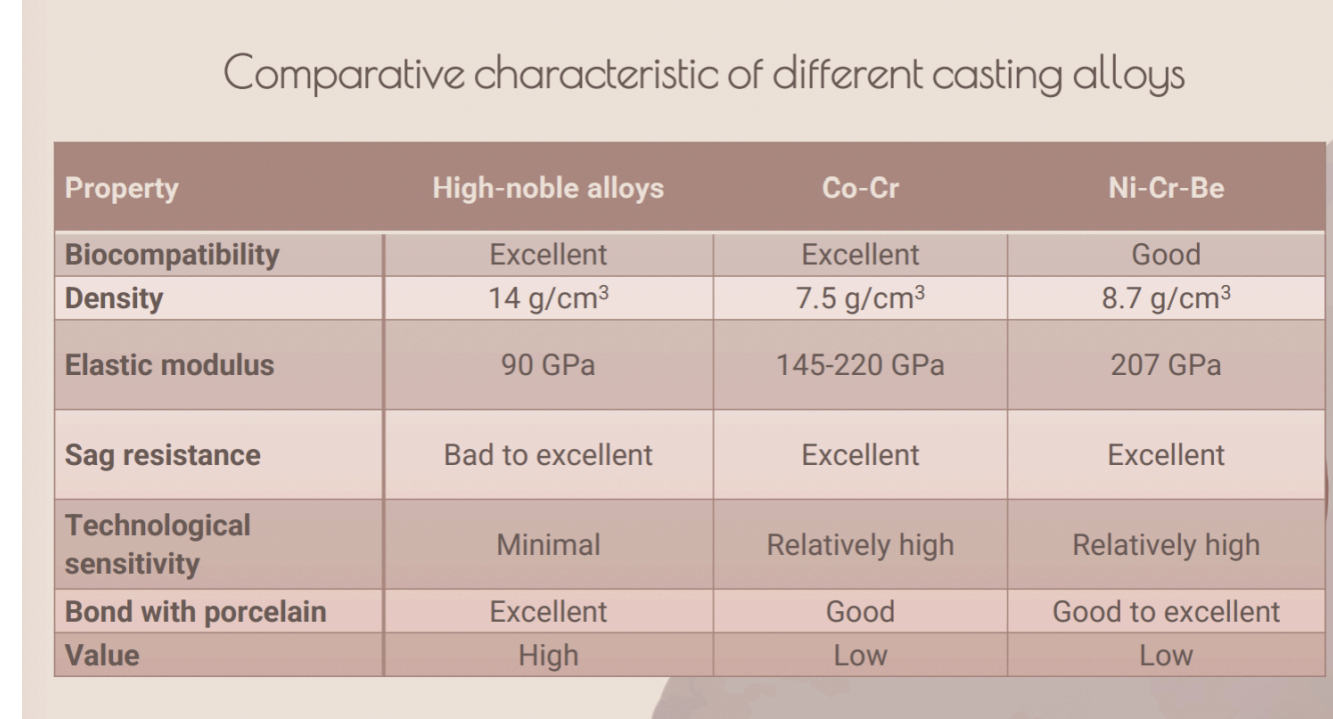
alloys for removable partial dentures (RPD)
Suitable alloys: Cobalt or nickel-based with chromium.
Common alloys: Cobalt-chromium, cobalt-chromium-nickel, nickel-chromium.
Elements: Molybdenum, aluminum, tungsten, iron, gallium, copper, silicon, carbon, platinum, and more.
Components of RPD requiring stiffness.
Major connector
Occlusal rests
Reciprocal arms
Denture base mesh
Clasps do not need as much stiffness.
Composition and properties of selected base metal alloys for RPD.
Cobalt-chromium: 60% cobalt, 25-30% chromium, plus other elements for hardening and strengthening.
Nickel-chromium: 70% nickel, 16% chromium, plus elements for strength, hardness, and fluidity.
what type of compound does aluminum and nickel form?
an intermetallic compound (Ni3Al) that contributes to strength and hardness, while beryllium lowers the melting range, enhances (uidity, and improves grain structure.
Physical properties of base metal alloys.
Melting temperatures: 1,399°C to 1,454°C.
Density: 8 to 9 g/cm³, lighter than gold alloys.
Lustrous, silvery white when polished.
Linear casting shrinkage: 2.05% to 2.33%.
Advantages of chromium-containing base metal casting alloys
Corrosion resistance
High strength
Low density
Cost-effectiveness
Used in RPD frameworks and fixed prosthodontic procedures.
mechanical properties of base metal alloys
About 30% harder than type IV golds.
• High indentation hardness measured on the Rockwell hardness scale (R-30N).
• Ultimate tensile strength ranges from 90,000 to 120,000 psi.
• Modulus of elasticity approximately twice that of cast dental gold alloys
Chemical properties of base metal alloys
At least 85% chromium, cobalt, and nickel for intraoral corrosion resistance.
Thin, transparent chromium oxide film reduces corrosion rate.
Electrolytic zirconium oxide coatings improve corrosion resistance.
alloys melting above 1300 shouldn’t be cast in what? what kind of hugh temperature equipment is required?
• Alloys melting above 1,300°C should not be cast in gypsum investments.
• High-temperature equipment (oxygen/acetylene, oxygen/ natural gas, or electric induction) is required.
• Careful attention to mold venting, wax elimination, and proper casting practices is essential.
Disadvantages of base metal alloys.
Occasional allergic responses, especially to nickel.
Fatigue and breakage of non-ductile clasps.
Difficulty in making adjustments due to high hardness and strength.
Excessive wear on restorations or natural teeth.
what are the two types of defects in crystals?
point defect and linear defect
Define point defects in crystal structures.
Localized disruptions in the crystal lattice involving individual or small groups of atoms.
Types of point defects
Vacancies: Empty spaces or missing atoms within the lattice, promoting diffusion.
Replacement defects: Occur when an atom is replaced by a different size atom.
Interatomic (Interstitial) defects: Small atoms occupy spaces between regular lattice atoms.
: Define linear defects.
Imperfections involving the arrangement of atoms along lines or planes, leading to dislocation of an atomic layer.
Front: Explain twinning as a form of plastic deformation. Back:
Characterized by a specific mirror orientation in a region of the crystal lattice.
Occurs during alloy solidification or under applied pressure.
Requires more force than dislocation.
Changes shape without altering the relative positions of atoms.
Front: Uses of stainless steel in dentistry. Back:
gym
Orthodontic wires (archwires) for braces.
Bent wire clasps in partial dentures.
Endodontic instruments for root canal treatments.
T-shaped metal crowns in pediatric dentistry.
Front: Define the useful working range of a material. Back:
Determined by the elastic stress it can handle before reaching the limit of proportionality, allowing deformation and return to original shape without permanent damage.
What are the types of stainless steel based on structure?
Ferrite
Martensite
Austenite
How do metallurgical properties relate to the iron-carbon binary phase in stainless steel and carbon steel? (metallurgical = properties of metals and stuff)
name the major phase
state the carbon content in stainless steel
state the crystal lattice changes
and state the carbon solubility in a body centred and face centred lattice
Major phase: Iron-carbon binary phase
Carbon content in carbon stainless steel: ≤ 2.1% by weight
Crystal lattice changes: (iron turns into a body centred cubic lattice at 912 degrees celsius, but at room temp, its face centered)
Carbon solubility in a bODY centred lattice =
Max 0.02% in body-centered lattice (ferrite)
carbon solubity in a face centred lattice = ?
Up to 2.1% in face-centered lattice (austenite)
What happens when a binary iron-carbon mixture with 0.8% carbon is cooled slowly in the austenite phase to 723°C?
Formation of pearlite
Microstructure: Combination of ferrite and iron carbide lamellae
Front: What occurs if austenite is rapidly cooled (quenched)?
Formation of martensite
Characteristics: High hardness, strength, and brittleness
Crystal lattice: Body-centered tetragonal
Phase nature: Metastable, converts back to austenite upon heating (tempering)
Front: What are the principal compositions of stainless steel?
Titanium and titanium alloys for casting and cold working
What are the challenges and considerations in casting titanium and its alloys?
High melting point: 1668°C
Reactivity with oxygen: Precautions needed above 900°C
Casting challenges: Low density, use of centrifugal forces, vacuum, and positive pressure
Investment materials: Zirconium-magnesium investments
Coating layer: Hard a-casing up to 150 microns thick
Vickers hardness: ~200 at surface, ~650 at 25 micrometers depth
Special machining tools required
Front: What are the characteristics of commercially pure titanium?
Outstanding corrosion resistance
Best biological performance in prostheses fabrication
Impressive strength-to-weight ratio
Classification into four classes based on impurity content (ASTM Standard F67)
Modulus of elasticity similar to enamel and noble alloys
Oxygen enhances strength and fatigue resistance
Front: Describe the phase transformation of titanium and titanium alloys.
Transformation temperature: 882°C
a-form: Below 882°C, hexagonal structure
B-form: Above 882°C, face-centered crystal structure
Increased ductility
Front: What are the types of titanium and titanium alloys?
Alpha Alloys
Beta Alloys
Alpha-Beta Alloys
Near Alpha Alloys
Near Beta Alloys
Front: What are the stabilizers for alpha and beta titanium alloys?
Alpha alloys: Aluminum, carbon, nitrogen, gallium (raise transformation temperature)
Alpha Cats Not Gamma
Beta alloys: Molybdenum, cobalt, nickel, niobium, copper, palladium, tantalum, vanadium (lower transformation temperature)
Near alpha alloys: Minimal beta phase when heated
Near beta alloys: Minimal alpha phase when cooled
(that is referred to as meta stable)
Common alloy: Ti-6Al-4V. it is an alpha beta alloy
which metal in high doses is regarded as extremely toxic, and which causes neurological probelms
vanadium, and then aluminium
in Ti 6Al 4V, what is an alternative to vanadium, and what does it have?
niobium, which has the Ti AL6 7Nb alloy
What are the properties and applications of Ti-6Al-4V and Ti-6Al-7Nb?
Suitable for biomedical applications
Similar mechanical properties
Comparable corrosion resistance to CPTi
Comparable modulus of elasticity to Type 4 alloys
Front: Compare commercially pure titanium and nickel-titanium alloys for cold working.
CPTi:
Grades 1 to 4
Highly ductile and malleable
Applications: Thin sheets, foils, wires, medical devices
Nickel-Titanium Alloys (Nitinol):
Composition: 55% nickel, 45% titanium
Structures: Austenitic (complex body-centered cubic), Martensitic (monoclinic, triclinic, hexagonal)
Superelasticity and memory properties
Front: Describe the transformation between austenitic and martensitic forms in Nickel-Titanium alloys.
Austenitic form: High temperature, low pressure
Martensitic form: Low temperature, high pressure
Transformation involves twinning
Bending moment and angular deflection equivalent to pressure
Front: Explain the memory property of Nickel-Titanium (Ni-Ti) alloys.
Fixation at high temperature (480°C) establishes austenitic structure
Cooling forms twinned martensitic structure
Deformation under pressure during orthodontic adjustments
Transformation back to austenite at body temperature (37°C)
Front: What are the characteristics of Nickel-Titanium alloys in endodontic instruments?
Low modulus of elasticity
Superelasticity
Transformable austenite
R-phase: Intermediate phase with unique mechanical properties
Manufacturing challenges: Defects in cutting edge can cause tool fracture
: Describe the evolution of Nickel-Titanium alloys for orthodontic wires.
CM-wire (2010):
Contains 52% Nickel
Controlled memory
3 times higher fracture resistance
NITI MAX wire™ (2015):
Electropolish-fleX
Exceptional fracture resistance, especially with JaxWire PENDO Shaper
Reacts to different temperatures
What are the characteristics of beta titanium alloys for cold working orthodontic wires?
Composition: 79% titanium, 11% molybdenum, 6% zirconium, 4% tin
Molybdenum stabilizes B-phase at room temperature
Low modulus of elasticity
First commercial alloy: Titanium-molybdenum alloy
Nickel-free
High surface roughness: Care needed during cold working to avoid irregularities
What are the additional materials and methods for fabrication of indirect restorations?
Electroplating
Sintering (Captektm)
Spark Erosion
Celay system (Copy-milling)
Milling (CAD/CAM - subtraction technology)
3D printing (CAD/CAM - addition technology)