Physio 3) Resting Membrane Potential
 Call Kai
 Learn
Learn Practice Test
 Spaced Repetition
 Match
Match Flashcards
 Knowt Play
1/47

There's no tags or description
Looks like no tags are added yet.
Name | Mastery | Learn | Test | Matching | Spaced | Call with Kai | Chat |
|---|
No analytics yet
Send a link to your students to track their progress
48 Terms
What are ion channels?
Integral membrane proteins that span the cell membrane and allow ions to cross. Many are selective for particular ions.
What are the basic states of an ion channel?
At minimum:
Open
Closed
Opening allows ion movement through the channel.
What are the three major ion-channel gating mechanisms?
Voltage-gated
Ligand-gated
Stretch/mechanosensitive
What opens a voltage-gated ion channel?
A change in membrane voltage Vm or redistribution of charge across the cell membrane.
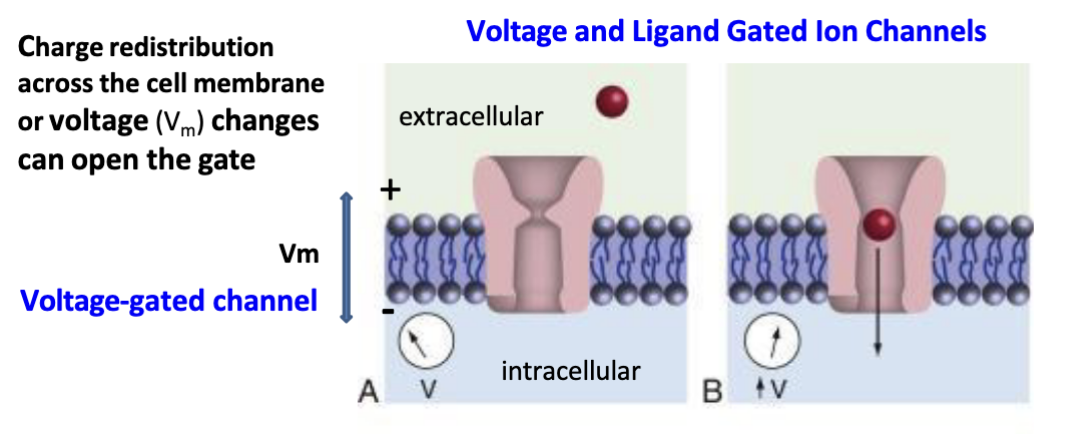
What opens a ligand-gated ion channel? Give an example.
Binding of a chemical ligand.
Example: acetylcholine (ACh) binds its receptor → channel opens → Na⁺ enters.
Other neurotransmitters shown include GABA, glycine, glutamate and serotonin.

What is an ionotropic receptor?
A receptor in which ligand binding directly opens an ion channel, producing a rapid change in membrane potential.
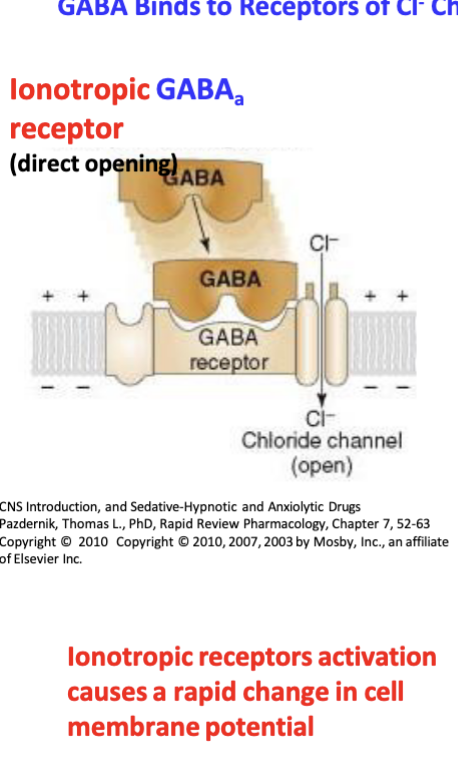
Ionotropic vs metabotropic receptors?
Ionotropic
→ ligand directly opens channel
→ rapid effect
Metabotropic
→ ligand activates a G-protein pathway that affects channels indirectly
→ slower effect
Metabotropic:

The lecture compares GABAA_A as ionotropic and GABAB_B as metabotropic.
How does GABAA_A signaling differ from GABAB_B signaling?
GABAA_A: directly opens a Cl⁻ channel. (ionotropic)
GABAB_B: G-protein signaling can open K⁺ channels and close Ca²⁺ channels. (metabotropic)
How does ion transport through channels differ from transport by carrier proteins?
Channel transport:
requires no ATP
moves ions down the electrochemical gradient
is faster
does not show carrier-type saturation
Carrier transport involves binding and conformational change and can saturate.

What determines the direction of ion movement through an open channel?
The ion's electrochemical gradient.
That combines:
chemical/concentration gradient
electrical gradient
Why are channels faster than carrier proteins?
Channels act like an open pore, allowing ions to flow through, whereas carriers must bind the ion and undergo conformational changes.
What is an ionic current?
The net movement of ions across a membrane.
Because ions carry charge, their movement produces an electrical current II.
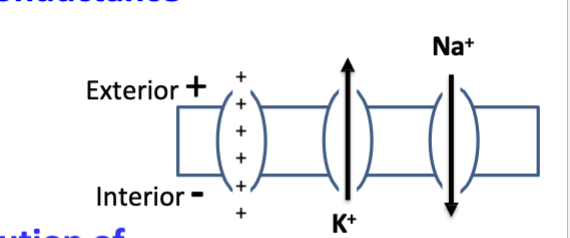
How can ionic current affect membrane voltage?
Ion movement changes the distribution of electrical charge across the membrane, thereby changing membrane potential VmV_m.
What is Ohm's Law in this lecture?
V=I×R
Where:
V = voltage
I = current
R = resistance
What is membrane resistance?
Resistance RR reflects how strongly a membrane/channel restricts ion movement.
More restriction → higher resistance.
What is conductance(g)?
Conductance g is the ease with which ions move through a channel.
g=1/R
So conductance and resistance are inversely related.
What happens to conductance and resistance when ion channels open?
Channel opening
→ ↑ conductance
→ ↓ resistance
Channel closure
→ ↓ conductance
→ ↑ resistance

How can ion-channel blockers affect resistance?
Blocking channels restricts ion flow → increases resistance.
The lecture gives local anesthetics as an example of ion-channel blockers.
True or false: Ion movement through channels requires cellular energy.
False. Ion movement through open channels is passive and follows the electrochemical gradient.
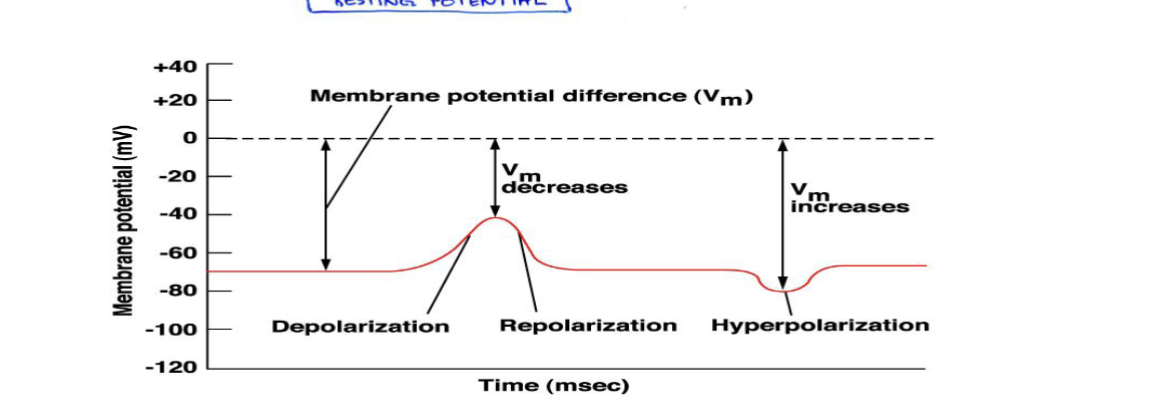
What is membrane potential?
The difference in electrical charge across the cell membrane, measured in millivolts.
At rest, the cell interior is generally negative relative to the exterior.
Why is membrane potential physiologically important?
It exists in all cells and is particularly important for nerve and muscle function.
What does depolarization mean?
The membrane potential becomes less negative.
Example from the lecture:
Na⁺ influx → positive charge enters → depolarization.
What does hyperpolarization mean?
The membrane potential becomes more negative.
Example:
K⁺ efflux can remove positive charge → hyperpolarization.
What is repolarization?
Movement of membrane potential back toward its resting level after a depolarization.
How are Na⁺ and K⁺ asymmetrically distributed across the membrane?
Na⁺: high outside, low inside
K⁺: high inside, low outside
Lecture examples:
Na⁺ ≈ 145 mM outside / 12–15 mM inside
K⁺ ≈ 4–5 mM outside / 150 mM inside
Why are fixed intracellular anions important?
Negatively charged intracellular substances such as proteins and ATP cannot readily leave the cell and contribute to the negative intracellular environment.

Which ion is most important for the resting membrane potential?
K⁺, because the resting membrane is much more permeable to K⁺ than to Na⁺.
What two forces of “dual nature” determine ion movement across a membrane?
Chemical gradient
Electrical gradient
Together they form the electrochemical gradient/potential.
What is the chemical gradient?
A concentration difference that drives particles from:
high concentration → low concentration
For K⁺, high intracellular K⁺ creates a chemical force pushing K⁺ out of the cell.
What is the electrical gradient?
The force created by electrical charges:
opposite charges attract
like charges repel
The negatively charged cell interior electrically attracts positively charged K⁺ inward.
What opposing forces act on K⁺ in a resting cell?
Chemical gradient: pushes K⁺ OUT
because Ki+≫Ko+
Electrical gradient: pulls K⁺ IN
because the intracellular environment is negative.
What is an ion's equilibrium potential?
The membrane potential at which the ion's chemical and electrical forces balance, producing no net movement of that ion.
What is the approximate equilibrium potential for K⁺?
EK≈−90 mV
At EK, inward and outward K⁺ movement balance.

What is the approximate equilibrium potential for Na⁺?
ENa≈+66 mV
If a membrane were permeable ONLY to K⁺, what would its membrane potential approach?
Vm→EK≈−90 mV
If a membrane were permeable ONLY to Na⁺, what would its membrane potential approach?
Vm→ENa≈+66 mV
Na⁺ would enter until Vm approached ENa, assuming the channels remained open.
What does the Nernst equation calculate?
The equilibrium potential for one specific ion based mainly on its concentration gradient and charge.
What Nernst equation does the lecture use? (dont memorize)
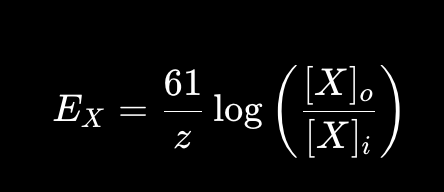
Where:
EX = equilibrium potential
Xo= concentration outside
Xi= concentration inside
z = ionic valence
Why are Nernst potentials important when ion channels open?
Opening channels tends to move Vm toward that ion's equilibrium potential.
Examples:
↑ Na⁺ permeability → Vm moves toward ENa→ depolarization
↑ K⁺ permeability → Vm moves toward EK
What is the approximate neuronal resting membrane potential? Why isn't it exactly EK?
RMP≈−70 mV
It is close to EK because resting permeability to K⁺ is high, but a small inward Na⁺ leak makes the membrane less negative than EK.

What two major factors determine how much an ion contributes to membrane potential?
Its concentration gradient
The membrane's permeability to that ion
An ion can strongly influence Vm only if the membrane is sufficiently permeable to it.
Why does K⁺ concentration have such a strong effect on resting membrane potential?
Because K⁺ is the most permeable ion at rest, so changes in its concentration gradient strongly alter Vm.
What does the Na⁺/K⁺ ATPase do?
It is a primary active transporter that uses ATP to move:
3 Na⁺ OUT
2 K⁺ IN
It maintains the Na⁺ and K⁺ concentration gradients.
What physiological functions does the Na⁺/K⁺ ATPase help maintain?
Na⁺ and K⁺ ionic gradients
resting membrane potential
cellular osmolarity
cell volume
neuronal excitability
Its direct contribution to Vm is relatively small, but maintaining the ion gradients is essential.
Why does inhibition of the Na⁺/K⁺ ATPase eventually cause depolarization?
Pump inhibition → Na⁺ and K⁺ gradients deteriorate → intracellular Na⁺ rises and K⁺ gradients fall → the membrane potential becomes less negative → depolarization.
How does cerebral ischemia connect ATP loss to neuronal swelling and dysfunction?
Ischemia
→ ↓ O₂
→ ↓ ATP
→ ↓ Na⁺/K⁺ ATPase activity
→ intracellular Na⁺ accumulation
→ water enters cell
→ neuronal swelling/brain edema
→ depolarization + impaired neuronal function
→ potentially coma
This connects membrane transport + osmosis + membrane potential.
What happens to neuronal membrane potential when extracellular K⁺ rises, such as from 4 → 12 mM? Why?
The neuron depolarizes and becomes less negative.
↑ extracellular K⁺
→ smaller K⁺ concentration gradient
→ ↓ K⁺ efflux through leak channels
→ more positive charge remains inside
→ depolarization/less negative
This is why hyperkalemia can be dangerous.
What is hyperkalemia, what commonly causes it, and how does it affect excitable cells?
Hyperkalemia = abnormally elevated blood K⁺.
The lecture says it is commonly caused by kidney disease, although massive tissue injury can also release intracellular K⁺.
Hyperkalemia:
Normal neuronal activity during mental tasks does not cause hyperkalemia
