biomechanics- mmm quiz #6- dpt
 Call Kai
 Learn
Learn Practice Test
 Spaced Repetition
 Match
Match Flashcards
 Knowt Play
1/19

There's no tags or description
Looks like no tags are added yet.
Name | Mastery | Learn | Test | Matching | Spaced | Call with Kai | Chat |
|---|
No analytics yet
Send a link to your students to track their progress
20 Terms
Which of the following joints is NOT located inside the capsule that anatomically defines the “elbow” joint:
distal radio-ulnar joint
Which of the following joints of the elbow and forearm complex is NOT a true synovial joint:
mid radio-ulnar joint
The humero-radial joint is formed by which two bony structures:
the capitulum and the radial head
Mary Smith is referred to physical therapy for treatment of right elbow pain. You assess and measure the carrying angle of her elbows. The carrying angle of her right elbow is 27 degrees, and her left elbow 18 degrees. Based on this finding, you could make which of the following statements:
she has excessive cubital valgus in her right elbow, but her left elbow is within normal limits
This nerve passes through the spiral groove of the humerus and may be injured by humeral shaft fractures.
radial
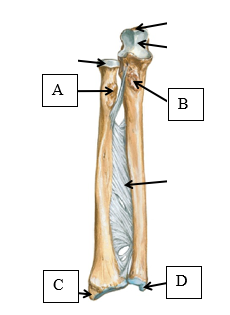
The biceps brachii and the brachialis brachii are both elbow flexors with distal attachments to the forearm. Use the above figure to identify their attachments. Which of the following statements is correct with regard to their attachments:
the biceps attaches at letter A and the brachialis attaches at letter B
Because of its attachment to the radius this muscle can function not only as an elbow flexor but also a forearm supinator:
biceps brachii
This muscle is the "work horse" of the elbow flexors and functions in elbow flexion with the forearm in any position and at any speed of contraction. It does not have a role in supination and pronation:
brachialis brachii
Energy efficiency is always a concern for the body as it decides which muscles to recruit. Recruiting the biceps to flex the elbow requires what shoulder muscle to provide adequate stabilization at the shoulder and to prevent the shoulder flexion that the biceps may create:
posterior deltoid
Two joint muscles may be recruited because they can more efficiently complete a complex task that involves movement at both joints that the muscle crosses. Which muscle is often recruited for a "pulling" motion because as it shortens at the elbow, it lengthens at the shoulder and maintains a better length-tension ratio:
biceps brachii
As the name suggests, the triceps has 3 heads. Which head functions as a two joint muscle, being able to extend the elbow and extend the shoulder:
long head
This is a common bursitis that occurs about the elbow. It occurs when students lean on their elbow in class or when individuals confined to wheelchairs lean on their elbow on the arm rest of the chair. It involves irritation of the bursa between the point of the elbow and the skin. This bursitis is known as:
olecranon bursitis
The ulnar collateral ligament or medial collateral ligament of the elbow is stressed by 2 mechanisms: 1) a throwing motion with the shoulder moving to an extreme position of external rotation and 2) which of the following forces at the elbow joint:
valgus force – trying to pull the forearm into abduction
Tearing of the ulnar collateral ligament or fractures around the elbow joint may lead to irritation of a nerve that passes through the cubital tunnel under this ligament. Irritation of this nerve may lead to numbness in the medial side of the hand and weakness of the hypothenar eminence muscles. This nerve is the:
ulnar nerve
This ligament encircles the radial head and holds the radial head against the ulna. If the radial head pulls out of this ligament, it creates a condition known as a “pulled elbow” or “nurse maid’s elbow”. This ligament is the:
annular ligament
Moving into extension from slight flexion, how does the head of the radius move on the capitulum at the humero-radial joint:
radial head rolls and glides dorsally
Moving into extension from slight flexion, how does the trochlear notch move on the trochlea at the humero-ulnar joint:
trochlear notch rolls and glides dorsally
The loose packed position of the humero-radial joint is which of the following:
full extension and full supination
You are trying to determine the end feel of elbow extension. You passively extend your patient’s elbow and then apply overpressure to push farther into the limitation of motion. In a normal elbow with elbow extension, you should feel what kind of end feel:
hard
During supination from the anatomical position, how does the head of the radius move on the radial notch of the ulna at the proximal radio-ulnar joint:
radial head rolls dorsolateral and glides volarmedial