AQA A level Chemistry 3.1.5 Kinetics
 Call Kai
 Learn
Learn Practice Test
 Spaced Repetition
 Match
Match Flashcards
 Knowt Play
1/21

There's no tags or description
Looks like no tags are added yet.
Name | Mastery | Learn | Test | Matching | Spaced | Call with Kai | Chat |
|---|
No analytics yet
Send a link to your students to track their progress
22 Terms
What is activation energy? (1)
The activation energy of a reaction is the minimum energy required for the reaction to occur
What is the trend in rate of reactions as frequency of collision of particles increases i.e. collision theory? (2)
- As frequency increases, the rate of reaction also increases
- But percentage of successful collisions will remain the same
What can rate of reaction be defined as? (1)
Change in concentration over time
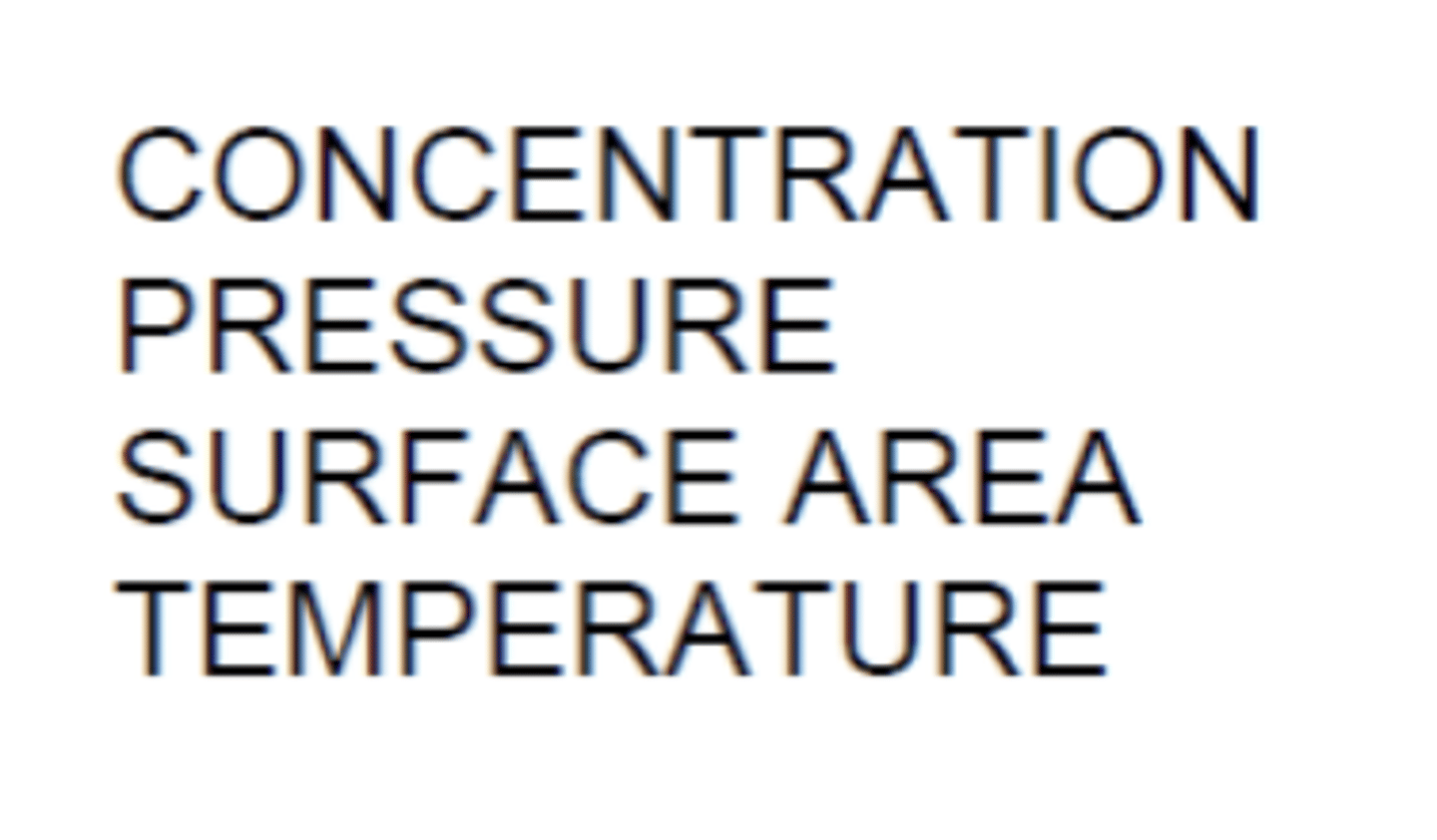
What factors affect frequency of collision and therefore rate of reaction? (4)
How does increasing concentration of reagents in a soloution increase rate of reaction? (3)
- Increases number of reactant particles in a given volume
- So increases frequency of collisions between particles
- Therefore, more successful collisions in a given time
How does increasing surface area increase rate of reaction? (3)
- Increases number of reactant particles available for collision
- Increases the frequency of collisions, leading to more successful collisions in a given time.
What is the effect of increasing pressure on the rate of reaction? (1)
Increases the number of particles in a given volume, resulting in more successful collisions in a given time.
What is the effect of increasing temperature on the rate of reaction? (3)
- Particles have more energy at higher temperatures.
- Particles move more quickly, leading to more collisions.
- Increases the number of successful collisions in a given time.
Draw a diagram to show the Maxwell Boltzmann Distribution curve (4)
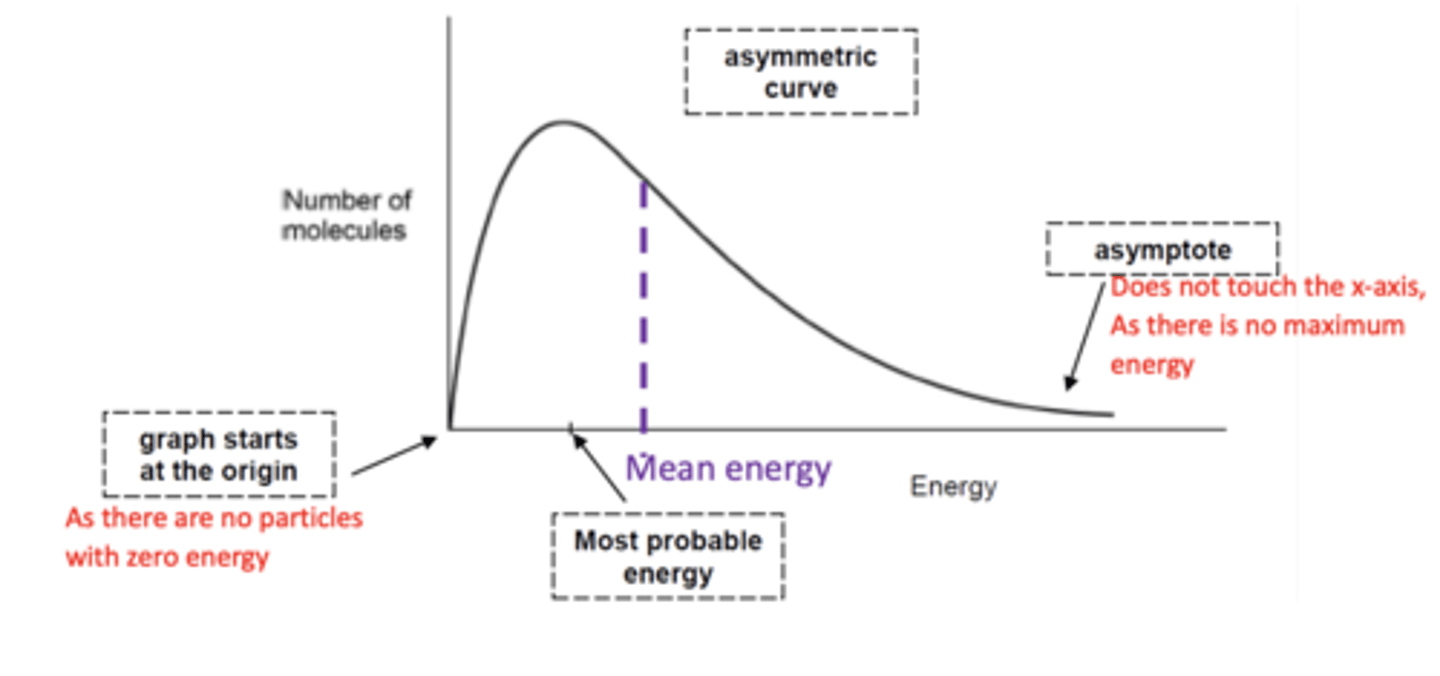
Why does the graph start at the origin in an energy distribution curve? (1)
There are no particles with zero energy.
Why does the curve not touch the x-axis at higher energy? (1)
There will always be some particles with very high energies (asymptote).
What does the area under the curve represent in an energy distribution graph? (1)
The total number of particles in the system.
What does the peak of the Boltzmann curve indicate? (1)
The most probable energy
Draw and explain a diagram to show how the Maxwell Boltzmann Distribution curve will change if temperature is increased (5)
- At higher temperature, many more particles will have energy greater than or equal to Ea
- Therefore, rate of reaction is greater because there are more successful collisions in a given time
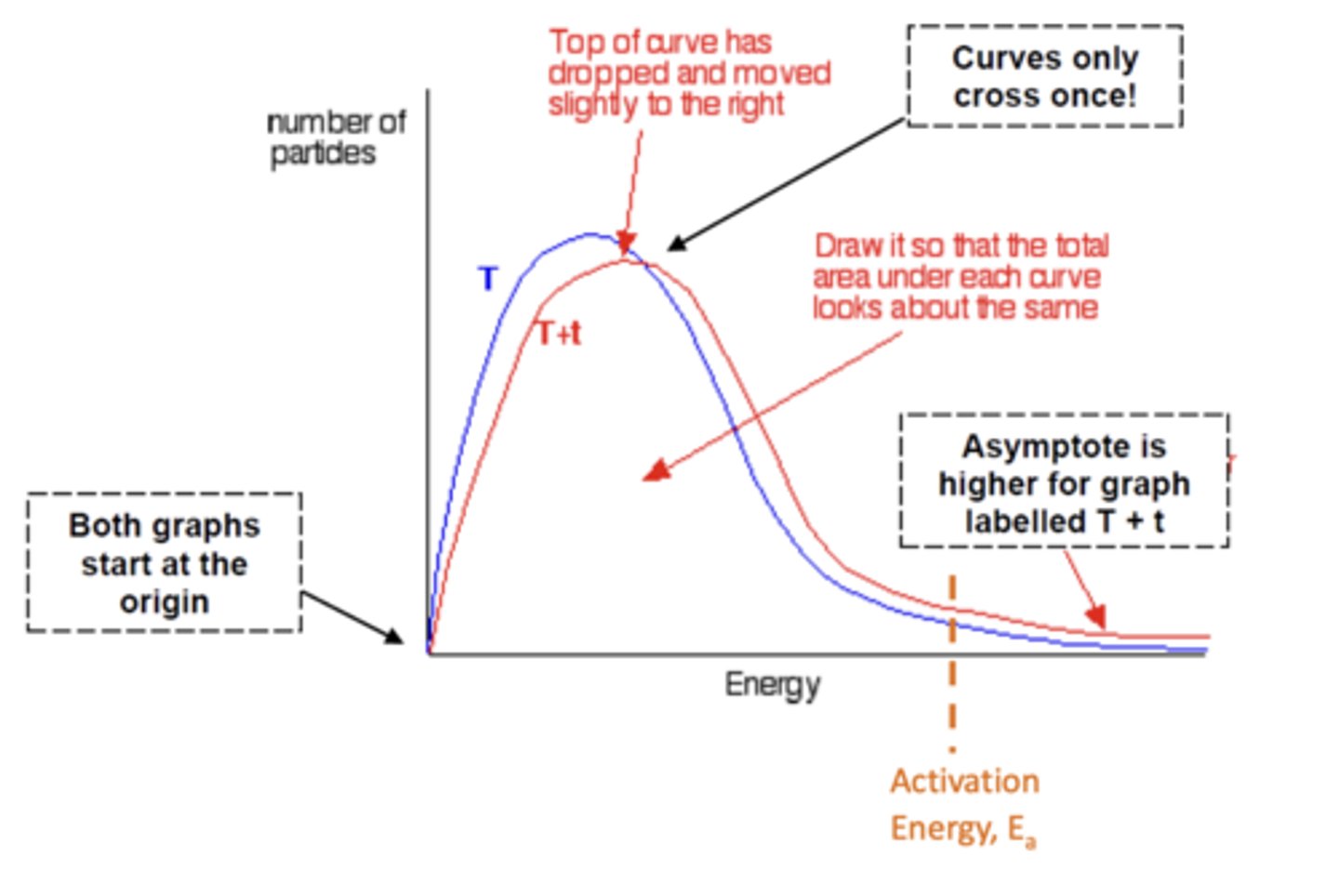
Draw and explain a diagram to show how the Maxwell Boltzmann Distribution curve will change if temperature is decreased (5)
- Many fewer particles have energy greater than or equal to Ea.
- The rate of reaction is slower because there are fewer successful collisions in a given time
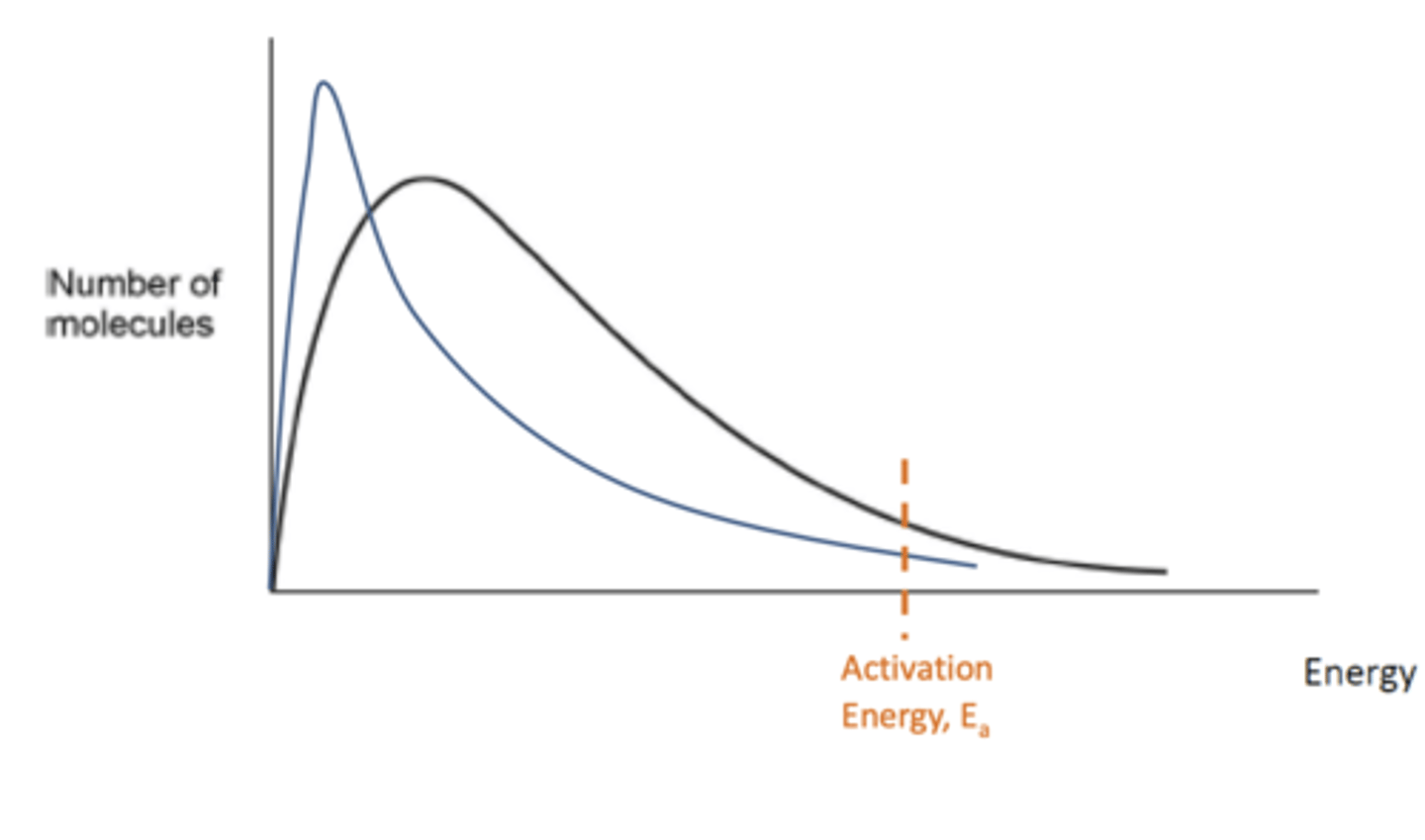
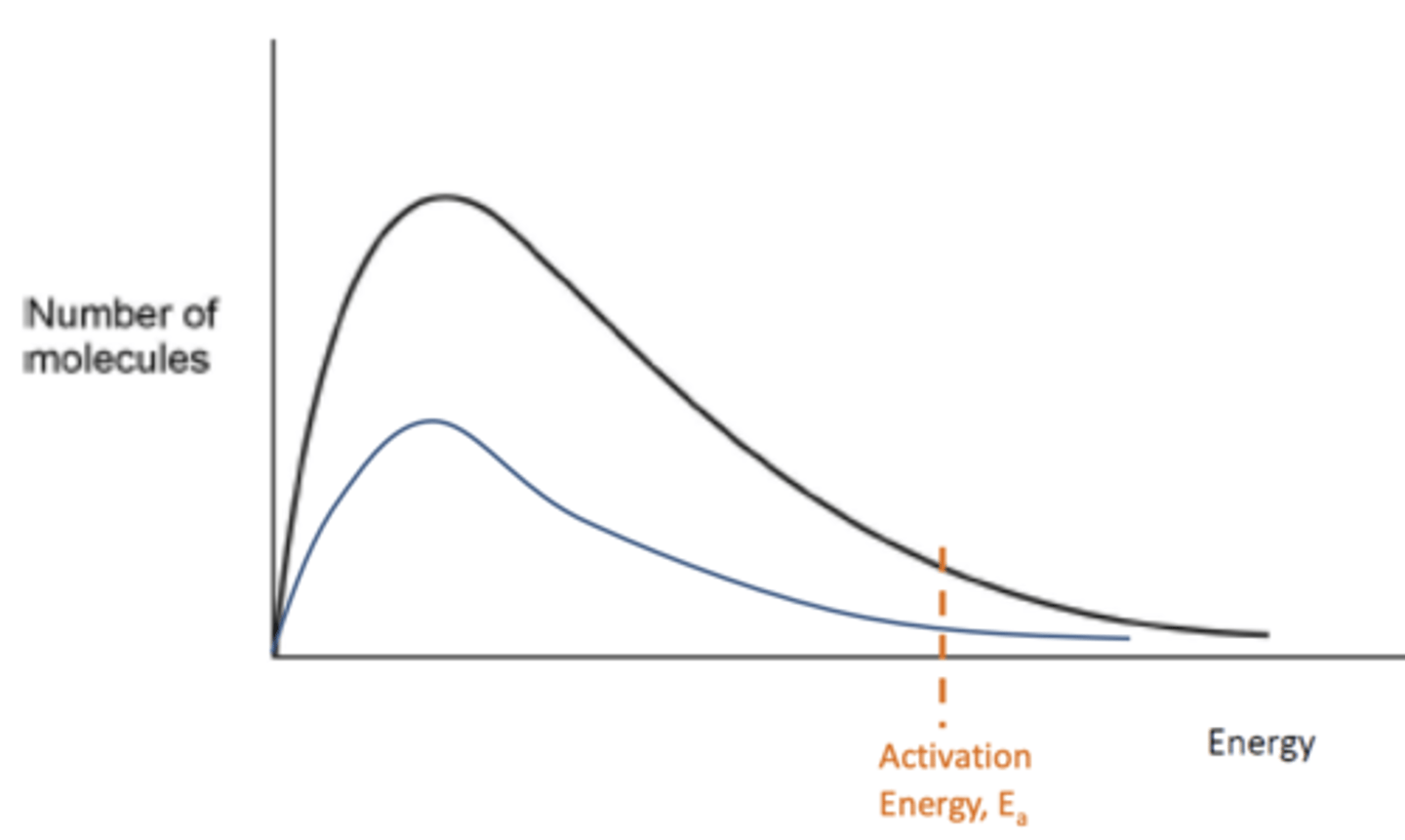
Draw a diagram to show how the Maxwell Boltzmann Distribution curve will change for half the sample of gas at the same temperature (3)
What is a catalyst? (1)
A substance that increases the rate of a reaction but is unchanged at the end of the reaction.
How does a catalyst work? (1)
A catalyst provides an alternative route with a lower activation energy than the uncatalysed route.
What effect does a catalyst have on the overall enthalpy change (ΔH)? (1)
A catalyst has no effect on the overall enthalpy change, so ΔH remains unchanged.
Draw a diagram to show how the Maxwell Boltzmann Distribution curve with a catalyst (3)
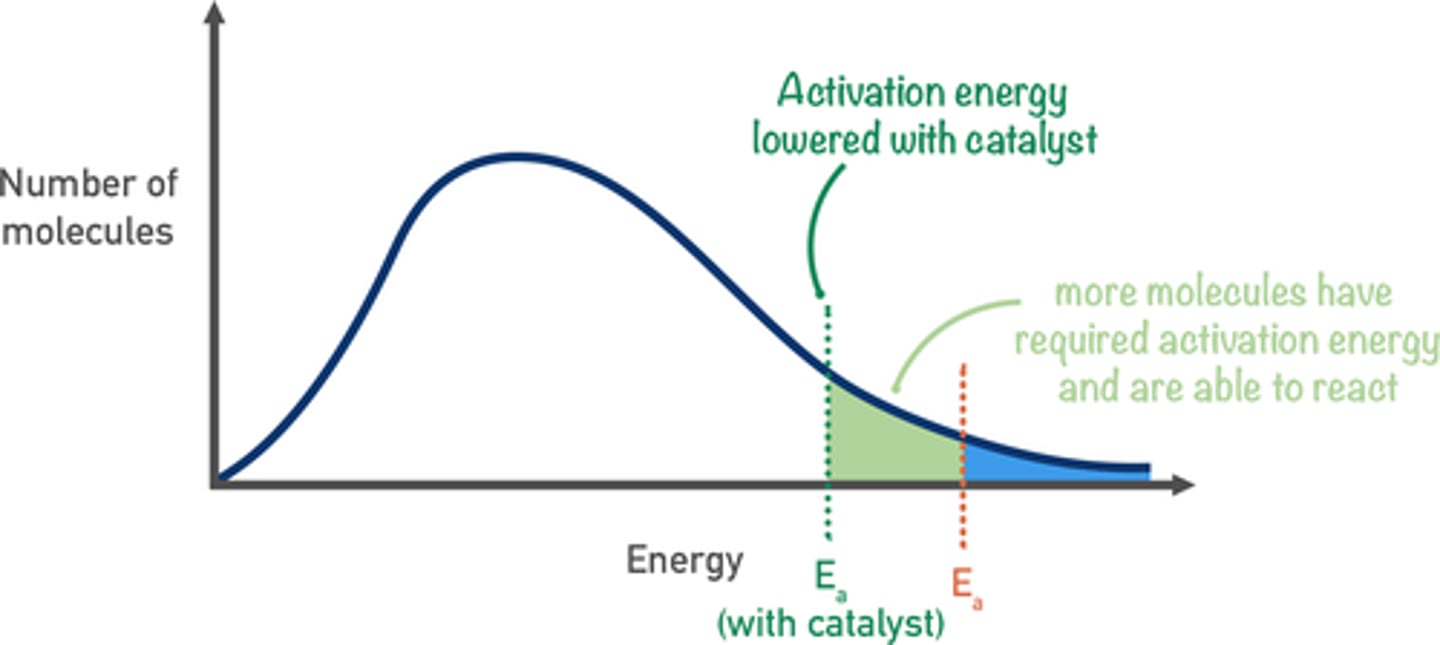
How does a catalyst affect the Maxwell-Boltzmann energy distribution curve? (2)
- Lowers the activation energy (Ea).
- Increases the number of molecules with energy greater than or equal to the activation energy.
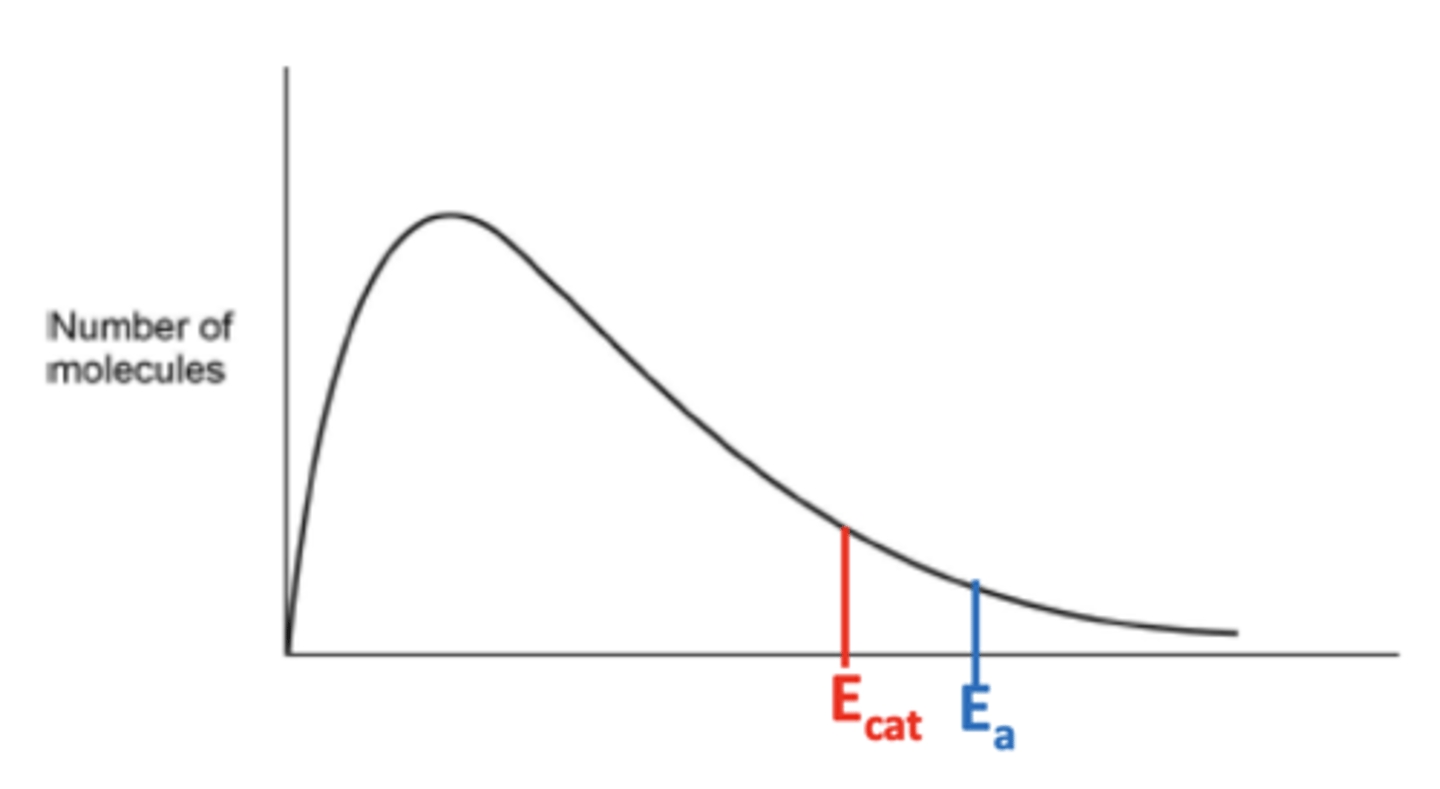
How does a catalyst increase the rate of reaction? (1)
It increases the frequency of successful collisions in a given time.