Ch. 22- Abnormalities of the Placenta and Umbilical Cord
 Call Kai
 Learn
Learn Practice Test
 Spaced Repetition
 Match
Match Flashcards
 Knowt Play
1/65

There's no tags or description
Looks like no tags are added yet.
Name | Mastery | Learn | Test | Matching | Spaced | Call with Kai | Chat |
|---|
No analytics yet
Send a link to your students to track their progress
66 Terms
Focal dilatation of an artery
aneurysm
Placenta where then lobes are nearly equal in size and the cord inserts into the chorionic bridge of tissue that connects the two lobes
bilobed placenta
succenturiate is an accessory lobe
Fatal condition associated with multiple congenital anomalies and absence of the umbilical cord
body stalk anomaly
Very rare condition where there is massive subchorionc thrombosis of the placenta secondary to extreme venous obstruction
Breus mole
Attachment of the placental membranes to the fetal surface of the placenta rather than to the underlying villous placental margin
extrachorial placenta
Bending, twisting, and bulging of the umblical cord vessels mimicking a knot in the umbilical cord
false knot
Periumbilical abdominal wall defect, typically to the right of normal cord insertion that allows for free-floating bowel in the amniotic fluid
gastroschisis
Condition characterized by multiple complex fetal anomalies and a short umbilical cord
limb-body wall complex
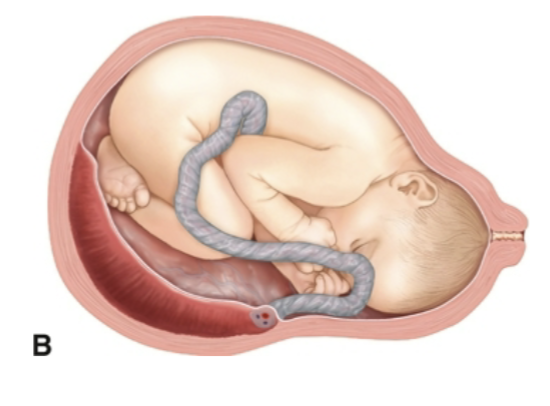
Occurs when the umbilical cord inserts at the placental margin
marginal insertion or battledore placenta
Central anterior abdominal wall defect at the site of cord insertion into the fetal abdomen that results in abdominal organ protruding outside the abdominal cavity but contained by a covering membrane consisting of peritoneum, Wharton jelly, and amnion
omphalocele
Term that refers to a thickened or hydropic placenta
placentomegaly
Linear, extra amniotic tissue that projects into the amniotic cavity with no restriction of fetal movement
synechiae (amniotic sheets)
causes no harm to fetus as opposed to amniotic bands
Intraplacental area of hemorrhage and clot
thrombosis
Result of fetus passing through a loop or loops of umbilical cord creating or more knots in the cord
true knot
Failure of the normal physiologic gut herniation to regress into the abdomen, resulting in a small amount of bowel protruding into the base of the umbilical cord
umbilical hernia
Vascular structure connecting the fetus and placenta that normally contains two arteries and one vein surrounded by Wharton jelly
umbilical cord
Method of assessing the degree of umbilical cord coiling, defined as the number of complete coils per centimeter length of cord
umbilical coiling index (UCI)
Tubular, anechoic structures found beneath the chorionic plate that correspond to blood-filled spaces found at delivery
venous lakes
Placental hydrops produces a:
thin placenta with venous lakes
thick placenta with a “ground glass appearance”
annular placenta with irregular contour
membranacea placenta with low resistance blood flow
thick placenta with a “ground glass appearance”
A “jelly like placenta” is associated with:
venous lakes
IUGR
adjacent fibroids
degeneration
IUGR
A succenturiate placenta:
has increased frequency in primigravidas
is ring shaped
most often have velamentous umbilical cord insertion
is edematous
most often have velamentous umbilical cord insertion
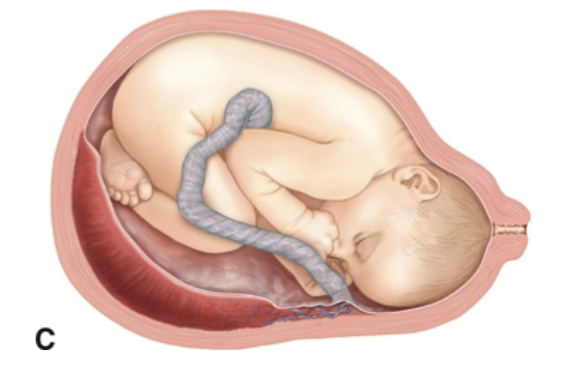
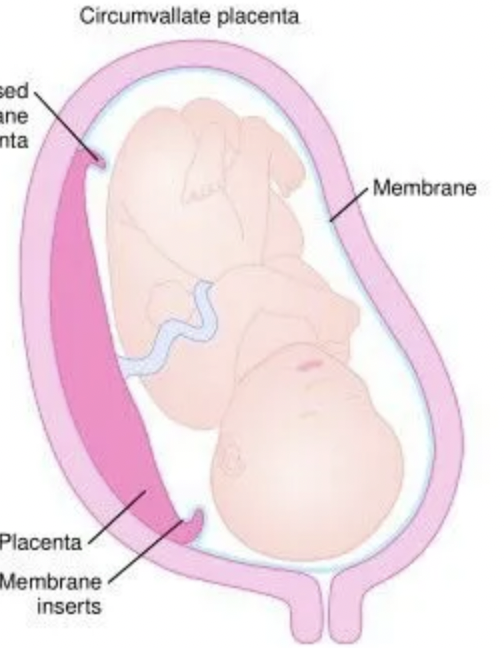
Circumvallate placental tissue is:
flat and noted on approximately 20% of placentas
associated with a thickened rolled chorioamniotic membrane
extremely rare, 1:20,000 to 40,000 pregnancies
prone to fetal macrosomia
associated with a thickened rolled chorioamniotic membrane
Risk factors for placenta previa include all except:
previous C-section
multiple gestations
previous elective abortions
hypertension
hypertension
A placenta is considered low-lying if the inferior margin is:
0.5 cm from the internal os
adjacent to the internal os
within 2 cm of the internal os
posterior
within 2 cm of the internal os
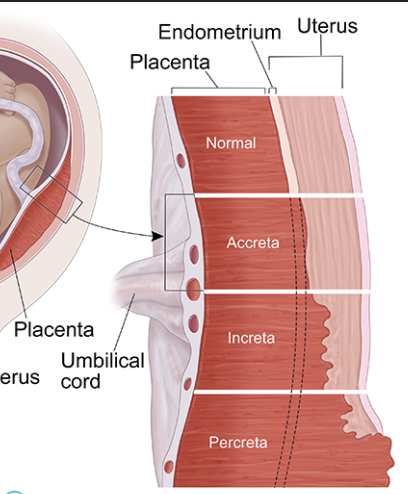
The most infiltrative form of placenta accreta is:
percreta
accreta
increta
invasive
percreta
Attachment problems of the placenta are known as all except:
morbidly adherent placenta
placental attachment disorder
abnormally invasive placenta
infiltrative myometrial placenta
infiltrative myometrial placenta
Placental infarction (necrosis) is:
visualized at the fetal placental surface
owing to obstructed spiral arteries
multiple hemorrhages into placental lakes
a factor in macrosomia
owing to obstructed spiral arteries
A benign vascular malformation of the placenta is a:
teratoma
septal cyst
lacunae
chorioangioma
chorioangioma
Premature separation of all or part of the placenta from the myometrium is:
hemorrhage
subchorionic
abruption
subdural
abruption
Linear, extra amniotic tissue projecting into the amniotic cavity is noted often in pregnant women with a history of:
uterine curettage
cervical dilation
multiples
STDs
uterine curettage
Amniotic band syndrome is a condition that:
involves free-floating membrane
is a result of rupture of the amnion without rupture of the chorion
is not revealed in the third trimester
involves the uterine septum
is a result of rupture of the amnion without rupture of the chorion
causes abnormalities but amniotic sheets don’t
A condition of pregnancy where the trophoblastic cells produce excessive amounts of beta-hCG is:
multiparity
fetal entrapment
molar pregnancy (hydatidiform mole)
compression syndrome
molar pregnancy (hydatidiform mole)
SUA (single umbilical artery) is associated with all except:
cardiovascular malformations
central nervous system defects
musculoskeletal abnormalities
skeletal dysplasia
skeletal dysplasia
PRUV, a common vascular variant, describes:
a strictured right portal vein
a duplicated right portal vein
pancreatic right portal vein
open right portal vein
open right portal vein
PRUV: persistent right umbilical vein
TTTS (twin-to-twin transfusion syndrome) is caused by:
battledore umbilical insertion
monochorionic twin pregnancies sharing a placenta with anastomoses between the umbilical vessels
oligohydramnios
discordant fetal size and pollyhydramnios
monochorionic twin pregnancies sharing a placenta with anastomoses between the umbilical vessels
Prenatal management of known umbilical pseudo and true cysts:
is not necessary because resolution is imminent
typically refers to MRI for evaluation
involve serial US examinations
displays echogenic characteristics near the placental insertion
typically refers to MRI for evaluation
Cord prolapse is defined as:
a compressed umbilical cord
presentation of the umbilical cord in advance of the fetal presenting part during labor and delivery
excessive bending and twisting of the umbilical cord
focal bulge or vascular protuberance of the umbilical cord
presentation of the umbilical cord in advance of the fetal presenting part during labor and delivery
Subamniotic cysts or subamniotic hematomas result form rupture of ___________ (________) _________ close to the umbilical cord insertion into the placenta.
chorionic (fetal) vessels
Selective loss of placental parts and growth of other parts is known as ______________ ________________.
trophoblastic trophotropism
The ring shaped annular placenta is related to postpartum ____________ mostly owing to poor separation.
hemorrhage
Acute placental abruption hemorrhage appears highly ____________ on ultrasound.
echogenic
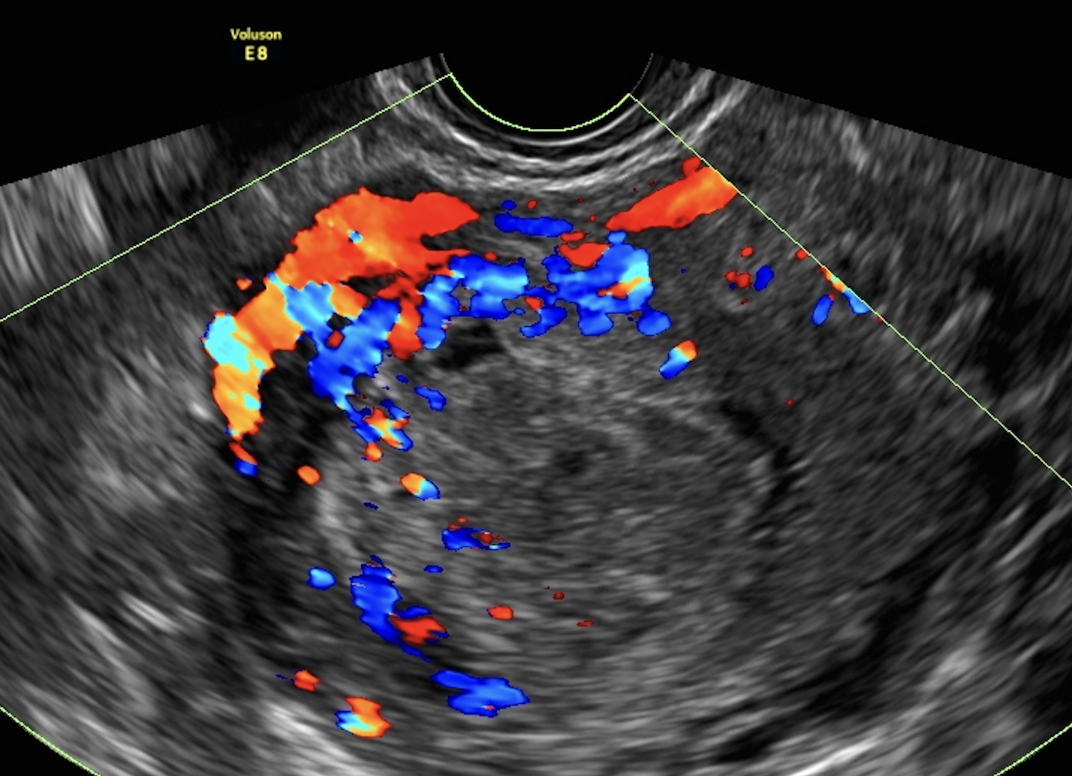
Choriocarcinomas appear as _____________, echogenic, and _______________ masses.
heterogenous; hypervascular
Placenta accrete is mostly located in the ___________, _________ uterine segment.
anterior, lower
Visualization of multiple ___________ are highly suggestive of placenta acreta.
lacunae
Multiple chorioangiomas or those larger than ___ cm are related to maternal and fetal complications.
5
Early detection of fetal anemia is possible where chorioangioma is suspected, through Doppler measurements of the _________ ____________ ________ (MCA).
middle cerebral artery
Extremely hydropic and swollen chorionic villi are frequently related to ____________ ______ (molar pregnancy).
hydatidiform mole
Molar pregnancies have a characteristic ____________ appearance with uterine cavity ____________.
snowstorm; distention
The most common reason for emergency postpartum hysterectomy is a morbidly __________ placenta.
adherent
A coexisting fetus with an enlarged thickened placenta revealing multiple small cystic spaces is a _________ hydatidiform mole.
partial
The placenta may sonographically appear thickened in some cases of IUGR, with patchy areas of _________________ and abnormal texture.
hypoechogenicity
A two-vessel umbilical cord reveals the presence of a single umbilical ___________ and is sometimes associated with congenital anomalies such as cardiovascular malformations, central nervous system defects, _____ or genitourinary defects, and ________ malformations.
artery; GI; MSKLTL
The umbilical vessel abnormality seen with conjoined twins is __________________ vessels.
supernumerary
Maternal cocaine abuse leads to the fatal condition ______ _______ __________.
body stalk anomaly
Velamentous insertion is more frequent in ___________ gestations.
multiple
Compressed umbilical cords place the fetus at risk for _______ ________ or ____________ compromise.
fetal hypoxia or circulatory
A successful method of identifying a nuchal cord is imaging using _______ ________ technology.
color Doppler
Which of the following is described as the focal dilation of the abdominal portion of the umbilical vein?
allantoic cyst
umbilical cord varix
umbilical cord aneurysm
umbilical cord berry
umbilical cord varix
An anechoic mass is noted within the umbilical cord during a routine sonographic examination. What is the most likely diagnosis?
hemangioma
vasa previa
chorioangioma
allantoic cyst
allantoic cyst
All of the following are associated with a thin placenta except:
preeclampsia
IUGR
fetal hydrops
long-standing diabetes
fetal hydrops
All of the following are associated with a thick placenta except:
fetal infections
Rh isoimmunization
placental insufficiency
multiple gestations
placental insufficiency
Placenta accreta denotes:
the abnormal attachment of the placenta to the myometrium
the premature separation of the placenta from the uterine wall
the invasion of the placenta into the myometrium
the condition of having the metal vessels rest over the internal os
the abnormal attachment of the placenta to the myometrium
Doppler sonography reveals vascular structures coursing over the internal os of the cervix. This finding is indicative of:
vasa previa
placenta previa
placenta increta
abruptio placentae
vasa previa
All of the following are clinical features of placental abruption except:
vaginal bleeding
uterine tenderness
abdominal pain
funneling of the cervix
funneling of the cervix
The most common placental tumor is the:
choriocarcinoma
maternal lake
chorioangioma
allantoic cyst
chorioangioma
What is the most common cause for an emergency postpartum hysterectomy?
morbidly adherent placenta
body stalk anomaly
placenta percrete
incomplete abortion
morbidly adherent placenta
placenta accreta, increta, and percreta