Circular Motion
 Call Kai
 Learn
Learn Practice Test
 Spaced Repetition
 Match
Match Flashcards
 Knowt Play
1/27

There's no tags or description
Looks like no tags are added yet.
Name | Mastery | Learn | Test | Matching | Spaced | Call with Kai | Chat |
|---|
No analytics yet
Send a link to your students to track their progress
28 Terms
Vector
Magnitude and direction. FORCE VELOCITY ACCELERATION
Newton First Law
a body remains at rest or continues to move in a straight line at constant speed unless acted on by unbalanced force
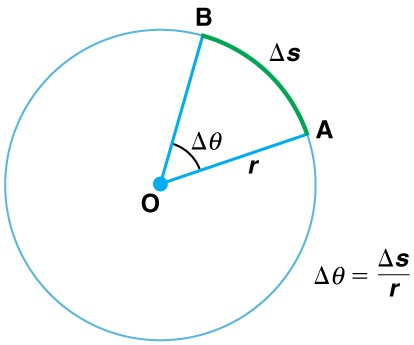
arc length
r0 0 is theta
angular displacement
angle through which a line rotates about a fixed point (radians)
angular velocity
rate of change of angular displacement (radians per sec)
how would u form relationship of time period of one complete rotation T, angular velocity
w = 2π/T 2π is angular displacement T is time period of 1 full rotation
what is w = 2πf
full rotations per second x how many radians are in a single rotation
T meaning
time taken for 1 Rotation time/rotation
f =
1/T
f meaning
total rotations / total time
Why do two children sitting at different distances from the centre of a spinning roundabout have the exact same angular velocity ?
Because they have the same angular displacement in the same time taken.
Why does the child sitting on the edge of the roundabout move with a faster linear speed (\(v\)) than the child near the centre?
Because the child on the edge has a greater radius (\(r\)).
To stay in a straight line with the centre, the outside child has to cover a much larger physical distance (a bigger circular track) in the exact same amount of time.
What does T and F mean

what happens when particle is moving around circular path when constant speed
accelerating
why doesnt centripetal acceleration speedup
acceleration is at right angles to motion, there’s no speeding up of particle just change of direction
How can an object be accelerating if it is moving around a circle at a perfectly constant speed?
Acceleration is the change in velocity over time.
Velocity is a vector (it includes direction). Because the object is turning, its direction is constantly changing, which means its velocity is changing. Therefore, it must be accelerating.

In the textbook triangle (Figure 15.5), what does the vector arrow \(\Delta v\) represent, and where does it point when placed back on the circle?
\(\Delta v\) represents the change in velocity (\(v_2 - v_1\)).
It points along the line \(BO\), directly towards the centre of the circle.

centripetal acceleration
when particle moves in a circular path of radius at constant speed, there must be centripetal acceleration towards centre
If the centripetal force suddenly drops to zero (e.g., the string breaks), why does the object fly off along a tangent linerather than straight outward?
Because of inertia (Newton's First Law).
At any exact millisecond, the object's velocity vector points along the tangent. Without an inward force to bend its path, the object simply continues moving in a straight line in the exact direction it was traveling at the moment of release.
Summarize why an object moving at a constant speed in a circle is accelerating, and what that acceleration does.
Why: Because its velocity is constantly changing direction at every point along the circular path.
What it does: It points toward the centre and only changes the direction of travel, never the speed.
What is the geometric relationship between the velocity vector and the acceleration vector in uniform circular motion?
They are always perpendicular (\(90^{\circ }\)) to each other.
The velocity vector points along the tangent line, while the centripetal acceleration vector points along the radius line directly toward the centre.
If an object moves in a circle at a steady rate, why is it technically incorrect to say the "acceleration is constant"?
Because acceleration is a vector (it has a direction).
While the magnitude (the numerical value) stays constant, the direction of the acceleration arrow is constantly rotating so it can keep pointing toward the centre.
What does instantaneous acceleration mean, and why is it important in circular motion?
It is the acceleration of an object at one exact, split second in time (an instant where the time window approaches zero).
In circular motion, it is crucial because the direction of the acceleration vector changes every millisecond. The instantaneous acceleration tells you exactly which way the vector points at one specific freeze-frame along the path.
In Figure 15.7, when the carriage turns a corner at a constant speed, what provides the unbalanced force (\(R\)), and which way does it point?
The vector sum of the string's tension (\(T\)) and the ball's weight (\(W\)) provides the unbalanced force \(R\).
It points directly horizontally towards the centre of the circle, providing the centripetal acceleration needed to turn the corner.
The ball in Figure 15.7 (turning train) and Figure 15.8 (held by a finger) are at the exact same angle. What is the fundamental difference in their net forces?
Figure 15.7 (Turning Train): The forces are unbalanced. The net force is \(R\), which acts sideways to constantly change the direction of the moving ball.
Figure 15.8 (Held by Finger): The forces are perfectly balanced (equilibrium). The net force is zero because the finger's push (\(P\)) keeps the stationary ball completely still.

If the train stops turning in Figure 15.7, vs. if the student removes their finger in Figure 15.8, how do the behaviors of the balls differ?
In 15.7: The ball stops turning and immediately flies off in a straight line along the tangent due to its forward inertia.
In 15.8: The ball starts from a dead stop and accelerates to the left, swinging back down toward the center because it has no forward velocity.
Explain how a force can change the velocity of a body without increasing its speed
A force can change velocity by changing its direction rather than its magnitude.
For an object moving in a circle, the force (and resulting acceleration) always points toward the centre - perpendicular to the velocity at every instant.
Since the force has no component along the direction of motion, it doesn't speed the object up or slow it down; it only changes the direction of the velocity vector.
This centripetal acceleration is what keeps the object turning while its speed stays constant.
Centripetal Force
When object move circular path,
There much be centripetal acting towards centre of circle
Something must provide this force like pull from string