#4 Ran GTPases

0.0(0)
Studied by 0 people
call kaiCall Kai
Locked
learnLearn
examPractice Test
spaced repetitionSpaced Repetition
heart puzzleMatch
flashcardsFlashcards
GameKnowt Play
Card Sorting

1/34

encourage image

There's no tags or description

Looks like no tags are added yet.

Last updated 3:30 PM on 8/22/26
Name
Mastery
Learn
Test
Matching
Spaced
Call with Kai
Chat

No analytics yet

Send a link to your students to track their progress

35 Terms

1
New cards
Nuclear pore complex
120MDa embedded complex in nuclear membrane, act as diffusion barrier and selective transport channel, composed of nucleoporins
2
New cards
Nuceloporins (Nups)
family of proteins that form NPCs, scaffold or FG repeat domains
3
New cards
Scaffold Nups

form ring complexes through membrane, anchor NPC, stabilize membrane curvature, attachment sites for FG

Inner ring complex - Nup53 complex

Outer, inner rings - Nup107-160 complex

4
New cards

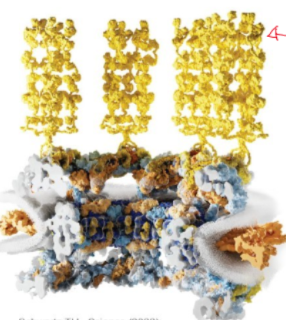
FG Nups

Made of Phe/Gly repeat domains, binding sites fro nuclear transport receptors, defines the permeability characteristics of the NPC
<p>Made of Phe/Gly repeat domains, binding sites fro nuclear transport receptors, defines the permeability characteristics of the NPC</p>
5
New cards
Cytoplasmic filaments
extend from the NPC into cytoplasm, made of Nup358/RanBP2
6
New cards
NLS
Nuclear Localization signal (NLS): specific aa sequences, localize proteins to the nucleus
7
New cards
NES
Nuclear export signal (NES): specific aa sequences, export proteins from the nucleus
8
New cards
Nuclear transport receptors
recognize transport signals, importins/exportins, mediate transport through NPCs via FG repeat interaction
9
New cards
Ran GTPase system
generates asymmetry in RanGTP distribution, 200X more in nucleus
10
New cards
Ran
Ras-related nuclear protein (Ran): GTPase, binds guanine nucleotides, very stable (does not convert GTP without effectors)
11
New cards
RanGAP
Ran GTPase Activating Protein, causes Ran to convert GTP to GDP (hydrolizes triphosphate to diphosphate)
12
New cards
RanGEF
Ran Guanyl Nucleotide Exchange Factor, causes RanGDP to exchange GDP for GTP
13
New cards
Ran GTP Transport Receptors
superfamily, shuttle continuously between nucleus/cytoplasm
14
New cards

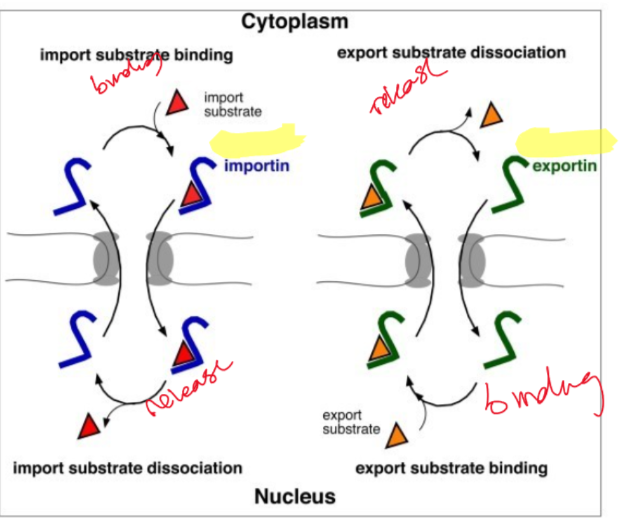
Importins

RanGTP transport receptor, high affinity for RanGTP, traffics RanGTP from cytoplasm into nucleus, RanGTP binding dissociates the import substrate
<p>RanGTP transport receptor,  high affinity for RanGTP, traffics RanGTP from cytoplasm into nucleus, RanGTP binding dissociates the import substrate</p>
15
New cards

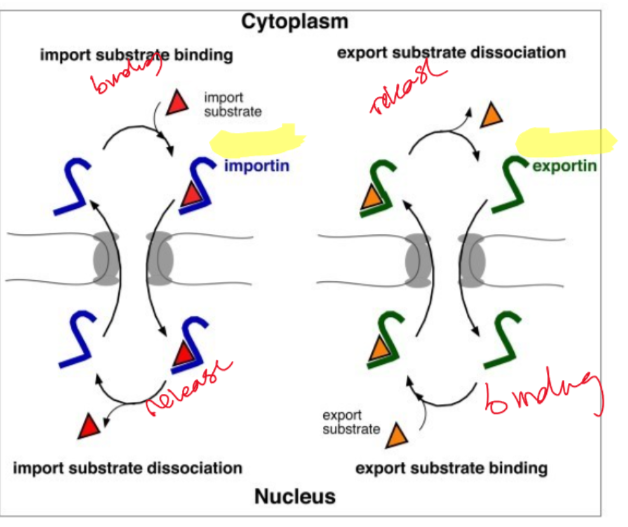
Exportins

RanGTP transport receptor, low affinity for RanGTP, cooperative binding with RanGTP and export substrate to allow export of RanGTP, GTP conversion causes dissociation and exportin returns to nucleus
<p>RanGTP transport receptor,  low affinity for RanGTP, cooperative binding with RanGTP and export substrate to allow export of RanGTP, GTP conversion causes dissociation and exportin returns to nucleus</p>
16
New cards
Facillitated diffusion
requirs molecular binding event (importin/exportin bind FG nups) saturable due to limited binding sites
17
New cards
Selective phase model
Nuclear transport receptors dissolve FG Nups "mesh" by pulling apart FG-FG interactions, allowing translocation via NPC
18
New cards

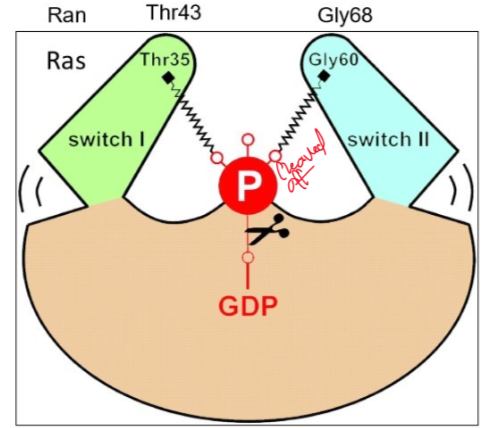
Ran Switch loops

part of Ran structure conformational changes during GTP -> GDP
<p>part of Ran structure conformational changes during GTP -&gt; GDP</p>
19
New cards
Loaded spring mechanism
switch 1/2 regions bring alpha-phosphate via Thr/Gly residues, upon GTP -> GDP hydrolysis, switch regions relax
20
New cards
Switch 3
in Ran, carboxyl-terminal tail packed against core of Ran during GDP binding, displaced when GTP binds
21
New cards
Importin B
RanGTP-binding transport receptor, composed of 19 helical HEAT repeats that form a spiral, contains IBB domain,  aa terminal arches align with switch regions of Ran, prevents enzymatic activity of Ran, multiple FG-repeat binding sites on surface
22
New cards
IBB Domain (importin B)
~35aa long N-terminal domain of Importin A that binds the C-terminal arch of Importin B
23
New cards
Exclusive binding (Importin B)
Ran-GTP and IBB-domain binding sites
24
New cards

CAS closed conformation

-RanGTP-exportin, requires contact of both RanGTP and cargo to form full exportin complex

-occurs when it is not bound, N-term and C-term arches interact, separation of this interaction required for open conformation
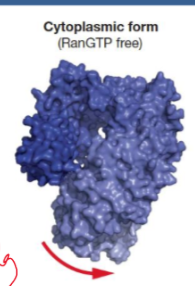
<p>-RanGTP-exportin, requires contact of both RanGTP and cargo to form full exportin complex</p><p>-occurs when it is not bound, N-term and C-term arches interact, separation of this interaction required for open conformation </p>
25
New cards

CAS opened confirmation

-RanGTP-exportin, requires contact of both RanGTP and cargo to form full exportin complex

-occurs when RanGTP binds due to induction/stabilization "
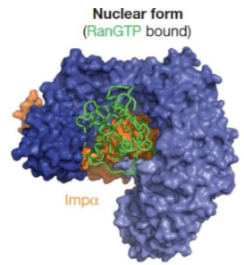
<p>-RanGTP-exportin, requires contact of both RanGTP and cargo to form full exportin complex</p><p>-occurs when RanGTP binds due to induction/stabilization "</p>
26
New cards

CRM1

exportin for NES cargo, donut shaped causing N-term and C-term HEAT repeats to interact, acidic loop interacts with Switch1 of Ran

-Ran: enclosed in donut, stabilizes ring closure, Switch 1 interacts with acidic loop of CRM1

-NES cargo: binds outside of donut, long-range allosteric communication with binding sites of cargo and RanGTP
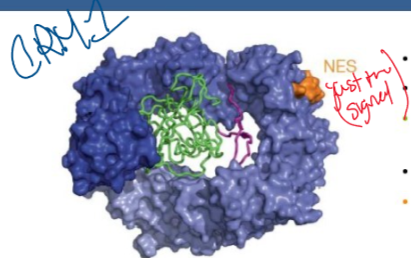
<p>exportin for NES cargo, donut shaped causing N-term and C-term HEAT repeats to interact, acidic loop interacts with Switch1 of Ran</p><p>-Ran: enclosed in donut, stabilizes ring closure, Switch 1 interacts with acidic loop of CRM1</p><p>-NES cargo: binds outside of donut, long-range allosteric communication with binding sites of cargo and RanGTP </p>
27
New cards

RanBP family

-Ran-binding protein family, effector group 2, cause nuclear transport receptor/RanGTP complexes to dissociate to allow for RanGAP attack via their Ran binding domains

-Ran binding domains (RanBD): enwrapped by switch3 domain of Ran, causes the destabilization of the RanGTP-NTR interaction
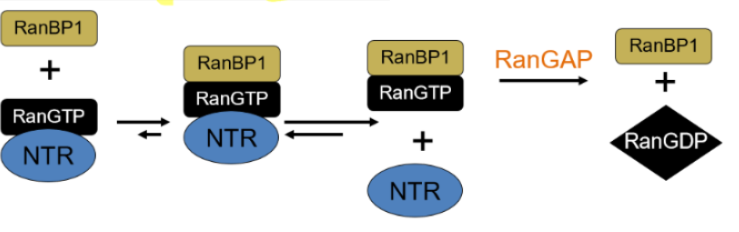
<p>-Ran-binding protein family, effector group 2, cause nuclear transport receptor/RanGTP complexes to dissociate to allow for RanGAP attack via their Ran binding domains</p><p>-Ran binding domains (RanBD): enwrapped by switch3 domain of Ran, causes the destabilization of the RanGTP-NTR interaction </p>
28
New cards
RanBP1
cytoplasmic, contains NES to maintain localization
29
New cards
RanBP2
part of filaments of NPC
30
New cards
RanGAP
cytoplasmic, stimulate intrinsic GTPase activity of Ran, required for Ran to reach transition state of conformation, contains leucine-rich repeat domain attached to NPC filaments
31
New cards
RanGAP transition state

-conformation formed during GTP hydrolyzation (transferring gamma-phosphate to water), requires Q-residue of Ran that must be stabilized by RanGAP

-Asn131: aa of RanGap that helps orient the catalytic residue Gln69 of Ran

-Tyr39: aa of Ran, forms hydrogen bonds with beta-phosphate and Gln60 side chain of Ran to further support transition state stabilization

32
New cards

NTF2

nuclear transport factor 2, 15kDadimeric protein, transport receptor, recycles RanGDP to nucleus, can bind 2 RanGDP molecules via their switch II regions
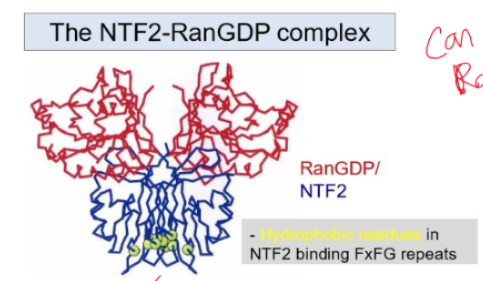
<p>nuclear transport factor 2, 15kDadimeric protein, transport receptor, recycles RanGDP to nucleus, can bind 2 RanGDP molecules via their switch II regions</p>
33
New cards
RanGEF
(RCC1), ~45kDA, accelerate GDP/GTP exchange by acting as catalyst , disrupt nucleotide binding site and stabilization of nucleotide free form
34
New cards
RanGEF Disruption of binding site
Catalytic kick-out model: B-wedge of RCC1 pushes aside Ploop needed for nucleotide-binding
35
New cards
RanGEF Stabilization

-RanGEF binds Ran and stabilizes the complex of Ran by itself without GDP or GTP binding

-GTP binds preferably due to much higher concentration of GTP in nucleus



