Chapters 1 to 4 Review BIO 141
 Call Kai
 Learn
Learn Practice Test
 Spaced Repetition
 Match
Match Flashcards
 Knowt Play
1/85

There's no tags or description
Looks like no tags are added yet.
Name | Mastery | Learn | Test | Matching | Spaced | Call with Kai | Chat |
|---|
No analytics yet
Send a link to your students to track their progress
86 Terms
What do scientists use?
Scientific method
Chemicals…
Break down into compounds and elements
4 properties of water.
Polar molecule, temperature moderation, universal solvent, cohesive behavior
elements may be toxic but
Their compounds might not be
What compound makes up most of your body
Water
Chemical bonds
Covalent, Ionic, Hydrogen
Covalent Bond
Strongest bond, shares a pair of valence electrons by two atoms
Ionic bonds
Ions are attracted to each other by opposite charges
Hydrogen bonding
2 elements are sharing a hydrogen
Kinetic energy
Movement of molecules
3rd most common element in your body
Hydrogen
Most common element in body
Oxygen
2nd most common element in the body
Carbon
Molecule shape matters because
You can co-op molecules for drugs, a molecule of the same shape but different property can bind to receptors and mimic the same reactions
Temperature
Measure of movement of molecules
Heat
Total amount of kinetic energy
Specific heat
Amount of heat that must be absorbed/lost to change temp by 1cal/g/Celcius
Why is specific heat?
Higher heat keeps bonding tighter which is harder to tear apart
How does water climb up a tree
Evaporation by H20 because gas rises and the cohesive properties of the hydrogen bonds connect as they go up the tree
Surface tension
how hard it is to break the hydrogen bonds that create tension
7 chemical groups in biological processes
Hydroxyl, Carbonyl, Carboxyl, Amino, Sulfhydryl, Phosphate, Methyl
3 isomers
Structural, Cistrans, Enantiomers
Which enanitiomers are created naturally
L-Enantiomers
what are enantiomers
mirror images of each other
Element
substance that cannot be broken down into other substances
compound
made of two or more elements
atom
smallest unit of matter that retains properties of an element and is made of protons, neutrons, and electrons
Proton
positive charge
Neutrons
no charge
electrons
negative charge, differ in potential energy and energy level/shell
Energy
capacity to cause change
potential energy
energy that has location or structure
Electrons in an atom
They have valence electrons
Describe energy levels of electrons
There are 3 shells. The first shell is the lowest energy potential and the third is the highest energy potential. Electrons transfer up each level when energy is absorbed, but when energy is lost, they drop down shells toward the nucleus of the atom
Valence electrons
outermost layer of the atom, which determines the atom's chemical behavior. Atoms with full shells are chemically inert.
Van Der Waals Interactions
attractions between molecules as a result of electrons collecting in parts of molecules or atoms
Why is water life?
It is the biological medium of our planet, all living organisms require water, surrounds most cells, 70-95% of cells are water, abundance of water is required for life
What is special about a polar molecule?
Allows for hydrogen bonding
4 properties of Water
Cohesive behavior, moderates temperature, expansion upon freezing, versatile solvent
Cohesion
Hydrogen bond to hold water molecules and helps the transport of water
adhesion
Attraction between different substances
Surface tension
Measure of how hard it is to break surface of liquid
How does water moderate temperature
Through kinetic energy and temperature
Kinetic energy
energy of motion
Temperature
measures the intensity of heat due to average kinetic energy molecules
Heat
measures total amount of kinetic energy due to molecular motion
Why does water have high specific heat
Minimizes temperate fluctuations and hydrogen bonding, 1cal/g/Celsius
Specific heat
Amount of heat that must be absorbed or lost for 1g of substance to change its temperature by 1 degree celsius
Evaporative cooling
When liquid turns to gas and helps stabilize temperatures in bodies of water
Evaporation
liquid to gas
Heat of vaporiztaoin
liquid that absorbs
Ice Floats why?
Hydrogen bonds make ice less dense
Solution
a liquid that is homogenous mixture
solvent
dissolving agent
solute
substance dissolved
Aqueous solution
solution where solvent is water
Why is water a versatile solvent
Because of its polarity and when an ionic compound is dissolved in water, each ion is surrounded by a sphere of water molecules called a hydration shell. Water can dissolved compounds made of nonionic polar molecules. Larger polar molecules, such as proteins can dissolved in water if they have ionic and polar regions
Polarity
allows for easy hydrogen bonding
Hydration shell
when water molecules orient around a dissolved ion or polar molecule due to water’s polarity
Acidic and basic conditions affect living organisms
Hydrogen bond between two water molecules can shift from one to another to become hydrogen ions, hydronium ions, and hydroxide ions
Hydrogen ion
hydrogen atom leaves its electron behind and is transferred as a proton
Hydronium ion
H2O molecule with the extra hydrogen proton from H2O molecule
Hydroxide ion
H2O molecule that lost hydrogen proton
Acid
any substance that increases the H+ concentration of a solution
Base
any substance that reduce the H+ concentration of a solution
Organic
Consisting of carbon and the molecular diversity of life being very simple to complex
Carbon - Backbone of life
Living organisms consist of mostly carbon-based compounds. Carbon is unparalleled in its ability to form large, complex, and diverse molecules. Proteins, DNA, carbohydrates, and other molecules that distinguish living matter are all composed of carbon compounds.
Stanley Miller
Classic experiment demonstrated the abiotic synthesis of organic compounds. Supports idea that abiotic synthesis of organic compounds could have been a stage in the origin of life
perhaps near volcanoes
Carbon bond formations
four valence electrons, complex molecules are possible, tetrahedral shape, double bond, compatibility with many different elements
Diverse Molecules

Most frequent partners of Carbon
hydrogen, oxygen nitrogen
Carbon atoms can..
partner with atoms other than hydrogen
Carbon bonding examples
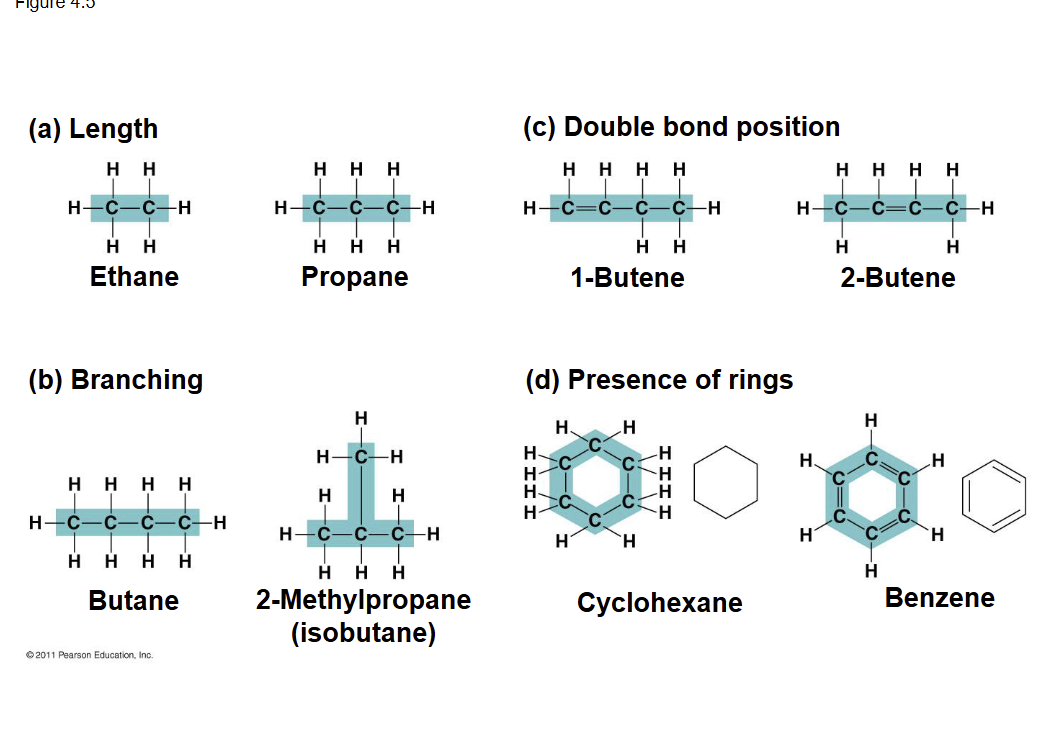
Hydrocarbons
Hydrocarbons, many organic molecules have hydrocarbon components. Can undergo reactions that release a large amount of energy
Hydrocarbons definition
Organic molecules consisting of only carbon and hydrogen
Isomers
Compounds with the same molecular formula but different structures and properties
Structural, Cis-trans, Enantiomers
Structural isomers
have different covalent arrangements of their atoms
Cis-trans isomers
have same covalent bonds but differ in spatial arrangements
Enantiomers
Isomers that are mirror images of each other
Hydroxyl
Alcohols, written as —OH, is polar, can form hydrogen bonds, helps dissolve organic compounds
Carbonyl
If the Carbonyl group is within a carbon skeleton: its a ketone
If the carbonyl group is at the end of a carbon skeleton: its a aldehyde
Carboxyl
Carboxyl acids/Organic compounds
Acts as an acid, can donate H+ because of the covalent bond between oxygen and hydrogen is polar
Amino
Amines structure, acts as a base, can pick up H+ from solution
Sulfhydryl
Thiols structure, two sulfhydryl groups can form covalent bond and “Cross-link” protein structure.
Phosphate
Organic phosphate structure, contributes negative charge to molecule. Molecules containing phosphate groups have the potential to react with water, releasing energy
Methyl
methylated compound structure that affects expression of genes in male/female sex hormones