PSY 420 Exam 4
 Call Kai
 Learn
Learn Practice Test
 Spaced Repetition
 Match
Match Flashcards
 Knowt Play
1/71

Earn XP
Description and Tags
Sensation and Perception Final Exam
Name | Mastery | Learn | Test | Matching | Spaced | Call with Kai | Chat |
|---|
No analytics yet
Send a link to your students to track their progress
72 Terms
Inverse projection problem
Retinal image is ambiguous → an object can create an infinite number of responses
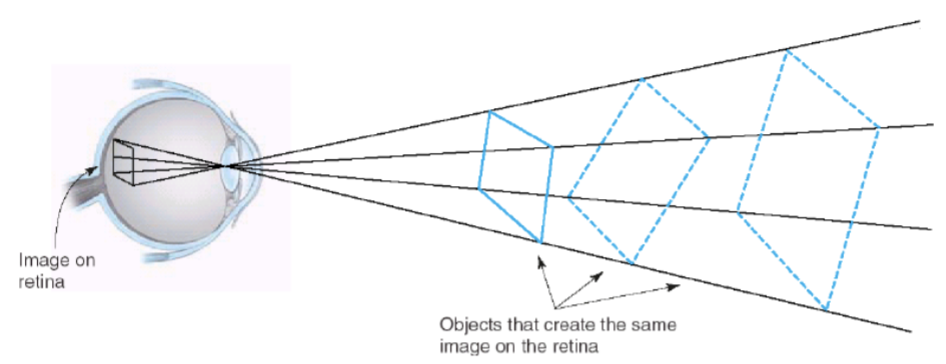
Edge at conceptual level
area in visual field that is high contrast, a clear line separating areas
How can the ambiguity of the retinal image (sensations) be resolved?
by two ways → bottom-up and top-down processing
need more information → constraints and assumptions
Buttom-up processing
information flows UP from lower levels to higher levels of analysis, integrating simple sensory attributes into large structures on the basis of built-in rules
rules are hard-wired into nervous system (ex. Gestalt grouping rules)
Gestalt grouping rules
set of rules describing when elements in an image will appear to group together by looking for patterns (contours, edges, what’s available)
rules of thumb → apply most of the time, but there are exceptions
ex. law of similarity, law of good continuation, law of proximity (nearness), law of familiarity
Law of similarity
similar things (ex. color, shape, distance, size) will be grouped together

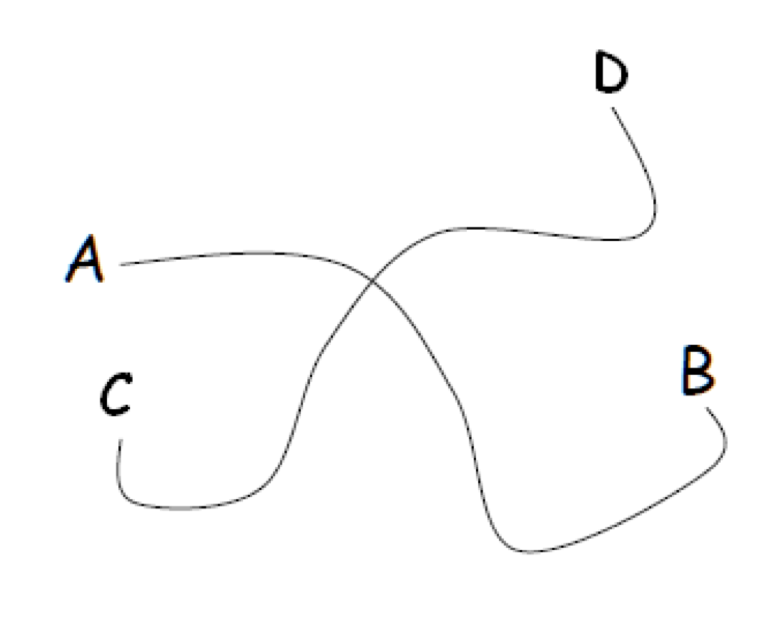
Law of good continuation
smoothest path determines sameness
Law of proximity (nearness)
closely spaced things are grouped together

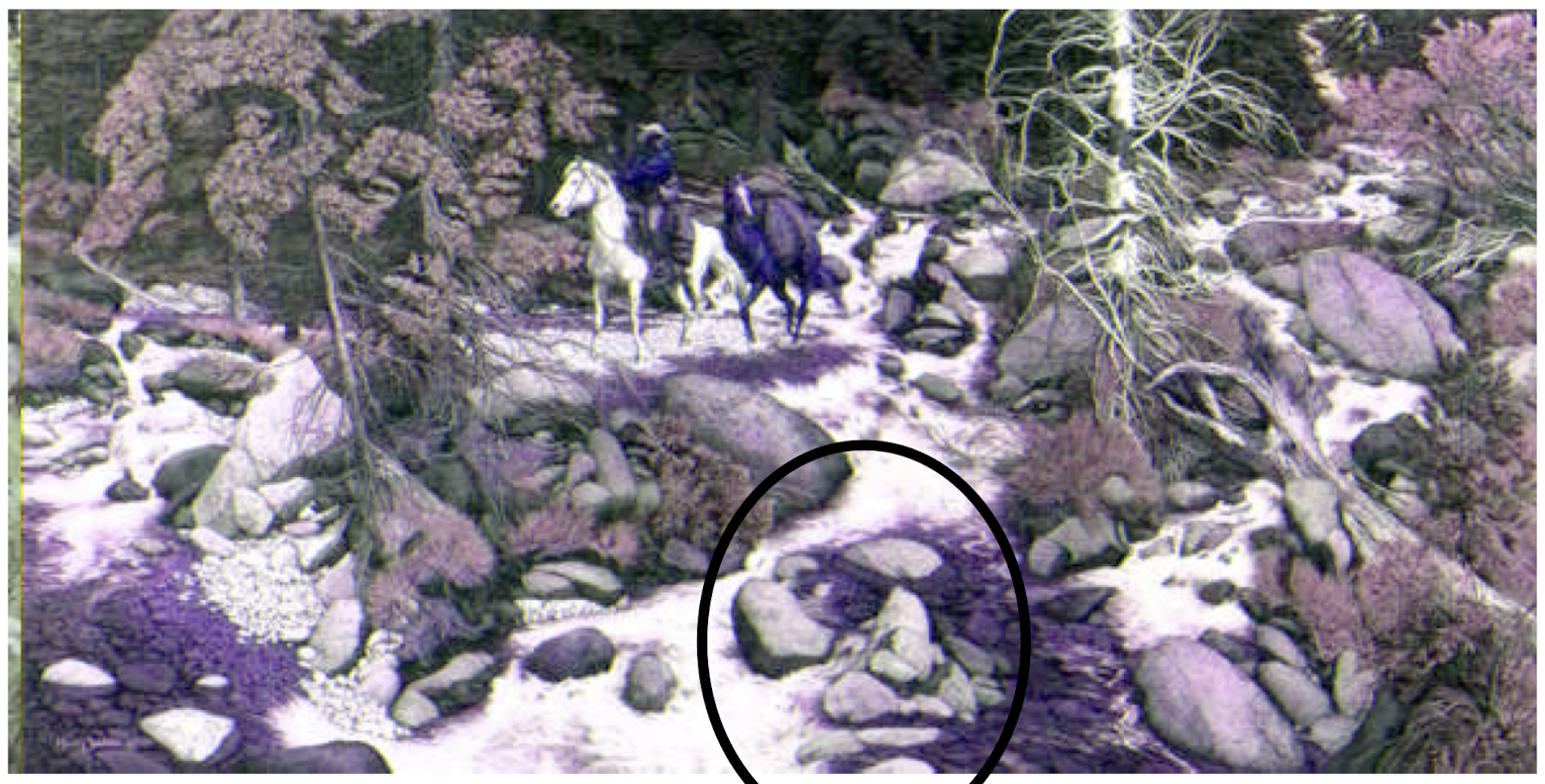
Law of familiarity
if the collection of parts is meaningful and familiar, it forms a group
Top-down processing
information flows DOWN from higher levels to lower levels of analysis, using prior knowledge and experience to steer lower level processes
perception fits incoming info. rather than having to deduce it
we know when things are physically impossible, so brain doesn’t consider any other option (ex. Light-from-above heuristic, size difference in pennies, and Eiffel tower)
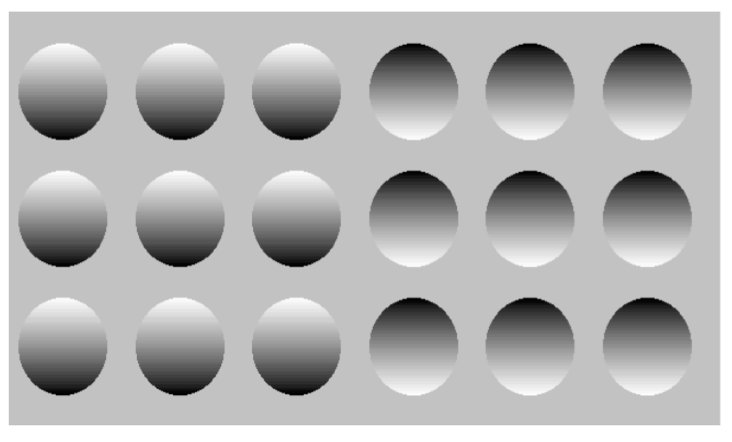
Light-from-above heuristic
assumptions that light sources are typically above our head (sunlight, light fixtures) → implacates in how we interpret shadows, and shapes based on those shadows
assumption can be exploited in illusions
Eiffel tower top-down processing
A giant hand isn’t picking up the Eiffel tower because we know exact size of the structure
interpretations depend on background knowledge
To study higher level perceptual processes deaing with ambiguity
have to use stimuli carefully designed to create specific kinds of ambiguity
ex. bistable, rivalrous, and impoverished stimuli
Bistable stimuli
stimuli presenting two equally plausible interpretations
visual ex. → necker cube (is the green part in front or back)
auditory ex. → auditory streaming (two streams when fast and one stream when slow) and verbal transformation (repeating same word turns into a different word)
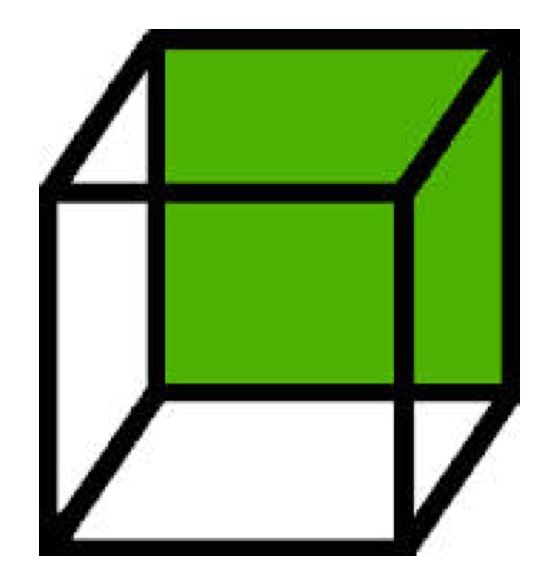
Bottom/Top processing evidence of bistable stimuli
bottom-up explanation → both stimuli compete, one becomes dominate, adaptation takes over when dominant is fatigued, and perception keeps alternating
top-down explanation → indecision in higher-level processes and interpretations switch depending on attention
Studies showing evidence of processing of bistable stimuli
auditory streaming → bottom-up processing; adaptation in frequency-selective cortical neurons
verbal transformation → top-down processing; transitions linked to frontal lobe (attention)
visual stimuli → both bottom-up and top-down processing
Rivalrous stimuli
two unrelated stimuli are presented at the same time to different sensory receptors, which would never naturally be present together
visual ex. → two different images presented to two eyes
smell ex. → two different odor compounds presented to two nostrils
hearing ex. → two tones of different pitch are presented to two ears
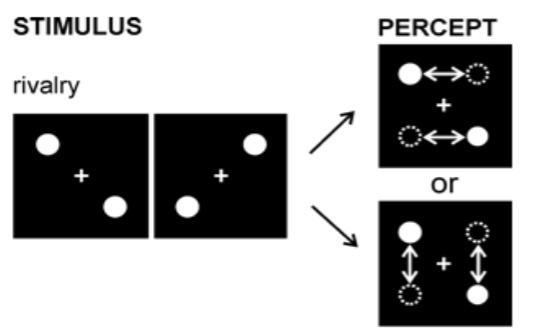
Processing evidence for rivalrous stimuli
one image, tone, odor dominates for a while and then is replaced by the other one
evidence for both adaptation (bottom-up) and top-down (attention) processing for alternating perceptions
Impoverished stimuli
stimuli with so little information that it may be difficult or impossible to interpret them without additional knowledge
used to explore role of top-down information flow when resolving ambiguity → interpretation correlated with activity in secondary visual cortex
once the “blobs” have been identified as a face, the image remains “organized” in subsequent presentations

Evidence of top-down influence in impoverished stimuli
interpretation of full picture (higher level process in secondary visual cortex) affects activity of low level processes in primary visual cortex
involves both feedforward signals from low-high levels of processing and also feedback from high level areas down to lower levels
Unconscious inference
Helmholtz’s explanation of how we use constraints/knowledge → logical process of drawing conclusions by combining incoming sensory data with memories of past experiences that match them
sensations are incomplete or incorrect, so → the matching process fixes these problems and provides an accurate representation of the real world
at the heart → is the application of Bayes rule: the combination of prior probabilities and likelihoods
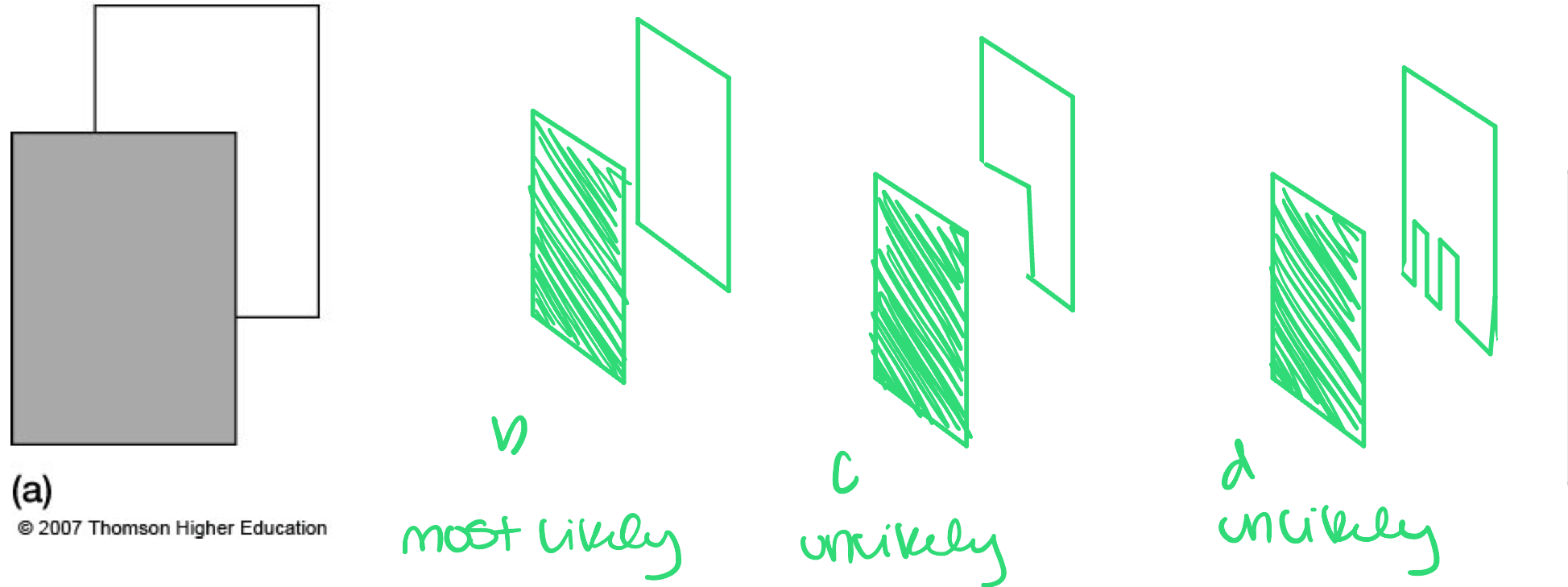
Bayes’ Theorem of resolving ambiguities in sensory processing
inductive logic → a general conclusion is drawn from a specific set of facts; similar to hypothesis-testing
ex. '“swans i’ve seen are white, therefore all swans must be white”
important terms → prior and likelihood
Prior
probability of a particular perceptual interception based on past experience (swans are white)
Likelihood
probability of a particular interpretation based on current sensory information (seeing a white swan)
Bayesian inference in perception
goals → calculate most reliable estimate of an object in the face of uncertain sensory information
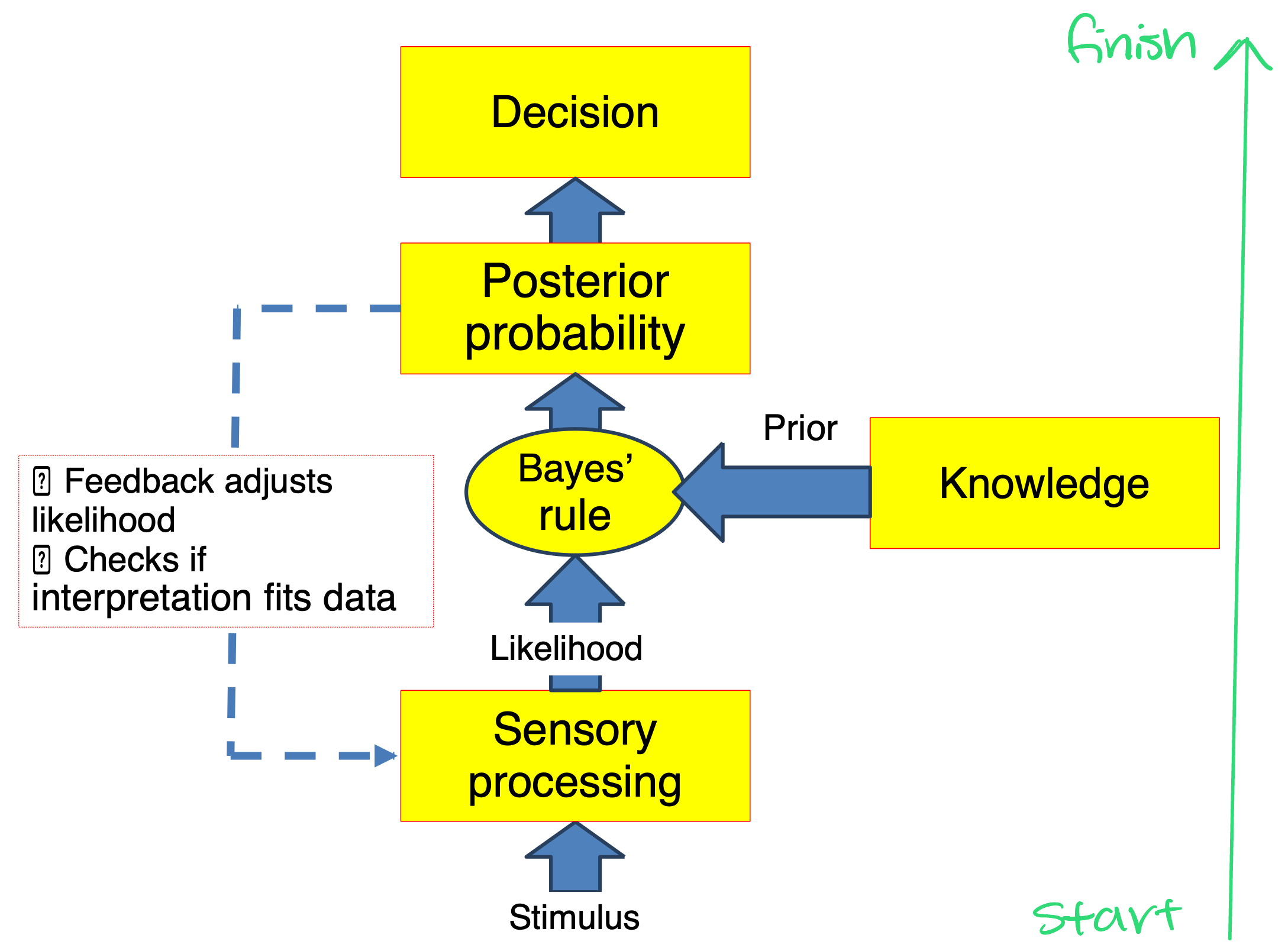
where → sensory data supplies likelihood and built-in knowledge supplies prior probability
likelihood + prior = posterior probability
Posterior probability
probability that a certain interpretation is correct based on combining priors and likelihood for interpretation
Maximum posterior probability
interpretation with the highest probability
Role of feedback in the Bayesian approach
involves using prior knowledge to update interpretations based on new sensory information to improve the reliability of perceptual judgments
perception is a trade-off between prior knowledge and the reliability of the incoming data
P(SII) = P(S) x P(IIS) (posterior = prior x likelihood)
Does the brain use Bayesian computation?
basic assumption → brain represents perceptual information probabilistically
population codes store relative probabilities of different stimulus values
population code for likelihoods + another for priors
Coding efficiency
minimization of ambiguity maximizes coding efficiency
top-down signals promote → once high-level representation is activated, the low-level activity becomes redundant
Perceptual constances
movement changes retinal images but brain still sees stable 3D objects due to inferences
Univariance
a problem that occurs when scientists measure neural activity from a single neuron → neuron responds to a lot of different stimuli, so there will be some cases where the neuron will produce the same amount of neural impulses to two different stimuli
not a problem for the perceiver → the perceiver uses groups of neurons (a population code) to respond to uniquely to a given stimulus
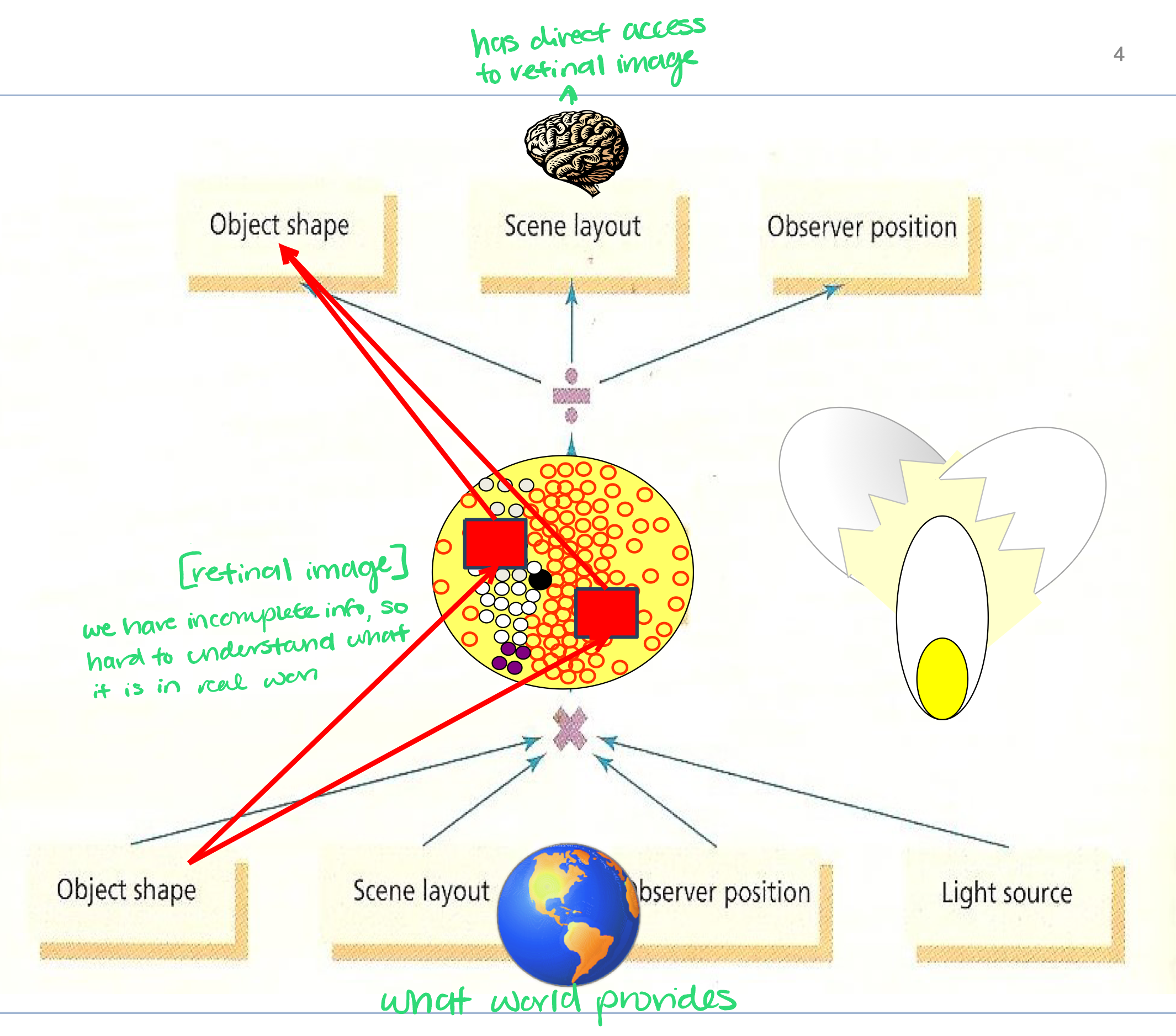
The perceptual process
stimulus generates a retinal image, which has to be matched to real object’s stored representation in cortex (assuming incoming info. is incomplete/incorrect and brain has to interpret from that)
analogy → “unscrambling scrambled eggs” → brain has to unscramble the scrambled retinal image
Top-down explanation of motion ambiguity
attention (a high-level cognitive process) determines which interpretation will dominate at any one time → can be driven by eye movements, as they attend to different parts of the stimulus
neuroimaging evidence supports this because during the switch from one interpretation to another, the parietal lobe is highly active → which controls visual attention
it’s a top-down influence → a high-level process overrides and reinterprets the raw stimulus.
7 questions of ecological psychology
1. Who perceives?
2. Where do we perceive?
3. What are the units of perception?
4. How do we perceive?
5. What is perception for?
6. What variables are perceived?
7. Where does richness of perception come from?
1. Who perceives?
the WHOLE organism, not just a sense organ
2. Where do we perceive?
perceiving takes place in an environment, not just in the head
“animal-environment interaction”
3. What are the units of perception?
the entire organism-environment system, not just neural impulses, receptor cells, sense organs, and/or brain
4. How do we perceive?
by active exploration by perceptual systems, NOT by passive stimulation of sense organs
eyes, head, neck, torso, and legs are ALL part of the visual system because all can affect what is seen by the perceiver
visual cliff exploration
5. What is perception for?
perception is for the control of action, NOT for the conscious seeing, hearing, feelings, smelling, and tasting of objects
concept of affordance
6. What variables are perceived?
invariants → complex (higher order) patterns of physical stimulation
we perceive affordances specified by invariants, NOT simple physical variables like amplitude/intensity, length, etc.
variables of relevance are global, wholistic patterns in the environment - proximal status is ignored
1:1 mapping
7. Where does richness of perception come from?
it comes from the richness of the stimulation, NOT from the complexity of the perceptual processing itself
if stimulation is rich and unambiguous, it needs no further processing
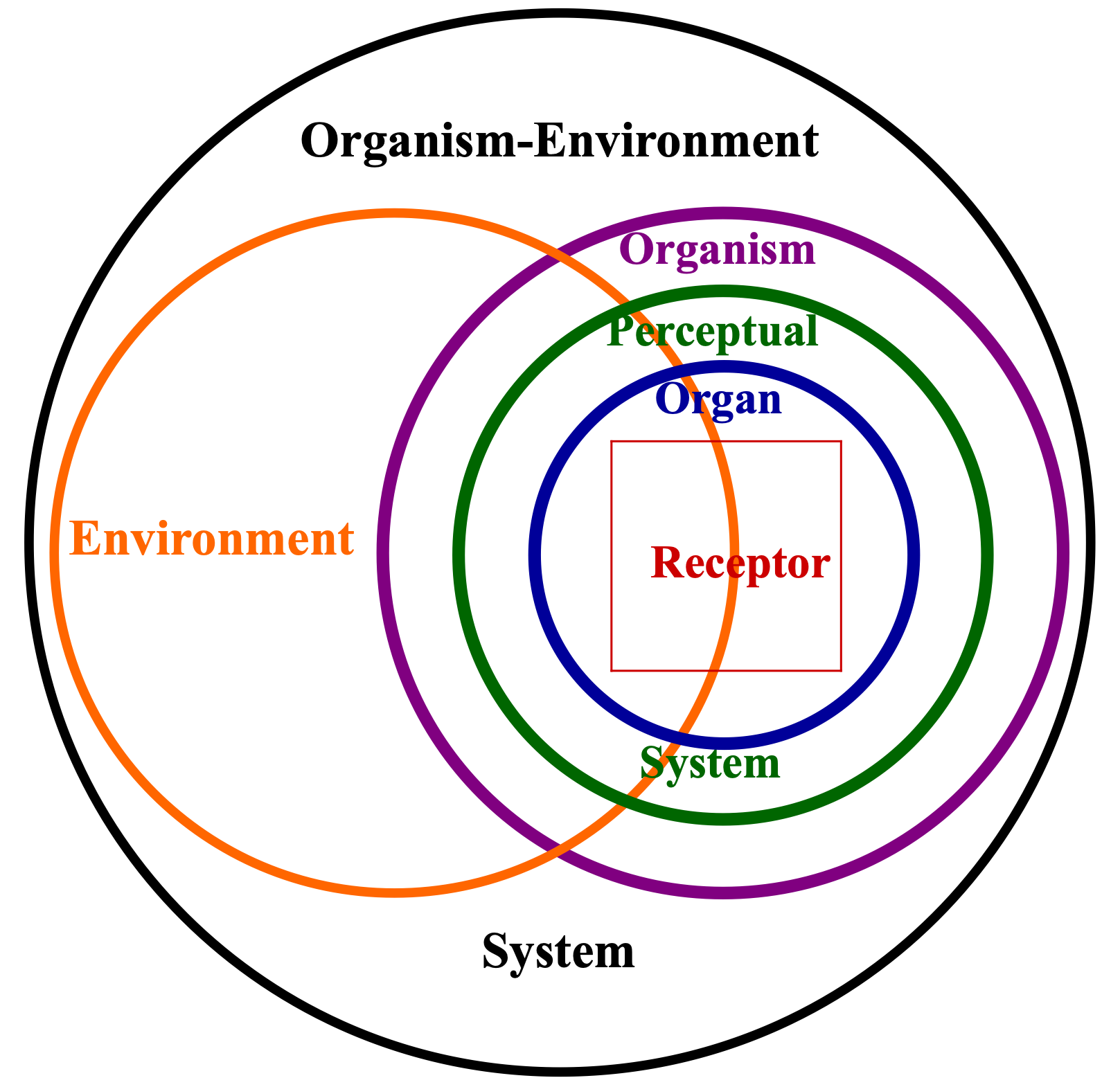
Organism-environment system
organism and environment are inseparable and form only one unitary system → mental activity is activity of the whole system
includes → receptors, sense organs, brain, and much more (such as structured environment)
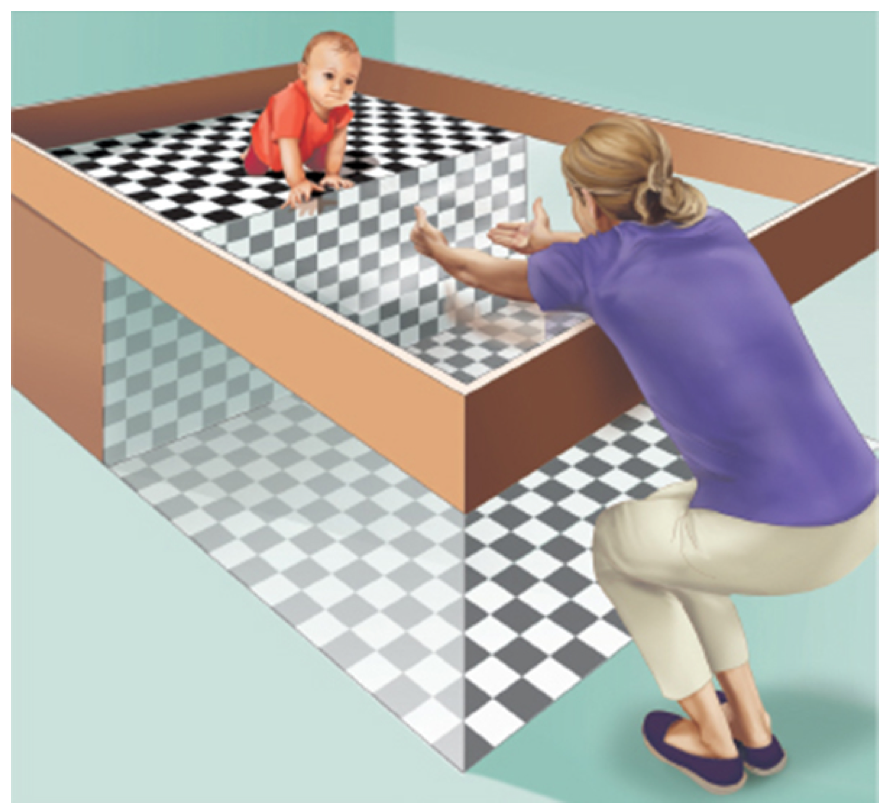
Visual cliff experiment
older infants avoided the “deep” side, whereas younger infants didn’t
perceiving affordances for a steep drop-off improves with more crawling experience (experience by exploration)
Exploratory Procedures (EPs) by Lederman & Klatzky
linked to specific object properties two ways → EP associated with an object property is (1) executed spontaneously when information about that property is desired and (2) appears to optimize info. uptake about that property
Exploratory Procedure: Lateral motion
associated property → surface texture
behavior → the skin is passed laterally across a surface, producing shear force
Exploratory Procedure: Pressure
associated property → compliance or hardness
behavior → force is exerted on the object against a resisting force; ex. by pressing into the surface, bending the object, or twisting
Exploratory Procedure: Static contact
associated property → apparent temperature
behavior → the skin surface is held in contact with the object surface, without motion; typically a large surface (like the whole hand) is applied; this EP gives rise to heat flow between the skin and the object.
Exploratory Procedure: Unsupported holding
associated property → weight
behavior → the object is held while the hand is not externally supported; typically this EP involves lifting, hefting or wielding the object
Exploratory Procedure: Enclosure
associated property → volume; global shape
behavior → the fingers (or other exploring effector) are molded closely to the object surface
Exploratory Procedure: Contour following
associated property → exact shape
behavior → skin contact follows the gradient of the object's surface or is maintained along edges when they are present
Affordances
of the environment → what it offers animals, what it provides or furnishes, either for good or ill
are opportunities for action for a given organism depending on the an animal’s behavioral repertoire (aka action capabilities)
perceiving them → perceiving what is possible, like telling the future
highlights the animal-environment interaction
Perceiving affordances means
to perceive surfaces in the environment in body-scaled items
information → relevant to behavior, body-scaled, and rich
π-number
riser height (cm)/leg length (cm) = pi (a dimensionless number without units)
can perceive opportunities for action and perceive opportunities for most efficient action
3 ways to describe the link between perceiver and environment
exteroception, proprioception, exproprioception
energy arrays must be rich enough to accommodate these perceptions
Exteroceptive properties
spatial location of objects in environment
ex. is the ball reachable
Proprioceptive properties
self → relative position of limbs
ex. how is my left arm positioned
Exproprioceptive properties
Self-environment → limbs relative to environment
ex. am I choked up enough on the racket
1:1 mapping between stimulation pattern and event
animal-environment relation generates → information, which specifies → animal-environment relation
information X means only event Y has occurred → produces a reduced need for processing, so perception is direct
if you do not find a single-valued relations between a physical variable and a perceptual experience → keep looking
Invariants
aspects of the environment that always stay the same → if info is reliable, then we need to look for aspects that are constant
it is the perceiver’s job to discover and “lock on to” them → change is often required to reveal one (“biological motion”)
horizon-ratio
Horizon-ratio as an invariant for perceived size
horizon ALWAYS appears to intersect at the viewer’s eye height
can help determine size → is bigger if object passes line, is smaller if below line
Invariants are independent of:
1) situational factors, 2) species, and 3) perceptual system
Smart Perceptual Device
capitalizes on invariants (without intermediary processing or calculating)
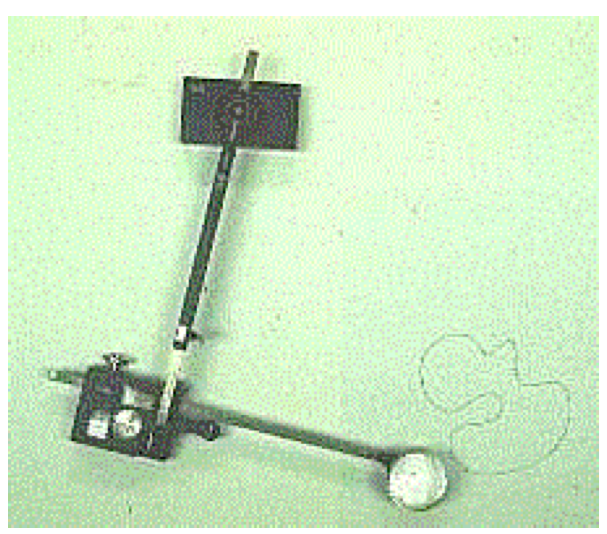
ex. Polar Planimeter → measures areas of irregularly shaped objects without calculation
Perceptual learning
is the development of perceptual skill with practice
ex. The “Scribble” Experiment → subject improved with practice (even without feedback)
Ambient optic array
the pattern of light reaching the eye from the environment, containing all the visual information about surfaces, textures, and objects in a scene
it's the source of visual data that our brain interprets to understand the environment
at an observation point → set of solid optical angles; shows how the perceiver is situated
Optic flow
the apparent motion of elements in the optic array as an observer moves through the environment
helps in perceiving motion, distance, and direction, such as how objects seem to "move" when walking forward
How does Gibson account for Motion Perception?
perceived motion is a result of local patterns of change in the optic array
some local patterns of change in optical texture specify motion across an observer, while others specify motion toward an observer
Determining direction of motion from optic flow patterns, “rules” for behavior
symmetric expansion → the object is directly approaching you and will hit
to catch object → arrange self so the optical texture is expanding symmetrically
asymmetric expansion → object is approaching you but will miss
to avoid object → arrange self so optical texture is expanding asymmetrically
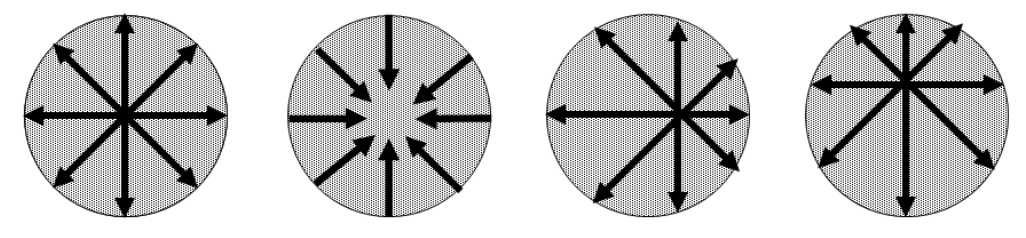
Global change in the optic array
tells about motion of self → certain pattern of expansion + occlusion = locomotion (movement)
transformation of optic array uniquely identified the motion as motion of objects or of me, my eyes, or my head
focus of expansion (FOE) → location is direction you are heading
Rules for the visual control of locomotion include:
1) to start, make the optic array flow by initiating movement; to stop, cancel the flow (no movement); to go back, make the flow reverse
2) to turn, shift the center of outflow from one patch in optic array to another; to steer, keep center of outflow from obstacles and brinks
Perception
is the active selection of information for controlling action
Perception-action cycles
a continuous process in which sensory perception guides motor actions, and those actions change the environment, leading to new sensory input
it highlights the dynamic interaction between perception and behavior to achieve goals