Lecture 4: Vertebrate Origin and Evolution: Fish through Tetrapods
 Call Kai
 Learn
Learn Practice Test
 Spaced Repetition
 Match
Match Flashcards
 Knowt Play
1/37

Earn XP
Description and Tags
Comprehensive vocabulary flashcards covering the origin of vertebrates, major jawless and jawed fish lineages, tetrapod transitions, skull fenestrations, and mammalian/avian taxonomy based on Chapter 3 lecture notes.
Name | Mastery | Learn | Test | Matching | Spaced | Call with Kai | Chat |
|---|
No analytics yet
Send a link to your students to track their progress
38 Terms
Who coined the term "Vertebrate Story”?
Alfred Romer (paleontologist / anatomist). Vertebrates evolved ~0.5 billion years ago between the Cambrian period (542 mya) and the Ordovician period (444 mya).
Sequence of appearance
Agnathans “jawless”, Gnathostomes “jawed” (Chondrichthyans- “cartilaginous fish” and Osteichthyans- "bony fish"), followed by early tetrapods.
Chondrichthyans
are a class of jawed vertebrates that includes sharks, rays, and skates, characterized by a cartilaginous skeleton.
Osteichthyans
are a diverse group of jawed vertebrates known as "bony fish". They have a skeleton made primarily of bone and include both ray-finned and lobe-finned fish.
Tetrapods
are vertebrates that have four limbs, including amphibians, reptiles, birds, and mammals. They evolved from lobe-finned fish and adapted to life on land.
Anamniotes
lack extra-embryonic membrane. ex) labryinthodonts and amphibians
Amniotes
extra membrane. They are vertebrates that possess extra-embryonic membranes, allowing for reproduction in a terrestrial environment. This group includes reptiles, birds, and mammals.
Extinction #1
Permian. ~250 mya. Pangea merge. Volcanoes lead to CO2 and temperature increases, and Oxygen decrease.
Extinction #2
Cretaceous. ~66 mya. Asteroid.
Prevertebrates and earliest agnathan vertebrates
Pikaia, Haikouella, Myllokummingia and Haikouichthyes
label prevertebrate phylogeny

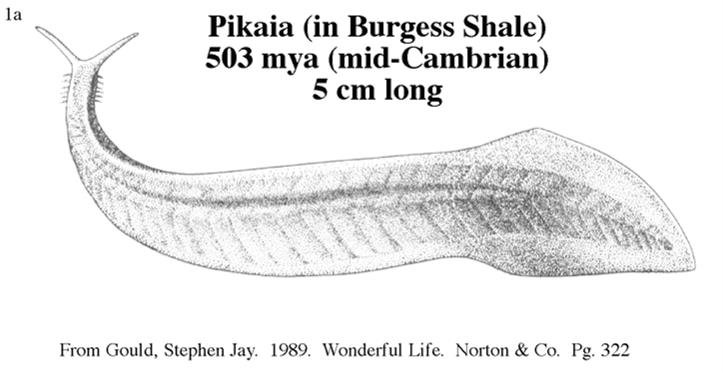
Pikaia
Early Cephalochordate or Prevertebrate? in Burgess Shale 503 mya (mid-Cambrian). 5 cm long. segmentation protects spinal cord.
Haikouichthyes
possession of protovertebral column, notochord with cartilaginous composition

Haikouella
early jawless vertebrates, Includes Haikouichthys and Myllokunmingia

Myllokunmingia
early jawless vertebrates

Agnthans (jawless fish)
Cyclostomata
Condodonts
Ostracoderms
Agnathans Phylogeny tree

Gnathostomes (Jawed)
Placoderms
Chondrichthyans
Elasmobranchs
Holocephali
Acanthodians
Osteichthyans (bony fish)
Actinopterygians
Sarcopterygians
Tetrapods

Cyclostomata
A group of jawless fish characterized by round mouths, comprising Myxinoidea (hagfish) and Petromyzontida (lampreys).
Myxinoidea → Hagfishes ("slime eels")
(Bdellostoma) release slime that helps break down their food. Agnathans

Conodonts
Extinct agnathans known for specialized micro-fossilized dental elements, including P, S, and M elements.
Ostracoderms
Jawless fish characterized by armored bony plates on their skin. dorsal eyes, lobe-like pectoral fin. Cephalospidomorpha and Pterospidomorpha are Ostracoderms.
Gnathostome phylogeny

Osteichthyan phylogeny

Achinistia Coelocanths phylogeny

Pterospidomorpha
A clade of ostracoderms characterized by bony armor surrounding the mouth.
Cephalaspidomorpha
A clade of ostracoderms featuring bony armor over the mouth, dorsal eyes, and lobe-like paired pectoral fins.
Gnathostomes
A major evolutionary lineage of vertebrates defined by the presence of jaws.
Placoderms
Early jawed fish possessing armor-plated or bony skin.
Chondrichthyans
Cartilaginous fish possessing serial replacement teeth, divided into Elasmobranchs (sharks, skates, rays) and Holocephali (chimaeras/ratfish).
Acanthodii
An extinct clade of jawed fish known as spiny forms.
Osteichthyans
Bony fish divided into two major groups: Actinopterygii (ray-finned) and Sarcopterygii (lobe-finned).
Actinopterygians
Ray-finned bony fish encompassing primitive Palaeonisciformes and advanced Neopterygii.
Sarcopterygians
Lobe-finned or fleshy-finned bony fish including Actinistia, Dipnoans, and Rhipidistians.
Actinistia
Deep-sea coelacanths with cosmoid scales and a divided diphycercal tail, exemplified by the "living fossil" Latimeria.
Dipnoans
Lungfish that inhabit shallow waters and possess paired lungs for breathing air.
Rhipidistians
Lobe-finned fish within the labyrinthodont lineage ancestral to land-dwelling tetrapods. anatomy of animal that can go from sea to land.
Latimeria
“Living Fossil”of the coelacanth, a deep-sea fish thought to be extinct until its discovery in 1938. It possesses unique features such as cosmoid scales and a lobed fin structure.