Industrial Production
 Call Kai
 Learn
Learn Practice Test
 Spaced Repetition
 Match
Match Flashcards
 Knowt Play
1/35

There's no tags or description
Looks like no tags are added yet.
Name | Mastery | Learn | Test | Matching | Spaced | Call with Kai | Chat |
|---|
No analytics yet
Send a link to your students to track their progress
36 Terms
physiological protein production
DNA unwinds from histones → RNA polymerase attach to start of gene
transcribe mRNA using complementary bases → mRNA to ribosome to be translated → amino acid chains
for activity/functionality, proteins must:
correct AA sequence
folded correctly (tertiary and quaternary)
not aggregate/precipitate
correct post-translational modification
post translational modification
are — changes to —
occur in —
covalent changes to R-group, peptide bonds, or N/C terminals
occur in multiple organelles
types of post-translational modification (PTM)
phsophorylation
glycosylation
ubiquitination
sumosylation
oxidation (disulfide bond)
acetylation
lipidation
methylation
hydroxylation
phosphorylation
add phospate to serine, threonine, tyrosine (AAs containing OH)
glycosylation
attaches to sugar to either an N or O atom in AA side chain
usually on asparagine or O of serine/threonine
N-linked oligosaccharides all have pentasaccharide core
pentasaccharide core = 3 mannose sugars + 2 N-acetylglucosamine
ubiquitination
adds ubuquitin to lysine residue to induce degradation
sumosylation
adds small protein sumo (small ubiquitin-like modifier) to target protein
oxidation (disulfide bond)
covalently binds to sulfur atoms of 2 different cysteine residues
thiol groups (SH) go thru this process to form disulfide bond
acetylation
adds acetyl group (CH3CO) to N-terminal of protein or lysine residue
lipidation
adds lipid to protein chain
methylation
adds methyl (CH3) usually to lysine or arginine residue
hydroxylation
adds OH group to side chain
natural sources of proteins
nonhuman animals or bacterial proteins
expensive or cause serum sickness
risk of prion (neurodegenerative disease) form misdfolded proteins
natural sources of protein examples
insulin
from bovine/porcine pancreas
botox
from botulinum toxin A of Clostridium botulinum
collagenase
from Clostridium botulinum
diphtheria antitoxin
from serum of immunized horse/sheep
venom antidotes
production line
upstream → downstream → formulation → packaging
optimization occurs at every step
protein production steps
determine gene sequence (nucleic acids) that make desired protein
obtain best source for nucleic acid
clone gene into vector
introduce vector into proper living cells and fermentation
determine gene sequence (nucleic acids) that make desired protein
use NCBI
optimization of protein requires modif/engineering → done by nucleic acids
Use mutagenesis to insert/delete/sub nucleic acid base pairs that encode key AA residues
obtain best source for nucleic acid
gene synthesis
genomic DNA
mRNA to cDNA (complementary)
Gene synthesis
preferred because it’s less expensive and laborious, but requires knowledge of exact sequence
Genomic DNA
contains all DNA info for all proteins, but have less of it for use
mRNA to cDNA (complementary)
extract mRNA from organ that expresses it a lot and form cDNA with reverse transcriptase
has desired nucleic acid in large quantity, but is less stable than DNA
clone gene into vector (usually plasmid)
multiple cloning site (MCS)
promoter
antibiotic resistant marker
origin of replication
Multiple cloning site (MCS) → once within a plasmid to allow DNA insertion into region
Promoter → DNA sequence for polymerase to bind and initiate transcription
Antibiotic Resistant Marker → added so that produced protein is resistant to a specific antibiotic
Allows screening since cells that didn’t intake DNA for resistance and replication will be removed by antibiotic
Origin of replication → where DNA replication is initiated in DNA sequence (not transcription)
Introduce vector into proper living cells and fermentation
Types of living cells: prokaryotes (E.coli), yeast, mammalian cells (CHO, HEK293, insect)
prokaryotes
Easy manipulation and rapid growth
Large scale fermentation
Simple, low-cost
High yield
Good for SMALL PROTEINS (<30,000 Da)
Production within the cells
Almost no PTM (post-translational modification)
Aggregation possible ← proteins may not fold correctly
Not good for large proteins since folding may be difficult
yeast
Rapid growth
Large scale fermentation
Some PTM performed
Some protein production within the cells
Does not do ALL PTMs
May do PTM differently
mammalian/insect
Good for LARGE PROTEINS
Performs ALL PTMs
Proteins are secreted into media
**Note: large is >30,000 Da
[EX.] Humira (adalimumab), Enbrel (etanercept)
Grows slowly
Expensive
Difficult to do large scale
Requires more technical skill
bacteria
e coli (main), vibrio cholera (Dukoral, cholera toxin subunit B), bordetella pertussis
Nuelasta
pegylated Filgrastim (G-CSF)
Roferon-A
interferon a2a
Fungi
saccharomyces cerevisiae
difficult to cultivate, expensive to purify
Gardasil = HPV vaccine
plant based lines
glycoprotein production in plant systems
can cause issues due to formation of products that are hyperglycosylated
contains sugars that are immunogenic in humans and deviod of sialic acid which will influence serum half life
ZMapp
biopharm: 3 humanized mABs
cell line: low nicotine tobacco variety
use: ebola product
transgenic animal production systems
express recombinant products in milk (ex: rabbits, goats)
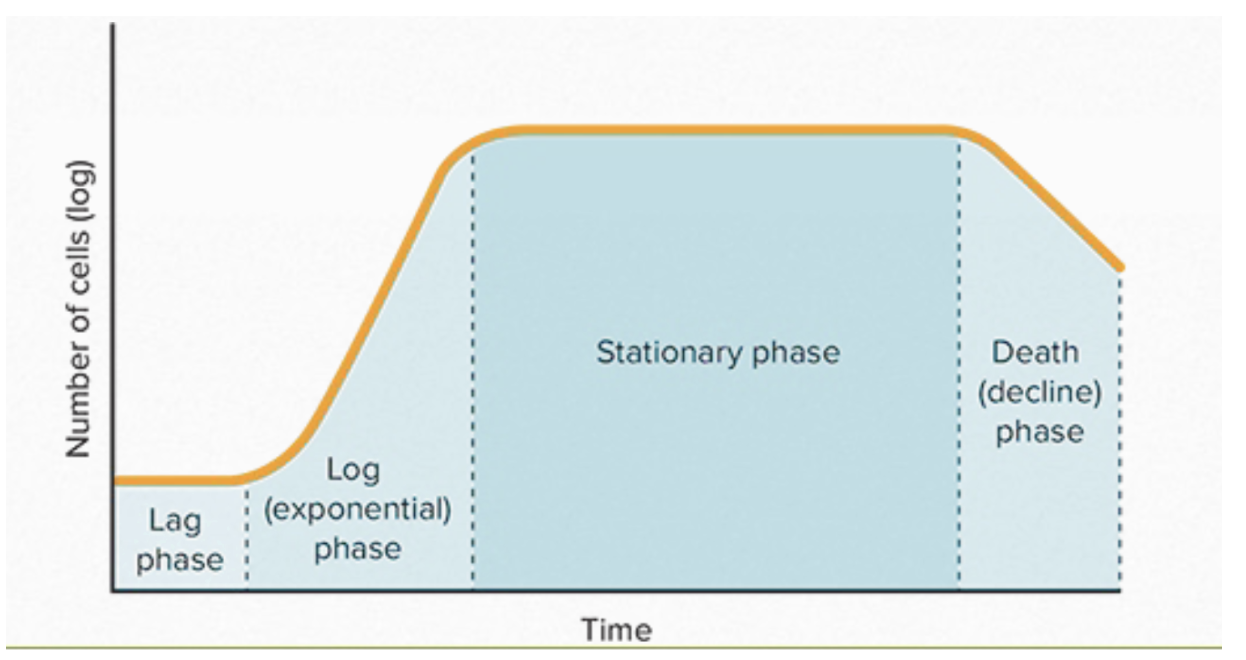
cell growth curve
protein production is OPTIMAl in LOG (exponential phase) = Most growth
cells harvested in stationary phase to maximize growth and minimize cell death
fermentation
requires control of conditions for cell growth and production
select cell line, culture media, growth parameters + optimize process
what provides control of conditions/environment for recombinant proteins?
bioreactors
bioreactors
contains everything after upstream process (culture + media)
maintain temp, pH, gas, etc
cells banks
master cell bank
working cell bank
master cell bank
produced from OG therapeutic producing cell line
under well-defined conditions
in ultra-temp (-80C) and vapor phased liquid nitrogen
pool of cells derived from single clone
if master bank is lost/destroyed, all validation for product must be —
repeated
working cell banks
derived from master cell bank
used in production of final biopharm product
can be obtained from master cell bank if lost