8.29 3D Structure of Proteins
 Call Kai
 Learn
Learn Practice Test
 Spaced Repetition
 Match
Match Flashcards
 Knowt Play
1/39

There's no tags or description
Looks like no tags are added yet.
Name | Mastery | Learn | Test | Matching | Spaced | Call with Kai | Chat |
|---|
No analytics yet
Send a link to your students to track their progress
40 Terms
Four levels of protein structure include definition
Primary: Single AA
Secondary: Spatial arrangement of the chain of peptides due to bond angles
Tertiary: Overall 3D arrangement, held via weaker interactions
Quaternary: Arrangement of 2+ polypeptide chains in a 3D complex
Planarity of the peptide bond restricts omega to ____ (____ peptide bond conformation)
180 degrees; trans
Four main secondary structures
Helices, Sheets, Turns, and random coils
phi psi vs omega angles
N-Ca vs Ca-C vs C-N
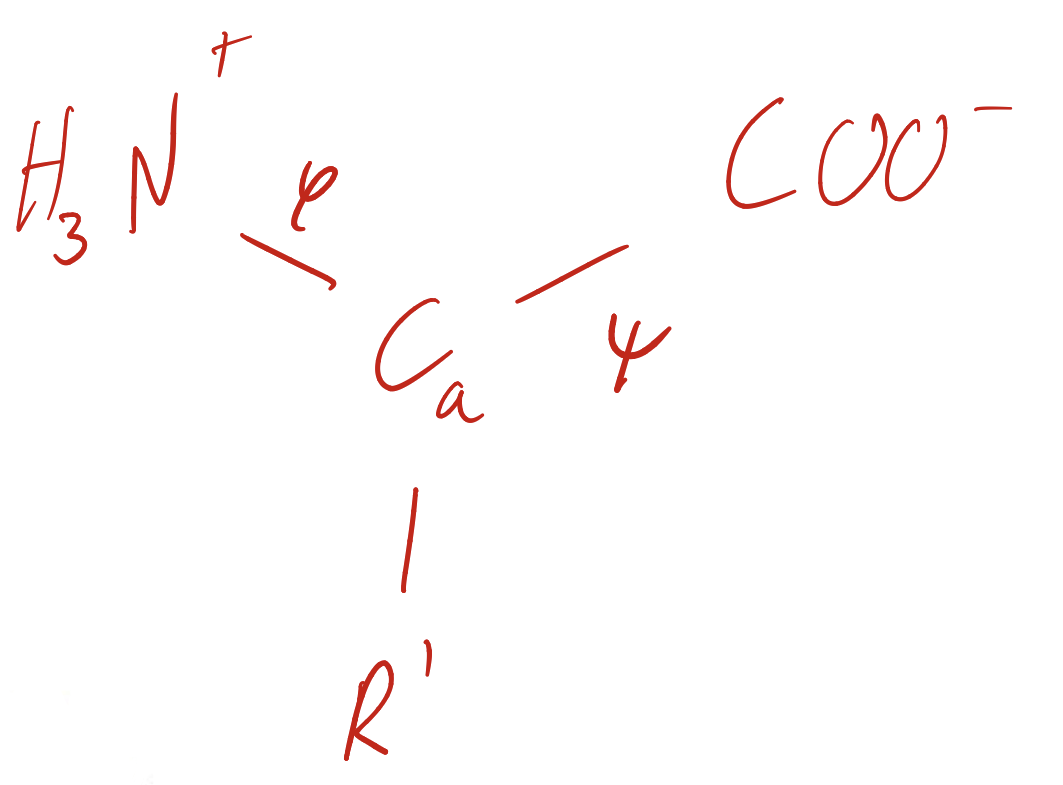
Peptide chain can rotate around the ___ and __ bonds.
phi and psi
Two principle secondary structural elements in proteins
alpha helix, beta strand (form sheets)
Helix is stabilized by ____ bonds between ____ ___ atoms
hydrogen; main chain
alpha helixes; R groups face where? Space between each turn; left or right handed
Simplest arrangement, max H-bonds, R groups face outwards, 3.6 residues, 5.4 A (0.54 nm); right-handed only
Amount of AAs between H-bonds
n + 4, H of N to O of C
Pauling and Corey (a-keratin)
most simple and elegant arrangement of a peptide chain is a right-handed (N-C) spiral conformation known as the alpha helix
Amino acid that is a helix breaker
proline
310 residues/turn; 310 # of atoms
3; 10
alpha residues/turn; alpha # of atoms
3.6; 13
pi residues/turns; pi # of atoms
4.4; 16
Flexible AA in helixes
glycine
Beta conformation; B-strand vs B-sheet
Zigzag, R group extends out of sheet; single protein segment vs several strand stacked together
Antiparallel vs parallel B-sheet
antiparallel has better orientation, straight H-bonds, more common; parallel is diagonal H-bond orientation so weaker and less common
B turns involve ___ amino acid residues in a ____ degree turn connecting segments of antiparallel B-sheets
Type I vs Type II turns
4; 180
Type I has Pro as residue 2
Type II has Gly as residue 3
__ and __ residues hydrogen bond in a beta turn
first and fourth
gamma turns involve ___ amino acid residues in a ___ degree turn and ___ is always the second residue
3; 180; proline
Crossovers are ______ observed in B-turns
rarely
In parallel B-sheets, the strands run in the ___ direction
same
In antiparallel B-sheets, strands run in ____ directions
opposite
Alpha Helix frequency of occurrence of an amino acid residue in secondary structure
Kristin Has Marvelous LACE Q-tips
Beta sheet frequency of occurrence of an amino acid residue in secondary structure
IVY For The Win
Reverse turns frequency of occurrence of an amino acid residue in secondary structure
SPDING
Which AA does not have a possibility of being in a alpha helix, beta sheet, and reverse turn
arginine
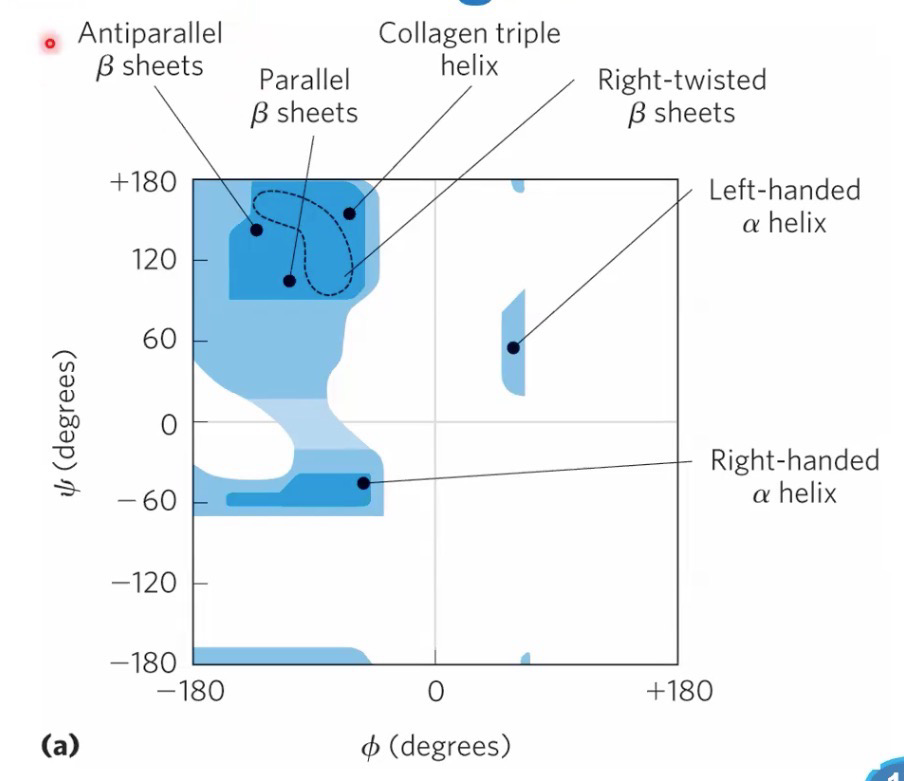
Rakmachandran plot
Shows phi and psi angles of each residue in a protein, describes secondary structure
Circular dichroism (CD) spectroscopy
Measures absorption of left-handed vs right handed polarized light
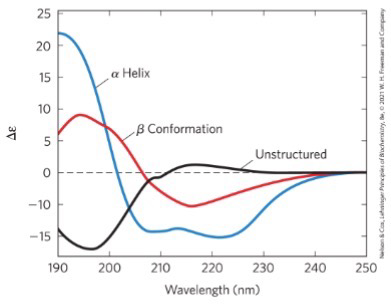
Chromophore
peptide bond
Four types of protein
Fibrous protein: Arranged in long strands or sheets
Globular protein: Spherical or globular shape
Membrane protein: Embedded in hydrophobic lipid membranes
Intrinsically disordered proteins: Lack a stable tertiary structure
alpha keratin, typical orientation of helixes, supertwisted helical orientation, end of each protein is Hydrophobic/philic; Crosslink stabilized by ________ bonds
right-handed, left handed, hydrophobic (A,V,L,I, M, F), disulfide
Collagen; found in __________ tissue; Secondary and Tert/Quart structure
connective tissue; Secondary is left-handed chain (not helix) (Gly, Pro, 4-HyP), right-handed turn of 3 separate polypeptides
Collagen Fibrils: Cross-linked by ________ bonds; Involving ___, _____, or ___
Covalent; Lys, HyLys, or His
Vitamin _ is needed for hydroxylation of ___ and ___ in collagen
C; Pro, Lys
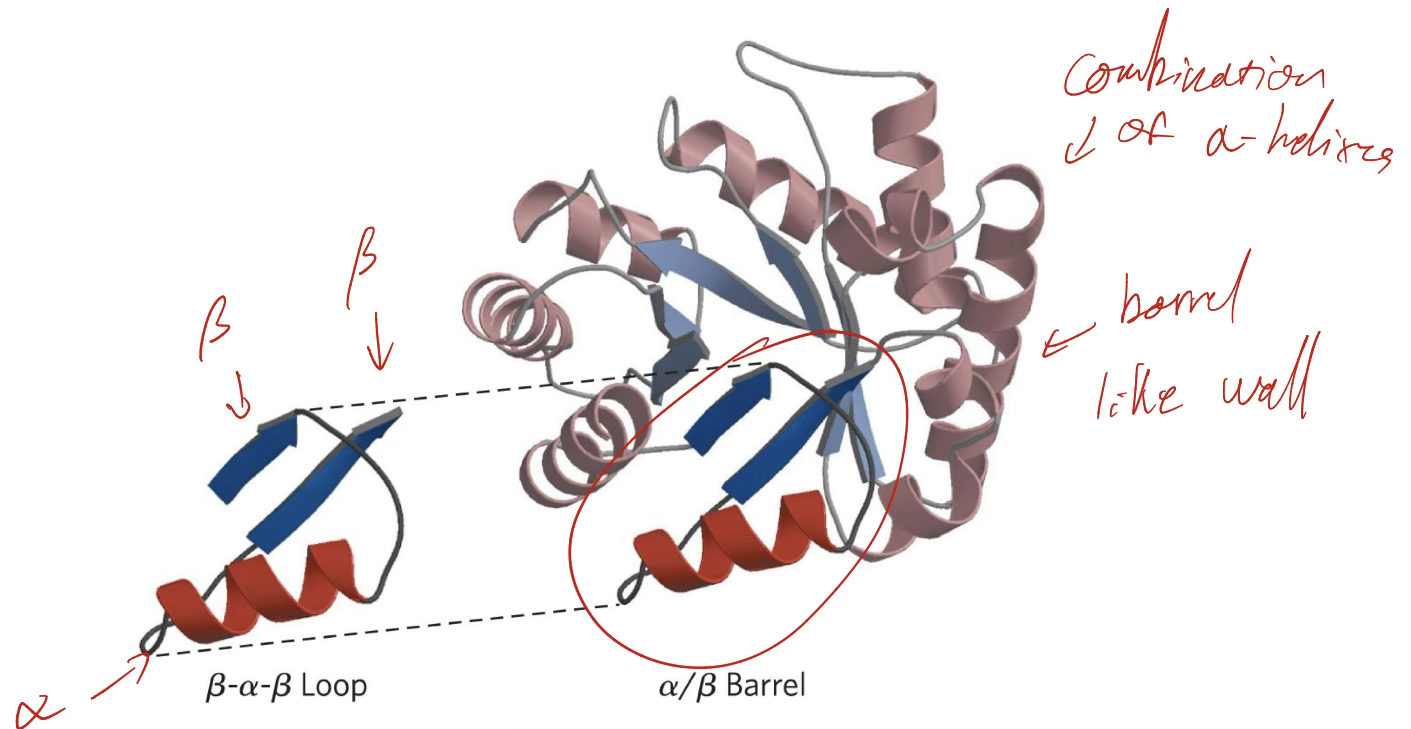
alpha/beta barrel
Series of beta-alpha-beta loops that forms a barrel
Intrinsically disordered proteins; lack _______ structure, often lacks __________ core, high density of _______ residues; helps facilitates a protein to interact with _______ binding partners; can assume different _______
definable; hydrophobic core; charged; multiple; structures
Topography diagram:
Represents secondary structure and relationship among segments
Protein family
similar in primary/tertiary structure
Superfamilies
2+ families that little seq similarity but same major structural motif and function