Earth Systems
 Call Kai
 Learn
Learn Practice Test
 Spaced Repetition
 Match
Match Flashcards
 Knowt Play
1/23

There's no tags or description
Looks like no tags are added yet.
Name | Mastery | Learn | Test | Matching | Spaced | Call with Kai | Chat |
|---|
No analytics yet
Send a link to your students to track their progress
24 Terms
Geosphere
Includes the rocks, minerals and molten rocks
Troposphere
Where weather occurs
Chemical weathering
CO2 in the atmosphere combines with rainwater → carbonic acid → breaks down minerals in rocks → bicarbonate → gets used by marine life in oceans
Carbon cycle
The transfer of carbon from the geosphere, biosphere and atmosphere
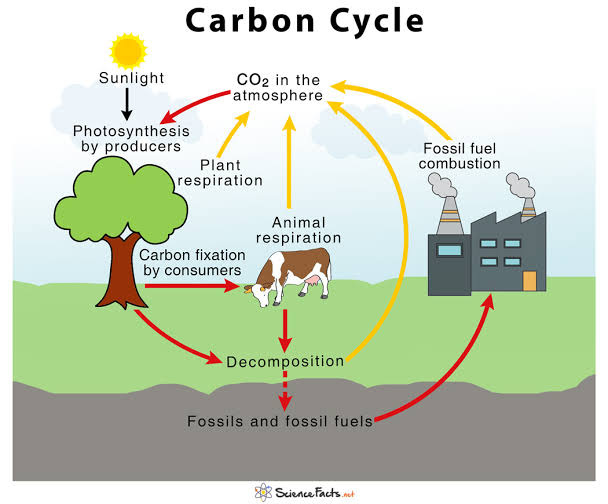
Stratosphere
Where the ozone layer is
Mesosphere
Where meteorites are
Sun
Shortwave radiation comes from the
Precipitation
The reverse of photosynthesis
Long wave radiation
Shortwave radiation that’s been absorbed and cooled down by earth’s surface to create
Water cycle
The hydrosphere and atmosphere are Responsible for this cycle
Greenhouse effect
Gasses in the atmosphere absorb the long wave radiation emitted by earth’s surface
Atmosphere
Responsible for protecting us from sun’s harmful rays and providing us with oxygen
Hydrosphere
Responsible for shaping rocks and land
Biosphere
Where photosynthesis is possible
Geosphere
Where volcanoes and earthquakes occur
Atmosphere
Encompasses all the gasses surrounding earth
Hydrosphere
Includes all the water under, on and over earth
Lithosphere
Is the hard shell surrounding earth and includes the 15 plates located on the crust
Asthenosphere
Located on the upper mantle, is malleable and under the lithosphere
Inner core
Made of solid iron and nickle
Outer core
Made of liquid iron and nickle
Mantle
Is mineral dense and contains magma has an upper and lower layer
Crust
Is the thinnest layer of earth and is divided into 15 plates
Tectonic plates
15 hard pieces of crust located on the lithosphere