Complex Genes
 Call Kai
 Learn
Learn Practice Test
 Spaced Repetition
 Match
Match Flashcards
 Knowt Play
1/32

There's no tags or description
Looks like no tags are added yet.
Name | Mastery | Learn | Test | Matching | Spaced | Call with Kai | Chat |
|---|
No analytics yet
Send a link to your students to track their progress
33 Terms
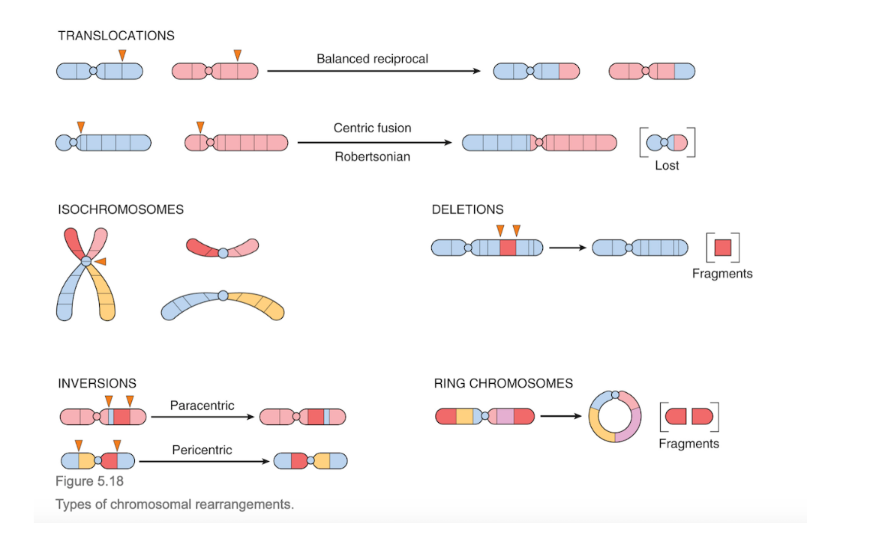
Describe Trisomy
What is it?
Common Cause
Trisomy
What is it?
Gain of single autosome
Common Cause:
Non-disjunction:
Failure of pair of chromosomes to separate during meiosis
STATs:
40-50% of chromosomal abnormalities identified in first trimester miscarriages
Describe Trisomy 21: Down:
3 causes
Characteristics/Predisposition
3 Causes:
95%: 21 (47 chromosomes)
4%: Translocation
1%: Mosaics
Mixtures of cells w/ 46/47 chromosomes
Mitotic nondisjunction
Characteristics
Intellectual disability
40% = congenital heart defects
(atrioventricular septal defects…)
High risk of leukemia
(20x increased risk acute lymphoblastic leukemia, 500x risk developing acute myeloid leukemia)
Pts >40 develop Alzheimer type changes
abnormal immune response -> serious infections
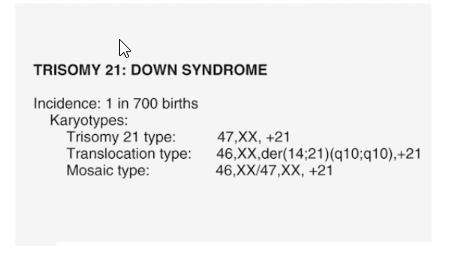
List the Symptoms associated w/ Down Syndrome
Symptoms:
flat facial profile,
Oblique palpebral fissure,
epicanthic fold
Altered neural maturation -> malformation in CNS and heart
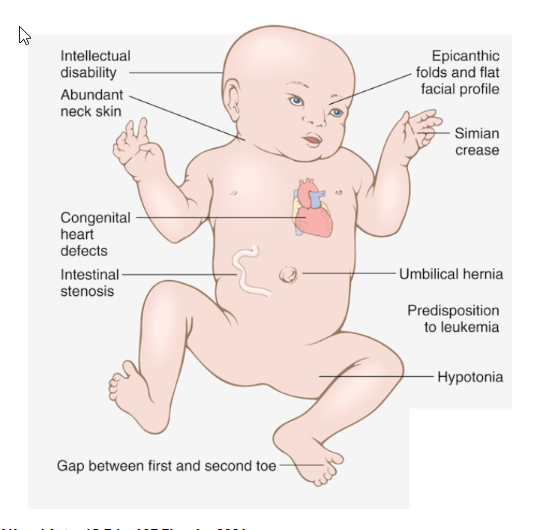
Differentiate between Robertsonian vs Translocation relative to cause of Down Syndrome
Robertsonian Translation:
Fusion of two acrocentric chromosomes
Long arm of chromosome 21 to another chromosome (usually 14)
chromosome count: 45
translocation trisomy 21:
Chromosome Count: 46
Higher recurrence rate in inherited cases
(mothers who have a translocation have higher risk of having a child with trisomy 21 than caused by non-disjunction)
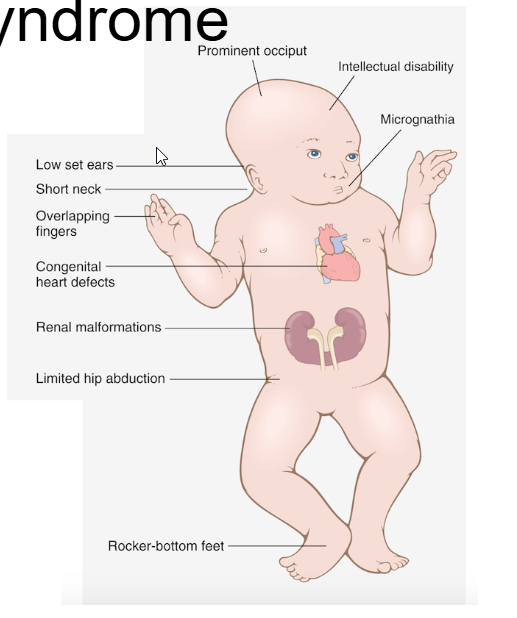
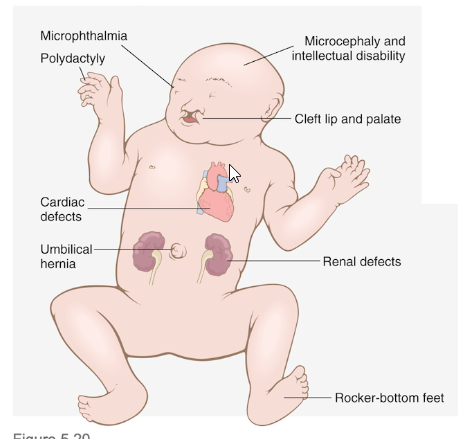
List the symptoms of Trisomy 18
Trisomy 18: Edwards Syndrome Symptoms
Growth + structure failure -> Heart/Limbs malformation
Growth restriction
Clenched fists
Rocker-bottom feet
List the symptoms of Trisomy 13: Patau Syndrome
Trisomy 13: Patau Syndrome
Midline patterning failure -> Brain, Face, Heart malformation
Holoprosencephaly
polydactyly
Describe Micro deletion Syndromes
What is it?
How?
Consequence?
Micro deletion Syndromes
What is it?
deletions of genes with predictable breakpoints
How?
Non-allelic homologous recombination
Recombination between non-alleles
Consequence:
50% gene dosage -> abnormal development
Describe Cri du Chat Syndrome
Deletion of?
Symptoms?
Cri du Chat Syndrome
Deletion?
5p
Symptoms:
Crying = cat meowing
Laryngeal and brainstem development genes
Intellectual disability
Loss of CTNND2 gene critical for neuronal development
Others:
microcephaly,
epicanthal folds,
low set ears
Hypotonia
Describe 22q11.2 Deletion Syndrome
Deletion of
Symptoms/Syndromes associated?
22q11.2 Deletion Syndrome
Deletion of?
30-40 genes responsible for clinical heterogeneity
Symptoms:
Malformations
face, heart, thymus and parathyroids
Velocardiofacial syndrome
outflow tracts,
facial dysmorphism
developmental delay
DiGeorge Syndrome
thymic hypoplasia w/ T-cell deficiency
parathyroid hypoplasia -> hypocalcemia
Due to failure of third and fourth pharyngeal pouch development
High risk for psychiatric illness
Describe Williams syndrome
Deletion of?
Symptoms?
Williams syndrome
Deletion of?
7q; ELN gene encodes for elastin
50% supravalvular aortic stenosis
Symptoms:
Characteristic facial appearance
sagging cheeks and wide mouth
small chin,
broad forehead
Small stature
Outgoing sociable personality
Mild-moderate learning difficulties
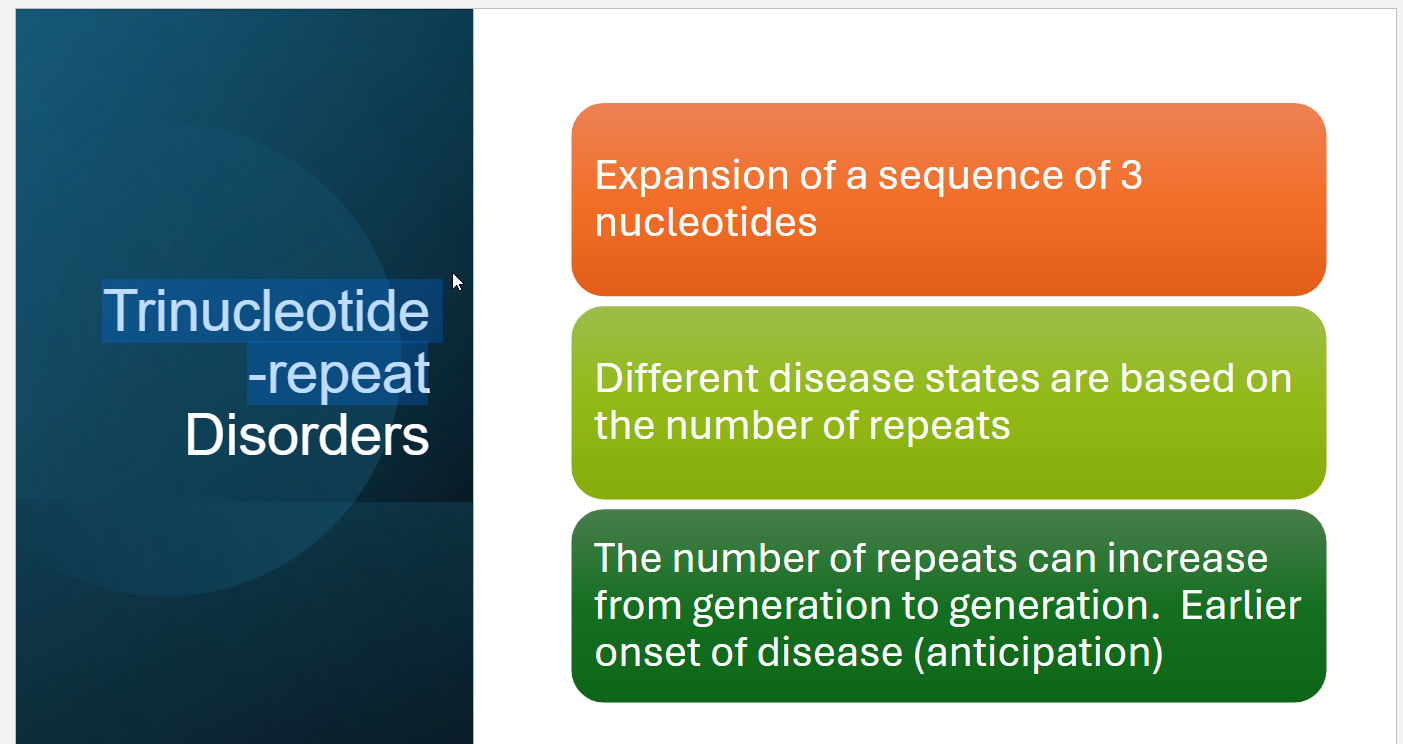
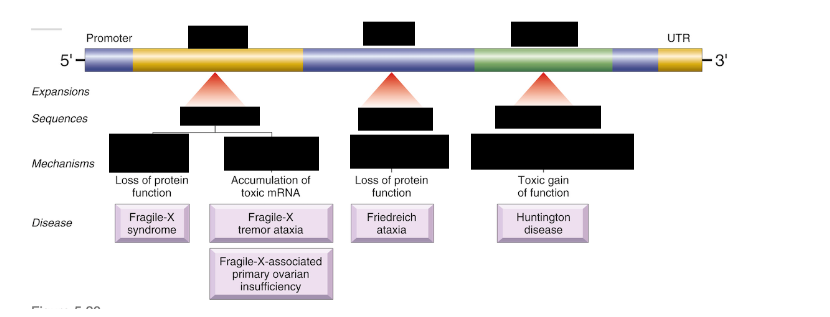
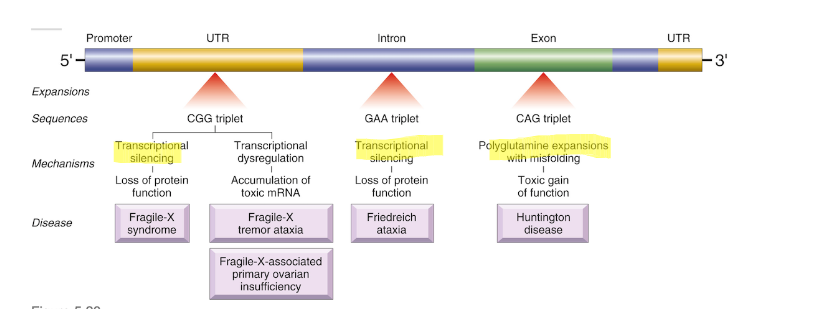
[REVIEW] Trinucleotide -repeat
Pathology?
Pathology:
Loss of function
-> epigenetic silencing
RNA Toxicity
Transcriptional dysregulation
Toxic gain of function
misfolded protein
Describe Fragile X Syndrome
Pathophysio
symptoms
Anticipation
Expansion numbers (Normal, premutation, full)
Describe the two syndromes linked to premutation of fragile X
Pathophysiology:
Trinucleotide expansion of CGG in FMR1
familial mental retardation 1 gene
FMR1 loss -> absence of translational repression -> excessive synaptic protein synthesis -> abnormal plasticity
Lies on X Chromosome
Symptoms:
long face w/ large mandible
large everted ears,
macro- orchidism
Int. disability
Aggressive + Autism
Anticipation:
symptoms worsens w/ each successive generation due to increased expansion
Oogenesis
Expansion
Normal: 29-55 CGG repeats
Premutation: 55-200 CGG repeats
> 200 CGG repeats full mutation
Premutation
Ataxia Syndrome
Progressive intention tremors
cerebellar ataxia -> Parkinson disease
Fragile X associated Primary Ovarian Failure
Premature ovarian failure before 40 years old
Describe Huntington Disease
Pathophysiology
Symptoms
Anticipation
Pathophysiology
Auto. Dom
Triple repeat (CAG) in huntingtin gene (HTT) -> misfolded proteins
Protein aggregation
Impaired transcription
Neuronal apoptosis
Symptom:
Striatum atrophy
progressive choreiform movement Disorders
psychiatric disturbance
dementia
Anticipation:
Repeat expansion occurs during spermatogenesis
Describe Friedreich Ataxia
Pathophysio
Symptoms
Pathophy:
Auto. recessive
trinucleotide repeat expansion (GAA) in frataxin gene
Frataxin protein = in mitochondria membrane -> iron accumulation -> rxt. O2 species -> Mit. DNA damage -> decreased ox. Phorphylation -> reduced ATP
Symptoms:
progressive ataxia,
spasticity,
weakness,
sensory neuropathy
Hypertrophic Cardiomyopathy
Unsteady Gait @ 10
Cardiac arrhythmias, CHF
Can’t walk w/in 5 yrs
Diabetes
pancreatic beta-cell dysfunction
Which organs have High/Low Threshold for mutant mit.
What is Heteroplasmy
Brain/heart has low threshold
Liver/kidney has higher threshold
Cells containing normal and mutant mitochondria are termed heteroplasmy
What does a mitochondrial disease pedigree look like?
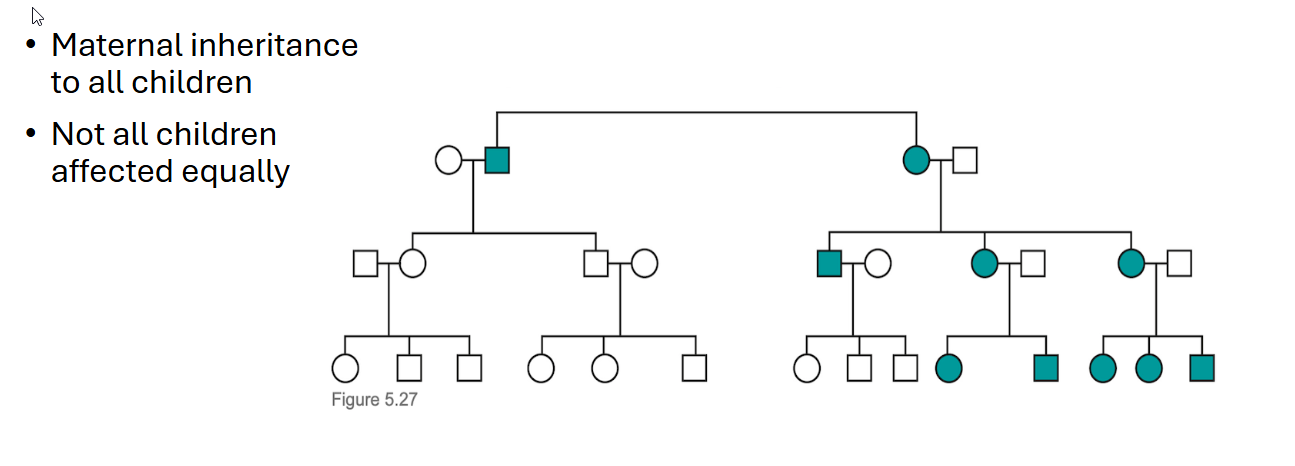
Describe MELAS
AKA?
Symptoms?
AKA:
Mitochondrial Encephalopathy w/ lactic acidosis and stroke-like episodes
Symptoms:
Initial development is normal
Affect children ages 2-10
target neurons
Energy disruption -> alt. Path + increased lactate levels
stroke-like neurological reversible deficits (hemiparesis)
Cognitive changes and muscle weakness
What are the symptoms of Myoclonic epilepsy with ragged red fibers
Symptoms:
Abnormal aggregates of mitochondria in skeletal muscle
myoclonic seizure disorder
Ataxia
due to neuronal loss
[REVIEW] Imprinting
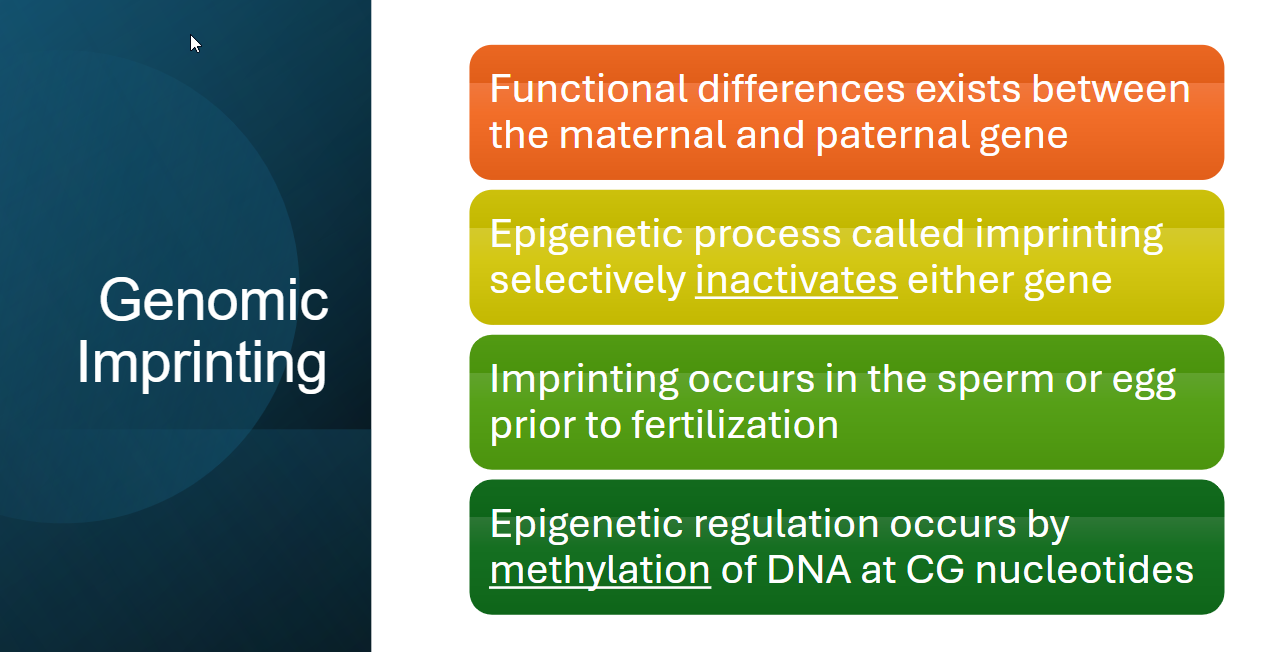
Differentiate between Prader-Willi Syndrome and Angelman Syndrome
Loss of which genes?
Symptoms?
Prader-Willi Syndrome
Loss of Genes:
Normally: 15q11 on maternal is imprinted
Abnormal: Loss on Paternal
Symptoms:
intellectual disabilities,
short stature
Hypotonia
Hyperphagia
small hands and feet
hypogonadism
Angelman Syndrome
Loss of genes:
Normally: 15q11 on paternal is imprinted
Abnormal: Loss of Maternal
Symptoms:
intellectual disabilities,
Ataxia,
Seizures
inappropriate laughter
Describe Beckwith-Wiedemann Syndrome
Pathophysiology
Symptoms
Beckwith-Wiedemann Syndrome
Pathophysiology
imprinted gene 11: IGF2 and CDKN1C Dysregulation
Symptoms:
Large Fetus (macrosomia)
Large tongue (macroglossia)
Hemi-hyperplasia (one side of the body grows more)
Abdominal wall defect (omphalocele)
Increased risk of developing embryonal tumors
(Wilms tumor and hepatoblastoma)
Describe Alzheimer Disease
Early Onset
Genetics
Pathophysiology
Late Onset
Pathophysiology
Early Onset: <65
Genetics:
Auto. Dom
mutations in APP, PSEN-1,PSEN-2 -> increase amyloid-beta production -> neurodegeneration
Pathophysiology:
Amyloid precursor protein: APP
Mutation = production of AB42 peptides (toxic)
-> early + aggressive amyloid accumulation (extracellular amyloid plaques)
Presenilin
Alters cleavage of APP -> increase AB42 production
most common early onset Alzheimer disease gene
PSEN-1
Late Onset: > 65 years
Pathophysiology:
Predisposition based on Apolipoprotein E (component of amyloid plaques)
APOE e4 – increases risk (one copy=2-3x, two copies=10-14x)
Decrease amyloid-B clearance
Increase AB aggregation
Increase Tau phosphorylation
APOE e2 – protective
APOE e3 - neutral
Describe Fanconi Anemia
Pathophysiology
Symptoms
Pathophysiology:
cannot repair DNA crosslinks -> increased chromosomal breakage -> bone marrow stem cell depletion
Symptoms:
Congenital Defects
Thumb/radial defects
Skin pigmentation: café au lait spots
Bone marrow failure
Age 5-10
-> aplastic anemia
Marked cancer predisposition
acute myeloid leukemia, myelodysplastic syndrome, head and neck carcinoma
Describe Neurofibromatosis Type 1
Genetics
Pathophysio
Symptoms
Neurofibromatosis Type 1
Genetics:
Auto. Dom
Loss of function mutation in the NF1 gene located at 17q11
High penetrance but variable expression
Pathophysio:
Neurofibromin = tumor suppressor -> inhibits Ras signaling.
Loss = Schwann cells proliferation and survival
Symptoms:
Seizures
~70-90%: brain lesion
intellectual disability
structural brain abnormalities
cortical dysplasia
abnormal neuronal migration
Lisch nodules
Pig. nodules on iris
cafe au lait spots
Neurofibromas
benign peripheral nerve sheath tumors
Describe Neurofibromatosis Type 2
Genetics
Symptom
Genetics:
Auto. Dom
Mutation in the NF2 gene located at 22q12
Codes for cytoskeleton protein merlin
Symptoms:
bilateral eight nerve schwannoma
multiple meningiomas
ependymomas of spinal cord
Describe Tuberous Sclerosis
Genetics
Pathophysiology
Symptoms
Genetics:
Autosomal dominant
TSC1 gene: hamartin
TSC2 gene: tuberin
Pathophysiology
Loss of TSC gene -> mTOR act. -> Cellular overgrowth + hamartomas formation
Symptoms:
Hamartomas and benign neoplasm of brain
(subependymal giant cell astrocytoma)
seizure, autism and intellectual disability
Describe Von Hippel-Lindau
Genetics
Symptoms
Genetics
Autosomal dominant
VHL = tumor suppressor gene
Symptoms:
Hemangioblastomas (vascular lesions of CNS)
Cysts that involve pancreas, liver, kidney
Renal cell carcinoma, pheochromocytoma
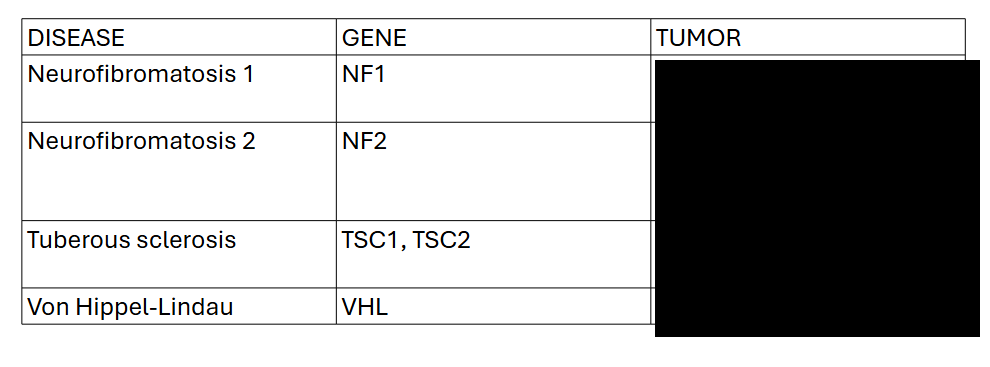
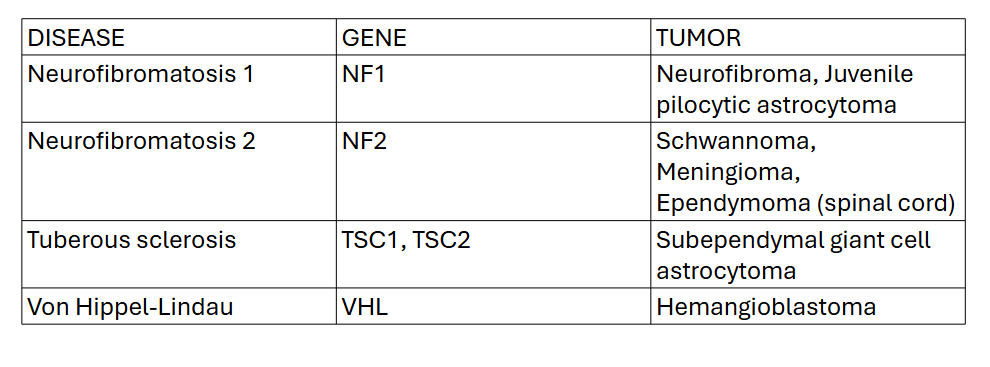
Describe Multiple Endocrine Neoplasia Type 1
Gene
Symptoms
Describe Multiple Endocrine Neoplasia Type 2a
Gene
Symptoms
Multiple Endocrine Neoplasia Type 1
GENE:
Auto. Dom
loss of function mutation in the MEN1
Tumor suppressor gene
Symptoms:
High risk for tumors:
Parathyroid hyperplasia
Hypercalcemia first manifestation
Pituitary adenoma (especially prolactinoma)
Pancreatic islet cell tumor (especially gastrinoma)
Multiple Endocrine Neoplasia Type 2a
Gene:
Auto. Dom
Gain of function in RET oncogene
Symptoms:
High risk for tumors:
parathyroid hyperplasia,
adrenal pheochromocytoma
Thyroid medullary carcinoma
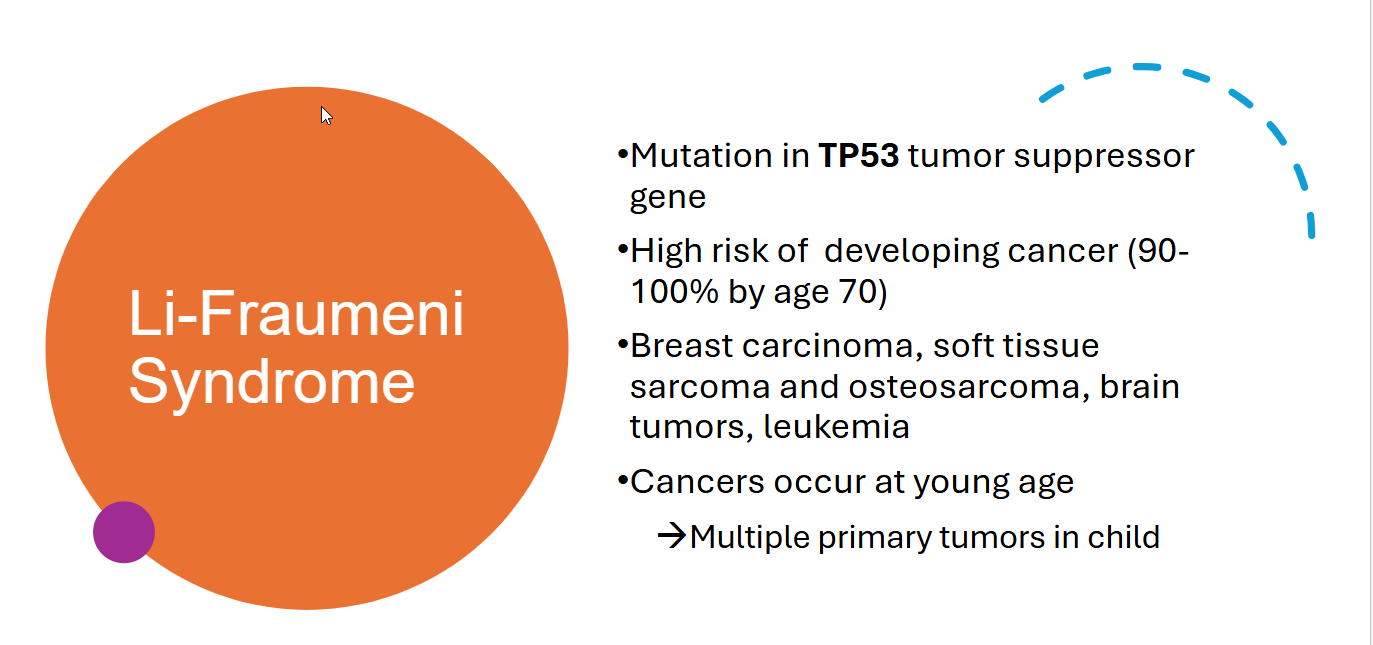
[REVIEW] Li-Fraumeni Syndrome