Water pollution W2
 Call Kai
 Learn
Learn Practice Test
 Spaced Repetition
 Match
Match Flashcards
 Knowt Play
1/51

Earn XP
Name | Mastery | Learn | Test | Matching | Spaced | Call with Kai |
|---|
No analytics yet
Send a link to your students to track their progress
52 Terms
Invasive alien species are considered…
the second greatest threat to global biodiversity after habitat loss (Earth Summit, Rio Convention 1992)
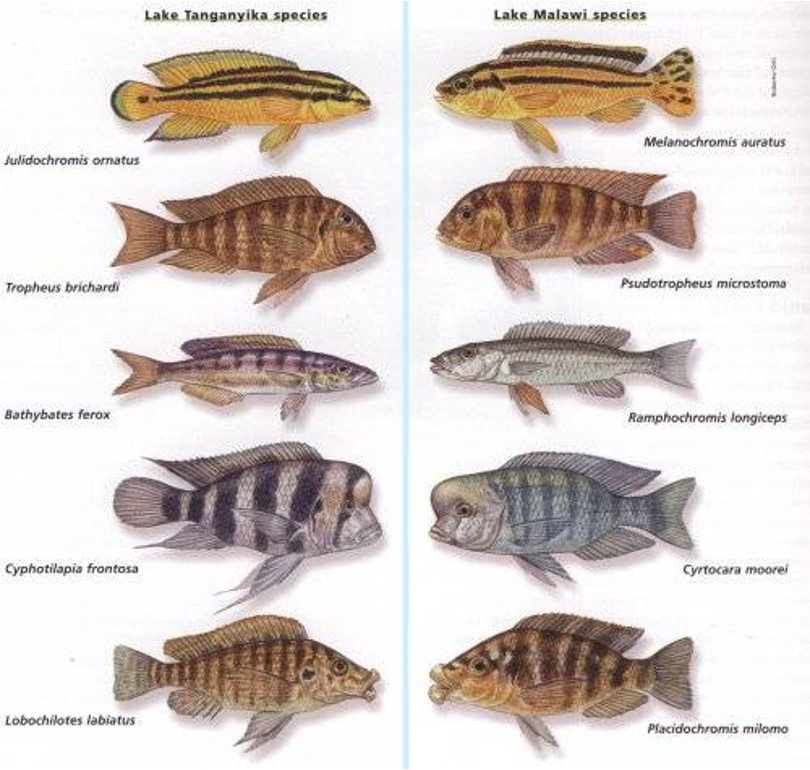
Cichlid family (fish) vs. Nile Perch
Endemic to three East-African lakes (Lake Victoria, Tanganyika, Malawi).
Three stage radiation allowed evolution of ecological + phenotypic diversity within a rapidly multiplying lineage.
1st stage: divergence of lineages into different major habitats
2nd stage: morphological specialisation - trophic differentiation within habitats.
3rd stage: sensory communication diversification
Intro of Nile Perch lead to loss of many endemic species, as it is a predator.
Future for lake Victoria now bleak.
Economics of Lake Victoria
Largest freshwater fishery in the world.
Major source of revenue in Tanzania, Kenya, + Uganda.
Uganda only country to enforce official controls on exploitation, + each factory must follow export quota.
Exports of fresh Nile perch have developed over last 5 years (long shelf life).
introduced species
organism not native to the place or area where it is considered introduced and instead has been accidentally/deliberately transported to the new location by human activity.
IUCN 2000 definition
“An alien species which becomes established in natural or semi-natural ecosystems or habitat, is an agent of change, and threatens native biological diversity”.
Invasive species
establishes successfully
reproduces successfully (rapidly, fecund)
capable of spreading efficiently
damaging
Japanese Knotweed (invasive species)
Introduced to UK in early 19th century by botanist, due to ornamental appearance.
It outcompetes other wildlife for water, light, + nutrients - hence destructing biodiversity.
Also causes damage to pipework, paved areas, tarmac + underground infrastructure.
Intro of non-native species in US
Over 50,000 species introduced —> $137 billion in damages each year.
About 42% of species on Threatened or Endangered species lists are at risk primarily because of non-indigenous species.
Direct impacts of invasive species
Disease, Predation, Hybridisation, parasitism, health hazard, Competition (interference).
Indirect impacts of invasive species
habitat alteration, economic loss, + competition (scramble)
Resource competition (scramble)
Number of organisms utilise common resources that are in short supply.
All individuals equally affected, no winners or losers.
Interference competition
Organisms seeking a resource harm one another in the process, even when resources are not in short supply.
There are winners and losers.
Ecological impacts depend on:
the invading species
extent of invasion
vulnerability of the recipient ecosystem
Hybridisation impacts
Interactions between invasive + native species during reproduction can result in severe impacts on native.
Erosion of native gene pools can lead to sterile offspring + decrease in population size
e.g. impact of invasive alien Mallard and New Zealand Grey duck
White clawed crayfish
Local distribution affected by availability of habitats and water quality.
Species in rapid decline due to releases of non-native crayfish e.g., Signal Crayfish, which was introduced for farming purposes and carries the crayfish plague.
economic impacts of non-native species introduction
US economic costs through damage to agriculture, forestry, fisheries, and other human enterprises estimated $137 billion per year.
Sea lamprey not controlled —> economic costs > US$ 500 million per year
Zebra mussel impact to Great Lakes = US$ 1 billion
Dutch elm disease costs Canadian economy $150 million
estimated that rabbits cost Australian farmers over $600 million annually in lost production
2 types of economic impacts
Market impacts (e.g., change in prices)
Non-market impacts (e.g., changes in ecosystem services)
Ecosystem susceptibility to invasion
suitable climate + habitat relative to invading species
limited assemblage of resident species = most susceptible to invasion . Lack of resident species decreases the number of potential competitors + predators.
probability that the species will successfully establish influenced by ecosystem
(island ecosystems more susceptible due to few predators + competition)
key traits of invasive species
weediness - species that can grow to reproductive maturity quickly + produce lots of highly dispersing offspring
strong competitor
ability to alter ecosystem e.g., nitrogen fixation
What has increased the likelihood of intentional/unintentional non-native species?
Rapid increases in volume of international trade + tourism
Sources of invasive species release for water/watersheds
ballast water, vehicular transportation, escaped ornamental plantings, fishing bait releases, illegal stockings, aquaculture escapes
pathways of entry of non-native species (unintentional)
transported commodities in commerce/international freight
ballast water, + hull fouling
passenger’s belongings, baggage, clothing
habitat alterations / canals
recreational activities
New Zealand flatworms
They prey on earthworms in UK —> deterioration of soil structure.
Believed to spread principally through movement of plant material + soil.
Zebra mussel
Brought into the Great Lakes, possibly on hulls or in ballast water of vessels from Europe. They filter out nearly all the phytoplankton and remove most of the food for filter feeders + microscopic zooplankton, which in turn supports larval + juvenile fish.
Habitat alterations/canals
Man-made canals + diversions have facilitated the intro of several fish species + some plants. Can accelerate spread of unwanted species.
pathways of entry of non-native species (intentional)
agriculture + horticulture
aquaculture
aquarium / ponds / amenity water
forestry
wildfowl + game stocking
fur farming
biological control
species conservation / education
research
pets, collection + domestic animal ( escape, release)
Rhododendrons
Scottish botanist amassed hundred of species of rhododendron, and other shrubs. Brought back c. 31,000 plant specimens.
Salmon farming in west coast of Scotland + Ireland
Cages consist of Atlantic salmon, which is native to UK, but the strains are not native, usually from Norway. Many concerns of environmental impacts (e.g., parasites + disease, genetic pollution, hybridisation )
Canadian pondweed
Invasive ornamental aquatic plant introduced to UK.
Forestry
Intro of fast growing non-native species such as European larch, Norway spruce, western hemlock.
Cane Toad
Example of biological control. Introduced to control pest species but have overpopulated Australia.
how to protect ecosystems from invasive species?
Intact ecosystems are best preventative measure against invasive species.
Safeguarding introductions
identify the risk e.g., potential pathways of intro
develop + use ‘codes of conduct’ to reduce this risk
strategies for pathway closure
interception of invasive species; regulations enforced with inspection + fees
treatment of material suspected to be contaminated with invasive species
prohibition of particular commodities in accordance with international regulations
public education to support prevention of introduced species
public awareness campaign DEFRA
Gyrodactylosis serious fish disease that infects skin, gills and fins of salmon, trout and other freshwater fish.
ballast water management
ballast water management
chemicals e.g., biocides, oxidising agents, non-oxidising biocides, ozone
heat treatment e.g., maintain water temp 35-45 degrees celsius
filtration e.g., filter water before it enters tank or as it is discharged
UV treatment
MAF Biosecurity New Zealand
Charged with leadership of biosecurity system. There to keep out, remove, or effectively manage the harm that pests or diseases can do to our economy, the environment and our health.
Invasive species specialist group (ISSG)
aims to reduce threats to natural ecosystems and the native species they contain by increasing awareness of invasive species, and of ways to prevent, control or eradicate them.
Wildlife and Countryside Act 1981
Offence to release or allow to escape, any non-native animal to the wild in Great Britain except under license issued by DEFRA. But does not place same restrictions on animals native to one part of country being moved outside their natural range.
EA banning use of live bait
Bans use of all freshwater fish as live bait or as dead bait in 14 of Great Lakes in Lake District. Anglers who don’t comply could face fines of up to £2,500.
EU ban wild bird trade
Made to limit spread of disease (e.g., bird flu)
Early detection
To detect invasions it is important to have baseline surveys + consistent monitoring programs in place. But monitoring expensive + time consuming.
Monitoring difficult if:
lack of financial resources
lack baseline data (how to monitor non-native of native species have yet to be described)
lack legal requirements to monitor or control
Key components of early detection:
community awareness + outreach
instruction of volunteer community support - preventative technique + control measures
communication of health and ecological risks associated with technique + measures
community support + political will
clear lines of authority for appropriate actions
decision support tools
monitoring of outcomes + analysis of success and failure
eradication
analysis of barrier to success + incentives
analysis of co-operation between countries in transboundary systems
engage local community
record results of attempted eradication
Coypu eradicated from East Anglia 1989
Introduced to fur farms in 1930s from South America. Early escapes, and they established in East Anglia, but a severe winter in 1946/47 killed most off. They dig large holes in banks + dykes, and also damage root crops. MAFF started campaign to limit Coypu to Norfolk Broads in their ‘heartland’. This only lead to increased spreading so resulted in eradication.
goals to control invasive species
contain species within geographic range
suppress the overall abundance down to some predetermine level
Mechanical control
highly specific
labour intensive
e.g., cutting trees, Lamprey trap (water)
Chemical control
effective in short term
high cost
often effects natives
health concerns
e.g., lampricides
Biological control
cost effective
permanent
self-sustaining
e.g., release of sterile males that outcompete wild individuals
the next generation of control: genetic tools
gene editing - identify a gene that could reduce fitness + insert into genome of invasive species
gene drive - genetic engineering propagates a particular suite of genes throughout a population by increasing probability that an allele will be transferred to offspring

