nervous system - EXAM 4!!!
 Call Kai
 Learn
Learn Practice Test
 Spaced Repetition
 Match
Match Flashcards
 Knowt Play
1/118

There's no tags or description
Looks like no tags are added yet.
Name | Mastery | Learn | Test | Matching | Spaced | Call with Kai | Chat |
|---|
No analytics yet
Send a link to your students to track their progress
119 Terms
nervous system
has nervous tissue
controls and coordinates with different systems of the body
cells in nervous system communicate with rest of the body cells by releasing certain chemicals or by electrical signals
response produced by ner sys is very quick to appear + dissappear and is specific
nerves
bundles of axons in PNS
tracts
bundle of axons in CNS!
func of nervous system + sensory inp + motor outp
func: receive all SENSORY INPUT /signals/infos , then send to brain, which interprets it, then send signals back to body as MOTOR OUPUT
—> **SENSORY INPUT: SIGNALS THAT GO FROM THE BODY TO THE NER SYS! - ANYTHING THAT GOES FROM BODY TO NER SYS
** MOTOR OUTPUT - SIGNALS THAT COME OUT OF NER SYS TOWARDS THE BODY! - ANY INFO THAT COMES FROM NER SYS TO BODY
sensory input **
SIGNALS THAT GO FROM THE BODY TO THE NER SYS! - ANYTHING THAT GOES FROM BODY TO NER SYS
motor output
** SIGNALS THAT COME OUT OF NER SYS TOWARDS THE BODY! - ANY INFO THAT COMES FROM NER SYS TO BODY
effector organs
parts of body affected by signals/message of brain/ner sys
INSERT FLOW CHART DIAG IN EMAIL HERE!!!
2 main divisions of ner sys
CNS - central ner sys (organs that sit in centre of body) + PNS peripheral ner sys (organs that sit away from centre)
2 parts of CNS **
BRAIN AND SPINAL CORD
PNS COMPONENTS /PARTS **
CRANIAL AND SPINAL NERVES
nerves is
cells of nervous sys ?? 8:43 voice 049
cranial nerves
nerves/cells that come out of brain and go back to brain
is part of PNS
spinal nerves
nerves that come out of spinal cord + go back to spinal cord!
is part of PNS!
PNS 2 divisions **
SENSORY (AFFERENT) NER SYS - BODY TO NER SYS (enter ner sys)
MOTOR (EFFERENT) NER SYS - NER SYS TO BODY
(exit ner sys)
SENSORY (AFFERENT) NER SYS 2 BIG PARTS
somatic sensory NS:
visceral sensory NS
somatic sensory NS **
ROUTE TAKEN WHEN INFO COMES FROM SKELETAL MUSCLES, JOINTS, BONES, SKIN AND GO TO NS!! **
voluntary parts - need signals from brain
division of sensory (afferent) NS
visceral sensory NS **
ROUTE TAKEN WHEN INFO COMES FROM SMOOTH MUSCLE, CARDIAC MUSCLE, ORGANS (VISCERA) AND GO TO NS!!!
involuntary parts - no need signals from brain!
division of sensory (afferent) NS
body divided into 2 TYPES OF parts
VOLUNTARY PARTS/SOMATIC ORGANS: skeletal muscles, joints, bones, skin - in control of em! - need signals from brain
INVOLUNTARY PARTS: smooth muscle, cardiac muscle, organs - dont’ need signals from brain cuz can work by itself, brain can only inc/dec activity!
MOTOR (EFFERENT) NS 2 divisions!
somatic motor NS
visceral motor NS/ AUTONOMIC ner SYS
info from ner sys towards body!
somatic motor NS **
** - route taken when info comes from NS to SKELETAL MUSCLES, BONES, JOINTS, SKIN!!! (volunt stuff)
** VISCERAL MOTOR NS
ROUTE TAKEN WHEN INFO FROM NS GO TO SMOOTH MUSCLE, CARDIAC MUSCLE, ALL ORGANS (involunt stuff - CAN ONLY INC/DEC THIS ACTIVITY)
smooth muscle, cardiac muscle, organs don’t need signals from brain: brain can only inc/dec the activitiy of these!
AKA AUTONOMIC/AUTOMATIC NS!!
AUTONOMIC/AUTOMATIC NS / VISCERAL MOTOR NS 2 DIVISIONS **
SYMPATHETIC NS
PARASYMPATHETIC NS
in autonomic ner sys, the organs are working independently so they dont need signals from brain : brain can inc / dec activity of organs, smooth muscle, cardiac muscle!
we up to voice 049: 29:54
sympathetic NS **
part of autonomic/automatic/ visceral motor ner sys that INCS activity of smooth muscle, cardiac muscle, organs (involunt
that stuff doesn’t need signals from brain to work, but brain can inc/dec the activity of ‘em!
is fight or flight ner sys!
parasympathetic NS **
part of autonomic/automatic/visceral motor ner sys that decs activitiy of smooth muscle, cardiac muscle, organs! (involunt
that stuff doesn’t need signals from brain to work, but brain can inc/dec the activity of ‘em!
is rest and digest!
mind map of ner sys org
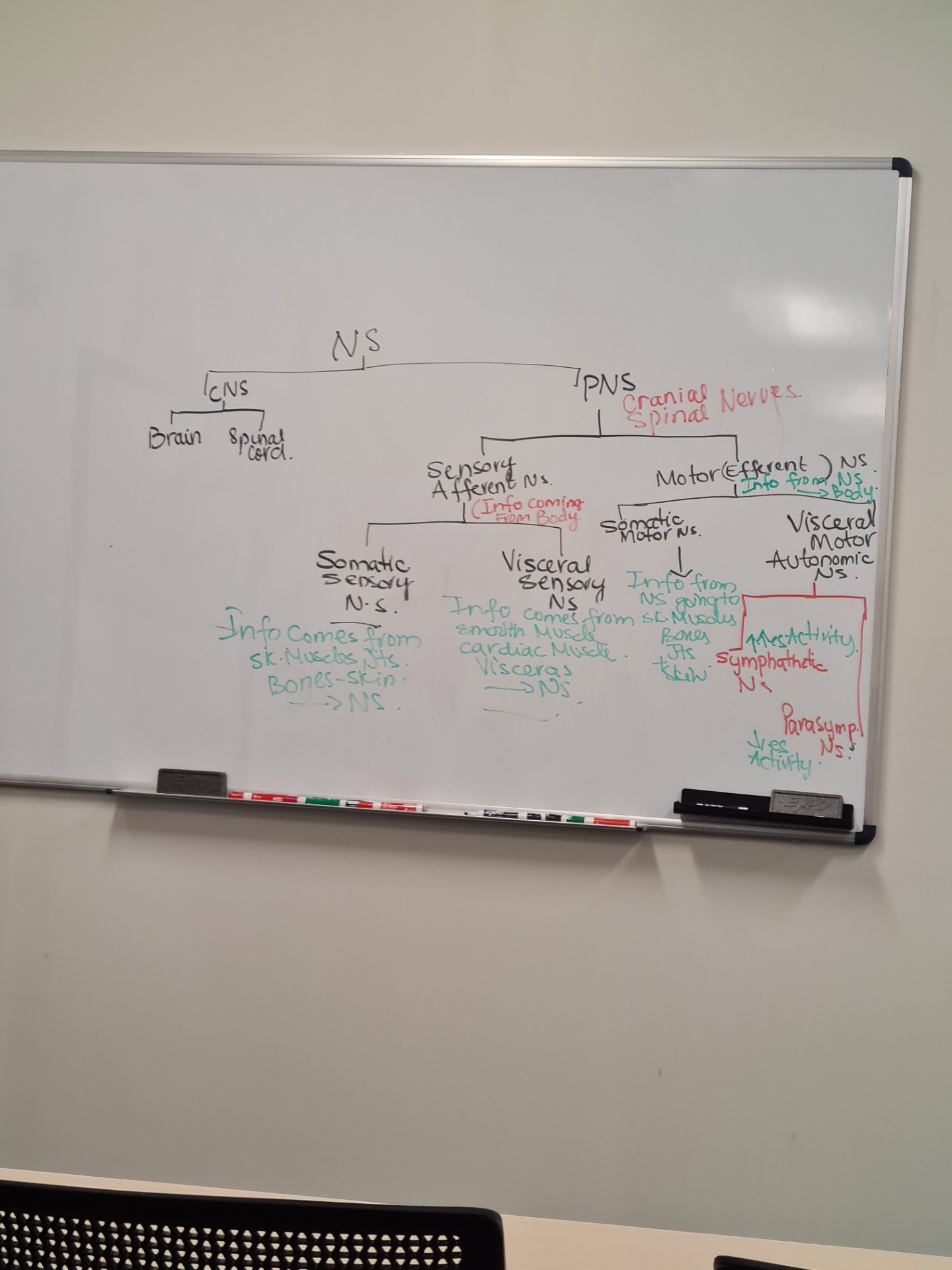
a brain dead/paralysed person…
can’t move their skeletal muscles cuz they don’t have the correct signals from the brain, but their heart still beats cuz is made of cardiac muscles that dont need signal from brain to function
ner sys is highly..
cellular
2 types of cell in ner sys
neurons (nerve cells) - is the acc cells responsible for sending (info to body) and receiving info (from body).
→ they communicate with the rest of body cells by release electrical signals + chemical signals (neurotransmitters)
neuroglia/neuroglial cells - helper cells of neurons that are glued to the neurons
6 types of neuroglia/neuroglial cells + whr they found!
• Astrocytes (CNS)
• Microglial cells (CNS)
• Ependymal cells (CNS)
• Oligodendrocytes (CNS)
-CNS- in brain + spinal cord
• Satellite cells (PNS)
• Schwann cells (PNS)
PNS - in cranial nerves + spinal nerves
neuroglia/neuroglial cells in CNS
• Astrocytes (CNS)
• Microglial cells (CNS)
• Ependymal cells (CNS)
• Oligodendrocytes (CNS)
AMEO
help neurons in brain and spinal cord
neuroglia/neuroglial cells in pns
schwann cells
satellite cells
help neurons in spinal + cranial nerves
ASTROCYTES **
MOST ABUNDANT!!!,
versatile, highly branched helper cells
attached to the neuron at one side and blood capilllary (bv) on the other side!
func: important role in EXCHANGE THINGS BETWEEN CAPILLARY(BLOOD) AND NEURON (take smth from neuron and give it to caplillary or take something from capillary + give to neuron!)
guide migrations (help in moving) of young neurons in brain and spinal cord
tell neurons where to go in the brain + spinal cord
control /maintain the chemicals that are produced by the neurons
(maintain chemical conditions in the brain + spinal cord
can receive and send info
support + brace the neurons
IN CNS
like satellite cells in PNS
MICROGLIAL CELLS **
small oval shaped helper cell with thorny processes that touch and monitor neurons
little nurses of brain and spinal cord
func: take care of any sick neurons,
—> but if neuron is too sick + can’t survive, microglial cell will eat up that neuron by phagocytosis cuz we don’t want any debris in the brain!
—> so, they clean up the brain
IN CNS
ependymal cell **
in CNS
is cuboidal/columnar cell
may have cilia on top of it
produces + circulates CSF
present in cavities of brain and spinal cord
oligodendrocytes **
neuroglial cell in CNS
func: produces myelin sheath covering/ memb over a part of neuron for protection
is like schwann cells in PNS
satellite cell
neuroglia in PNS
surround the body of neuron in PNS!
SAME FUNCS AS ASTROCYTES but just for cranial + spinal nerves (PNS)
func: important role in EXCHANGE THINGS BETWEEN CAPILLARY(BLOOD) AND NEURON (take smth from neuron and give it to caplillary or take something from capillary + give to neuron!)
guide migrations (help in moving) of young neurons in brain and spinal cord
tell neurons where to go in the brain + spinal cord
control /maintain the chemicals that are produced by the neurons
(maintain chemical conditions in the brain + spinal cord
can receive and send info
support + brace the neurons
schwann cells
same func as oligodendrocytes but the diff is that they do this func in the PNS (cranial + spinal nerves)
-produce myelin sheath over the neurons present in PNS
neurons
AKA nerve cells
are the actual cells making up brain + spinal cord + ner sys
large, highly specialized cells resp for sending + receiving info (nerve impulse/action potential)
3 parts of neuron
1: (cell) body
processes:
2: dendrites
3: axons
neuron cell body
AKA perikaryon/soma
func: is where all the chemicals (like neurotransmitters) + proteins for neurons are produced
it acc makes all these chems + prots too!
func: receives all info (receptive region)
—has rough ER + ribosomes called NISSL BODIES that produce proteins!
has nucleus + nucleolus in it !
is most important part!
nuclei - CHECK
neuron cell bodies in CNS
ganglia - CHECK
neuron cell bodies in PNS
neurofilaments + neurotubules
(is filaments that make) cytoskeleton in neurons
dendrites **
are short highly branched processes that are coming out from the cell body
the first part of the neuron that receives info!
info first comes to dendrites, which conveys it to cell body!
when info flows from dendrite to cell body, which are very close, we call THIS INFO GRADED POTENTIAL!!
GRADED POTENTIAL IS SHORT MESSAGE FROM DENDRITE TO CELL BODY
axon **
is a long, cytoplasmic, ALWAYS SINGLE process
ONLY 1 AXON IN EACH NEURON
most imp func: CONDUCT MESSAGE AWAY FROM THE CELL BODY
—→ TAKE INFO FROM THE cell BODY AND WILL CONVEY IT TO OTHER CELL OR ANYWHERE ELSE
parts of axon
axolemma
axoplasm
axon hillock
telodendria
axon terminal
axolemma
plasma memb of axon
axoplasm
cytoplasm of axon
axon hillock
initial part where axon is coming out of the body!
cone-shaped beginning part of the axon arising from the cell body
func: to take info from cell body and convey it to another neuron
axon terminals
end tips (they are knob/button-like) of the telondendria
—> (telodendria is end branches of axon)
telodendria
end branches of axon- they end in knob / button like terminals called axon terminals
2 directions of movement in axons + defines **
anterograde movement : when things move forward (foreward movement of things) - from cell body towards axon terminals
→ things that do this are proteins + neurotransmitters
retrograde movement: (backward movement of things) from axon terminals towards cell body
→ Things that do this are virus + bad cells/ organelles that will be killed that will be killed by the lysosomes in the cells body
good things move forward, bad thing move backwards
myelin sheath **
made by oligodendrocytes in CNS (brain + spinal cord)
made by schwann cells in PNS
myelin sheath is a protective insulated covering only seen around axons of neurons!
func: cover, protect, insulate, and increase the speed of message conduction on the axons!
is made up of fat/lipids , which does not take any colour or stain, so it appears white!
myelin does not take any colour or stain, so it will appear white!
—> myelin only present covering the axons of the neurons!!
white matter **
appear white cuz myelin dont take any stain
regions of brain and spinal cord that have myelinated axons!
cell bodies + dendrites…
can take any stain! - usually take grey stain!
grey matter **
area of brain/spinal cord with UNMYELINATED cell bodies + dendrites
—> can take any stain, but usually take grey stain!
myelin sheath gaps/ nodes of ranvier!
breaks/ spaces in myelin sheath
demyelination
when myelin sheath, due to some reason, is not formed on the axon or it disappears!
2 reasons demyelination could occur **
diphtheria - disease in which Schwann cells of the PNS are dead, then due to a diseasse, bacteria eats those Schwann cells and we lack myelin sheath on axon - seen in PNS
MULTIPLE SCLEROSIS (MS) : autoimmune disease in which there is demyelination (loss of myelin sheath), oligodendrocytes affected
(destroys myelin in the CNS)
—> it is seen in CNS
—> can affect your speech, vision, balance, bladder control, all skeletel muscle movements!
classifics of neurons based on structure
multipolar
bipolar
unipolar
based on processes (dendrite + axon)
multipolar **
multiple dendrites, 1 body, 1 axon
(multiple processes)
MOST COMMON IN CNS (BRAIN + SPINAL CORD)
bipolar
1 dendrite, 1 axon come out from cell body
is very rare, but we see them in special sense organs: in eyes + nose + tongue
E.G. RETINA, OLFACTORY MUCOSA (sense of smell in nose)
unipolar
1 body + only 1 process!
one branch(process) can act as axon, one branch (process) can act as dendrite
see in PNS! only
—> ALL SENSORY NEURONS TAKING INFO FROM THE BODY TO GO TO BRAIN ARE UNIPOLAR (according to shape)!!
types of neurons based on which direction they transmit info!
sensory neurons (Afferent
motor neurons (efferent)
interneurons (connecting)
sensory neurons (afferent) + subtypes
take info from body (to brain and spinal cord)???
2 subtypes:
→somatic sensory neurons: neurons that take info from skeletal muscles, bones, joints, skin + go to NS (brain)
→ visceral sensory neurons: neurons that take info from smooth muscle, cardiac muscle, organs + go to NS (brain)
motor neuron (Efferent)
take info from brain + spinal cord towards body (periphery!)
somatic motor neurons - neurons that take info from NS + go to skelet muscles, joints, bones, skin
visceral motor neurons - neurons that take info from NS + go to smooth muscle, cardia muscle, organs!
receive info is…
sensory
take info back..
motor
interneuron
take info from brain + give it to body / take info from body + give to brain
they are in between! - they connect!
moat important electrolyte + charge in the cell
is potassium
- is negative
plasma memb keeps this difference of electricity + keeps this difference of electrolytes
charge + electrolyte abundant outside the cell
positive excitatory charge
sodium
plasma memb keeps this difference of electricity + keeps this difference of electrolytes
when plasma memb keeps this difference of charge + electrolytes in and out it is called…
RESTING MEMBRANE POTENTIAL!/ RESTING CONDITION OF THE CELL/POLARIZED STATE/POLARIZED CONDITION
whenever you want to send a special message inside the cell. (e.g. contract muscles).
you need to change this resting condition!
normally, sodium is not allowed to enter inside the cell cuz it is a very excitatory electrolyte! - but it is coming and leaving thru sodium-potassium pumps cuz things always want to move from whr they high concent to low concent
—→ so cuz of this sodium will enter cell and potassium will move out of cell! continuously due to difference in concent —> cuz we have no sodium in + no potassium out!
—> to reverse this, we have sodium potassium pumps that will throw sodium out + bring potassium back in- need energy - this goes on 24/7 + does not affect resting condition of the cell!
to change this resting condition (cuz u want to contract muscles etc.) , plasma memb should allow sodium to enter activation gates
YOU CALL THE MESSAGE THAT IS COMING INSIDE THE CELL AS ACTION POTENTIAL
when sodium enters into cell, it means cell is excited; has received info from outside
activation gates/chemically gated channel
gates thru which sodium will enter to excite the cell
gated channels/chemical gates
special gates that will ONLY open when neurotransmitter is released on plasma membrane
chemically gated channels/chemical gates:
doors that will open when some chemical (e.g. acetylcholine acting on t tubules to allow sodium to enter) act upon ‘em!
chemically gated channels in muscle contraction
gates on which chemical acts and sodium enters inside the cell!
e.g. T tubule is one!
voltage gated channels
open when there is change in electricity
leakage gates
gates thru which sodium + potassium is continuously entering + leaving (e.g. sodium-potassium pump)
mechanically gated channels
Open and close in response to
physical deformation of receptors,
as in sensory receptors
ACTION POTENTIAL
a mean by which cell receives + conducts message
special gates in plasma memb
called gates / channels
they will change their state of mind + allow some electrolytes to enter and leave the cell!
if you want things to enter and leave the cell..
need to change the permeability of the plasm a memb so it can allow things to enter
in a resting cell you do not want..
sodium to enter inside and potassium to leave cuz cell loves potassium but cell does not like sodium inside
what is responsible for negative charge inside cell
is the protein channels
voltage inside resting memb potential cell/polarized state of cell
- -90- -70
what maintains internal resting condition of cell
sodium-potassium pump 24/7
amount of sodium going out and potassium going in ** - sodium-potassium pump!
3 sodium out 2 potassium in
when sodium enters inside the cell by opening special chemical gates you call these gates…
chemically gated channels cuz activated by acetylcholine
what is an action potential
long distance messages sent by neurons to other neurons or to the other cells of the body!
AKA nerve impulse
what maintains resting condition of cell
plasma membrane
resting condition of cell/polarized state of cell
potassium inside, no sodium, negative charge inside
sodium outside, no potassium, positive charge outside
when you want to send message inside cell - simplified
we want to reverse resting condition
we need to open chemically gated channel whr chemicals can act on plasma memb + allow sodium to enter inside the cell
when sodium enters inside cell by open special gates, it changes the negative resting condition to pos
—> voltage can go from -10 to +50-+70 mV
cuz cell is no longer in polarized condition, is excited, has sodium inside as DEPOLARIZED STATE
depolarized state of cell
we call this condition in which sodium enters thru chem gated channels + excites the cell - converts neg cell charge to pos cell charge
means cell has received info from brain - is ready to contract!
cell is not resting, cell is excited
change voltage from -10 mV to +60-+70mB
REPOLARIZATION/REPOLARIZED STAGE
state in which cell wants to relax (reachieve resting cond) so:
when sodium leaves the cell again after having done its job + cell throws potassium outside - so cell can regain max resting conditio
HYPERPOLARIZATION
a time will come where we will not let potassium in!!!!!
action potential stages
polarization
depolarizaton
repolarization
hyperpolarization
1:11:24 NER SYS PT 2 FOR ANALOGY FOR ACTION POTENTIAL
threshold / all or
the voltage/chemcals/messgae should be strong enough so action potentials can occur/message will be conducted inside
if the voltage/chemicals/message are weak, action potentials will not occur/message will not be conducted inside
all or none
the voltage/chemcals/messgae should be strong enough so action potentials can occur/message will be conducted inside/sent
if the voltage/chemicals/message are weak, action potentials will not occur/message will not be conducted inside/sent
SEND OR DO NOT SEND