Disorders of the Immune System
 Call Kai
 Learn
Learn Practice Test
 Spaced Repetition
 Match
Match Flashcards
 Knowt Play
1/77

There's no tags or description
Looks like no tags are added yet.
Name | Mastery | Learn | Test | Matching | Spaced | Call with Kai | Chat |
|---|
No analytics yet
Send a link to your students to track their progress
78 Terms
autoimmune diseases
cause by activation of self-reactive helper T-cells due to lack of self tolerance; types: cell mediated and Ab-mediated (most common)
hypersensitivity
autoimmune reactions such as lupus, Grave's, myasthenia gravis, RA, MS
development
factors that influence autoimmune disease _________________________:
-genetics (HLA)
-hormonal factors (90% occurs in women, probably due to estrogen)
-environmental: bacteria or viruses, drugs, or heavy metals
multiple sclerosis
autoimmune disorder in which autoreactive T-cells and activated macrophages cause demyelination of the white matter of the brain
insulin-dependent diabetes melitus
autoimmune disorder in which autoreactive T-cells destroy the islets of pancreas
guillain-barre syndrome
autoimmune disorder that is the most common cause of acute paralysis in the US; produces antibodies against myelin
crohn's disease and ulcerative colitis (IBD)
autoimmune disorder in which there is chronic inflammation of the ileum caused by abnormal immune response to normal GI flora
Rheumatoid arthritis
autoimmune disorder in which autoantibodies against IgG called rheumatoid factor
rheumatic fever
autoimmune disorder in which antibodies against the M protein of group A strep which cross reacts with myosin of the heart
congenital
immunodeficiency disorders that are innate; rare and poorly understood genetic disorders
-thymic dysplasia
-X-linked hypogammaglobulinemia
-primary T and B-cell deficiencies
-complement deficiency
-phagocytic dysfunction
secondary
immunodeficiency disorders due to acquired disease:
-HIV/AIDS (CD4)
-malignancy - Hodgkin's Lymphoma, bone marrow
-irradiation
-immunosuppression drugs
-liver disease, diabetes
B-cell deficiencies
symptoms: recurrent infections with pyogenic bacteria (staph) - otitis media, pneumonia
ex: hypogammaglobulinemia - very low levels of Igs and absence of B-cells
IgA deficiency - recurrent sinus and lung infections
T cell deficiencies
symptoms: recurrent infections with fungi, viruses, protozoa
ex: thymic aplasia (DiGeorge's syndrome) - thymus fails to develop properly
Combined B and T cell deficiencies
symptoms: recurrent infections caused by bacteria, viruses, functi, and protozoa occur in infancy
ex: SCID - T and B cells are absent or very low numbers, hereditary
phagocyte deficiencies
cell deficiency: severe infections (bacterial and fungal) are common
complement deficiency: susceptibility to a variety of infections to increase in autoimmune disease incidence
codominant
A and B genes that encode for specific sugars on surface of RBCs are _______________
transfusion
___________________ reaction due to antigen-antibody reaction is a type II-cytotoxic hypersensitivity reaction
O
universal donor blood type; has anti-A and anti-B antibodies
AB
universal recipient blood type - does not have antibodies against A or B
A
blood type with A antigen and anti-B antibody
B
blood type with B antigen and anti-A antibody
erythroblastosis fetalis
result of passage of maternal IgG anti-Rh antibodies through the placenta to the fetus, causing lysis of fetal erythroblasts
Rho-Gam
high titer Rh immune globulins given to mother at 28 weeks of gestion and upon delivery; prevent Rh+ erythrocytes form acting as sensitizing antigen so erythroblastosis fetalis does not occur
+, -, second, +
erythroblastosis fetalis is only a concern if the father is Rh______, the mother is Rh_______, and the ___________ child is Rh_______
first
even if the father is Rh+, the mother is Rh-, and the ___________ child is Rh+, there is no risk for erythroblastosis fetalis
MHC I
glycoproteins responsible for recognition of self and non-self; found on the surface of virtually all nucleated cells
MHC II
glycoproteins recognized by T helper cells that will activate cytotoxic T cells to attack donor tissue
HLA (human MHC)
human leukocyte antigens; alloantigens; genes are clustered in the MHC
autologous graft
graft in which donor and recipient are the same person; don't require any immunosuppression because the graft is coming from the person's own tissue
syngeneic graft
graft in which the donor and recipient are identical twins
allogenic graft (allograft)
graft in which the donor and recipient share similar HLA types and same blood type (most common)
xenograft
graft in which the donor and recipient are different species (ex: pig --> human)
CD8 T cells
play the most important role in transplant rejection; reactions cause killing of allograft cells when foreign MHC activates immune response
necrosis
develops from transplant rejection of untreated
HLA
better _________ match between donor and recipient = longer graft survival
GVH (graft versus host disease)
occurs when a graft contains immunocompetent T-cells from the donor, the host is immunocompromised, and the host expresses antigens foreign to the donor causing the donor T cells to attack the host
T cells
to prevent GVH, treat donor tissue prior to transplant to eliminate mature __________ from the graft that will attack recipient tissue
calcineurin inhibitors
Cyclosporine (Neoral, Sandimmune, Gengraf)
Tacrolimus (FK506, Prograf)
mTOR inhibitors
Sirolimus (Rapamycin, Rapamune)
antiproliferative agents
Azathioprine (Imuran)
Mycophenolate mofetil (Cellcept)
corticosteroids
prednisone (Deltasone)
T lymphocytes
rejected graft tissue is highly infiltrated by ______________________
calcineurin inhibitors (cyclosporine and tacrolimus)
Inhibit calcineurin-dependent dephosphorylation: results in no IL-2 transcription which means no proliferation of T cells

tacrolimus (Prograf)
macrolide lactone antibiotic; decreases expression of IL-2 and therefore decreases T-cell proliferation; approximately 100-fold more potent than cyclosporine and 10-fold more potent inhibiting T cell activator
Used to prevent and treat acute rejection
prevent, treat
Cyclosporine and Tacrolimus can both be used for _________________, but only Tacrolimus is potent enough to _____________ acute rejection
Sirolimus (Rapamycin, Rapamune)
macrolide antibiotic; acts specifically by binding the TOR protein kinases which prevents cell cycle progression by blocking the ability of T cells to proliferate in response to IL-2 stimulus; used in prevention of acute rejection
pharmacologically different from both CsA and Tacrolimus
cannot
Cyclosporine and Tacrolimus __________ be mixed because the have the same mechanism of action, but they can be taken at the same time as Sirolimus
synergistic
sirolimus is _____________ with calcineurin inhibitor: in combination with cyclosporine and steroids
Mycophenolate mofetil (CellCept)
semisynthetic derivative of mycophenolic acid from fungus; inhibit de novo purine synthesis by inhibiting the enzyme inosine monophosphate dehydrogenase (IMP) that is crucial for purine synthesis
reduces or stops T and B lymphocytes proliferation by blocking the formation of GMP - prevents nucleic acid synthesis
IMP dehydrogenase
mycophenolate mofetil (CellCept) inhibits ______________________________, preventing the proliferation of B and T cells (blocks purine synthesis)
6-mercaptopurine (Purinethol) and azathioprine (Imuran)
reduce or stop T and B cell proliferation by interfering with purines on DNA or RNA
steroids
used for almost all transplant patients (paired with other drugs); very safe and specific to T-cells; lipophilic drug targets nuclear receptors (transcription mechanism of action); causes T-cells to undergo apoptosis
tumor
____________-specific T-lymphocytes and antibodies detected in patients with cancer; able to evade immune response by secreting immunosuppressive cytokines and downregulate MHC-I
inhibiting
cancer drugs work by ___________________ the hiding of tumors from our immune systems
escape
mechanisms of tumor ________:
-engagement of inhibitory molecules (CTLA-4, PD-1)
-secretion of immunosuppressive cytokines
-loss of tumor antigen expression
-downregulation of MHC-I
cancer
cells involved in __________ immunology:
-innate: NK, macrophages, DCs
-adaptive: T cells
vaccination
use of inactivated whole germs (pertussis, influenza, Polio), close relative (tuberculosis-BCG) or component antigens (Tetanus, diphtheria, hep A and B) to develop immunity to pathogens. Goal is to provide long-lasting and protective immunity
1 billion
it is estimated that vaccines have saved more than __________________ lives
herd immunity
the resistance to the spread of a contageous disease within a population that results if a sufficiently high proportion of individuals are immune to the disease, especially through vaccination
attenuated
use of ___________ organisms reduces pathogenicity which can stimulate protective immunity but not cause disease; relies on replication within host cells, generating both T cell and Ig immunities.
immunocompromised
Attenuated vaccines provide excellent immune responses but are dangerous for __________________ patients
inactivated
vaccine that uses killed or purified components of organisms (proteins, mRNA, adenovirus) that would be as effective as live whole organisms
desirable because it is safe for immunocompromised patients and is stable upon storage
adjuvant
enhances immunogenicity of vaccines; not specific to any particular disease but is added to all vaccines
years
vaccines give sustained protection that lasts against illnesses for several ___________
neutralizing
vaccines induce __________ antibody; prevents infection of non-replaceable cells such as neurons
cell mediated
some pathogens, particularly intracellular, are more effectively dealt with by ______________ responses (vaccines induce protective T cells)
practical
low cost per dose, biological stability, ease of administration, and few side effects are ___________ considerations for an effective vaccine
point of entry
the ideal vaccination induces host defense at the __________________________ of the infectious agent
oral
route of vaccine administration with the goal of stimulation of mucosal immunity for organisms that enter mucosal surfaces
injection
most vaccines are given by _____________ which are painful, have reduced vaccine uptake, expensive, laborious, and do not mimic the usual route of entry
murine
antibody that is 100% mouse; foreign to humans and will elicit immune response
chimeric
antibody in which the Fc region is entirely human and the Fab region is murine
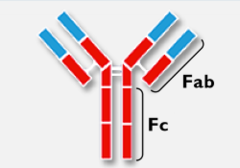
humanized
antibody that is mostly human but has murine portions of the Fab region that interact with antibody

human
antibody that is 100% human; the only type of antibody therapy that does not require an immunosuppressive drug
mouse
-omab
chimera
-ximab
humanized
-zumab
human
-(m)umab