Chapter 4 - Requirements Engineering
 Studied by 1 person
 Call Kai
 Learn
Learn Practice Test
 Spaced Repetition
 Match
Match Flashcards
 Knowt Play
1/38

Earn XP
Description and Tags
CS 3354
Name | Mastery | Learn | Test | Matching | Spaced |
|---|
No study sessions yet.
39 Terms
Problems with Requirements
Failure to communicate
Insufficient focus on up-front activities
Over promise, under deliver
Requirements volatility
Perspective on Dealing with Requirements Problem
Computer scientists use formal specification techniques
System analysts use modeling approaches
Software project managers use iterative-and-incremental development
Developers use peer reviews (inspections) of the requirements
Testers and QA people require testable requirements and do early test set construction (test-driven development)
Agile advocates place a customer representative on the development team
Solutions to Known Problems
Talk to stakeholders (customers, users, and others)
Iterative and incremental development (manages volatile requirements and provides visibility)
Agile methods and UP are “methodologies” that systematically address these issues
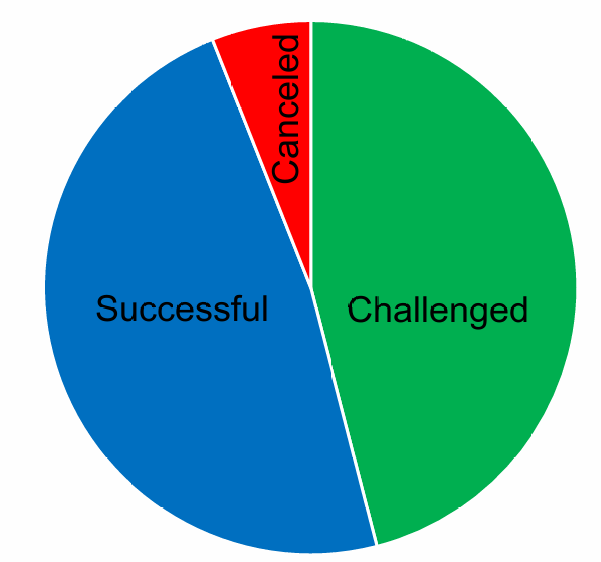
“Sweet Spot” for Requirements Volatility in Agile Methods
30-50% (or more) per month
Unified Process (UP) Requirements Workflow
What must the product be able to do?
Develop understanding of application domain (specific environment it operates in)
Build business model of client’s business processes
Use business model to determine client’s requirements
Iterate, as necessary
Phases: Inception, Elaboration, Construction, Transition
Requirements Engineering
Process of establishing services that a customer requires from a system and the constraints under which it operates and is developed
Concerned with discovering, eliciting, developing, analyzing, determining verification methods, validating, communicating, documenting, and managing requirements.
Requirement
A statement which translates or expresses a need and its associated constraints and conditions (may range from high-level abstract statement to a detailed math functional specification; requirements abstraction)
Derived Requirements
Requirements that are deduced or inferred from the collection and organization of requirements into a particular system configuration and solution
User Requirements
Statements in natural language plus diagrams of services that the system provides and its operation constraints
Written for customers

System Requirements
Structured document setting out detailed descriptions of system’s functions, services, and operational constraints.
Defines what should be implemented so may be part of a contract between client and contractor
Readers of User Requirements
Client managers
System end-users
Client engineers
Contractor managers
System architects
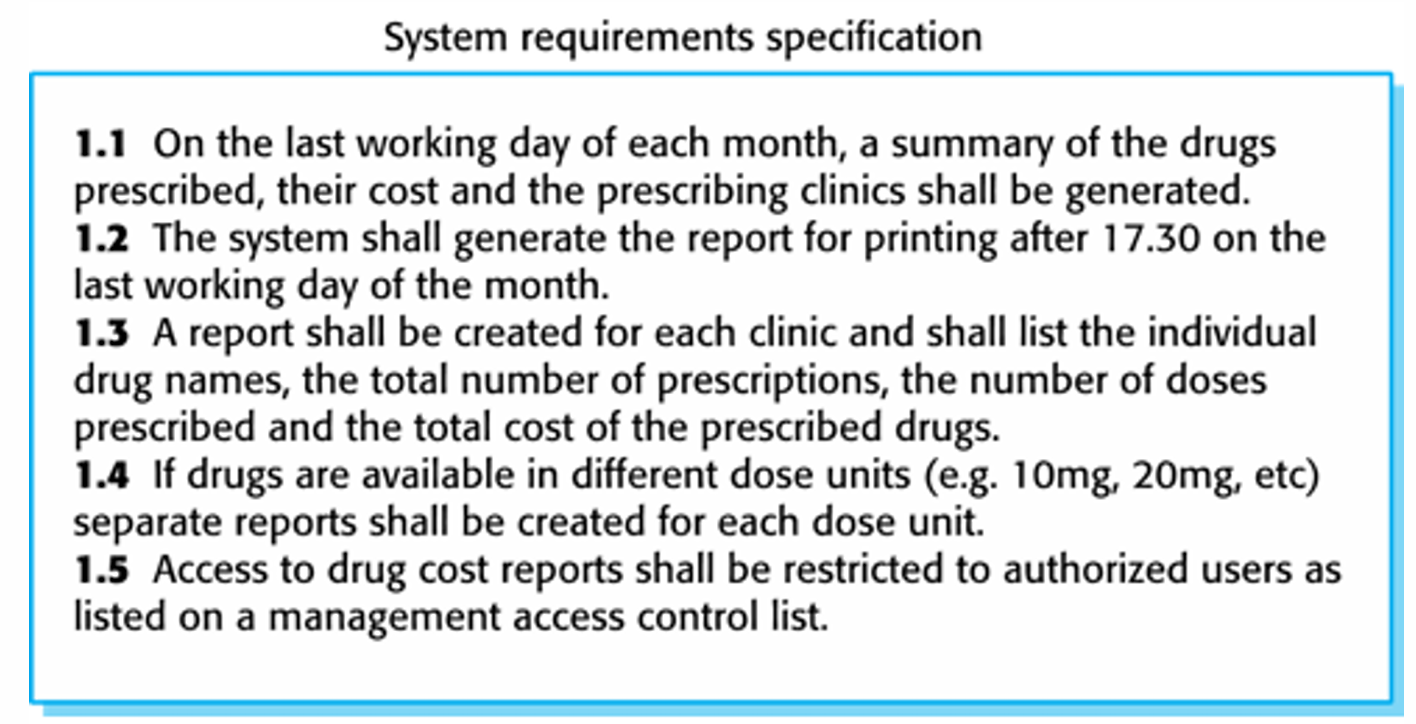
Readers of System Requirements
System end-users
Client engineers
System architects
Software developers
System stakeholders
Any person/organization who’s affected by the system in some way and has a legitimate interest
Types:
End users
System managers
System owners
External stakeholders
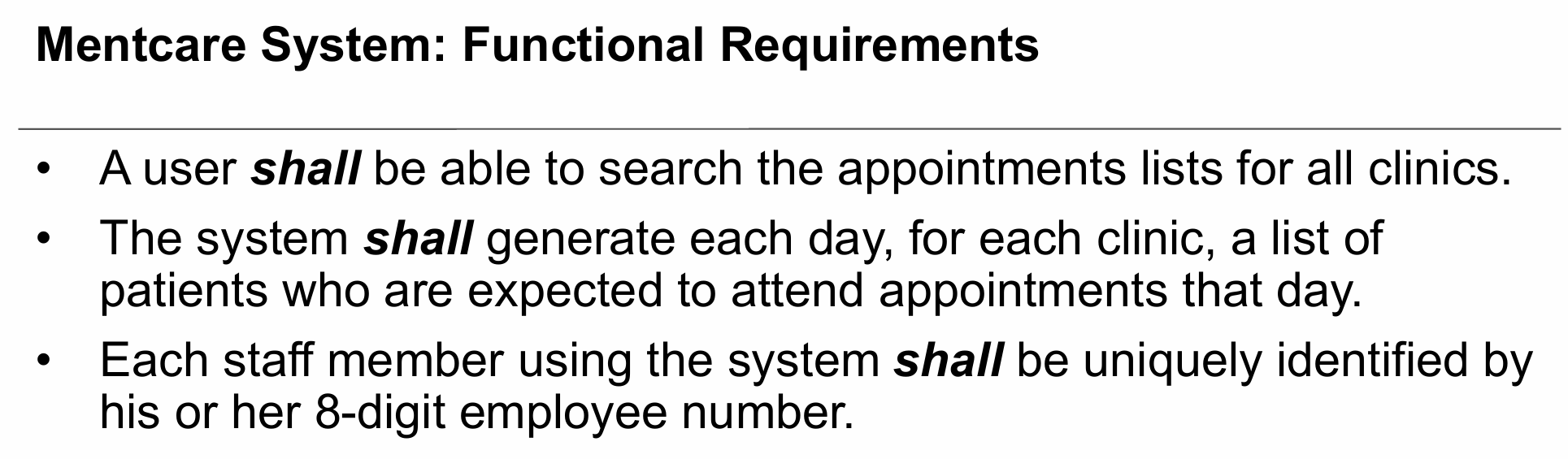
Functional Requirements
The “What?” — statements of:
services system should provide
how system should react to particular inputs
how system should behave in particular situations
May state what system shouldn’t do as well
Describes functionality or system services, often expressed in terms of inputs and outputs.
May be high-level statements of what system should do, should describe system services in detail.
Non-Functional Requirements
The “How?” — defines constraints on services or functions offered by system such as timing constraints, constraints on development process, standards, etc.
Process requirements may also be specified mandating a particular IDE, programming language, or development method.
Often applied to the system as a whole rather than individual features or services (system properties and constraints).
May be more critical than functional requirements, as the system may be useless if they aren’t met.
Requirements Jargon
Requirements → “shall”
Statements of fact, futurity, or declaration of purpose → “will”
Preferences or goals → “should”
Suggestions or allowances → “may”
Non-requirements → “are”, “is”, “was”
Avoid “must” due to misinterpretations and negative requirements (“shall not”)
Use active voice, not passive.
Characteristics of a Good Set of Requirements
In principle:
1) Complete
2) Consistent
3) Affordable (in budget, time, and life cycle constraints)
4) Bounded (maintains scope)
In practice, it’s impossible to make a complete AND consistent requirements document due to system and environmental complexity
Requirements Scrubbing
Requirements consistency checks
Requirements reviews
Requirements-driven early test case design
Testable requirements
Modeling, simulation, and prototyping to check early requirements validity
Formal specification techniques
Non-Functional Classifications
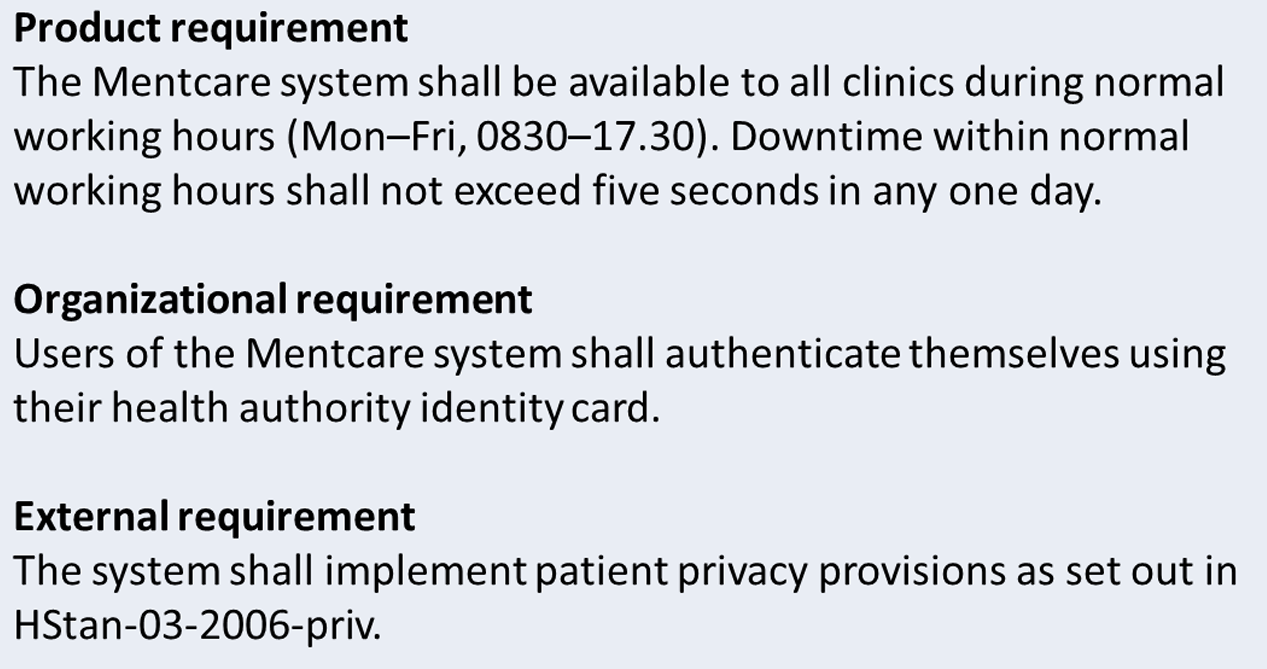
Product Requirements — specifies that delivered product behaves in a particular way (execution speed, reliability, etc)
Organizational Requirements — a consequence of organizational policies and procedures (process standards used, implementation requirements, etc)
External Requirements — Arises from factors external to system (interoperability requirements, legislative requirements, etc)
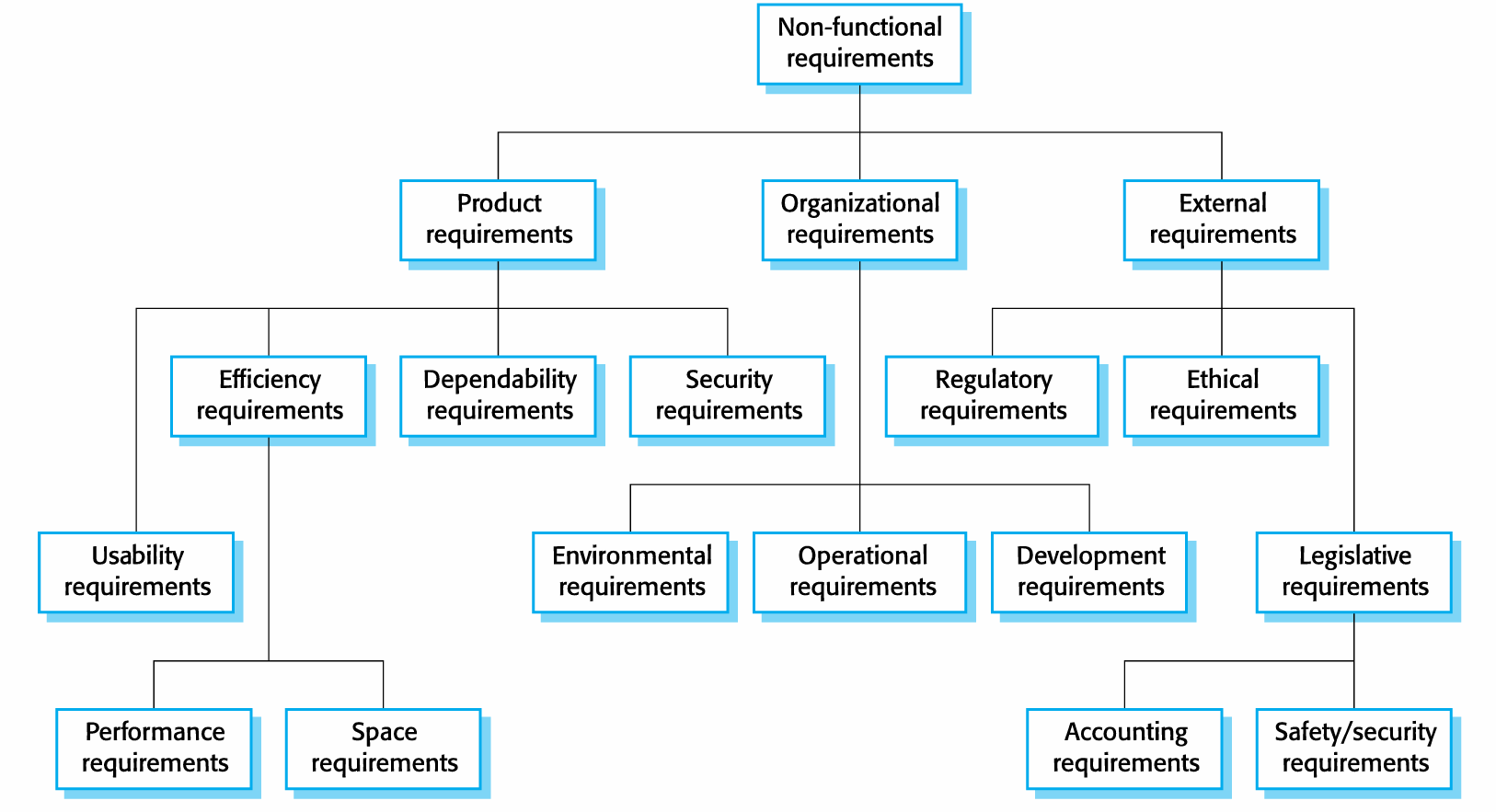
Example of Non-Functional Requirements
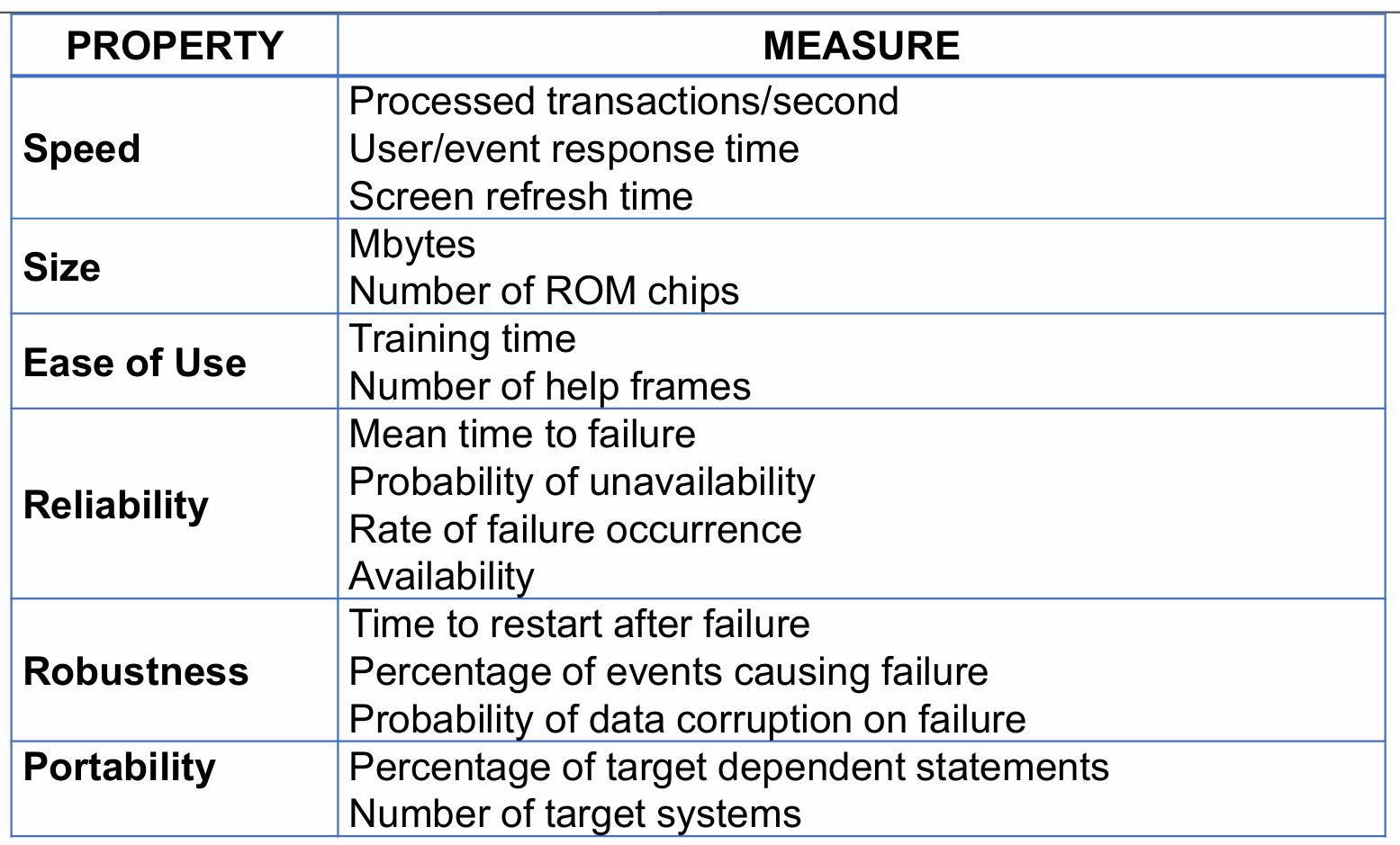
Metrics for Specifying Non-Functional Requirements
Speed, Size, Ease of Use, Reliability, Robustness, Portability
Requirements Engineering Processes
Common Generic Activities:
1) Requirements elicitation and analysis
2) Requirements specification
3) Requirements Validation
4) Requirements Management
In practice, RE is an iterative activity in which these processes are interleaved.
Requirements Elicitation and Analysis
Discovery, classification and organization, prioritization and negotiation, and specification of requirements
Problems: stakeholders don’t know what they want and can’t express requirements, different stakeholders may have conflicting requirements, influence from organizational and political factors, changing requirements from new stakeholders or business environment
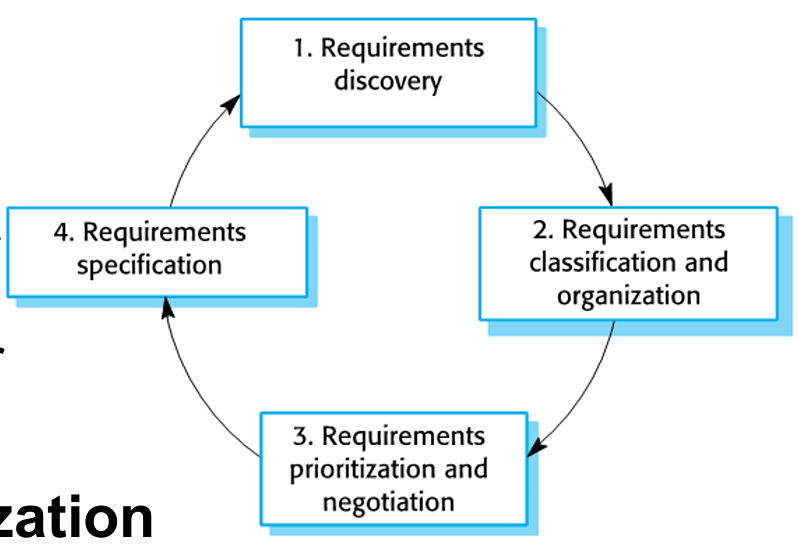
Problems with Interviews
Technical or language gaps between application specialists and requirements engineers
Not good for understanding domain requirements
Thus, use ethnography (social scientists)!
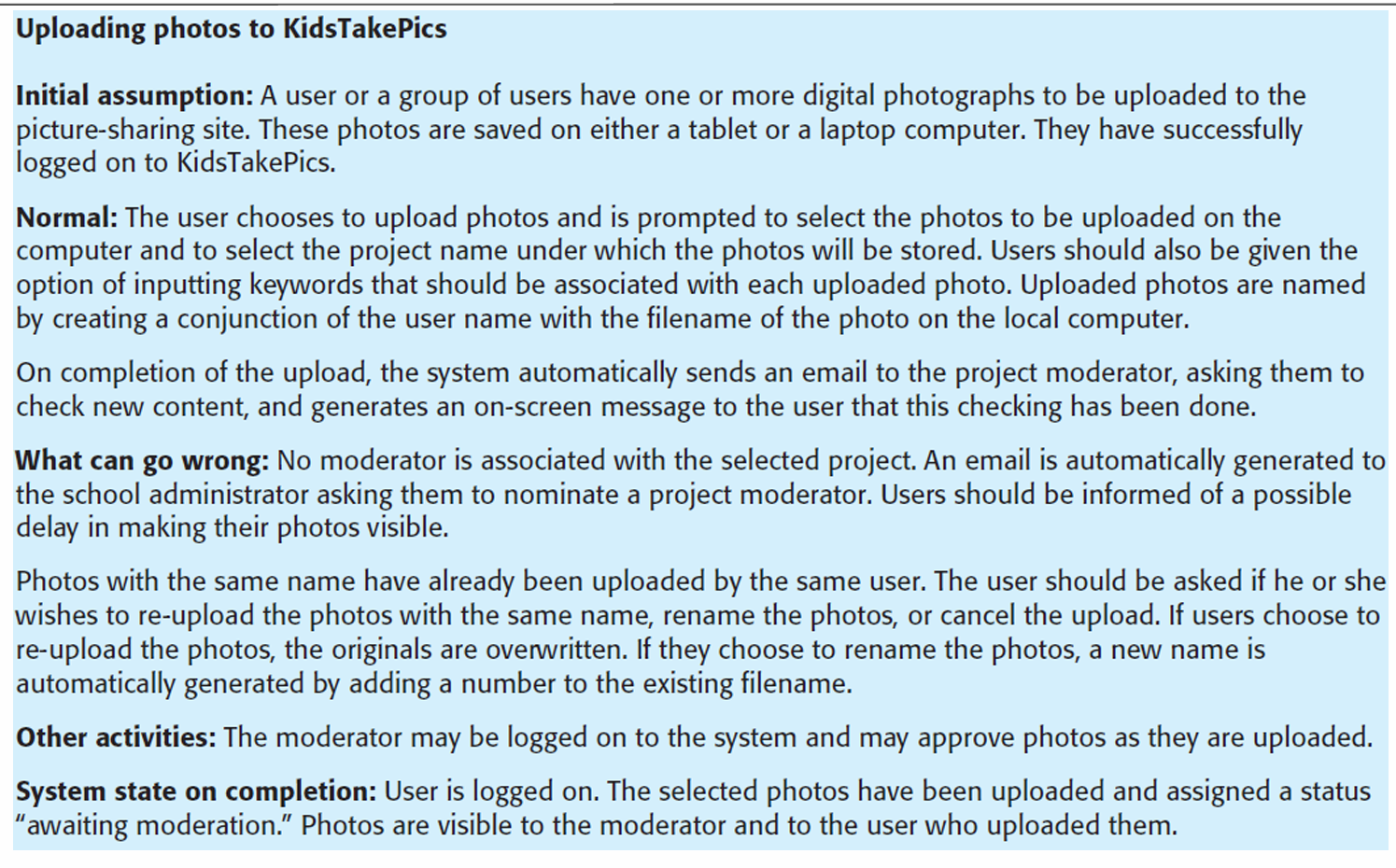
Scenarios
Structured form of user story
Should include:
Description of starting situation
Description of normal flow of events
Desc of of what can go wrong
Information about other concurrent activities
Description of the state when the scenario finishes
Requirements Specification
Process of writing down user and system requirements in a requirements document; should be as complete as possible as it may be used for contracts
User requirements → understandable to non-technical backgrounds and end-users
System requirements → more detailed and includes more technical information
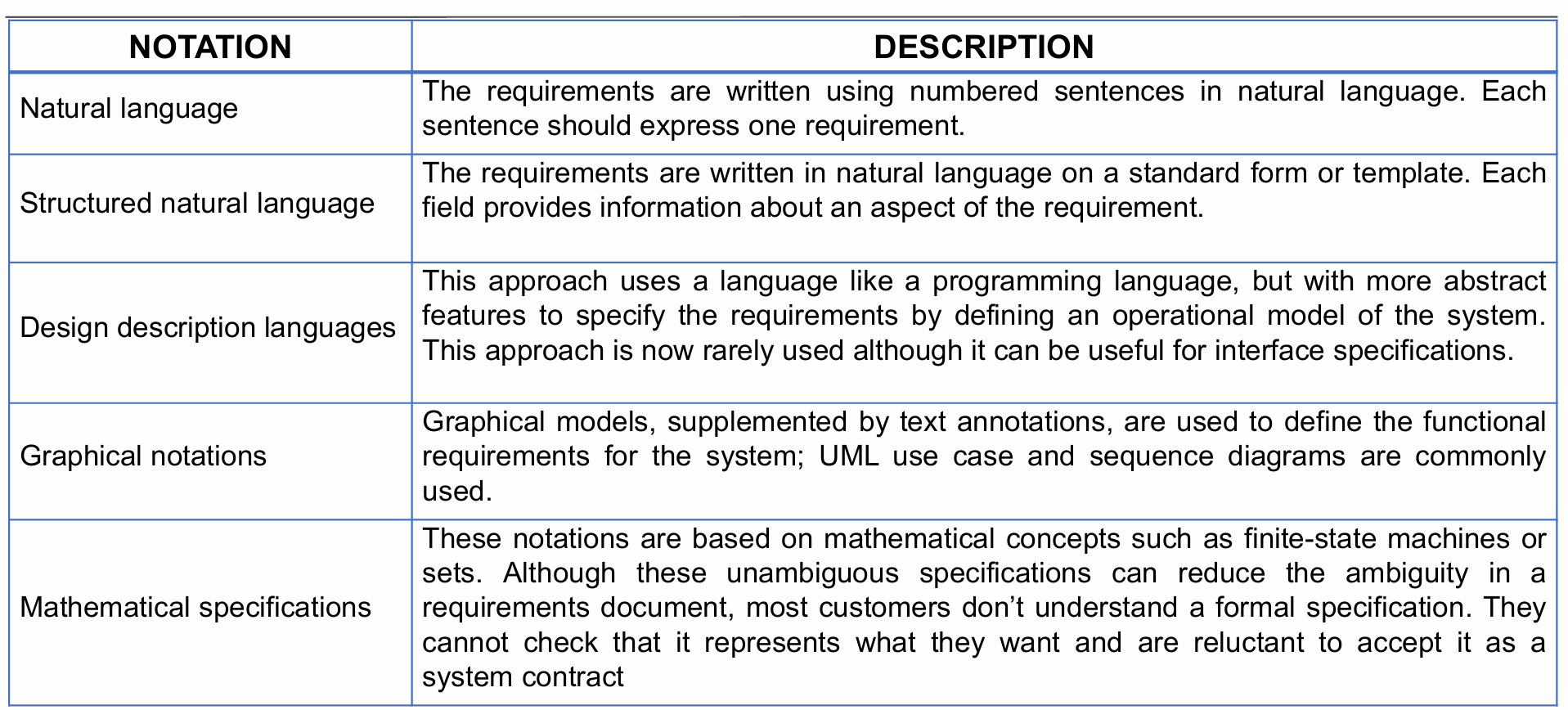
Requirements Representations
Natural language, structured natural language, design description languages, graphical notations, mathematical specifications
Structured Specification
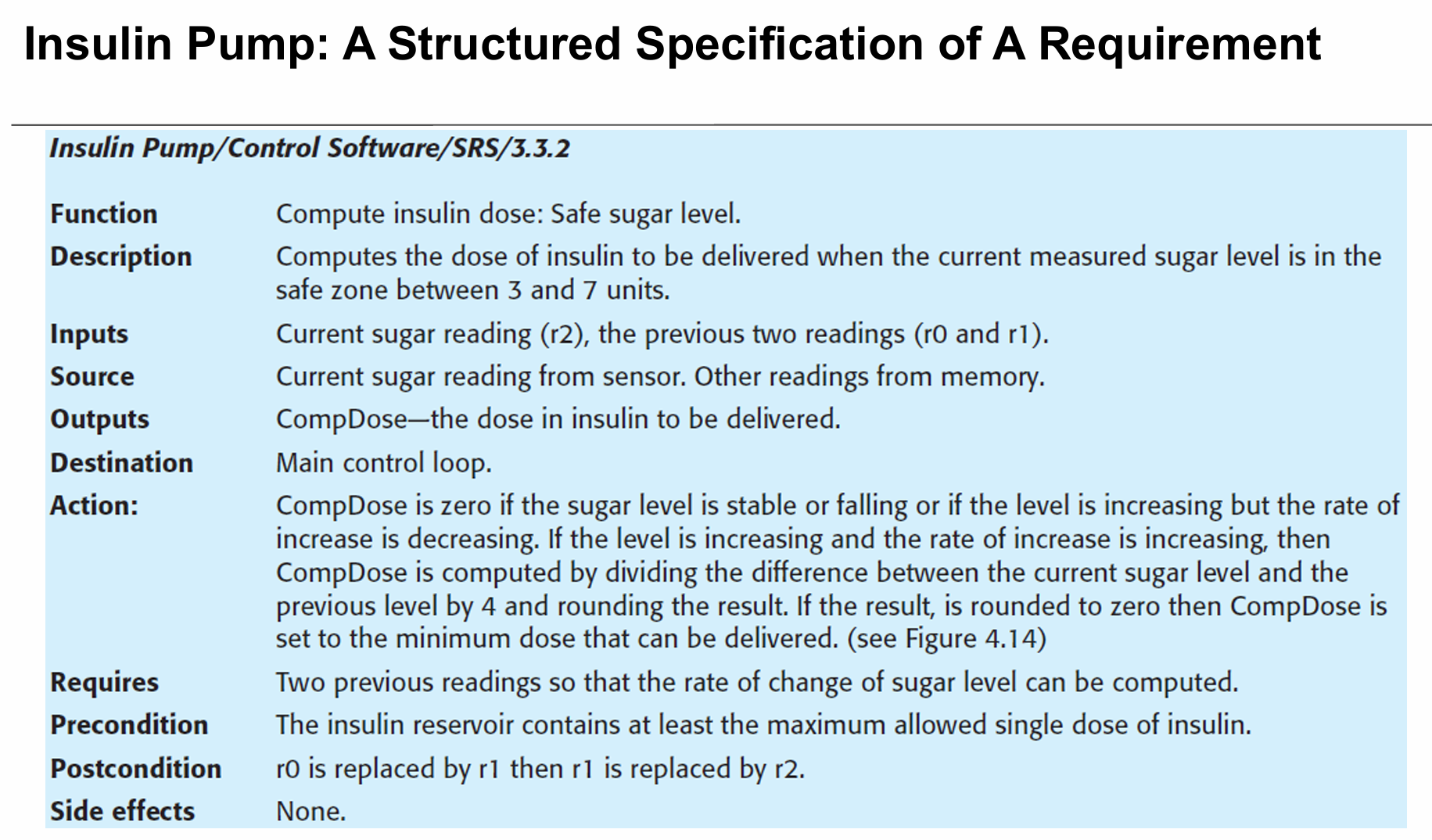
Approach to writing requirements where the freedom of the requirements writer is limited, and requirements are written in a standard way
Works well for some types of requirements (like for an embedded control system), but sometimes too rigid for writing business system requirements
Tabular Specification
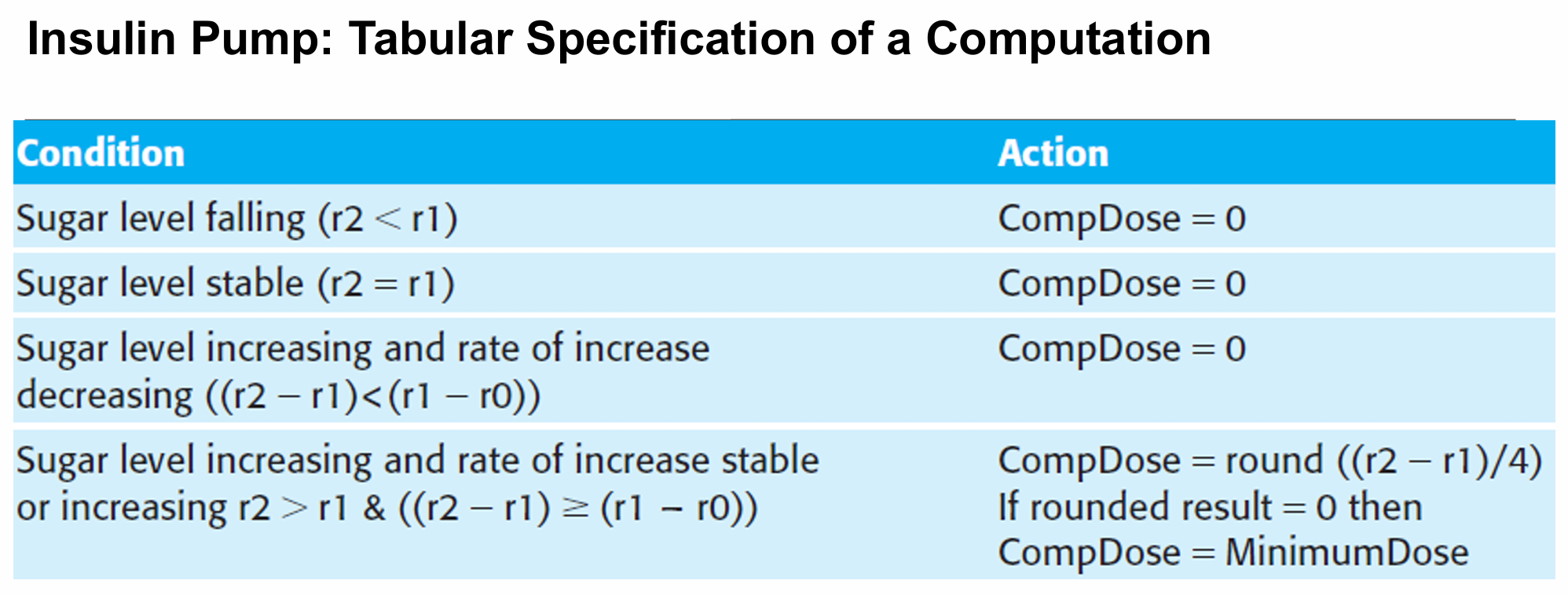
Used to supplement natural language; useful when you have to define a number of possible alternative courses of action
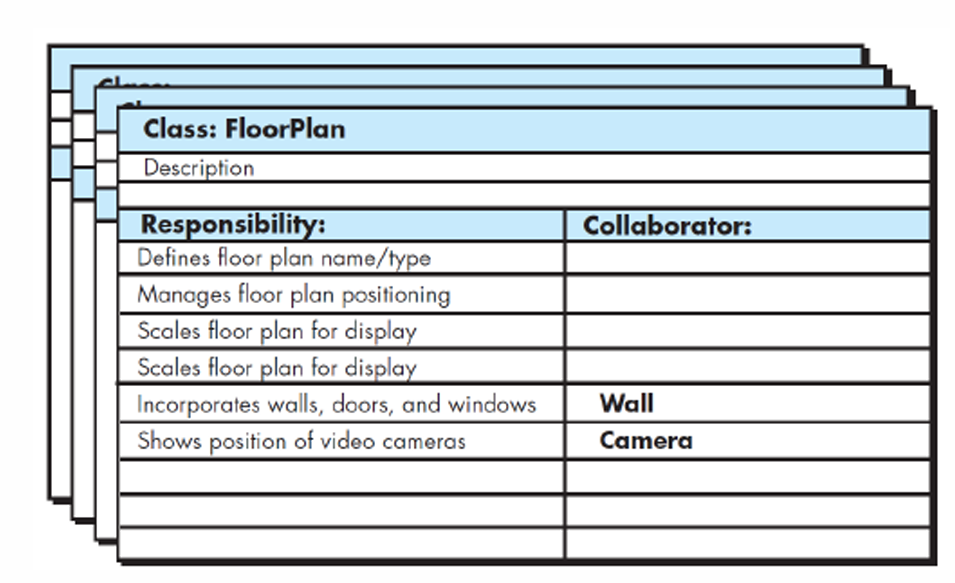
Tabular Specification + Class Responsibility Collaborator (CRC) Modelling
Class — name of class
Responsibility — attributes and operations that’re relevant for class (anything it does or knows)
Collaborator — classes that are required to provide current class with info needed to complete responsibility (a request for info or action)
Use Cases
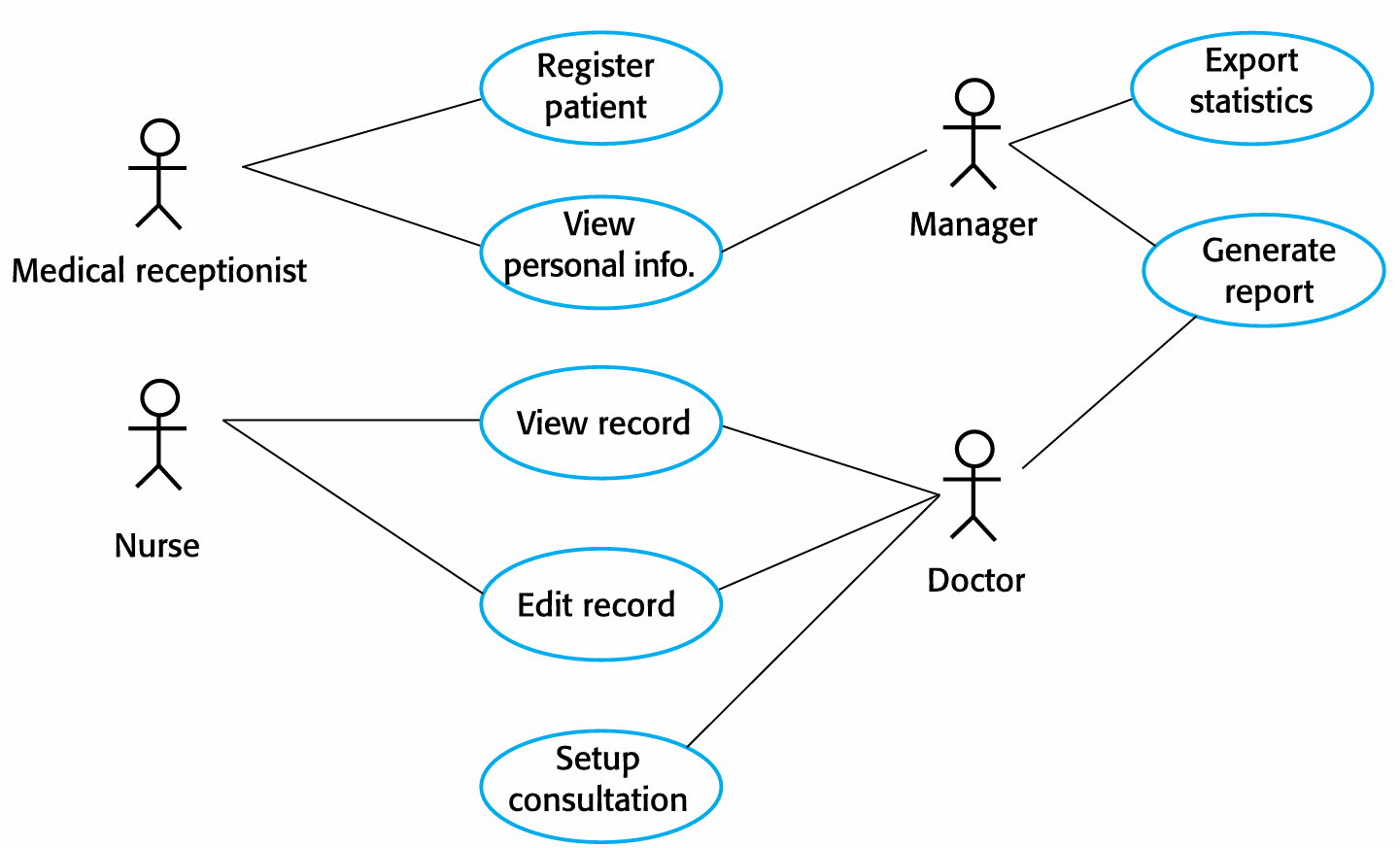
A kind of scenario included in the UML that identifies actors in interaction and describes interaction itself
A set of use cases should describe all possible interactions within system
Requirements Validation
Concerned with demonstrating that the requirements define the system that the customer really wants due to requirement error costs being very high
Fixing requirements error may cost 100x the cost of fixing an implementation error
Requirements Checks
Validity (does system provide functions which best support customer needs?)
Consistency
Completeness
Realism (can it be done given available budget and tech?)
Verifiability
Requirements Validation Techniques
Requirements reviews
Prototyping
Test-case generation
Requirements Management
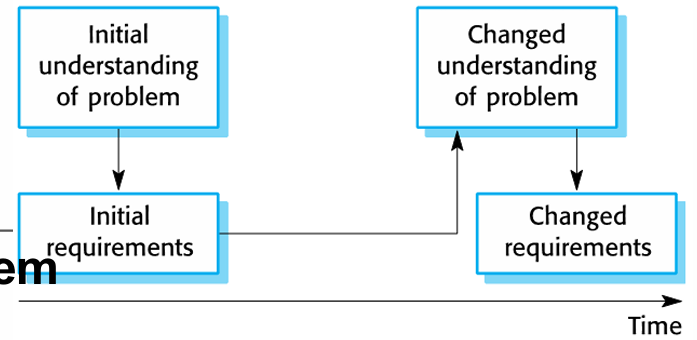
Process of managing changing requirements during RE process and system development
New requirements emerge as a system is being developed and after it’s gone into use
Must keep track of individual requirements and maintain links between dependent requirements to assess impact of requirement changes
Must establish formal process for making change proposals and linking these to system requirements
Changing Requirements
Business and technical environment of system always changes after installation
People who pay for system and users of system are rarely the same people
Large systems usually have diverse user community, with many users having different requirements and priorities that may be conflicting/contradictory
Requirements Management Planning
Establishes level of requirements management detail that’s required.
Requirements management decisions:
Requirements identification → each requirement must be uniquely identified (used for cross-referencing between other requirements)
A change management process → set of activities that assess impact and cost of changes
Traceability policies → defines relationships between each requirement and between requirements and system design
Tool support tools → ranges from specialist requirements and management systems to spreadsheets and simple databases
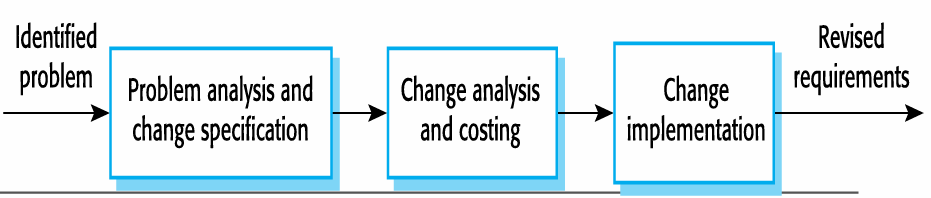
Requirements Change Management
Deciding if requirements change should be accepted
Stages:
Problem analysis and change specification
Change analysis and costing
Change implementation
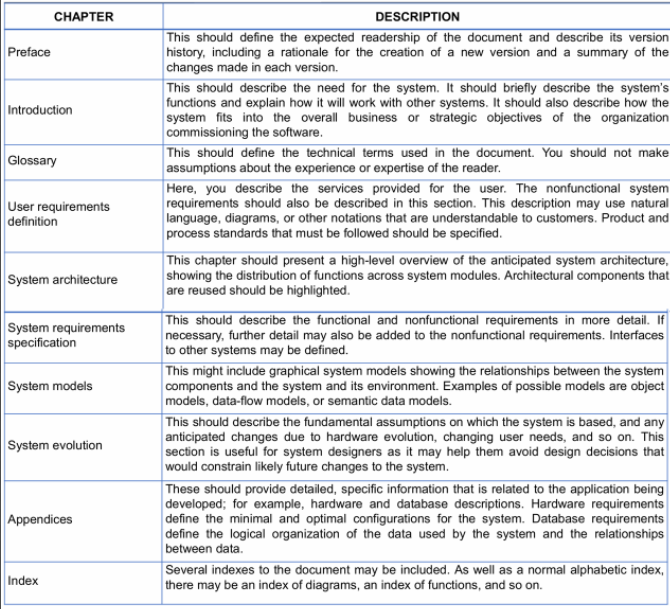
Structure of Requirements Document
Preface
Introduction
Glossary
User requirements definition
System architecture
System requirements specification
System models
System evolution
Appendices
Index