Chapter 21 -Carboxylic Acid Derivatives

5.0(1)
studied byStudied by 3 people
5.0(1)
full-widthCall Kai
learnLearn
examPractice Test
spaced repetitionSpaced Repetition
heart puzzleMatch
flashcardsFlashcards
GameKnowt Play
Card Sorting

1/25

encourage image

There's no tags or description

Looks like no tags are added yet.

Study Analytics
Name
Mastery
Learn
Test
Matching
Spaced

No study sessions yet.

26 Terms

1
New cards

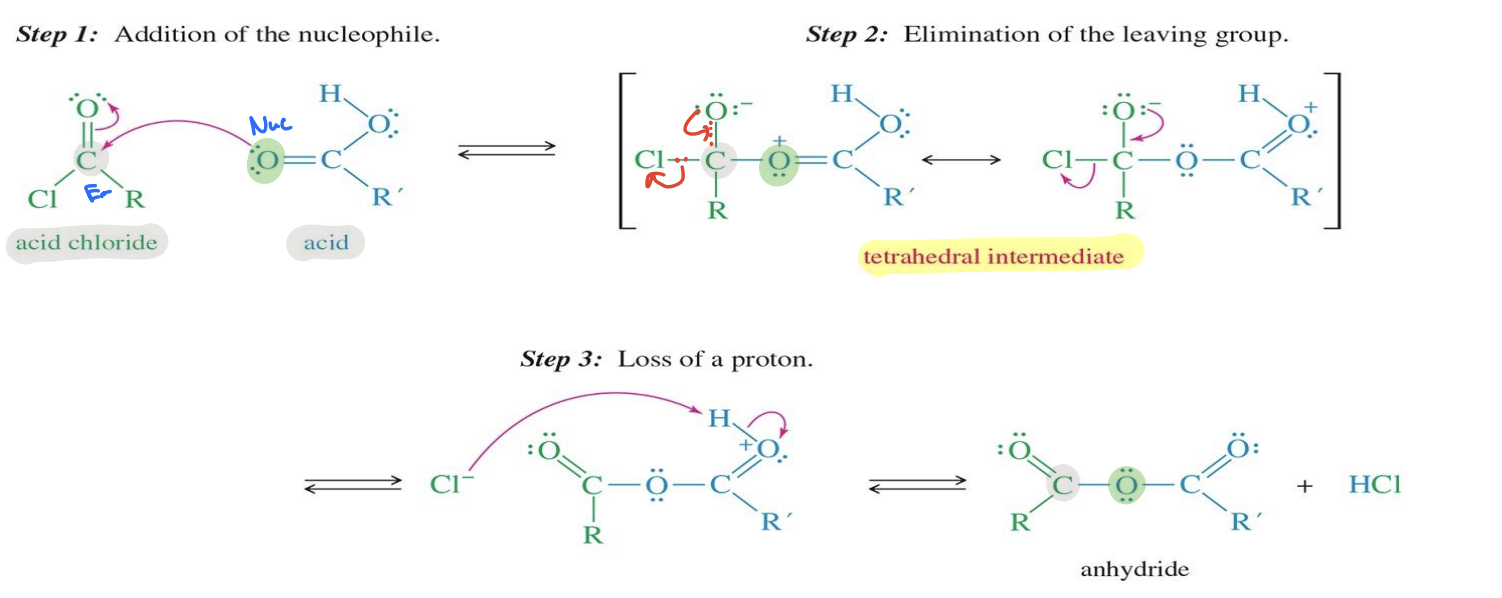
Acid Chloride to anhydride

Starting

  • Acid Chloride ( Cl - C (=O) - R)

Reagent

  • carboxylic Acid

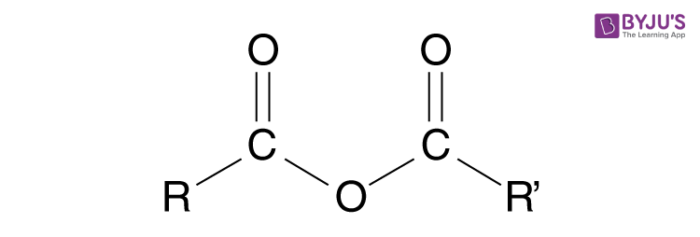
End product Anhydride ( R - CO - O - CO - R)

Mechanism

  1. Addition of the reagent : the Oxygen from the carboxylic attacks to acid chloride → the double bond oxy of the acid chloride becomes a singe bond

A Tetrahedral intermediate forms

  1. Chloride (Cl⁻) leaves, restoring the C=O double bond

  2. The Cl removes a proton (H⁺) → forms the anhydride product
<p>Starting</p><ul><li><p>Acid Chloride ( Cl - C (=O) - R) </p></li></ul><p>Reagent</p><ul><li><p>carboxylic Acid</p></li></ul><p>End product Anhydride ( R - CO - O - CO - R) </p><p>Mechanism</p><ol><li><p>Addition of the reagent :  the Oxygen from the carboxylic attacks to acid chloride → the double bond oxy of the acid chloride becomes a singe bond </p></li></ol><p>A Tetrahedral intermediate forms </p><ol start="2"><li><p>Chloride  (Cl⁻) leaves, restoring the C=O double bond</p></li><li><p>The Cl removes a proton (H⁺) → forms the anhydride product</p></li></ol><img src="https://knowt-user-attachments.s3.amazonaws.com/8ed4ea50-e383-4bdd-a148-185a611a5e57.png" data-width="100%" data-align="center"><p></p>
2
New cards

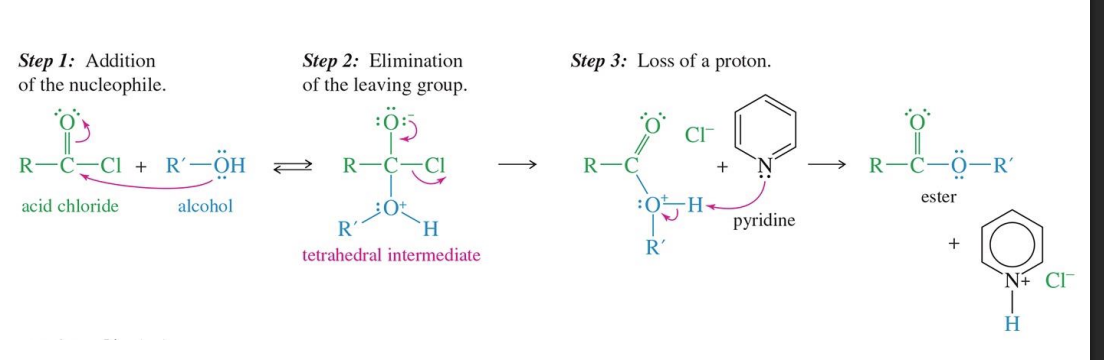
Acid Chloride to Ester

Starting

  • Acid Chloride

Reagents

  • Alcohol

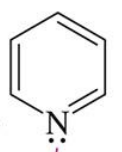
  • Pyridine

Mechanism

  1. the alcohol attacks the acid chloride forming tetrahedral. ( the double bond with O of acid chloride becomes a single bond)

  2. the Cl Leaves causing the double bond with oxygen to be restored

  3. The Pyridine comes in and take a hydrogen from R - OH
<p>Starting </p><ul><li><p>Acid Chloride </p></li></ul><p>Reagents</p><ul><li><p>Alcohol</p></li><li><p>Pyridine</p></li></ul><img src="https://knowt-user-attachments.s3.amazonaws.com/ed0b59b2-8129-4f05-b48a-d62e09b59c38.png" data-width="100%" data-align="center"><p>Mechanism </p><ol><li><p>the alcohol attacks the acid chloride forming tetrahedral. ( the double bond with O of acid chloride becomes a single bond)</p></li><li><p>the Cl Leaves causing the double bond with oxygen to be restored </p></li><li><p>The Pyridine comes in and take a hydrogen from R - OH</p></li></ol><p></p>
3
New cards

Acid chloride to Amide

Starting

  • Acid chloride (R-C(=O)-Cl)

Reagent

  • Amine (R₂N-H) — can be ammonia, primary amine (1°), or secondary amine (2°)

Mechanism

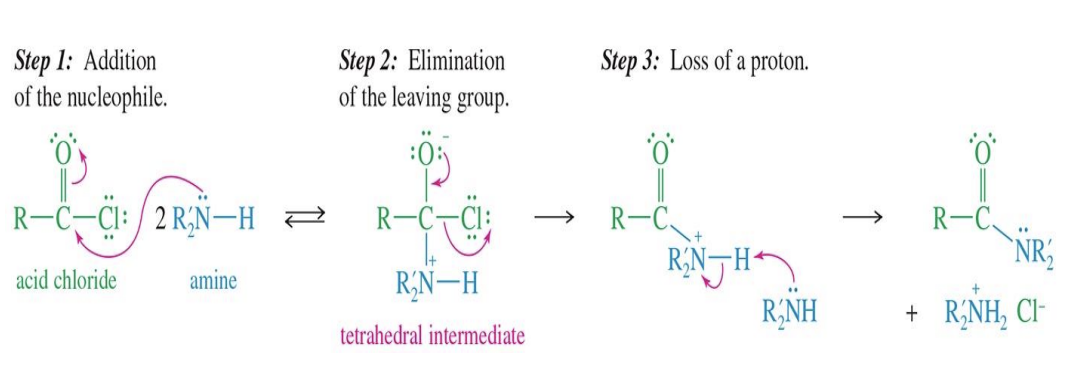
Step 1: Addition of nucleophile

  • The amine's nitrogen attacks the carbonyl carbon

  • Forms tetrahedral intermediate

Step 2:

  • Chloride ion (Cl⁻) leaves

  • Restores the C=O double bond

Step 3: Loss of a proton

  • Another Amine removes a proton from the nitrogen

  • Forms the amide product

Product types:

  • Ammonia (NH₃) → primary amide (1°)

  • Primary amine (RNH₂) → secondary amide (2°)

  • Secondary amine (R₂NH) → tertiary amide (3°)
<p>Starting</p><ul><li><p>Acid chloride (R-C(=O)-Cl)</p></li></ul><p>Reagent</p><ul><li><p>Amine (R₂N-H) — can be ammonia, primary amine (1°), or secondary amine (2°)</p></li></ul><p>Mechanism </p><p><strong>Step 1: Addition of nucleophile</strong></p><ul><li><p>The amine's nitrogen attacks the carbonyl carbon</p></li><li><p>Forms tetrahedral intermediate</p></li></ul><p><strong>Step 2: </strong></p><ul><li><p>Chloride ion (Cl⁻) leaves</p></li><li><p>Restores the C=O double bond</p></li></ul><p><strong>Step 3: Loss of a proton</strong></p><ul><li><p>Another Amine removes a proton from the nitrogen</p></li><li><p>Forms the amide product</p></li></ul><p><strong>Product types:</strong></p><ul><li><p>Ammonia (NH₃) → <strong>primary amide (1°)</strong></p></li><li><p>Primary amine (RNH₂) → <strong>secondary amide (2°)</strong></p></li><li><p>Secondary amine (R₂NH) → <strong>tertiary amide (3°)</strong></p></li></ul><p></p>
4
New cards

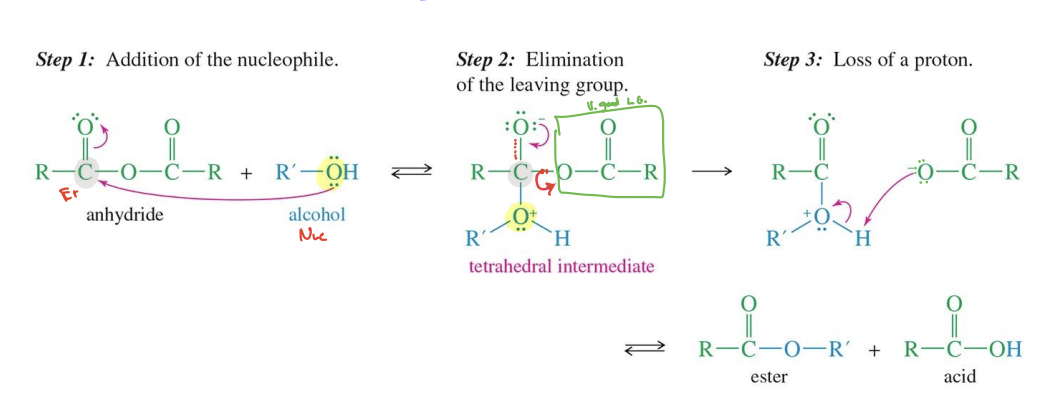
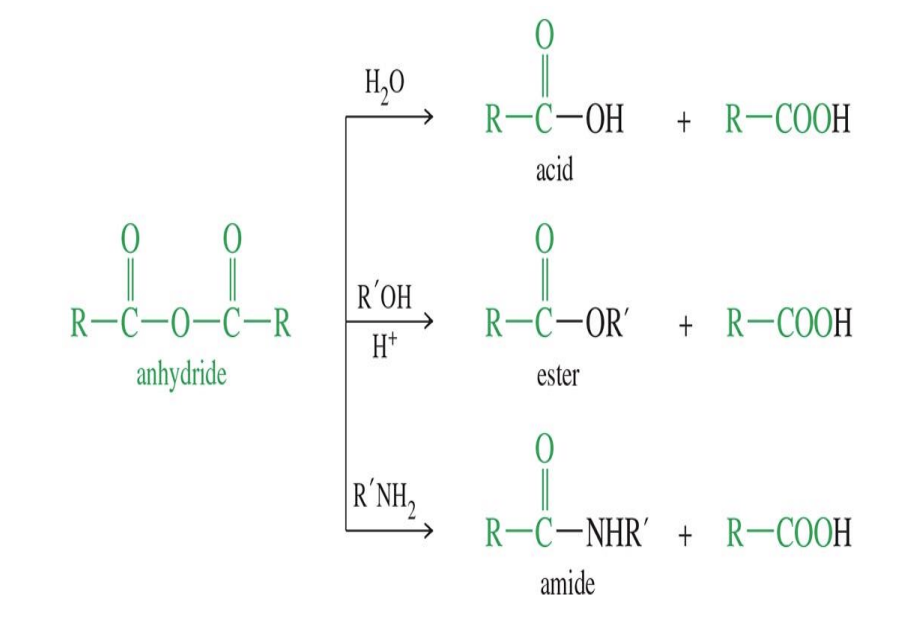
Anhydride to Ester

Starting:

  • Anhydride ( R - CO - O - CO - R)

Reagent:

  • Alcohol ( R-OH)

Mechanism

  1. Alcohol Attacks one carbonyl group of the anhydride forming a tetrahedral intermediate

  2. The other acid salt (carboxylate salt) ( O - C=O - R) acts a leaving group

  3. The acid group that left takes a hydrogen from the R - OH

End product:

  • Ester

  • Acid

<p>Starting:</p><ul><li><p>Anhydride ( R - CO - O - CO - R)</p></li></ul><p>Reagent:</p><ul><li><p>Alcohol ( R-OH)</p></li></ul><p>Mechanism</p><ol><li><p>Alcohol Attacks one carbonyl group of the anhydride forming a tetrahedral intermediate</p></li><li><p>The other acid salt (carboxylate salt) ( O - C=O - R) acts a leaving group</p></li><li><p>The acid group that left takes a hydrogen from the R - OH</p></li></ol><p>End product:</p><ul><li><p>Ester</p></li><li><p>Acid</p></li></ul><p></p><p></p>
5
New cards

Anhydride to amide

Starting

  • Anhydride

Reagent:

  • Amine ( can be can be ammonia, primary amine (1°), or secondary amine (2°)

Mechanism

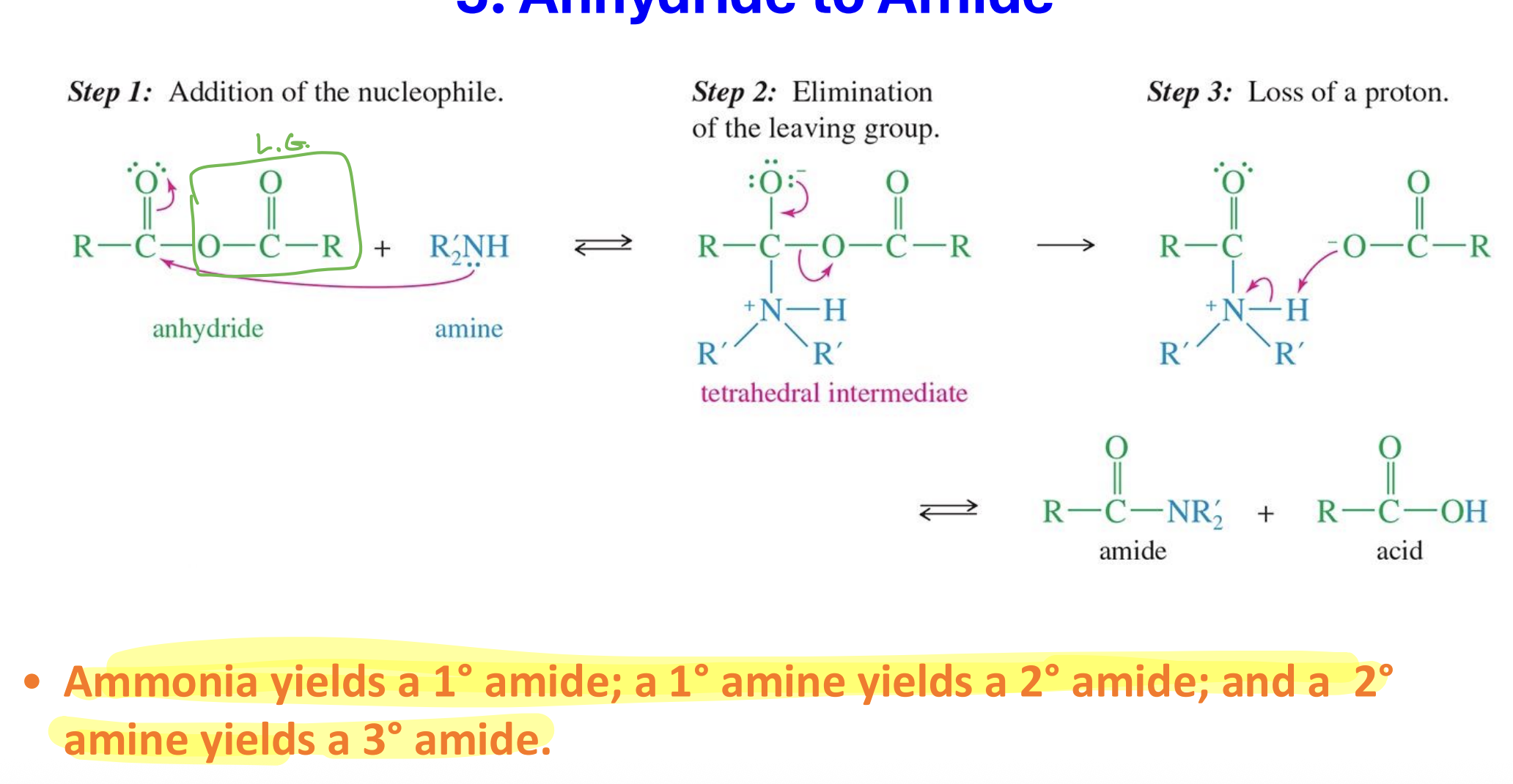
  1. the amine attacks the carbon forming a tetrahedral

  2. the acid group ( O - C=O - R) acts a leaving group

  3. The same acid takes the Hydrogen from the amine

End product

  • Amide

  • Acid

Product types:

  • Ammonia (NH₃) → primary amide (1°)

  • Primary amine (RNH₂) → secondary amide (2°)

  • Secondary amine (R₂NH) → tertiary amide (3°)
<p>Starting</p><ul><li><p>Anhydride</p></li></ul><p>Reagent:</p><ul><li><p>Amine ( can be can be ammonia, primary amine (1°), or secondary amine (2°)</p></li></ul><p>Mechanism</p><ol><li><p>the amine attacks the carbon forming a tetrahedral</p></li><li><p>the acid group ( O - C=O - R) acts a leaving group</p></li><li><p>The same acid takes the Hydrogen from the amine</p></li></ol><p>End product</p><ul><li><p>Amide</p></li><li><p>Acid</p></li></ul><p><strong>Product types:</strong></p><ul><li><p>Ammonia (NH₃) → <strong>primary amide (1°)</strong></p></li><li><p>Primary amine (RNH₂) → <strong>secondary amide (2°)</strong></p></li><li><p>Secondary amine (R₂NH) → <strong>tertiary amide (3°)</strong></p></li></ul><p></p>
6
New cards

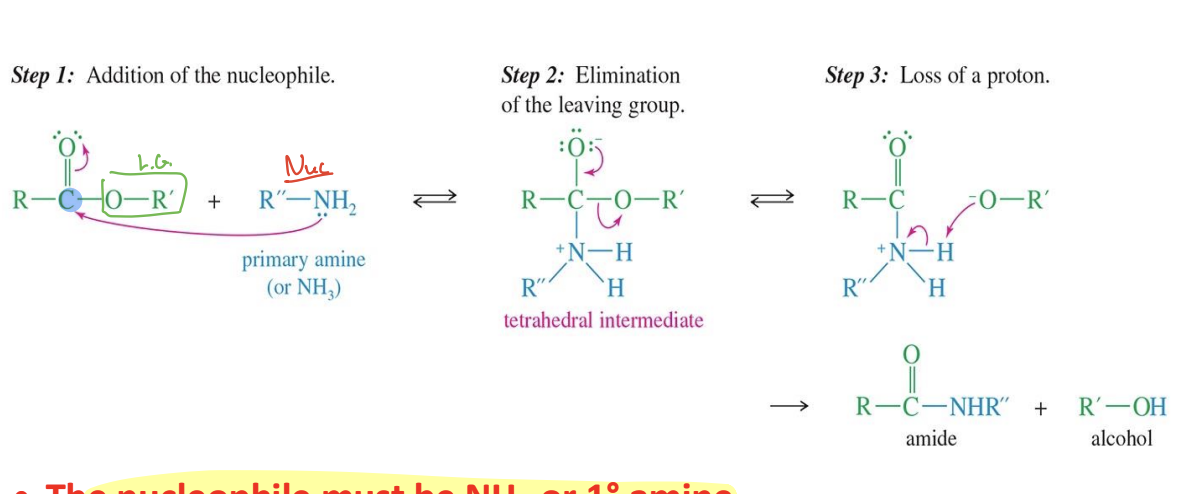
Ester to amide ( Ammonolysis)

Starting

  • ester ( R - CO - OR)

Reagent :

  • NH3 Or Amine (R - NH2)

MUST BE AMONIA OR 1° AMINE

Mechanism

  1. the amine attacks the carbon of the ester

  2. a tetrahedral intermediate is formed

  3. the OR acts asa leaving group and breaks the bond with carbon

  4. The same OR takes a hydrogen from the Nitrogen in amine

End Product

  • Amide

  • Alcohol

<p>Starting</p><ul><li><p>ester ( R - CO - OR)</p></li></ul><p>Reagent :</p><ul><li><p>NH<sub>3</sub> Or <strong>1° </strong>Amine (R - NH<sub>2</sub>)</p></li></ul><p><strong>MUST BE AMONIA OR 1° AMINE</strong></p><p>Mechanism</p><ol><li><p>the amine attacks the carbon of the ester</p></li><li><p>a tetrahedral intermediate is formed</p></li><li><p>the OR acts asa leaving group and breaks the bond with carbon</p></li><li><p>The same OR takes a hydrogen from the Nitrogen in amine</p></li></ol><p>End Product</p><ul><li><p>Amide</p></li><li><p>Alcohol</p></li></ul><p></p>
7
New cards

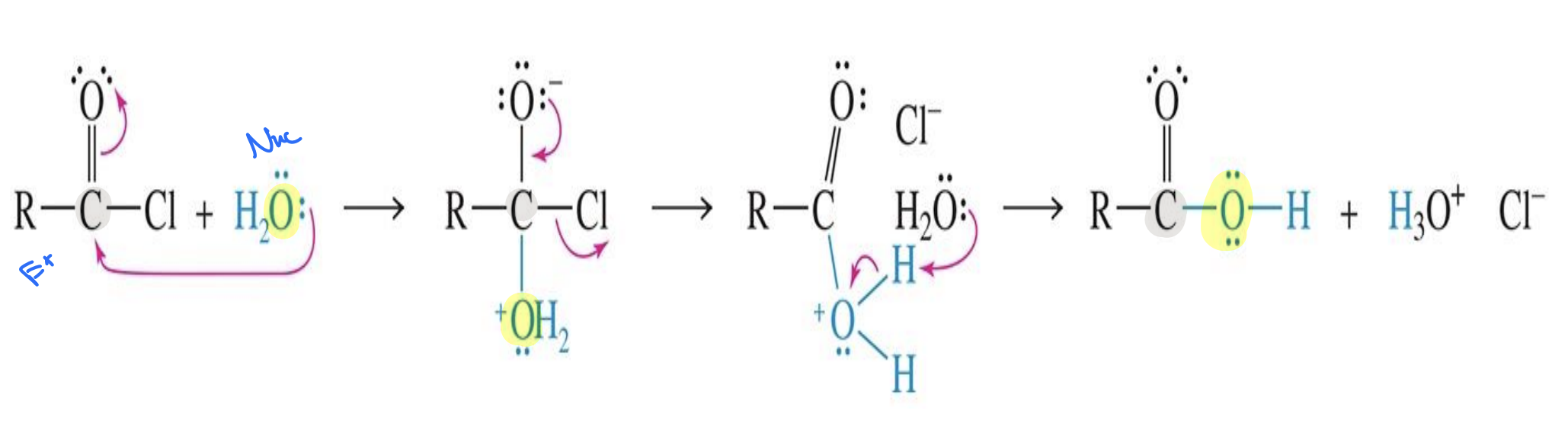
Hydrolysis of acid chlorides and Anhydrides

Starting

  • Acid chloride or Anhydrides

ReagentL

  • Water (H2O)

Mechanics

  • water comes in attacks the carbon from acid chloride adding H- O -H

  • the Chloride (Cl) leaves

  • Another water comes in a removed a hydrogen from H-O-H

End product

  • carboxylic acid

  • H3O+

With Anhydrides → 2 carboxylic acid
<p>Starting </p><ul><li><p>Acid chloride or Anhydrides</p></li></ul><p>ReagentL </p><ul><li><p>Water (H<sub>2</sub>O) </p></li></ul><p>Mechanics </p><ul><li><p>water comes in attacks the carbon from acid chloride adding H- O -H</p></li><li><p>the Chloride (Cl) leaves </p></li><li><p>Another water comes in a removed a hydrogen from H-O-H</p></li></ul><p>End product </p><ul><li><p>carboxylic acid </p></li><li><p>H<sub>3</sub>O<sup>+</sup></p></li></ul><p>With Anhydrides → 2 carboxylic acid </p>
8
New cards

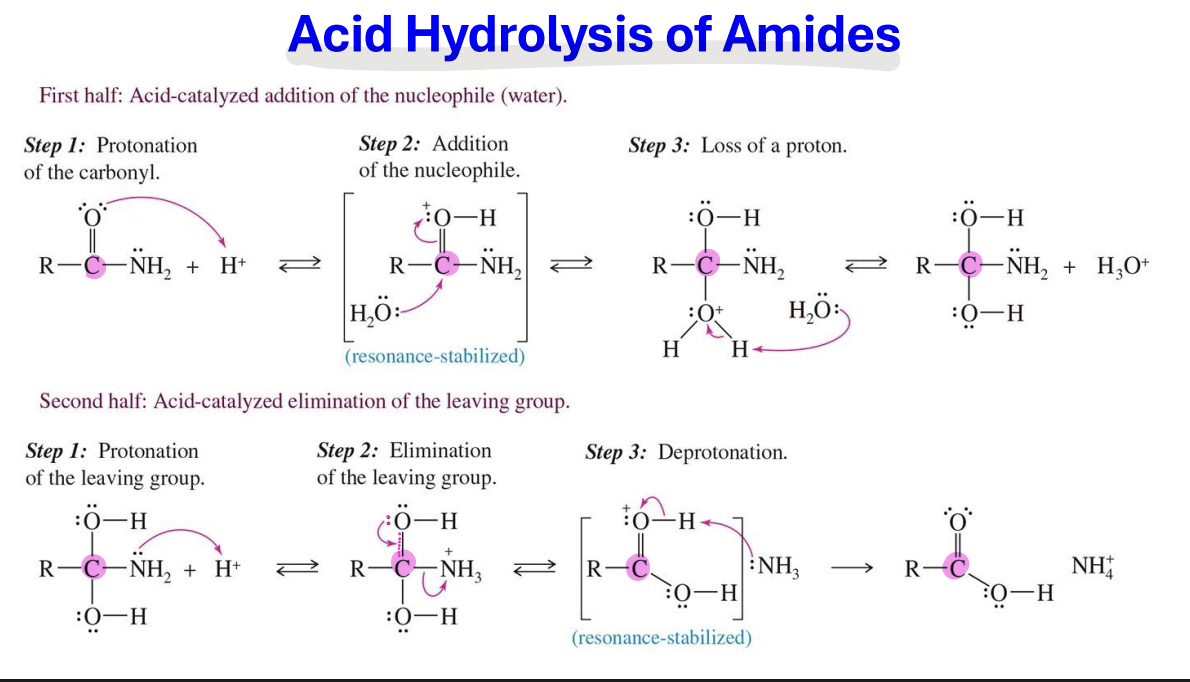
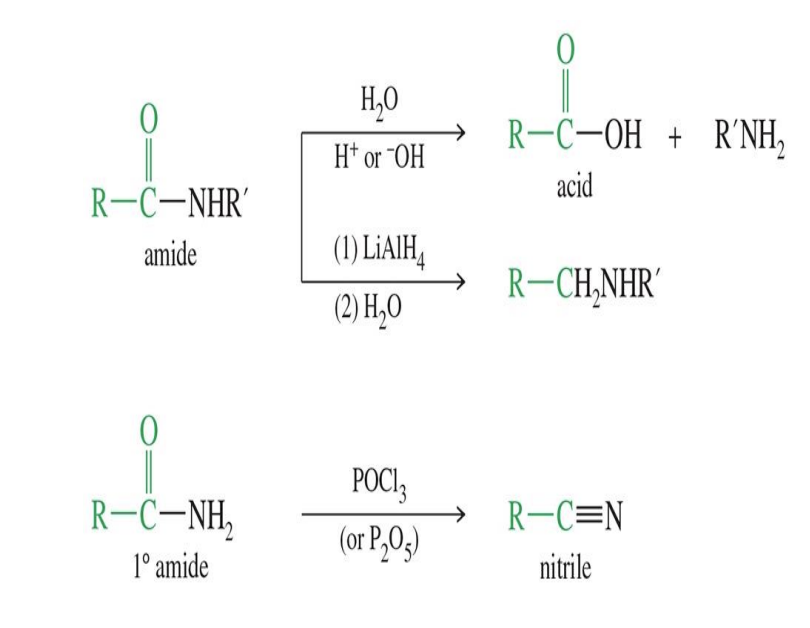
Hydrolysis of Amides

Starting :

  • Amide → R–C(=O)–NHR′

Reagent:

  • H3 O+ ( or strong acid H2SO4)

  • H2O

Mechanism

Part 1:

  1. the Amide Oxygen attacks the H+ (acid) taking a hydrogen making (OH)

  2. water comes in and attacks the carbon of the amides cause the double bond with oxygen and carbon to become single bonded

  3. Another water comes in and takes a hydrogen from the H-O-H

Part 2:

  1. Another Acid (H+) comes in and the Nitrogen (NH2) attacks it taking a Hydrogen making (NH3)

  2. The NH3 Leaves restoring the double bond with carbon and oxygen

  3. the NH3 takes the Hydrogen from the O

End Product:

  • carboxylic acid

  • NH4

<p>Starting : </p><ul><li><p>Amide → R–C(=O)–NHR′</p></li></ul><p>Reagent: </p><ul><li><p>H<sub>3 </sub>O<sup>+</sup> ( or strong acid H<sub>2</sub>SO<sub>4</sub>) </p></li><li><p> H<sub>2</sub>O</p></li></ul><p>Mechanism</p><p>Part 1:</p><ol><li><p>the Amide Oxygen attacks the H<sup>+ </sup>(acid) taking a hydrogen making (OH)</p></li><li><p>water comes in and attacks the carbon of the amides cause the double bond with oxygen and carbon to become single bonded</p></li><li><p>Another water comes in and takes a hydrogen from the H-O-H</p></li></ol><p>Part 2: </p><ol><li><p> Another Acid (H<sup>+</sup>) comes in and the Nitrogen (NH<sub>2</sub>) attacks it  taking a Hydrogen making (NH<sub>3</sub>)</p></li><li><p>The NH<sub>3</sub> Leaves restoring the double bond with carbon and oxygen </p></li><li><p>the NH<sub>3 </sub> takes the Hydrogen from the O </p></li></ol><p>End Product: </p><ul><li><p>carboxylic acid </p></li><li><p>NH<sub>4</sub></p></li></ul><p></p>
9
New cards

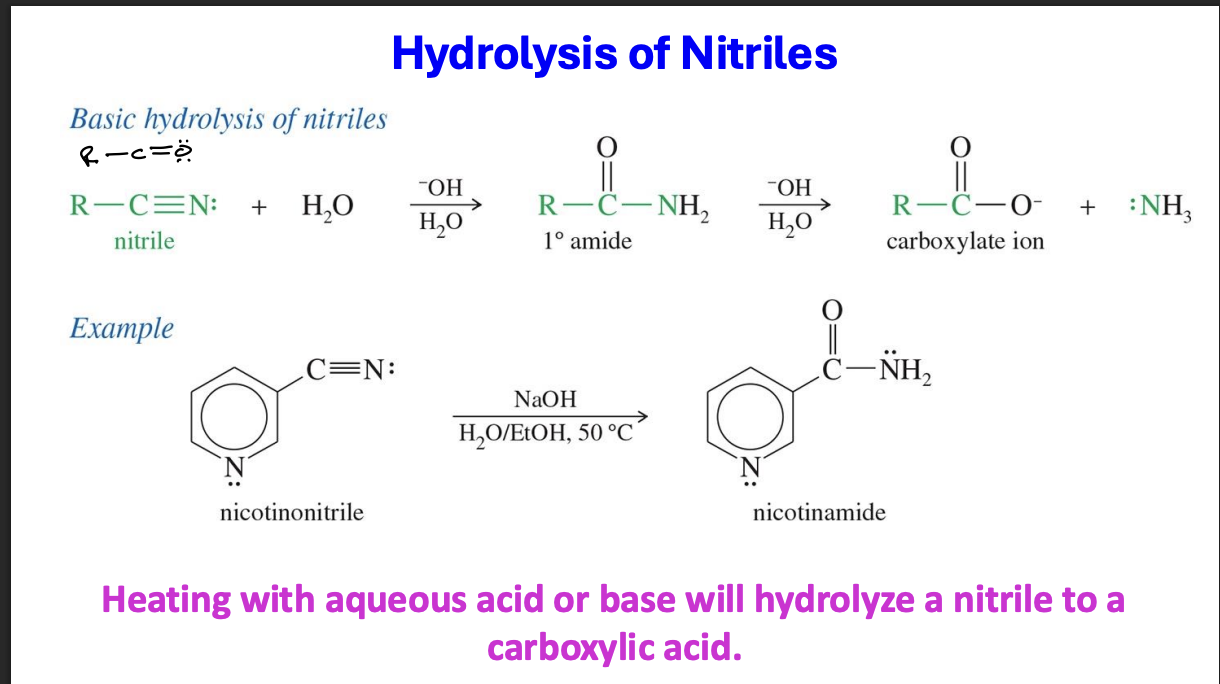
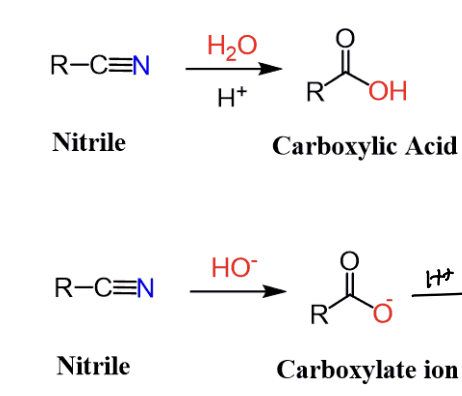
Hydrolysis of Nitriles

Starting:

  • Nitriles ( R–C≡N)

Reagent :

  • OH , H2O → basic

  • H+ , H2O → Acidic

End product

under acidic condition = Carboxylic acid

Basic condition = Carboxylate ion
<p>Starting: </p><ul><li><p>Nitriles ( R–C≡N)</p></li></ul><p>Reagent : </p><ul><li><p>OH , H<sub>2</sub>O → basic </p></li><li><p>H<sup>+</sup> , H<sub>2</sub>O → Acidic </p></li></ul><p>End product </p><p>under acidic condition = Carboxylic acid </p><p>Basic condition = Carboxylate ion </p><img src="https://knowt-user-attachments.s3.amazonaws.com/22efebab-a920-45be-9283-2698f56ec408.png" data-width="100%" data-align="center"><p></p>
10
New cards

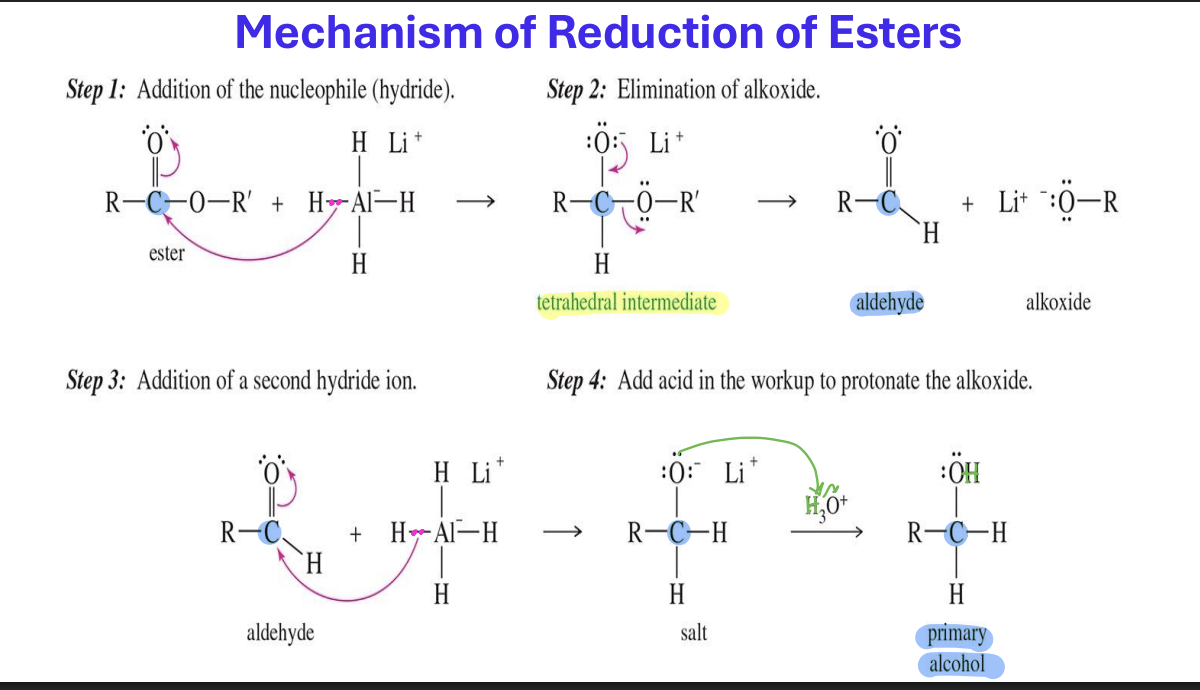
Reduction of Esters, carboxylic acid, acid halide to 1 Alcohols

Starting

  • Ester: R-C(=O)-O-R

  • Carboxylic Acid : R-C(=O)-OH

  • Acid chlorides R-C(=O)-Cl

Reagent:

  • LiALH4

  • LAH

  • H3O+

Mechanism

  1. the Carbon of the starting reagent attacks the LiAlh4 taking a hydrogen from the reagent , the double with Oxygen becomes singular

  2. A tetrahedral intermediate is formed R - C- O- OR

  3. The OR leaves and he double bond is restored → forming an aldehyde

  4. Another LiALH4 comes in and the carbon of the aldehyde attacks it taking a Hydrogen breaking the double bond

  5. Acid comes in and the Oxygen takes a hydrogen forming a primary alcohol
<p>Starting</p><ul><li><p>Ester: R-C(=O)-O-R</p></li><li><p>Carboxylic Acid : R-C(=O)-OH</p></li><li><p>Acid chlorides R-C(=O)-Cl</p></li></ul><p>Reagent:</p><ul><li><p>LiALH<sub>4</sub></p></li><li><p>LAH</p></li><li><p>H<sub>3</sub>O<sup>+</sup></p></li></ul><p>Mechanism</p><ol><li><p>the Carbon of the starting reagent attacks the LiAlh<sub>4</sub> taking a hydrogen from the reagent , the double with Oxygen becomes singular</p></li><li><p>A tetrahedral intermediate is formed R - C- O- OR</p></li><li><p>The OR leaves and he double bond is restored → forming an aldehyde</p></li><li><p>Another LiALH<sub>4</sub> comes in and the carbon of the aldehyde attacks it taking a Hydrogen breaking the double bond</p></li><li><p>Acid comes in and the Oxygen takes a hydrogen forming a primary alcohol</p></li><li><p></p></li></ol><p></p>
11
New cards

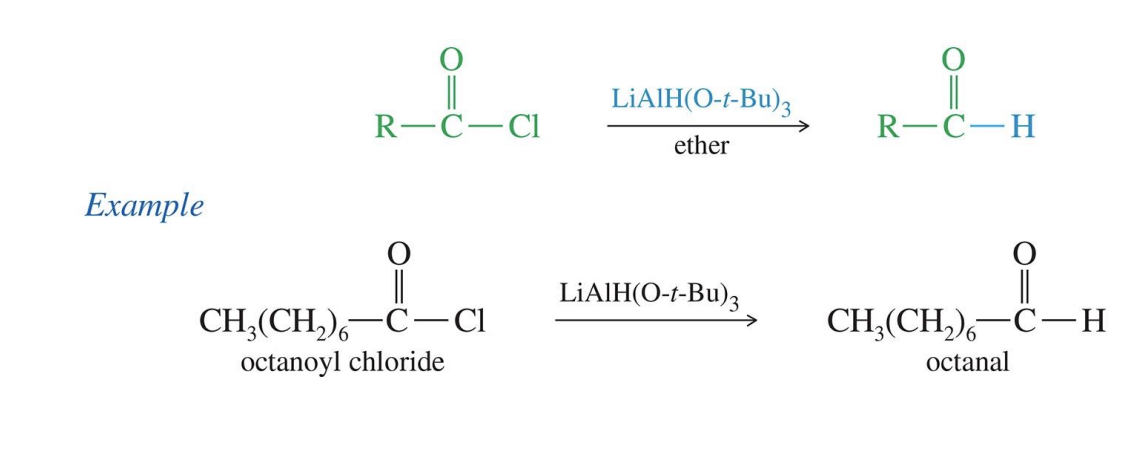
Reduction of Acyl Halides to Aldehydes

Starting :

  • Acyl Halides ( R - C ( = O) - X)

Reagent

  • LiALH ( O- t -BU)3

End product

  • aldehyde

<p>Starting : </p><ul><li><p>Acyl Halides ( R - C ( = O) - X)</p></li></ul><p>Reagent </p><ul><li><p>LiALH ( O- t -BU)<sub>3</sub></p></li></ul><p>End product </p><ul><li><p>aldehyde </p></li></ul><p></p>
12
New cards

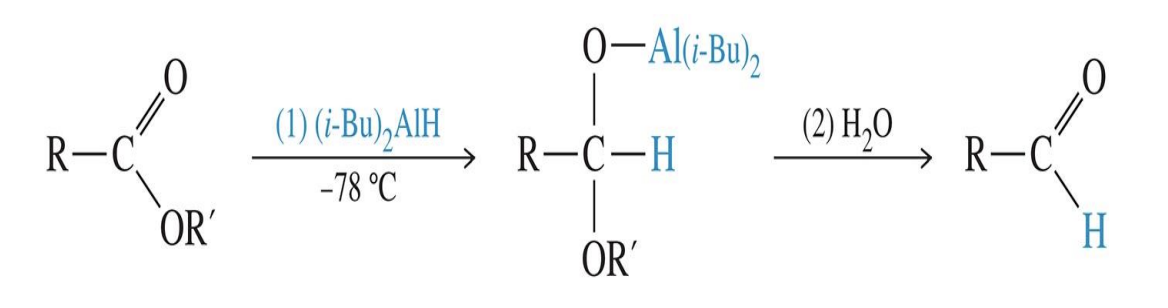
Reduction to aldehydes with DIABL

Starting

  • Esters R - C (=O) - OR

Reagent

  • DIABL or DIBAL -H

  • (i-Bu)2ALH

End product

  • aldehydes

<p>Starting </p><ul><li><p>Esters R - C (=O) - OR</p></li></ul><p>Reagent </p><ul><li><p>DIABL or DIBAL -H</p></li><li><p>(i-Bu)<sub>2</sub>ALH</p></li></ul><p>End product </p><ul><li><p>aldehydes </p></li></ul><p></p>
13
New cards

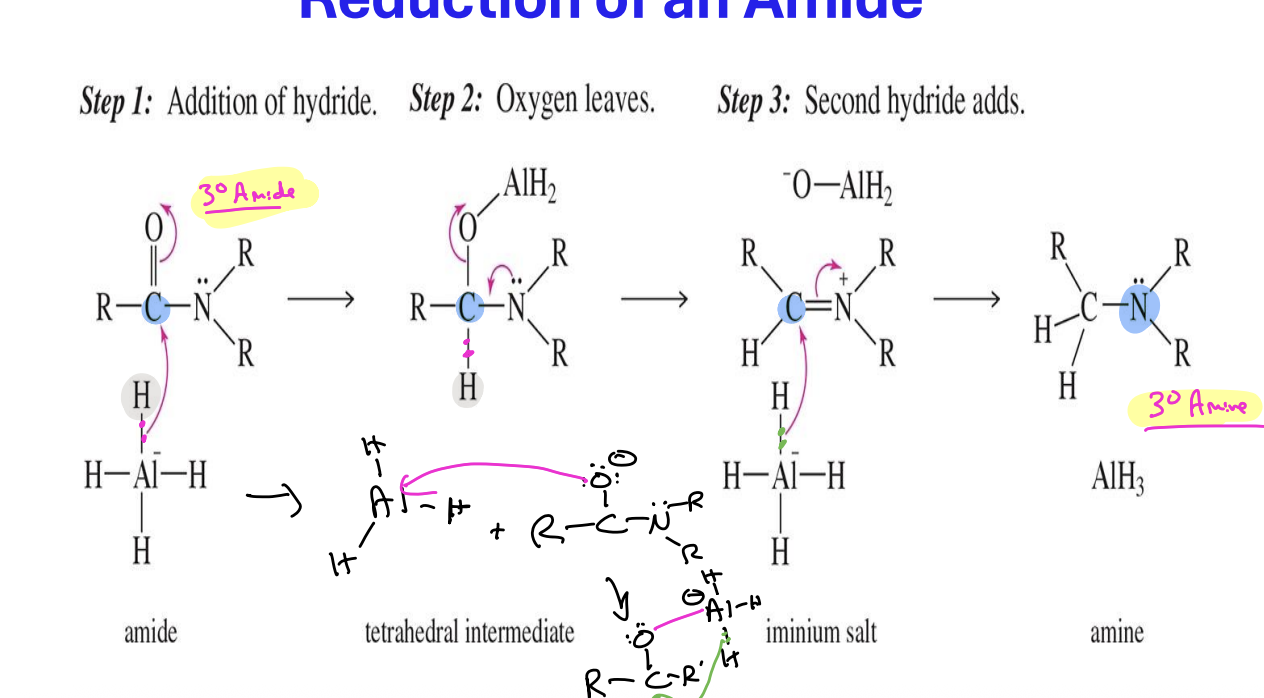
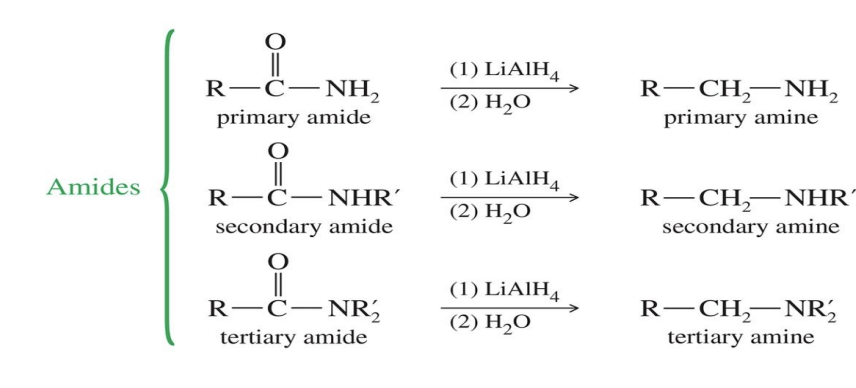
Reduction of amide to an amine

Starting:

  • Amide ( R - C ( = O ) - NH2

Reagent:

  • LiALH4

  • H2O

End product

  • amine

R - CH2 - NH2

R - CH2 - NH - R

<p>Starting: </p><ul><li><p>Amide ( R - C ( = O ) - NH<sub>2</sub></p></li></ul><p>Reagent: </p><ul><li><p>LiALH<sub>4</sub></p></li><li><p>H<sub>2</sub>O</p></li></ul><p>End product </p><ul><li><p>amine </p></li></ul><p>R - CH<sub>2</sub> - NH<sub>2</sub></p><p>R - CH<sub>2</sub> - NH - R</p><img src="https://knowt-user-attachments.s3.amazonaws.com/81fed3f1-62a5-4196-aa44-9c09d26e58cd.png" data-width="100%" data-align="center"><p></p>
14
New cards

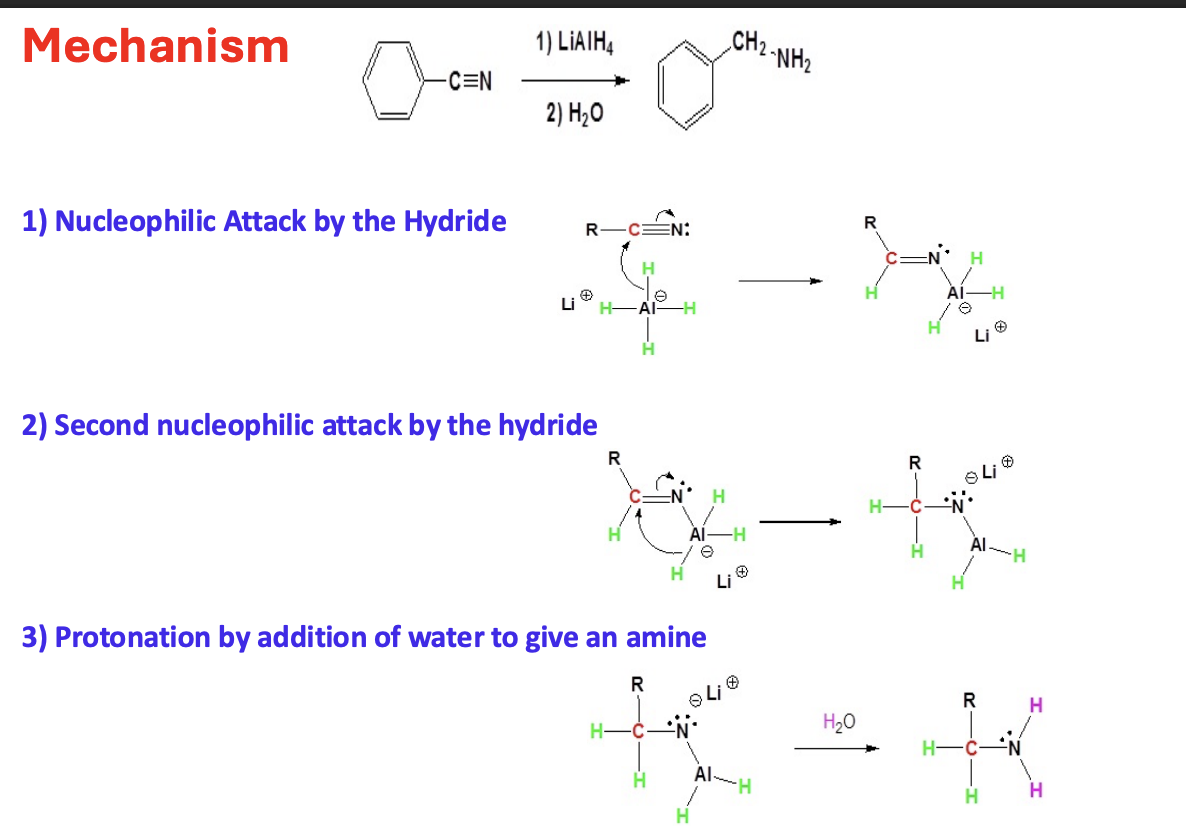
Reduction of Nitriles to primary Amines

Starting:

  • Nitriles R–C≡N

Reagent:

  • LAH or LiALH4

  • H2O

Mechanism

  1. One of the hydride ions (H⁻) from LiAlH₄ attacks the electrophilic carbon of the nitrile triple bond. This adds hydrogen to the carbon.

  2. A second hydride attacks. Now you have two H atoms added to the carbon

  3. When the water comes in it give two more hydrogen to nitrogen making the Al leave

End product primary amines
<p>Starting: </p><ul><li><p>Nitriles R–C≡N</p></li></ul><p>Reagent: </p><ul><li><p>LAH or LiALH<sub>4</sub></p></li><li><p>H<sub>2</sub>O</p></li></ul><p>Mechanism</p><ol><li><p><span style="font-size: medium;"><span>One of the hydride ions (H⁻) from LiAlH₄ attacks the electrophilic carbon of the nitrile triple bond. This adds hydrogen to the carbon.</span></span></p></li><li><p><span style="font-size: medium;"><span>A second hydride attacks. Now you have two H atoms added to the carbon</span></span></p></li><li><p><span style="font-size: medium;"><span>When the water comes in it give two more hydrogen to nitrogen making the Al leave </span></span></p></li></ol><p>End product primary amines </p><p></p>
15
New cards

Gringard reagent → to alcohol

Starting

  • Ester

  • Acid chloride

Reagent

  • R - MgX (comes in 2x)

  • H3O +

Mechanism

  1. the grignard attacks the starting product giving a R group

  2. a tetrahedral intermediate is formed where the double bond of O is single bonded

  3. The OR group leaves forming a Ketone

  4. Another R - mgX comes in and attack the ketone give an R group

FInal product

2 or 3 Alcohol depending on the R group

16
New cards

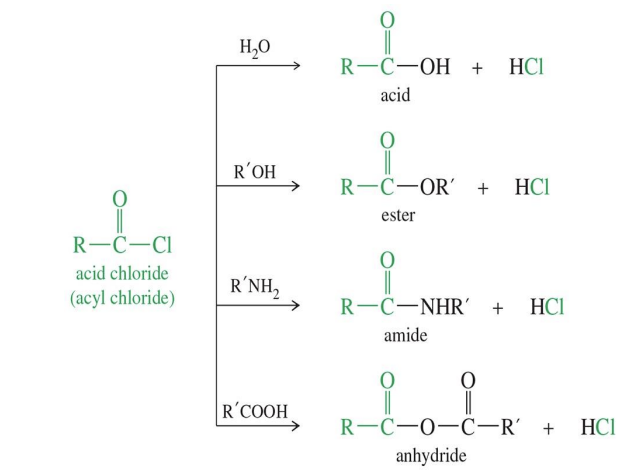
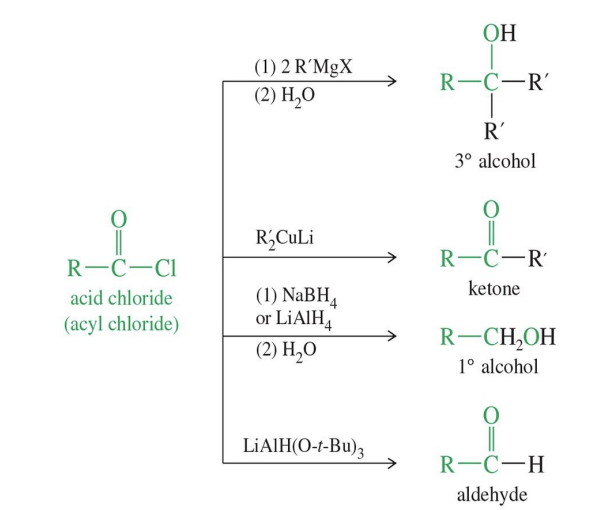
DIfferent Acid chloride reaction

17
New cards

Friedel crafts acylation

Starting

  • acid chloride

  • Benzene ring

Reagent

  • AlCL3

  • H2O

FInal product

  • Ketone

18
New cards

Anhydride Synthesis

Starting

  • Acid Chloride

  • Carboxylate

  • Carboxylic Acid

Reagent :

  • pyridine

<p>Starting </p><ul><li><p>Acid Chloride </p></li><li><p>Carboxylate</p></li><li><p>Carboxylic Acid </p></li></ul><p>Reagent : </p><ul><li><p>pyridine</p></li></ul><p></p>
19
New cards

Reaction of Anhydrides

<p> </p>
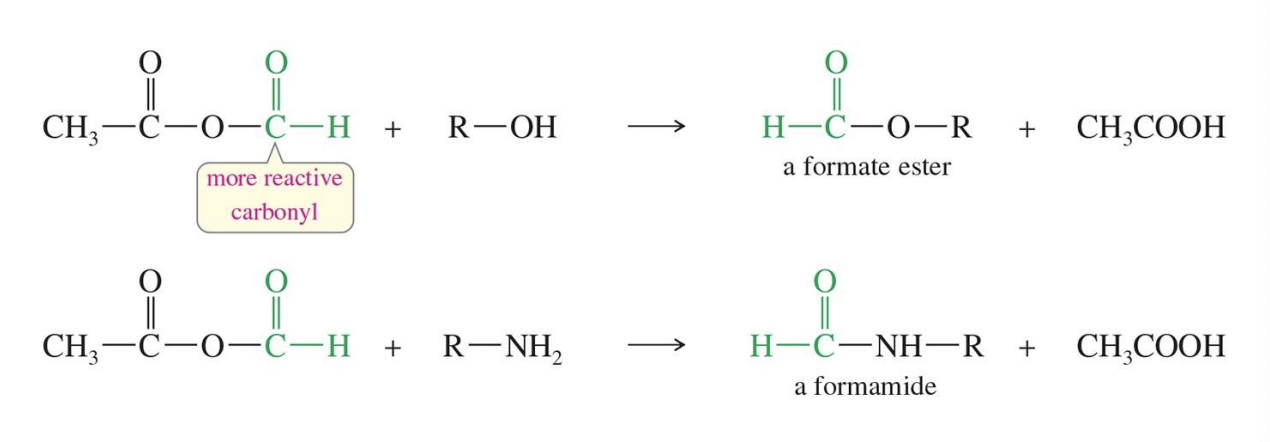
20
New cards

Acetic Formic Anhydride

Starting

  • Acetic Formic Anhydride CH₃-C(=O)-O-C(=O)-H)

Reagent

  • R - OH

  • R - NH2

End

  • Ester

  • Amide

  • Carboxylic Acid

<p>Starting </p><ul><li><p>Acetic Formic Anhydride CH₃-C(=O)-O-C(=O)-H)</p></li></ul><p>Reagent </p><ul><li><p>R - OH </p></li><li><p>R - NH<sub>2</sub></p></li></ul><p>End </p><ul><li><p>Ester </p></li><li><p>Amide </p></li><li><p>Carboxylic Acid </p></li></ul><p></p>
21
New cards

lactone formation

Starting :

  • hydroxy acid (a molecule with both -OH and -COOH groups)

Reagents:

5-6 membered rings: Form easily with just H⁺

7+ membered rings: Needs H+ And Benzene

End product:

  • Lactrones : cyclic esters formed from hydroxy acids
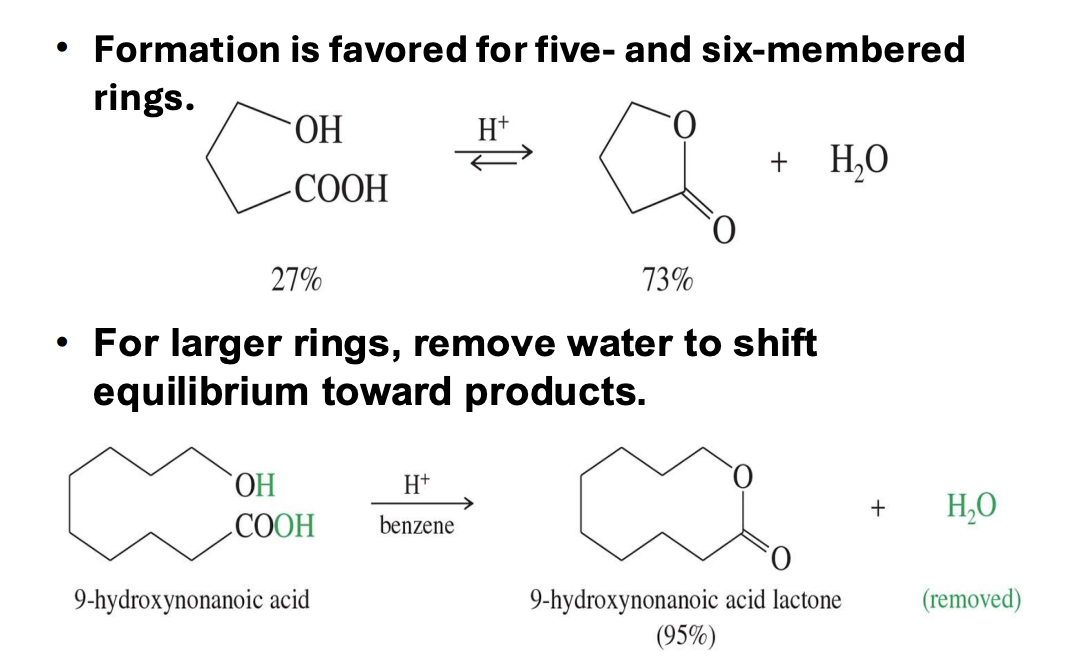
<p>Starting : </p><ul><li><p><strong>hydroxy acid</strong> (a molecule with both -OH and -COOH groups)</p></li></ul><p>Reagents:</p><p><strong>5-6 membered rings:</strong> Form easily with just H⁺</p><p><strong>7+ membered rings:</strong> Needs H<sup>+</sup> And Benzene</p><p></p><p>End product: </p><ul><li><p>Lactrones : cyclic esters formed from hydroxy acids</p></li></ul><p></p>
22
New cards

Reactions of Amides

<p></p><p></p>
23
New cards

Formation of Lactams

Starting :

  • An amino acid (a molecule with both -NH₂ and -COOH groups

Reagent

  • Heat

End product

Lactam → cyclic amide
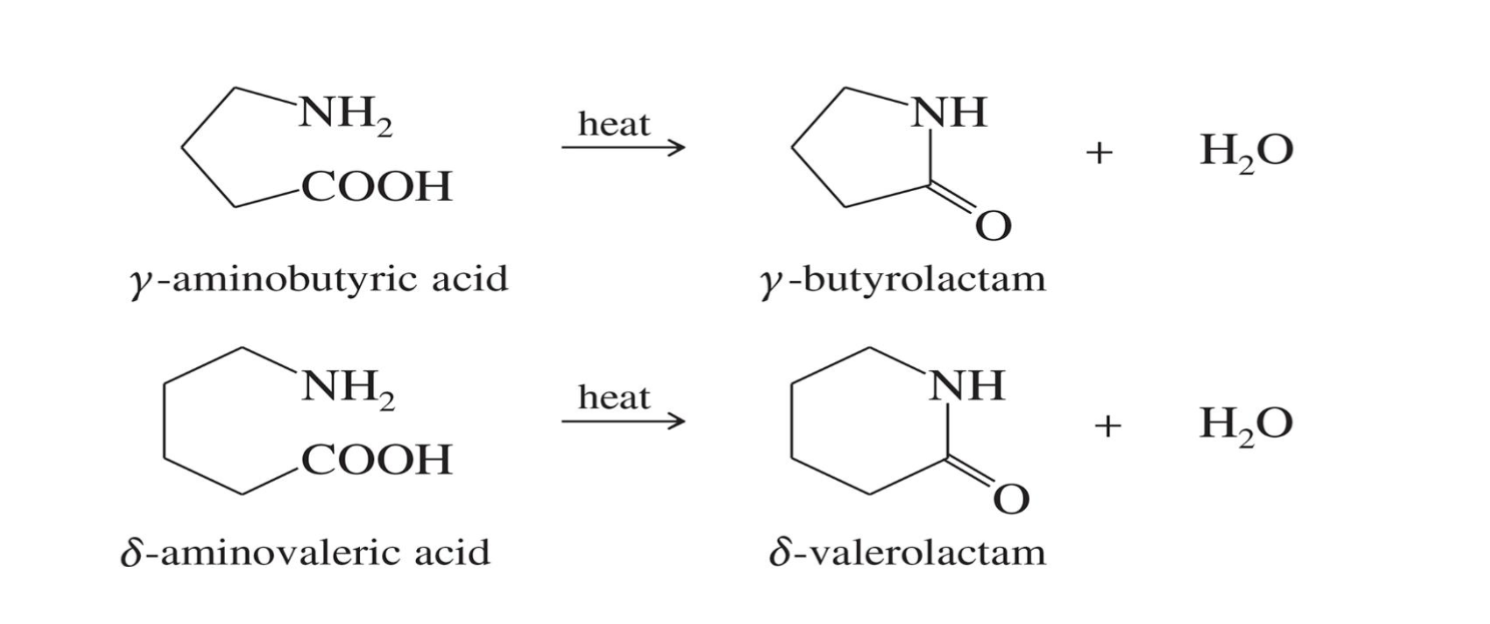
<p>Starting : </p><ul><li><p>An <strong>amino acid</strong> (a molecule with both -NH₂ and -COOH groups</p></li></ul><p>Reagent </p><ul><li><p>Heat</p></li></ul><p>End product</p><p> Lactam → cyclic amide</p>
24
New cards

Mechanism of B-Lactam Acylation

Starting material:

  • β-propiolactam (a 4-membered ring lactam with a C=O)

Reagent:

  • Nuc: (a nucleophile — could be water, an amine, an alcohol, etc.)

  • Water

Mechanism

  1. the Nuc attacks the Carbon with the double bonde with Oxygen

  2. The bond breaks between N and C

  3. Water comes in and donates a Hydrogen to the Nitrogen (protonation)

End product

Open-chain amide with a protonated amine group → acylated product
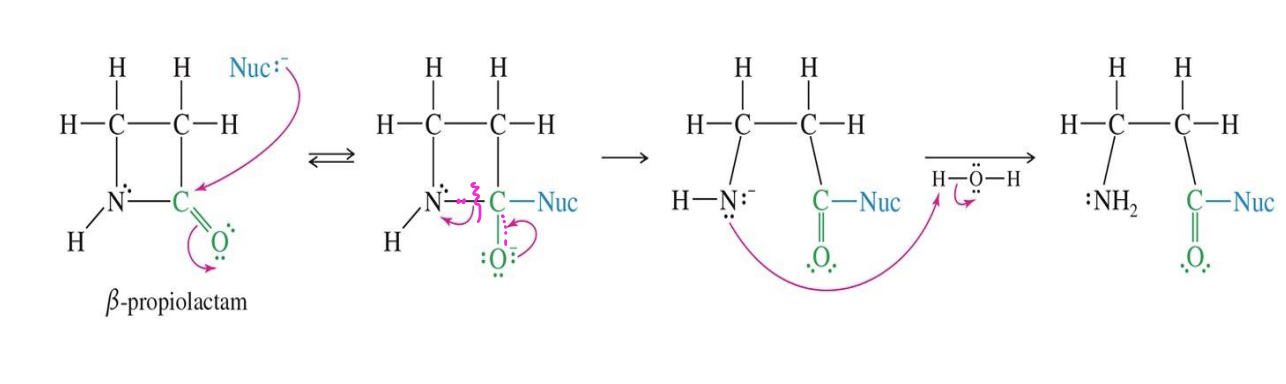
<p><strong>Starting material:</strong></p><ul><li><p><strong>β-propiolactam</strong> (a 4-membered ring lactam with a C=O)</p></li></ul><p class="font-claude-response-body break-words whitespace-normal "><strong>Reagent:</strong></p><ul><li><p><strong>Nuc:</strong> (a nucleophile — could be water, an amine, an alcohol, etc.)</p></li><li><p>Water</p></li></ul><p>Mechanism </p><ol><li><p>the Nuc attacks the Carbon with the double bonde with Oxygen </p></li><li><p>The bond breaks between N and C </p></li><li><p>Water comes in and donates a Hydrogen to the Nitrogen (protonation)</p></li></ol><p>End product </p><p>Open-chain amide with a protonated amine group → acylated product</p>
25
New cards

Thioesters formation

Starting

  • Carboxylic Acid

Reagent

  • Thiol ( R - SH)

Mechanism

  1. Thiol attacks the carbonyl carbon

  2. Oxygen gets protonated to make water (a good leaving group)

<p>Starting </p><ul><li><p>Carboxylic Acid </p></li></ul><p>Reagent </p><ul><li><p>Thiol ( R - SH)</p></li></ul><p>Mechanism </p><ol><li><p><strong>Thiol attacks</strong> the carbonyl carbon</p></li><li><p><strong>Oxygen gets protonated</strong> to make water (a good leaving group)</p></li></ol><p></p>
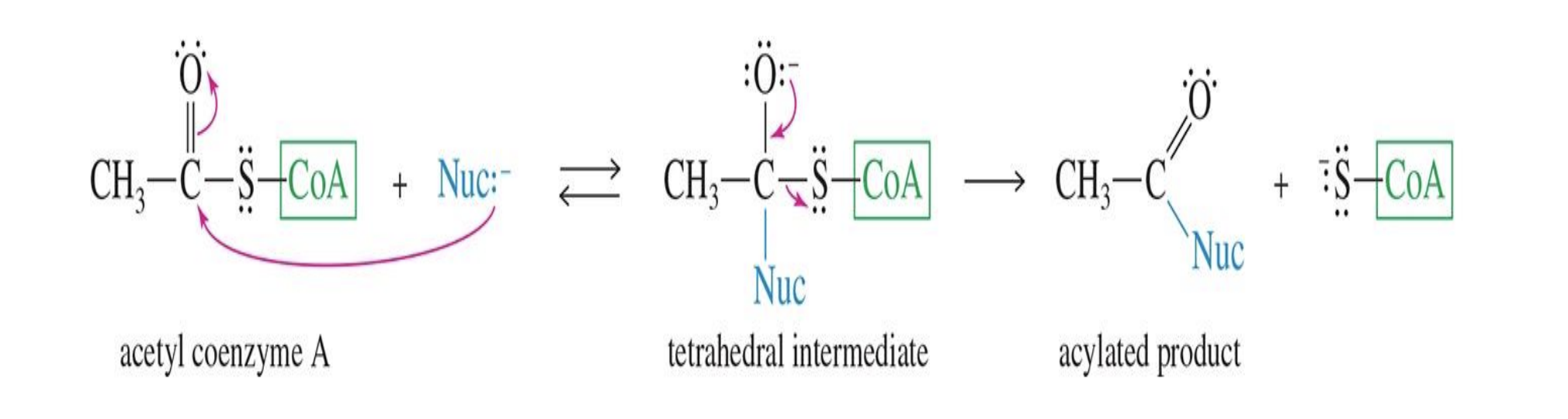
26
New cards

Mechanism of Action of Acetyl CoA:

Starting :

  • Acetyl CoA (acetyl coenzyme A) CH₃-C(=O)-S-CoA

Reagent:

Nuc: (a nucleophile — could be an -OH, -NH₂, -SH, or another nucleophile)

Mechanism

  1. Nucleophile attacks the carbonyl carbon of acetyl CoA → forms a tetrahedral intermediate

  2. CoA leaves as the leaving group

  3. Acylated product forms — the nucleophile now has an acetyl group attached

End product

  • acylated product (CH₃-C(=O)-Nuc)

  • Plus free coenzyme A (CoA-SH)

<p>Starting : </p><ul><li><p><strong>Acetyl CoA</strong> (acetyl coenzyme A)  CH₃-C(=O)-S-CoA</p></li></ul><p>Reagent: </p><p><strong>Nuc:</strong> (a nucleophile — could be an -OH, -NH₂, -SH, or another nucleophile)</p><p>Mechanism </p><ol><li><p><strong>Nucleophile attacks</strong> the carbonyl carbon of acetyl CoA → forms a tetrahedral intermediate</p></li><li><p><strong>CoA leaves</strong> as the leaving group</p></li><li><p><strong>Acylated product forms</strong> — the nucleophile now has an acetyl group attached</p></li></ol><p>End product </p><ul><li><p> <strong>acylated product</strong> (CH₃-C(=O)-Nuc)</p></li><li><p>Plus free <strong>coenzyme A</strong> (CoA-SH)</p></li></ul><p></p><p class="font-claude-response-body break-words whitespace-normal "></p>