Biological Psychology
 Call Kai
 Learn
Learn Practice Test
 Spaced Repetition
 Match
Match Flashcards
 Knowt Play
1/87

There's no tags or description
Looks like no tags are added yet.
Name | Mastery | Learn | Test | Matching | Spaced | Call with Kai | Chat |
|---|
No analytics yet
Send a link to your students to track their progress
88 Terms
What is the nervous system?
The nervous system is a specialised and complex network of cells in the human body. It is out primary internal communication system.
What are the two main functions of the nervous system?
It collects, processes and responds to information in the environment.
It coordinates the working of different organs and cells in the body.
What are the two components of the central nervous system (CNS)?
The brain
The spinal cord
What is the spinal cord?
A tube-like extension of the brain.
What is the spinal cord responsible for?
It passes messages to and from the brain, linking the brain to the peripheral nervous system.
It is also responsible for reflex actions.
What does the peripheral nervous system (PNS) consist of?
A series of nerve that carry information between the CNS and the rest of the body.
What is the function of the brain?
The brain is the source of our conscious awareness and where decision-making take place?
How are the two hemispheres of the brain connected?
The main one is the corpus callosum
Are the two hemispheres of the brain structurally similar?
Yes, they are nearly structurally identical
What is lateralisation in terms of the two brain hemispheres?
While the two hemispheres of the brain are nearly structurally identical, the two hemispheres have different functions.
What is localisation in terms of the two brain hemispheres?
Within each hemisphere, certain areas are responsible for specific functions and behaviours.
What is the name for the outer layer of the brain?
The cortex
What is the function of the cortex?
It allows humans to complete higher order mental functioning, and our highly developed cortex is what distinguishes our mental functioning from that of other animals.
What are gyri (singular gyrus)?
Ridges in the cerebral cortex
What are sulci (singular, sulcus)?
Valleys in the cerebral cortex
What are the lobes that each hemisphere of the cerebral cortex is divided into?
The frontal lobe, the parietal lobe, the occipital lobe and the temporal lobe.
What is the function of gray matter in the brain?
Conducts, processes, and sends information to various parts of the body.
What is the function of white matter in the brain?
Interprets sensory information from various parts of the body.
Where is cerebrospinal fluid contained?
In the central canal, which lies in the center of the spinal cord.
What is the purpose of the cerebrospinal fluid?
The primary function is to cushion the brain within the skull and serve as a shock absorber for the central nervous system.
Cerebrospinal fluid also circulates nutrients and removes waste products from the brain.
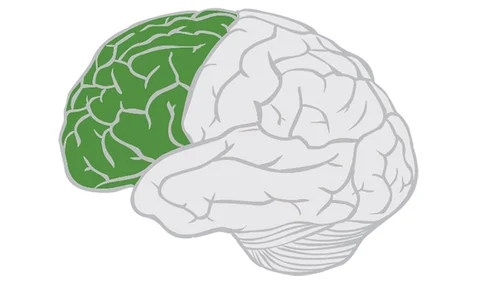
What is this bit of the brain called?
The frontal lobe
What is the function of the frontal lobe?
It controls memory, thinking and planning or all high level cognitive functions.
How does the prefrontal cortex influence aggression?
The prefrontal cortex is involved in decision-making, including the regulating of the activity of the amygdala which can lead to stress and aggressive behaviours.
Where is the motor cortex located?
In the frontal lobe
What is the motor cortex?
A long strip of neurons that run down alongside the centrul sulcus (valley) of the frontal lobe and the parietal lobe
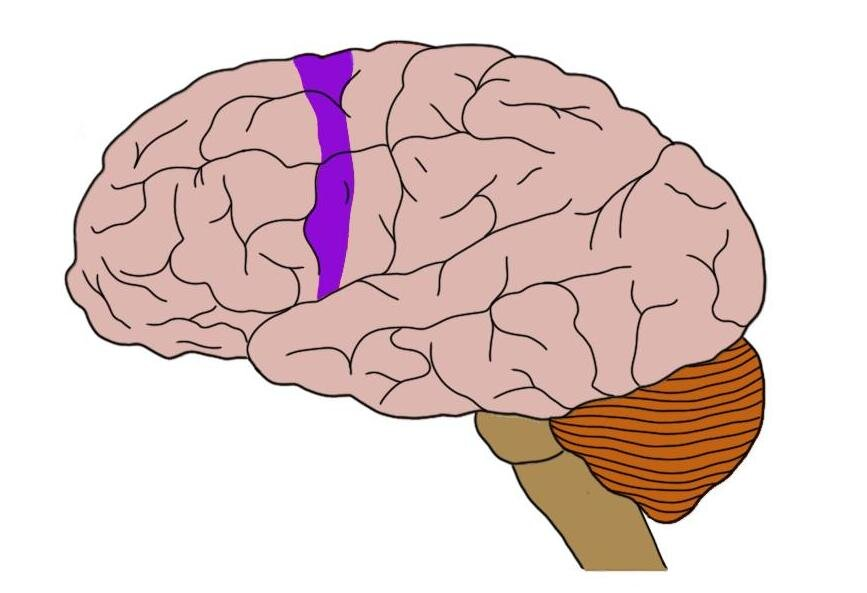
What is this?
The motor cortex
What side of the body’s voluntary movements does the motor cortex control?
The opposite side of the body (it is contralateral).
Where is the Broca’s area located?
The left frontal lobe
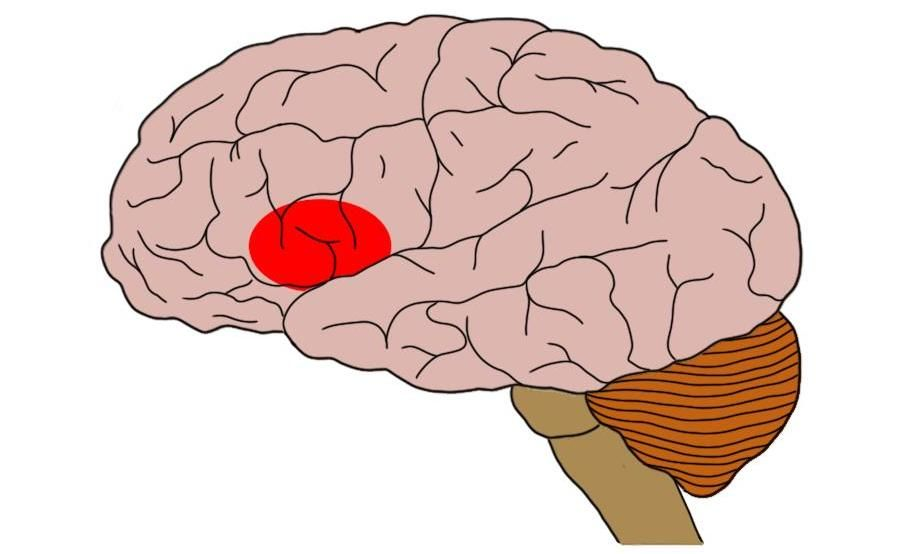
What is this part of the brain called?
Broca’s area
What is Broca’s area responsible for?
Speech production
What is damage to Broca’s area called?
Broca’s aphasia
How is a person affected if they suffer from Broca’s aphasia?
The main feature of Broca’s aphasia is slow and laborious speech lacking in fluency and a difficulty remembering how to form words
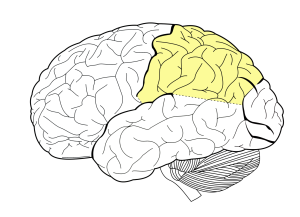
What part of the brain is this?
The parietal lobe
What does the parietal lobe do?
It processes sensory information, including touch, temperature, pressure, and pain, as well as spatial orientation and guidance for movement movement.
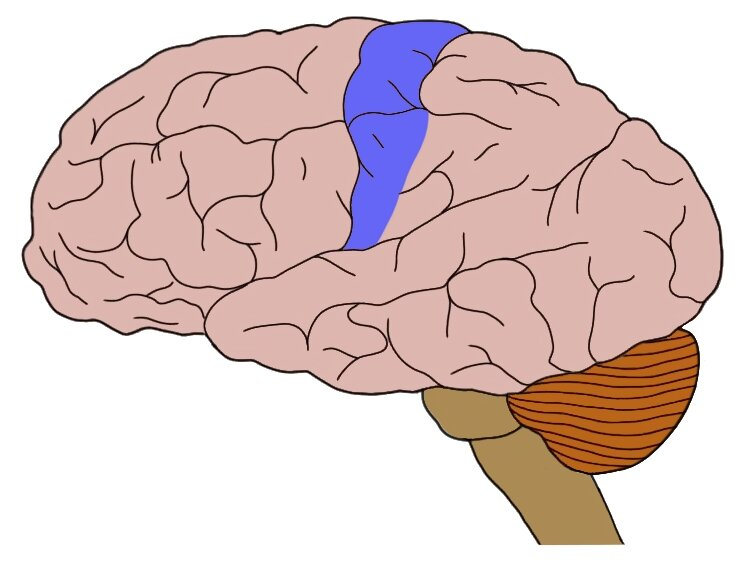
What is this area of the brain called?
The somatosensory cortex
Which lobe in the brain is the somatosensory cortex in?
The parietal lobe
What does the somatosensory cortex do?
It processes information from the skin, such as touch, heat and pressure, in a contralateral manner.
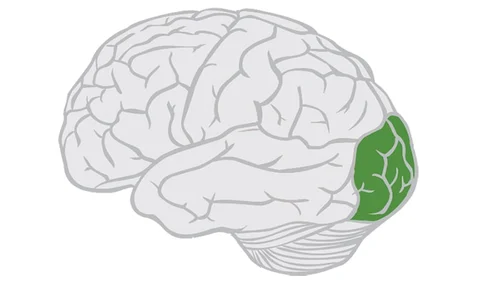
What is this part of the brain called?
The occipital lobe
What does the occipital lobe do?
The occipital love processes visual information including colour, shape and distance
What is this part of the brain called?
The primary visual cortex
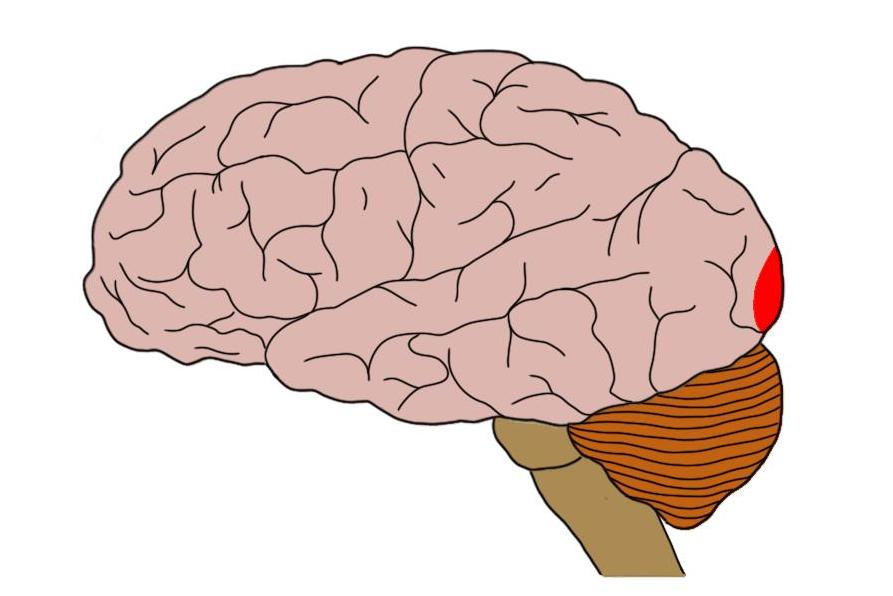
How is the visual cortex contralateral?
Everything we see to the right field of vision (from both the left and the right eye) is initally processes by the left visual cortex before being shared (via the corpus callosum) with the right visual cortex, and vice versa.
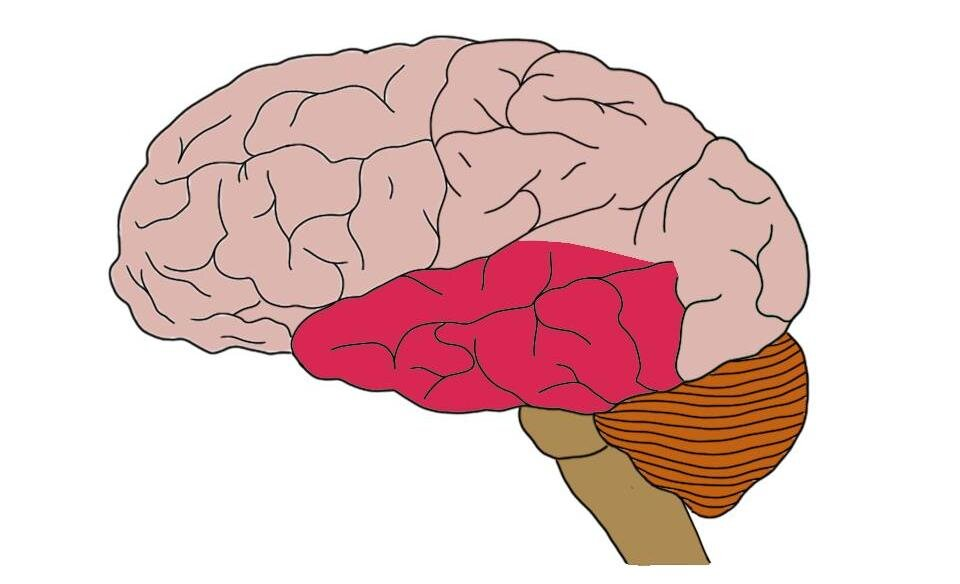
What is this part of the brain called?
The temporal lobe
What is the function of the temporal lobe?
Auditory processing, and for all hearing and language
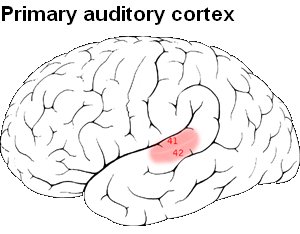
What is this part of the brain called?
The auditory cortex
What does part of the brain is the auditory cortex in?
The temporal lobe
What does the auditory cortex do?
It deals with sound information mainly coming from the opposite ear, and process the location, volume and pitches of sounds and therefore have a role in understanding language.
Where is Wernicke’s area located?
The upper left temporal lobe
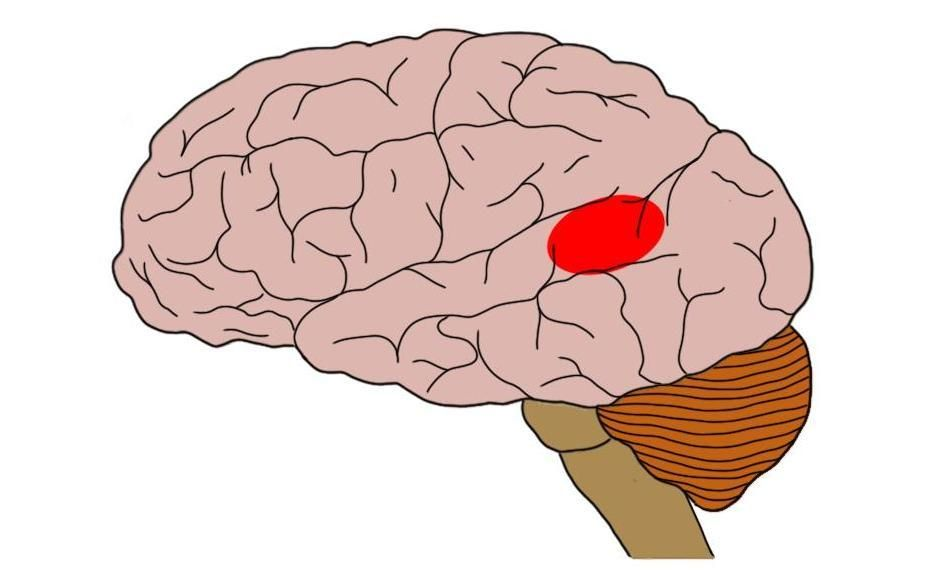
What is the name for this part of the brain?
Wernicke’s area
What is the name for patients who have damaged Wernicke’s area?
Wernicke’s aphasia
What are the symptoms of Wernicke’s aphasia
Patients have difficulty understanding language, and so produced fluent but meaningless speech
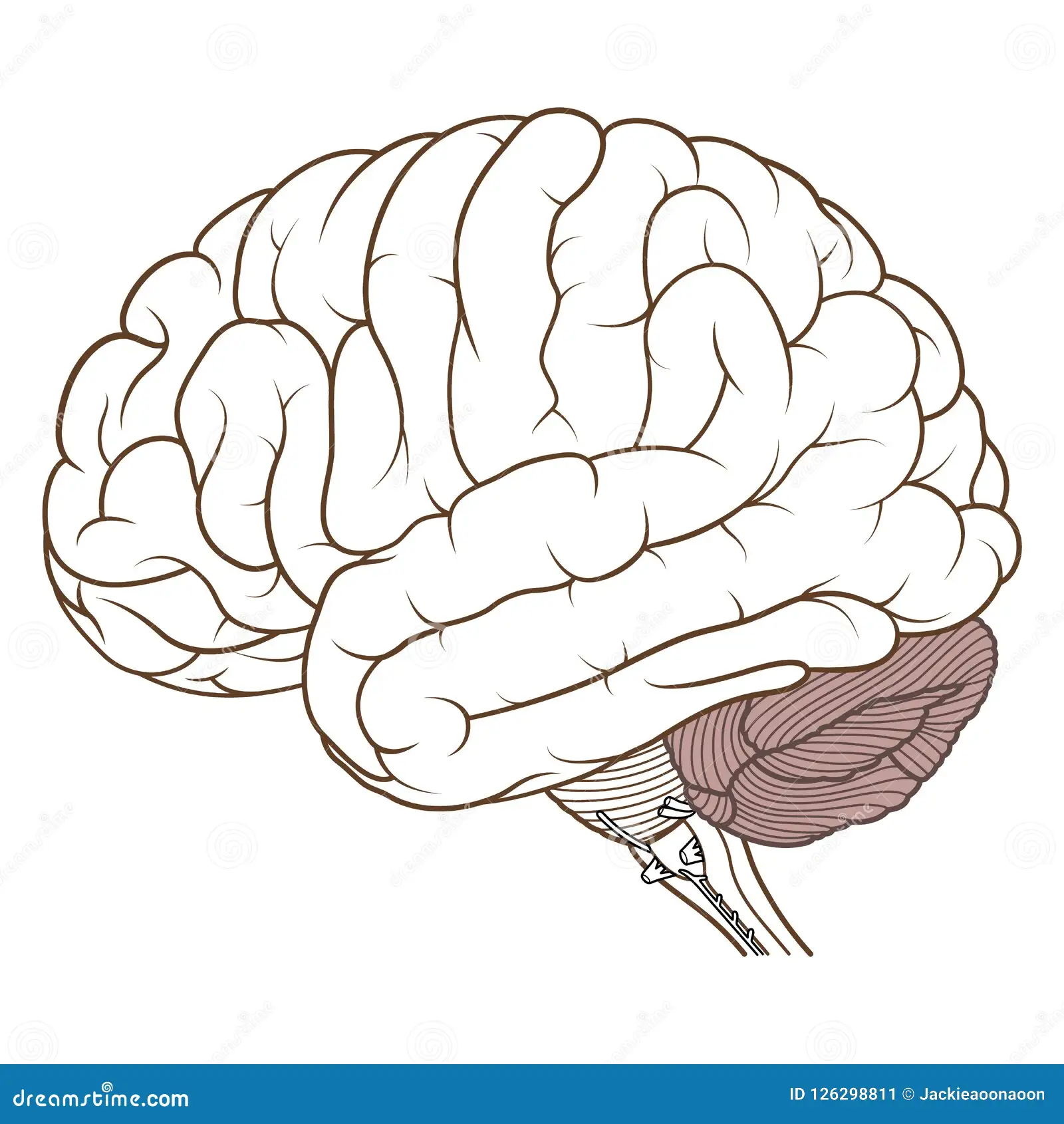
What is this part of the brain called?
The cerebellum
What is the function of the cerebellum?
To coordinate posture, balance, coordination and movement. The cerebellum controls automatic movements (like walking and running) and makes them smoother and more automatic. It also has a role in cognition (attention and language)
What is a neuron?
A nerve cell, the basic unit of the nervous system.
What is the function of a neuron?
To transmit signals electrically and chemically, allowing the nervous system to fulfil its communication function.
What is the axon?
A tube like structure in the middle of the neuron
What does function of the the axon?
It transfers electrical impulse signals from the cell body to the synapse
What are the dendrites connected to?
The cell body or the soma
What is the cell body also called?
The soma
What is the function of the axon terminal buttons?
It is where neurotransmission takes place
What is the function of a synapse?
To send electrical impulses to neighbouring neurons
What is the myelin sheath formed of?
Gial cells that wrap themselves around the axon
What is the function of the myelin sheath?
It covers the axon and works like insulation to help keep electrical signals inside the cell, which allows them to move more quickly.
What is the function of a node of ranvier?
It increases the speed of electrical transmission of the impulse, as it forces the impulses to ‘jump’ across the gap in the myelin sheath
What does the nucleus contain?
The cell’s genetic material (DNA)
What is the nerve impulse or electrical signal know as?
Action potential
What direction does the action potential travel in the axon?
Away from the nucleus down the axon towards the axon terminal buttons.
What type of axons are not surrounded by a myelin sheath?
Relay neurones
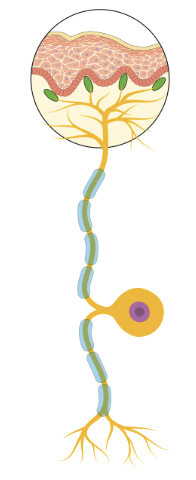
What type of neuron is this?
A sensory neuron (sticky out bit)
What is the function of sensory neurons?
They carry nerve impulses from sensory receptors (e.g. touch and temperature-sensitive receptors in the skin) along nerves in the peripheral nervous system PNS) to the central nervous system (CNS)
Where are sensory neurons found?
In receptor cells (e.g. eyes and skin)
How do sensory neurons allow for quick reflex actions?
Not all sensory neurons reach the brain, and some neurons stop at the spinal cord, allowing for quick reflex actions.
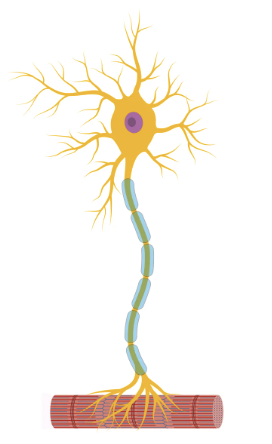
What type of neuron is this?
Motor neuron (Miles of straight axon)
Where are motor neurons found?
In the central nervous system (CNS)
What is the function of motor neurons?
They control muscle movements, when motor neurones are stimulated, they release neurotransmitters that bind to the receptors on muscles to trigger a response, which lead to movement.
What do motor neurones connect?
They connect the central nervous system (CNS) or the brain to effectors such as muscles and glands
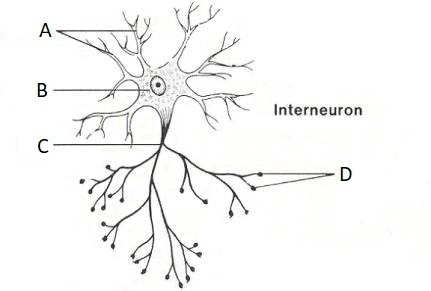
What type of neuron is this?
Relay Neuron (Really short axon, removed myelin sheath)
What are the function of relay neurones?
They connect sensory and motor neurons together, but also connect to other relay neurons, they allow sensory and motor neurons to communicate
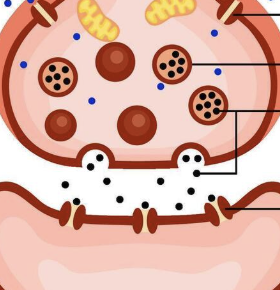
What part of the neuron is this?
Synapse
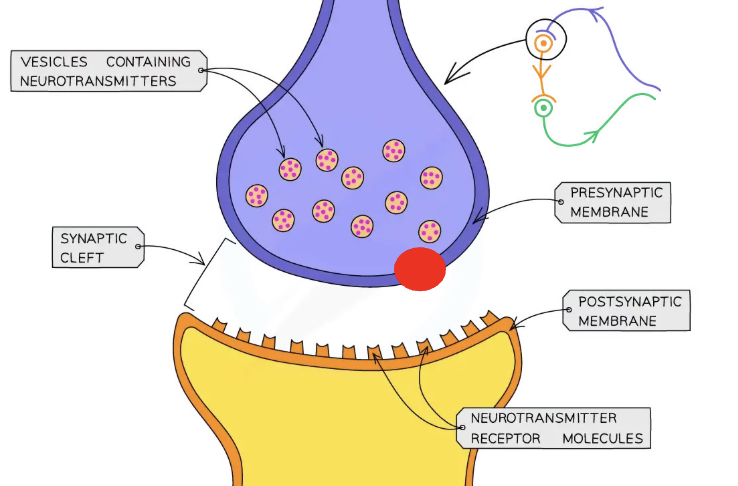
What is this red dot in the synapse of a neuron called?
Reuptake transporter protein
Describe the process of synaptic transmission in a neuron?
Action potential stimulates the vesicles in the presynaptic neuron, and the vesicles move and bind to the presynaptic membrane. Neurotransmitters diffuse across the synapse and bind to the post-synaptic receptor; the action potential returns in the post synaptic neuron.
In the presynaptic neuron membrane, there is a reuptake transporter protein, which reuptakes neurotransmitters in the presynaptic neuron and recycles the neurotransmitters to the vesicles.
What are neurotransmitters?
Brain chemicals released from presynaptic vesicles
What do neurotransmitters do?
Neurotransmitters relay signals from one neuron to another across a synapse
What is the definition of recreational drugs?
Recreational drugs are taken without medical justification for their psychoactive effects in the belief that they are not habit forming or addictive.
What biological effect do recreational drugs have that produces pleasurable feelings of euphoria?
Drugs hijack the reward systems, such as the basal ganglia which plays an important role in positive forms of motivation, to produces pleasurable feelings of euphoria
What are the last two general A01 points to bring into an essay on recreational drugs?
Some drugs mimic the role of a neurotransmitter and can bind to the receptor sites of post-synaptic neurons in order to increase neurotransmission functions.
Other drugs can cause the neurons to release large amounts of natural neurotransmitters or preven the normal recycling of these brain chemicals by interfering with transporters.
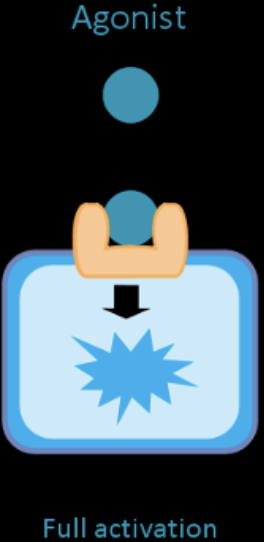
What are agonists?
Drugs that occupy receptors and activate them, or stimulators.
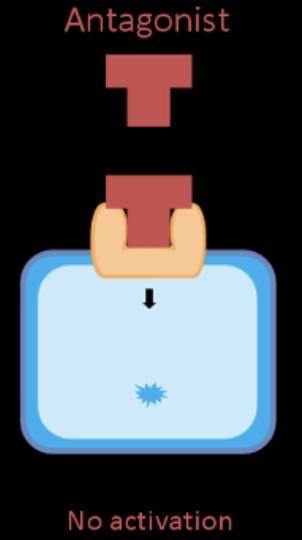
What are antagonists?
Drugs that occupy receptors but do not active them, instead antagonists bloc receptor activation by agonists, they are inhibitors.
What was Schroeder (2007)?
The study deliberately damaged the mesocorticolimbic in mice brains, this meant the neurons were unable to produce levels of dopamine normally associated with reward.
Normal mice would self administer cocaine
However the damaged mice didn’t
This finding supports the view that cocaine’s effects are due to the activity of dopamine in the brain’s reward system.