Cranial nerves - NS - final
 Call Kai
 Learn
Learn Practice Test
 Spaced Repetition
 Match
Match Flashcards
 Knowt Play
1/60

There's no tags or description
Looks like no tags are added yet.
Name | Mastery | Learn | Test | Matching | Spaced | Call with Kai | Chat |
|---|
No analytics yet
Send a link to your students to track their progress
61 Terms
Cranial nerves - 4 main function?
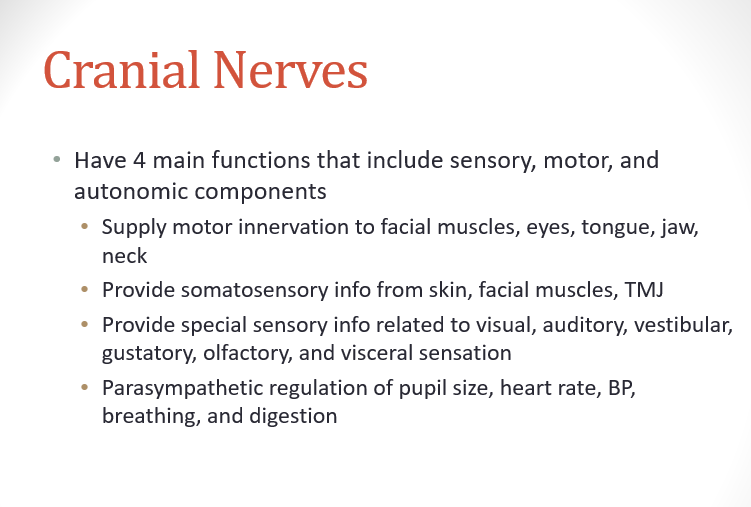
Supply motor innervation to?
Provide somatosensory info from?
Provide special sensory info related to?
Parasympathetic regulation of?
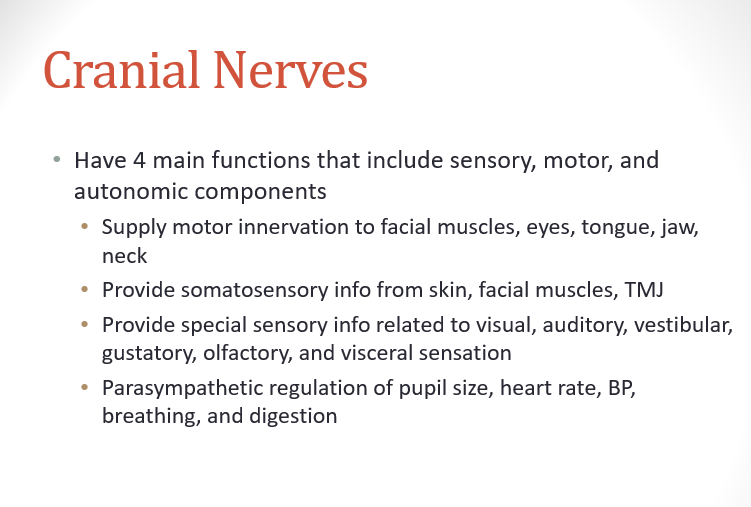
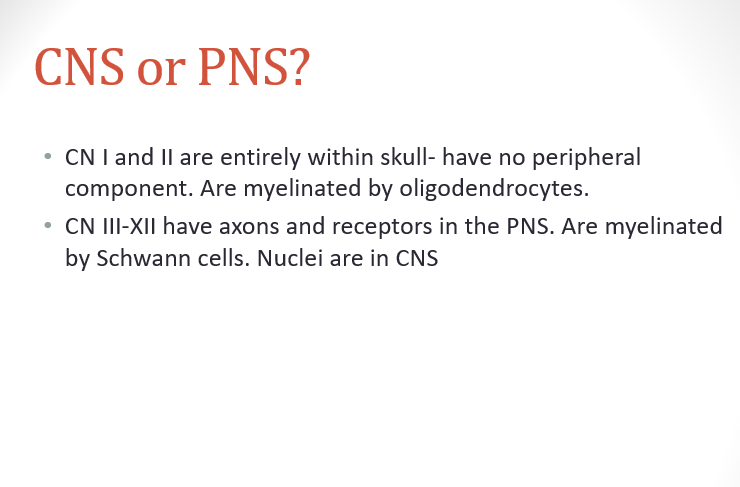
Which cranial nerves are CNS vs PNS

What are the cranial nerves myelinated by?
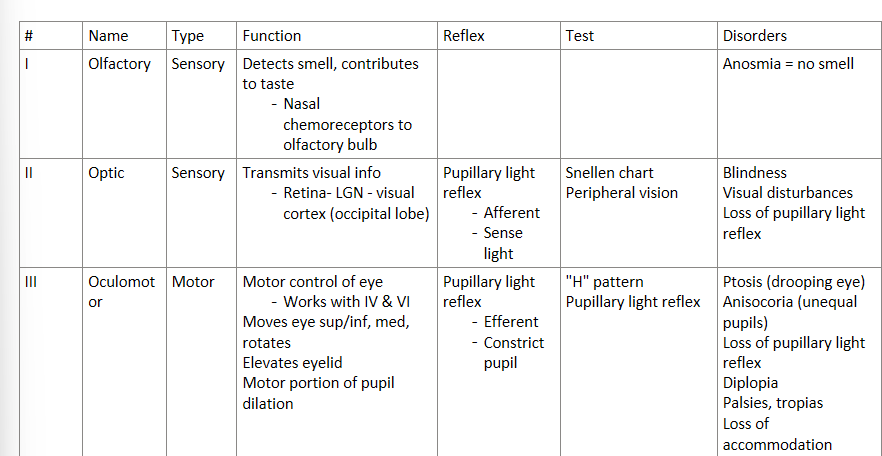
Cranial nerves name and type

CN I - function?
CN I
__ to __

CN II function
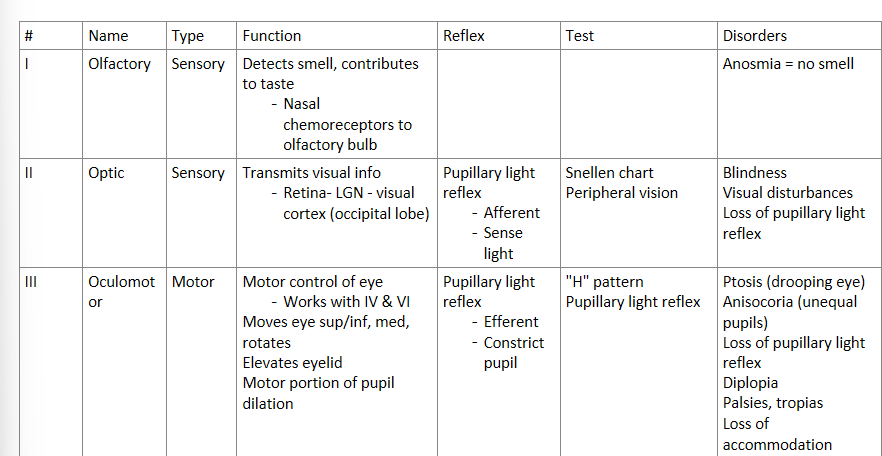
CN III Function

CN IV function

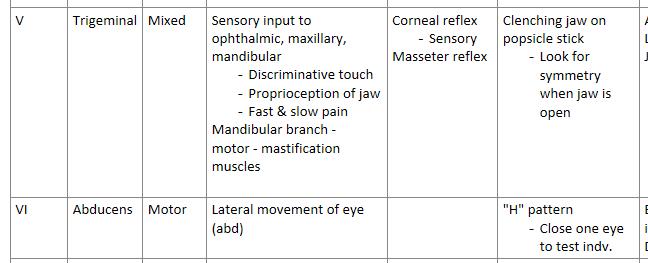
CN V function
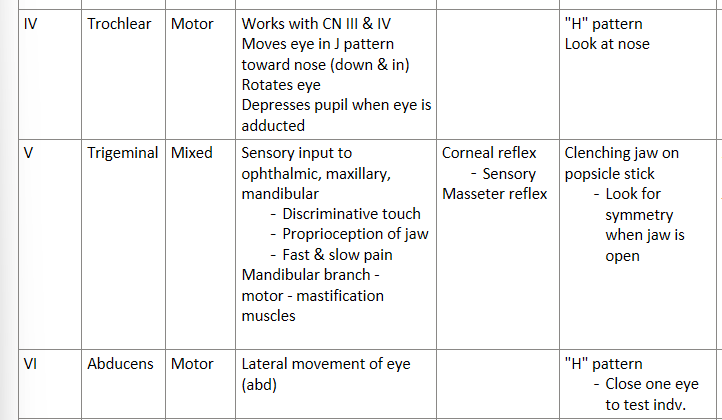
CN VI function

CN VII function
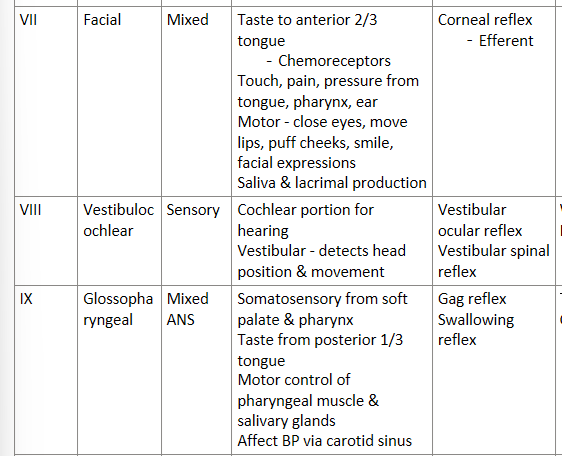
CN VIII function
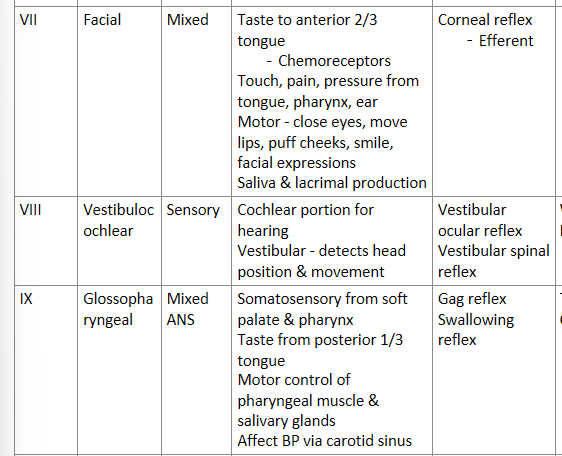
CN IX function

CN X function
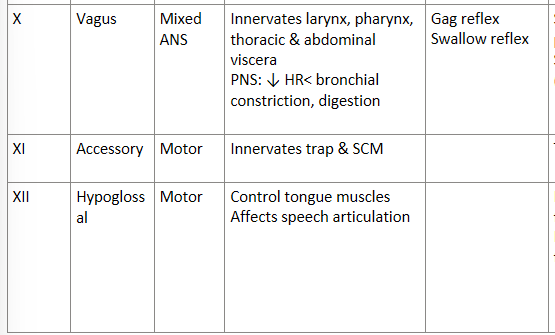
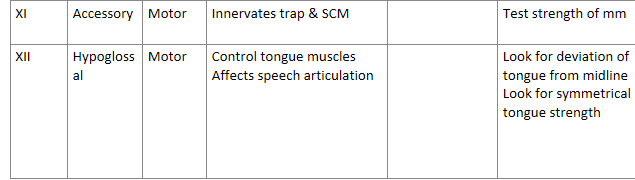
CN XI function

CN XII function

Reflexes
Which have reflexes & what parts
II: Pupillary light reflex (afferent - sense light)
III: Pupillary light reflex (motor- constrict pupil)
V: Corneal reflex (sensory) & Masseter reflex
VII: Corneal reflex (efferent)
VIII: Vestibular ocular & spinal reflex
IX: Gag & swallow reflex
X: Gag & swallow reflex
How do you test the optic nerve?
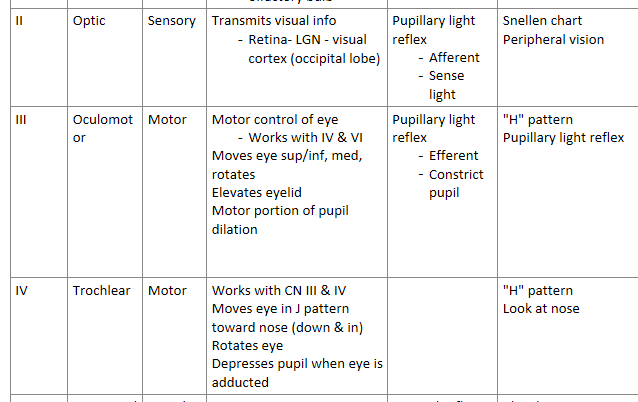
How do you test the oculomotor nerve

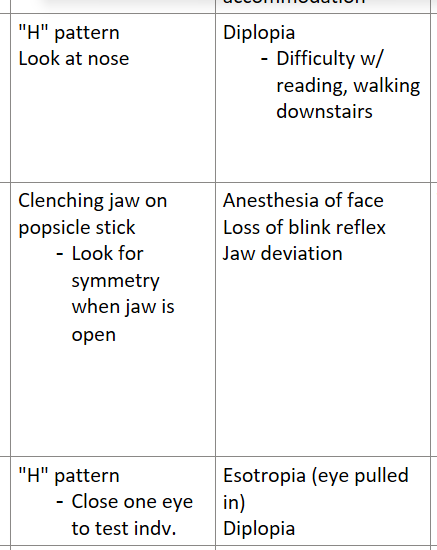
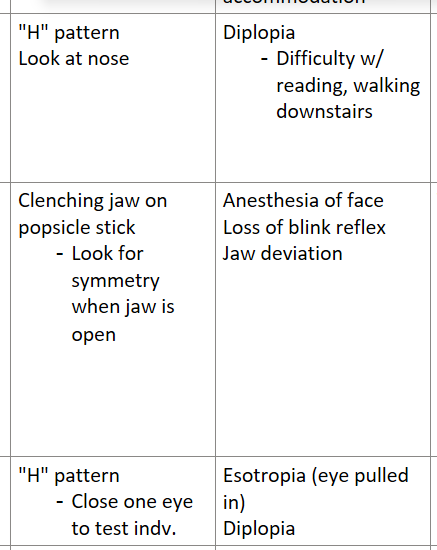
How do you test the trochlear nerve

How do you test the trigeminal nerve?

How do you test the abducens nerve?
How do you test the vestibulocochlear nerve
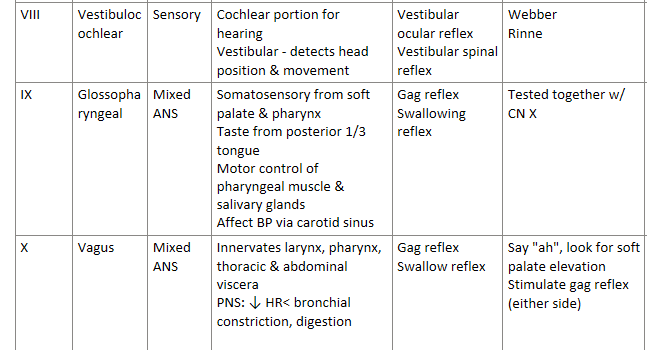
How do you test the glossopharyngeal nerve
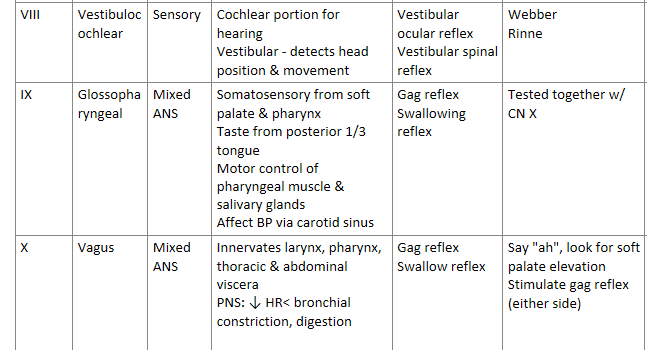
How do you test the vagus nerve

How do you test the accessory nerve

How do you test the hypoglossal nerve
Disorders of CN I
Anosmia = no smell

Disorders of CN II
Blindness
Visual disturbances
Loss of pupillary light reflex

Disorders of CN III
Ptosis (drooping eye)
Anisocoria (unequal pupils)
Loss of pupillary light reflex
Diplopia
Palsies, tropias
Loss of accommodation

Disorders of CN IV
Diplopia
Difficulty w/ reading, walking downstairs
Disorders of CN V
Anesthesia of face
Loss of blink reflex
Jaw deviation
Disorders of CN VI
Esotropia (eye pulled in)
Diplopia

Disorders of CN VII
Inability to close mouth or eye
Facial or mouth droop
Difficulty articulating speech
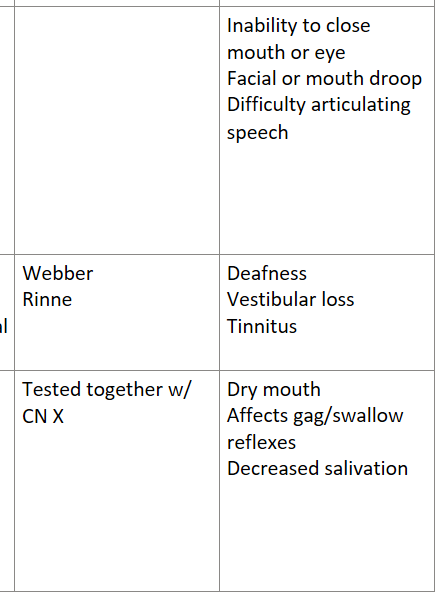
Disorders of CN VIII
Deafness
Vestibular loss
Tinnitus

Disorders of CN IX
Dry mouth
Affects gag/swallow reflexes
Decreased salivation

Disorders of CN X
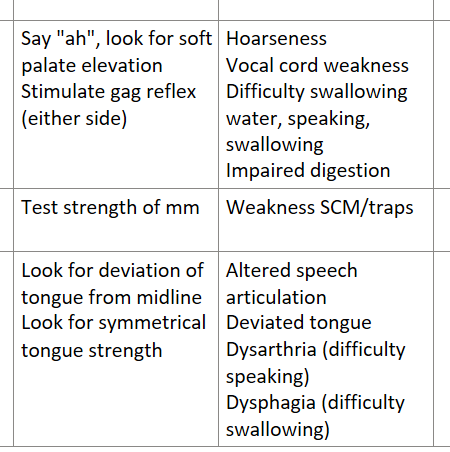
Hoarseness
Vocal cord weakness
Difficulty swallowing water, speaking, swallowing
Impaired digestion

Disorders of CN XI
Weakness SCM/traps
Disorders of CN XII
Altered speech articulation
Deviated tongue
Dysarthria (difficulty speaking)
Dysphagia (difficulty swallowing)
Which cranial nerve is associated with Horner’s syndrome
CN III - oculomotor
Which cranial nerve is associated with Bell’s Palsy, trauma, Lyme disease, MS, tumor, cyst, Ramsay-Hunt (also affects CN VIII)
VII - facial
Pupillary light reflex tests which cranial nerve
CN II & III together
PNS - which nerve & functions
PNS
CN III
Accommodation of lens for near vision
Constricts pupil
SNS functions
SNS
Elevates eyelid
Dilates pupil
How to tell the difference with pupillary light reflex
Pupillary reflex: pupil constriction by direct stimulation of eye with bright light
CN II: afferent, sense light
CN III: efferent, constricts pupil
Neither eye constricts - sensory issue
Unilateral constriction - motor issue
What is the consensual reflex
Consensual reflex : simultaneous constriction of pupil in other eye
What is the corneal reflex and what nerves?
Corneal reflex: blink in response to corneal touch
Combo of trigeminal & facial
What is the masseter reflex
Masseter reflex: light downward tap to chin = jaw closes)
The Organ of Corti convers what into what?
Organ of Corti is the organ of hearing: converts mechanical energy (vibration) into sound
Auditory info is transmitted to what 3 structures and what are there functions?
Auditory info transmitted to
Reticular formation: sound that wakes you up
Inferior colliculus: detects location of sounds
Medial geniculate body: to primary auditory cortex - conscious awareness
What is the function of the vestibular ocular and spinal reflexes
Vestibular ocular and spinal reflex
Helps you stay up against gravity
Gag & swallow reflex - what nerves have what parts?
Gag & swallow reflex
Afferent: glossopharyngeal
Motor: vagus
Swallowing
Oral Stage
Lips close around food:
Jaw, cheek, tongue manipulate food:
Larynx closes:
Swallow reflex:
Swallowing
Oral Stage
Lips close around food: Facial (VII)
Jaw, cheek, tongue manipulate food: Trigeminal, Facial, Hypoglossal (V, VII, XII)
Larynx closes: Vagus (X)
Swallow reflex: Glossopharyngeal (IX)
Swallowing
Pharyngeal/Laryngeal Stage
Food moves into pharynx:
Soft palate rises, epiglottis covers trachea, food moves into esophagus:
Pharyngeal/Laryngeal Stage
Food moves into pharynx: Glossopharyngeal (IX)
Soft palate rises, epiglottis covers trachea, food moves into esophagus: Vagus (X)
Swallowing
Esophageal Phase
Peristalsis moves food down to stomach:
Esophageal Phase
Peristalsis moves food down to stomach: Vagus (X)
Speaking
Sound generated by ___ & articulated by ____:
Sound generated by larynx & articulated by soft palate: Vagus (X)
Speaking
To form sounds, requires what 3 things? nerves?
To form sounds, requires
Tongue: Hypoglossal (XII)
Lips: Facial (VII)
Jaw: Trigeminal (V)
What is a drooping eye called?
What is unequal pupils called?
What is double vision called?
What is eye pulled in called?
Ptosis
Anisocoria
Diplopia
Esotropia
Dysfunction with which nerves can cause diplopia
III, IV, VI