calc formulas cummulative
 Studied by 0 people
 Call with Kai
 Learn
Learn Practice Test
 Spaced Repetition
 Match
Match Flashcards
 Knowt Play
1/65

There's no tags or description
Looks like no tags are added yet.
Name | Mastery | Learn | Test | Matching | Spaced | Call with Kai |
|---|
No study sessions yet.
66 Terms
tanx=
sinx/cosx
cotx=
cosx/sinx
secx=
1/cosx
cscx=
1/sinx
sin2x + cos2x =
1
sec2x - tan2x =
1
sin2x =
2sinxcosx
cos2x =
cos2x - sin2x
cos2x =
(1/2)(1 + cos2x)
sin2x =
(1/2)(1 - cos2x)
sin(A + B) =
sinAcosB + cosAsinB
sin(A - B) =
sinAcosB - cosAsinB
cos(A + B) =
cosAcosB - sinAsinB
cos(A - B) =
cosAcosB + sinAsinB
sinAcosB =
(1/2)(sin(A + B) + sin(A - B))
cosAsinB
(1/2)(sin(A + B) - sin(A - B))
sinAsinB =
(1/2)(cos(A - B) - cos(A + B))
cosAcosB =
(1/2)(cos(A - B) + cos(A + B))
ln(ab) =
lna + lnb
ln(a/b)
lna - lnb
ln(an)
nlna
ln(1/a) =
-lna
limit
limx→af(x) = L
Definition of Continuity: function is continuous at x=a iff
f(a) exists
limx→af(x) exists
limx→af(x) = f(a)
Intermediate Value Theorem (IVT): If
f is continuous on the closed interval [a,b]
f(a) ≠ f(b)
k is between f(a) and f(b)
Then there exists a number c between a and b for which f(c) = k
Squeeze Theorem
If f(x) ≤ g(x) ≤ h(x) and as x → a, f(x) → L and h(x) → L then g(x) → L
Law of Cosines:
c2 = a2 + b2 - 2abcosc
Law of Sines
a/sin(A) = b/sin(B) = c/sin(C)
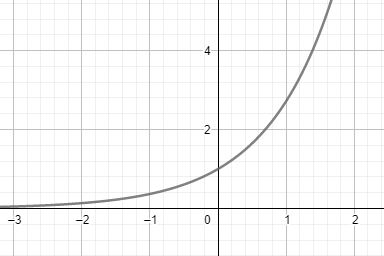
ex graph
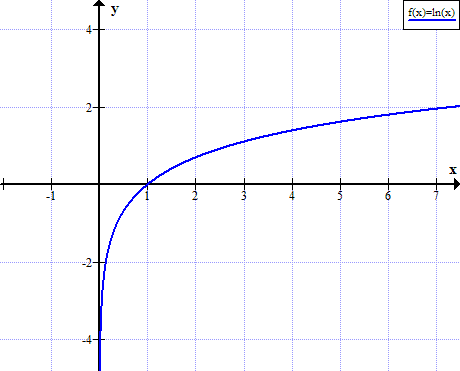
ln graph
definition of derivative formula
f’(x) = limh→0 [f(x+h) - f(x)] / h
Definition of derivative alternate form
f’(x) = limx→b[f(x) - f(b)]/x - b
Avg rate of change
[f(b) - f(a)] / [b - a]
Reasons f won’t be differentiable at point x=a:
f not continuous at x=a
the graph has a corner or cusp at x=a
the graph has a vertical tangent at x=a
chain rule
if h(x) = f(g(x)), then h’(x) = f’(g(x)) * g’(x)
product rule
d/dx (f * g) = f ‘g + fg’
quotient rule
d/dx (f/g) = [f’g - fg’]/g2
Linear Approximation
y = f(a) + f’(a)(x - a)
Inverse Functions
d/dx[f-1(x)] = 1/f’(f-1(x))
d/dx (xn) =
n * xn-1
d/dx sinx =
cosx
d/dx cosx =
-sinx
d/dx tanx =
sec2x
d/dx cscx =
-cscx * cotx
d/dx secx =
secx * tanx
d/dx cotx =
-csc2x
d/dx arcsinx =
1/√1-x²
d/dx arctanx =
1/ (1+x²)
d/dx arcsec x
1/ [ |x|√x²-1
d/dx ex =
ex
d/dx lnx =
1/x
d/dx logax
1/xlna
d/dx ax
axlna
Extreme Value Theorum (EVT):
If f is continuous on a closed interval [a,b]
Then f has an absolute max and an absolute min on the interval [a,b]
critical points
f’(c) = 0 (stationary point)
f(c) DNE (singular point)
Mean Value Theorum
If f is continuous on [a,b]
differentiable on (a,b)
Then there exists a number c between a and b such that f’(c) = AVG rate change
Rolle’s Theorum
f is continuous on [a,b]
Differentiable on (a,b)
f(a) = f(b)
Then there is at least one number c on (a,b) such that f’(c) = 0
∫xn du =
[xn+1] / [n+1] +C, n ≠ -1
∫1/u du =
ln|u| + C
∫eu du =
eu + C
∫audu =
au/lna + C
∫du/√a²-u² =
arcsin u/a + C
∫du/a²+u² =
(1/a)arctan(u/a) + C
∫du/u√u²-a² =
(1/a)arcsec (|u|/a) + C
Total Distance Travelled
a to b ∫|v(t)|dt
Total displacement
a to b ∫v(t)dt