Taxonomy, Phyllotaxy, and Microscopes - Unit 1 bio terms
 Call Kai
 Learn
Learn Practice Test
 Spaced Repetition
 Match
Match Flashcards
 Knowt Play
1/59

There's no tags or description
Looks like no tags are added yet.
Name | Mastery | Learn | Test | Matching | Spaced | Call with Kai | Chat |
|---|
No analytics yet
Send a link to your students to track their progress
60 Terms
Characteristics of living organisms
One or more cells
DNA is genetic/hereditary material
Taxonomy
the classification and naming of living organisms; separated into kingdoms
Taxon
a group of real organisms that occupies a particualr rank in the hierarchy
Broadest to most specific taxons
Domain, Kingdom, Phylum, Class, Order, Family, Genus, Species
Father of Taxonomy
Cardus Linnaeus ← his latinized name (Carl Van Linné)
made modern system of naming: binomial nomenclature
Archaea
Domain: Archaea
Kingdom: Archaebacteria (archaea)
Nucleus in cell: No
Cellularity: Unicellular, Filamentous, or Colonial
Cell size: <10 μm (micrometers)
Mode of nutrition: Autotrophic or Heterotrophic
Cell walls: Yes, but NO pepitdoglycans
Motile (does it move): Some do
Color: Varies
Bacteria
Domain: Bacteria
Kingdom: Eubacteria (bacteria)
Nucleus in cell: No
Cellularity: Unicellular, Filamentous, or Colonial
Cell size: < 10 μm (micrometers)
Mode of nutrition: Autotrophic or Heterotrophic
Cell walls: Yes, but peptidoglycans present
Motile: Some do
Color: Varies (some green or blue-green)
Protists
Domain: Eukarya
Kingdom: Protista
Nucleus in cell: Yes
Cellularity: Unicellular, Filamentous, Colonial, or Multicellular
Cell size: > 10 μm
Mode of nutrition: Autotrophic and Heterotrophic
Cell walls: Some have cells walls, and some do not
Motile: Some do
Color: Varies (some green)
Fungi
Domain: Eukarya
Kingdom: Fungi
Nucleus in cell: Yes
Cellularity: Multicellular (exception = yeast)
Cell size: > 10 μm
Mode of nutrition: Absorptive heterotrophs
Cell walls: Yes, chitin present
Motile: No
Color: Varies (mainly NO green)
Plants
Domain: Eukarya
Kingdom: Plantae
Nucleus in cell: Yes
Cellularity: Mulitcellular
Cell size: > 10 μm
Mode of nutrition: Photosynthetic Autotrophs
Cell walls: Yes, cellulose present
Motile: No
Color: Green (almost all)
Animals
Domain: Eukarya
Kingdom: Animalia
Nucleus in cell: Yes
Cellularity: Multicellular
Cell size: > 10 μm
Mode of nutrition: Ingestive heterotrophs
Cell walls: No
Motile: Yes
Color: Varies (mainly NO green)
Absorptive Heterotroph
decomposes organic matter externally so it can absorb its nutrients
Autotroph
makes its own food; ex: photosynthesis
Binomial (Nomenclature)
The two-part format for naming a species, consisting of a genus and specific epithet; ex: Homo Sapiens L. or Callinectes sapidus Rath. (first letter in genus has to be capitalized, whole name must be italicized or underlined with author’s intial(s))
Biology
The study of Life/living organisms
Cell Theory
All living organisms are composed of cells, and all cells come from other cells
1. All living organisms are made of one or more cells
2. All cells come from pre-existing cells
3. Nothing less than a cell can be considered a living organism AND it’s the basic or fundamental unit of life
Colonial
a visible mass of microorganisms all originating from a single mother cell
Emergent Properties
New properties that arise with each step upward in the hierarchy of life, owing to the arrangements and interactions of parts as complexity increases
Eukaryotic Cell
complex cells characterized by a membrane-enclosed nucleus and membrane-bound organelles
Evolution
The process of change that has transformed life on earth from its earliest forms to the vast array of organisms living today
Core theme of biology
Charles Darwin made two main points
Descent with modification
Natural Selection
Descent with modification
ex: flamingo, penguin, and hummingbird (all have common bird features, but the features are specialized for each bird’s lifestyle)
Natural Selection
a process in which individuals with certain inherited traits are more likely to survive and reproduce than others without said traits, leading to evolutionary changes in population over time
Filamentous
cells in form of long rods or chains
Heterotroph
Can not make its own food
Mixotroph
capable of both autotrophy and heterotrophy
Robert Hooke
Examined piece of bark from oak tree and discovered cells walls
cellulae (little rooms in Latin)
Ingestive Heterotroph
gets its food by ingesting other organisms
Mulitcellular
consists of more than one cell
DNA
Deoxyribonucleic Acid
RNA makes copy of DNA, then RNA molecule carries information to the protein-manufacturing machinery in cell
DNA → RNA → protein-manufacturing machinery
Artificial Seclection
selective breeding of domesticated animals and plants to promote the occurrence of desirable traits
ex: we use artificial selection when choosing specific traits or genes in organisms that we breed. Our intentional and unintentional manipulations change the environment and thus affect natural selection.
Nomenclature vs. Classification
Nomenclature
the naming of organisms
Classification
organizing of the organisms
Levels of biological organization
atoms, molecules, organelles, cells, tissues, organs, organ-systems, organisms, populations, communities, ecosystems, biosphere
Nucleus
central core of an atom, containing protons and neutrons, and in eukaryotic cells
Photosynthetic Autotroph
creates its own food by using sunlight to produce sugars
Prokaryotic cell
a cell that lacks a membrane-enclosed nucleus and membrane-bound organelles
Schleiden
Botanist (studied plants)
cofounded cell theory
Schwann
Zoologist (studied animals)
cofounded cell theory
Unicellular
consist of a single cell, where all life processes occur within that one cell
5 major themes of Biology
Evolution
Information Flow
Structure and Function
Energy and Matter
Interactions
Information flow
Life depends on the flow of information
instructions come from DNA (the blueprints)
All forms of life use essentially same chemical language to translate info stored in DNA into proteins, called genetic code
Information from internal and external environment affects gene expression where and when particular genes are activated and proteins made
Structure and Function
at a molecular level, structure of protein correlates with tis function
ex: strong ligaments holding bones together
the organisms whose structures best performed, their functions would have been likely to have reproductions; thereby passing those adaptations onto their offspring (explained by natural selection)
Energy and Matter
life depends on the transfer and transformation of energy and matter
the input of energy, primarily from the sun, and the conversion of energy from one form to another make life possible
dynamics of ecosystem => the flow of energy and the cycling of matter
Interactions
life depends on interactions within and between systems
the emergent properties of each level result from the specific arrangement and interactions of its parts
an alteration in one of the components of such a system disrupts its functioning and can lead to disease
ex: type 1 diabetes: pancreatic cells no longer produce insulin; type 2 diabetes: body cells no longer respond to insulin
Category vs. Taxon
Taxon is a unit of classification that groups organisms based on shared characteristics, while category refers to the specific ranks within the classification system that organize these groups hierarchically
Population
a group of individuals of the same species
Community
an interacting group of various species in a common location
Molecule
two or more atoms held together by covalent bonds
Organelle
a membrane-enclosed structure with a specialized function within a cell
Cell
basic unit of living matter, serving as the fundamental structural unit of life
defined by its plasma membrane, which separates it from its environment, and contains various organelles that perform essential functions for its organism
Tissue
an integrated group of cells that share a common function and structure, forming the building blocks of organs in both plants and animals
Organ
a specialized structure composed of various types of tissues that work together to perform specific functions within an organism
Organ System
a group of organs that work together to perform vital body functions
Organism
an individual living thing, which consists of one or more cells
Ecosystem
All the organisms in a given area, along with the nonliving (abiotic) factors with which they interact, forming a biological community and its physical environment
Biosphere
The entire portion of earth inhabited by life; the sum of all the plant’s ecosystems
Transmission Electron Microscope (TEM)
organism has to be dead and isn’t shown in natural color
allows you to view internal structures of living cells in detail
function:
sends electron through thin slices of specimens to show internal structure
best for:
studying texture, shape, and surface features
Scanning Electron Microscope (SEM)
has to be dead and isn’t shown in natural color
function:
produces detailed 3D images at the surface of specimens
best for:
studying texture, shape, and surface features
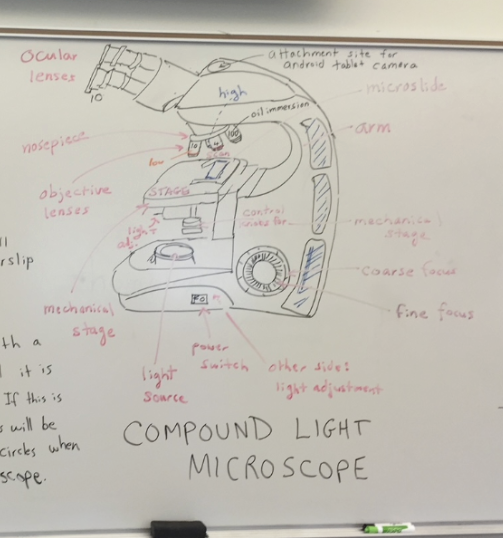
Compound Light Microscope (CLM)
max magnification = 400x
alive and in natural color
function:
uses visible light and glass lenses to magnify specimens (up to 1000x)
best for:
viewing living or stained cells, cell shape, size, arrangement
Dissecting Microscope/Scope (DS)
max magnification = 20x
alive and in natural color
function:
use low magnification (typically up to 100x) with light reflected off the surface of specimens to produce a 3D view
best for:
observing the surface details of larger specimens (insects, plants, small animals) and for dissection work
Parts of a CLM
ocular lenses
objective lenses
stage
coarse focus
fine focus
nose piece
mechanical stage adjustment knobs