Human Anatomy & Physiology: Key Concepts and Study Strategies
 Call Kai
 Learn
Learn Practice Test
 Spaced Repetition
 Match
Match Flashcards
 Knowt Play
1/67

There's no tags or description
Looks like no tags are added yet.
Name | Mastery | Learn | Test | Matching | Spaced | Call with Kai | Chat |
|---|
No analytics yet
Send a link to your students to track their progress
68 Terms
What does human anatomy study?
The structure or form of the human body.
What does human physiology study?
The functions of the body.
How are structure and function related in the human body?
The body's structure and function are closely related.

What is the smallest unit that carries out the functions of life?
Cell
What is metabolism?
The chemical processes that living organisms carry out.
What are the two types of metabolic processes?
Anabolism (building processes) and Catabolism (breaking down processes).
What does growth in living organisms refer to?
An increase in the size and/or number of cells.
What is excretion in living organisms?
The elimination of potentially harmful waste products created by metabolic processes.
What does responsiveness or irritability mean in living organisms?
The ability to sense and react to changes or stimuli in their environment.
What is movement in the context of living organisms?
The ability of organisms or individual cells to move.
What is reproduction in living organisms?
The production of new cells during growth or repair or the reproduction of new organisms.
What are the structural levels of organization in the human body?
Chemical, Cellular, Tissue, Organ, Organ System, Organism.
What is the chemical level of structural organization?
The smallest level, consisting of chemicals ranging from tiny atoms to complex molecules.
What defines the cellular level of structural organization?
Groups of different types of molecules combine to form cellular structures.
What is the tissue level of structural organization?
Two or more cell types and material outside them combine to perform a common function.
What is the organ level of structural organization?
Two or more tissue types combine to form an organ with a recognizable shape that performs a specialized task.
How many organ systems does the human body have?
11 organ systems.
What is systemic anatomy?
The study of individual organ systems.
What is regional anatomy?
The study of the body in regions, such as the head and neck.
What does surface anatomy examine?
Surface markings of the body.
What is gross anatomy?
The study of structures that can be seen with the unaided eye.
What is microscopic anatomy?
The study of cells (Cytology) and tissues (Histology) using a microscope.
What is the anatomical position?
A common frame of reference where the body is standing upright, feet shoulder-width apart, upper limbs at the sides, and head and palms facing forward.

What do the terms anterior and posterior refer to?
Anterior refers to the front, and posterior refers to the back.

What does superior mean in anatomical terms?
Towards the head.

What does inferior mean in anatomical terms?
Towards the tail.

What do proximal and distal refer to?
Proximal means closer to the point of origin, and distal means further from the point of origin.

What does medial mean in anatomical terms?
Closer to the midline of the body.

What does lateral mean in anatomical terms?
Farther away from the midline.

What does superficial mean in anatomical terms?
Closer to the surface of the body.

What does deep mean in anatomical terms?
Farther below the surface of the body.

What are common causes of medical errors?
Dispensing the wrong type or dose of medication, or performing 'wrong site' or 'wrong body' procedures.
What are regional terms in anatomy?
Terms that divide the body into broad regions: Axial (head, neck, trunk) and Appendicular (limbs).
What is the sagittal plane?
A plane that divides the body into right and left sections.

What is the frontal plane?
Also called the coronal plane; it divides the body into anterior and posterior sections.

What is the transverse plane?
Also called a horizontal plane; it divides the body into superior and inferior sections.
What is the purpose of flashcards in studying anatomy?
Flashcards help with active recall and effective independent study.
What is the posterior body cavity?
The posterior body cavity is located on the posterior side of the body and includes the cranial and spinal cavities.
What does the cranial cavity contain?
The cranial cavity contains the brain.
What does the spinal cavity contain?
The spinal cavity contains the spinal cord.
What fluid fills the cranial and spinal cavities?
Cerebrospinal Fluid.
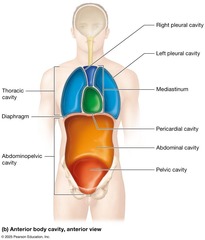
What separates the thoracic and abdominopelvic cavities?
The muscular diaphragm.
What is contained within the thoracic cavity?
The pleural cavities, mediastinum, and pericardial cavity.
What does the mediastinum house?
The heart, great vessels, trachea, and esophagus.
What is the abdominopelvic cavity subdivided into?
The superior abdominal cavity and the inferior pelvic cavity.
What organs are contained in the abdominopelvic cavity?
Organs from the digestive, lymphatic, urinary, and reproductive systems.
What is the peritoneal cavity?
The abdominal subcavity found within serous membranes.
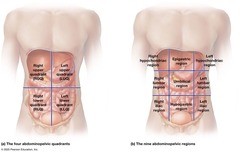
What are the four quadrants of the abdominopelvic cavity?
Right upper quadrant (RUQ), left upper quadrant (LUQ), right lower quadrant (RLQ), and left lower quadrant (LLQ).
What are the nine regions of the abdominopelvic cavity?
Right and left hypochondriac regions, right and left lumbar regions, right and left iliac regions, epigastric region, umbilical region, and hypogastric region.
What are serous membranes?
Thin sheets of tissue that fold over to form double-layered structures filled with serous fluid.
What are the two layers of serous membranes?
Visceral layer (contacts the organ) and parietal layer (attaches to surrounding structures).
What do pleural membranes surround?
The lungs.
What do pericardial membranes surround?
The heart.
What do peritoneal membranes surround?
Some abdominal organs.
What is the purpose of medical imaging?
To look inside patients without surgery.
What is an X-ray?
A form of imaging that uses ionizing radiation to create images of internal structures.
What is a CT scan?
A computed tomography scan that uses ionizing radiation to generate 3-D images.
What is MRI?
Magnetic Resonance Imaging that uses a magnetic field to create 3-D images.
What is homeostasis?
The condition in which the body maintains a stable internal environment.
What are feedback loops?
Mechanisms that regulate changes in a variable to maintain homeostasis.
What is a negative feedback loop?
A loop that opposes initial changes and promotes stability.
What is a positive feedback loop?
A loop that reinforces initial changes and increases the output.
What is the set point in a feedback loop?
The normal range for a regulated variable.
What are the steps of a negative feedback loop?
Stimulus, receptor, control center, effector, and response.
What is a common misconception about negative feedback?
That it is bad for the body; it actually promotes homeostasis.
What is the principle of complementarity of structure and function?
The form of a structure is such that it best suits its function.
What drives many physiological processes?
Gradients, which are differences in concentration or pressure.
How do cells communicate to maintain homeostasis?
Through electrical signals and chemical messengers.