L22 - Purines
 Call Kai
 Learn
Learn Practice Test
 Spaced Repetition
 Match
Match Flashcards
 Knowt Play
1/12

There's no tags or description
Looks like no tags are added yet.
13 Terms
Difference between Purine and Pyrimidine biosynthesis
Purine: Sugar and phosphate group is attached first, and the base is built on that. Very energy expensive, which is why the salvage pathway is critical.
Pyrimidine: Base is built first and phosphate/sugar is attached after
How are purine rings built
Via various different Amino acids and other metabolites
Different to pyrimidines which is built using aspartate and glutamine

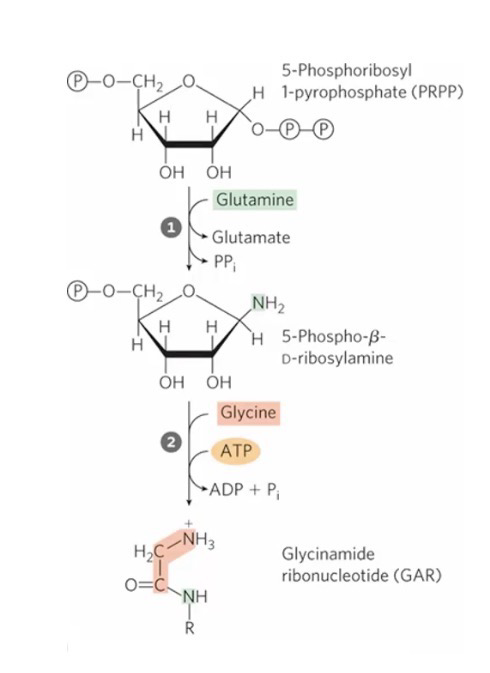
Step 1-2 of purine biosynthesis
Commitment step
Gln + PRPP → Glu + PPi + 5-Phospho-β-D-ribosylamine via glutamine-PRPP amidotransferase
In the second step, three atoms are added from glycine (Needs ATP)
5-Phospho-β-D-ribosylamine → Glycinamide ribonucleotide (GAR)
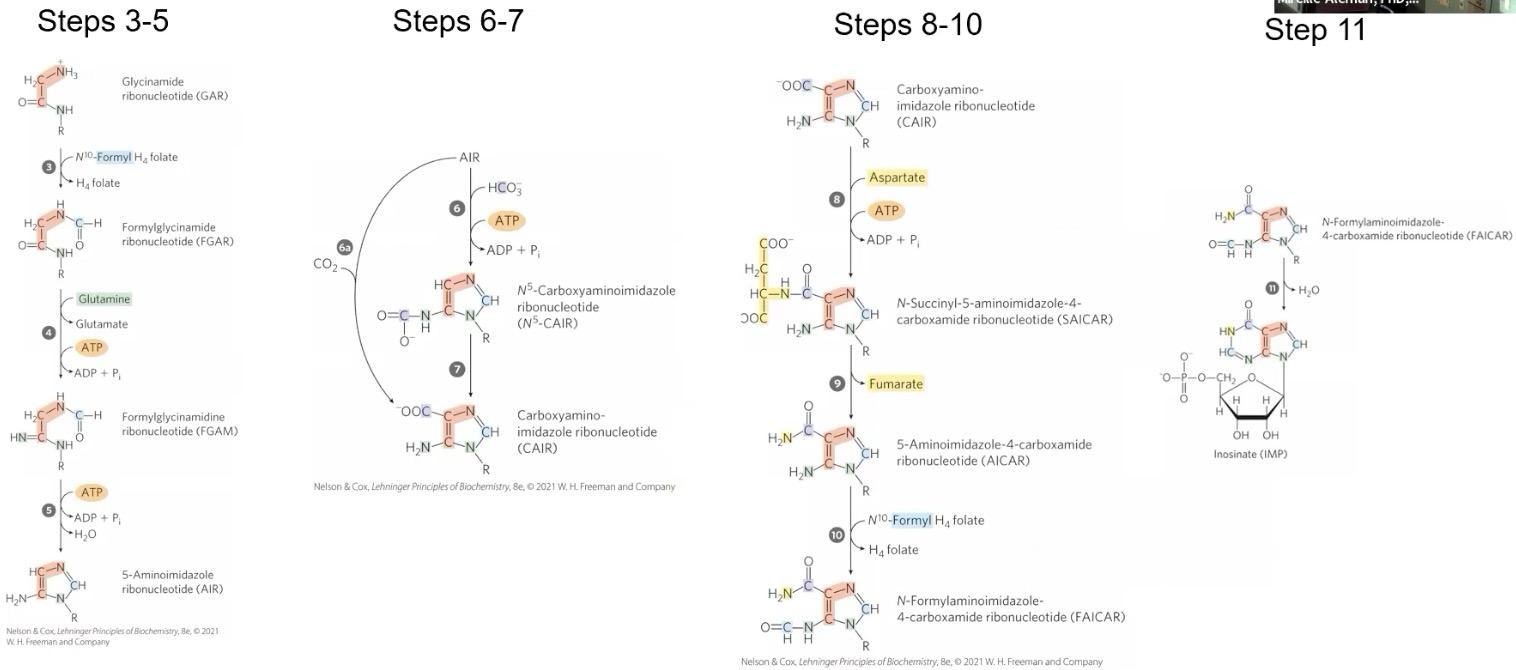
Steps 3-11 of purine biosynthesis
Know that this pathway is very energy expensive; Requires many AAs and an N-Formyl Tetrahydrofolate (Type of THF) (Formyl transfer happens in Step 10)
Step 5 forms the first ring; Step 11 forms the first purine ring set
Inosinate (IMP) is made in step 11 via IMP synthase and is the first nucleotide in this pathway
Know IMP structure
Conversion of IMP to AMP and GMP
IMP to AMP:
IMP + D + GTP → Adenylosuccinate + GDP + Pi via Adenylosuccinate synthetase
Adenylosuccinate → Adenylate (AMP) + Fumarate via Adenylosuccinate lyase
IMP to GMP:
IMP + H2O + NAD+ → Xanthylate (XMP) + NADH + H+ via IMP dehydrogenase
XMP + H2O + N + ATP → Guanylate (GMP) + E + AMP + PPi via XMP-glutamine amidotransferase (GMP synthetase)

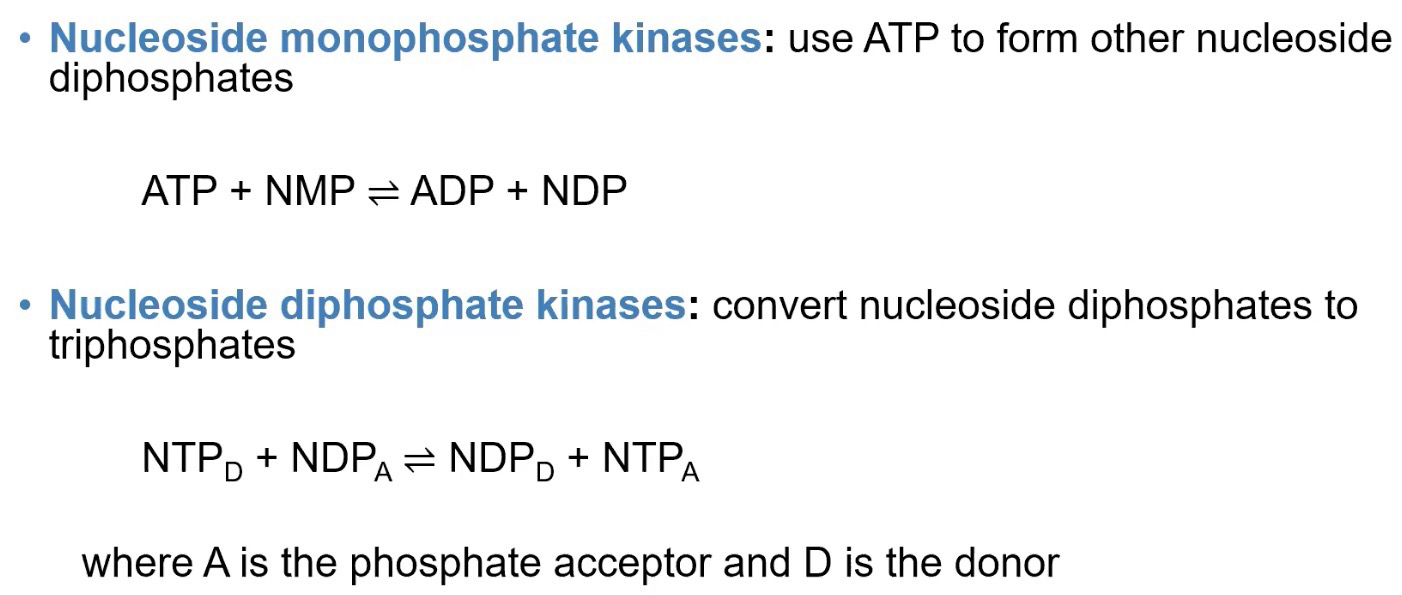
Mono and Di-Phosphate Kinases
“housekeeping” kinases that catalyzes the formation of both di and triphosphate
Nucleoside monophosphate kinases use ATP to turn Mono to Di
Nucleoside diphosphate kinases use NTP to turn Di to Tri
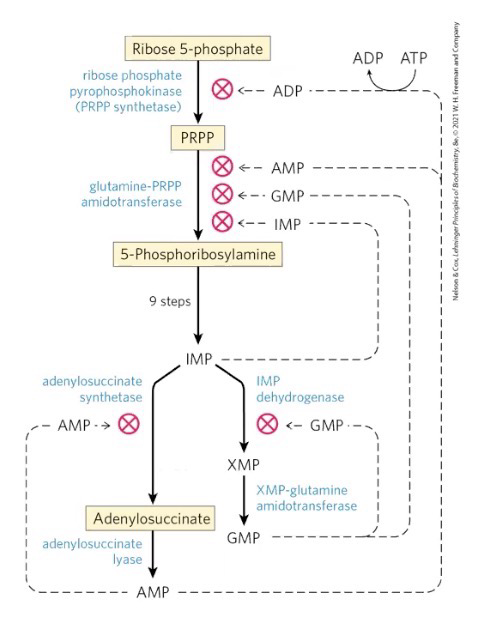
Regulation of purine biosynthesis via feedback inhibition
Focus on regulation up to IMP:
Ribose 5-phosphate → PRPP (PRPP synthetase) is inhibited by energy level (ADP)
PRPP → 5-phosphoribosylamine (Glutamine-PRPP amidotransferase) (Step 1) is inhibited by all end products (IMP, GMP, and AMP)
Post IMP (“Fork-in-the-road”):
IMP → AMP is feedback-inhibited by AMP
Same for IMP → GMP feedback-inhibited by GMP
Basically a balancing act so that AMP and GMP levels will stay at the correct level
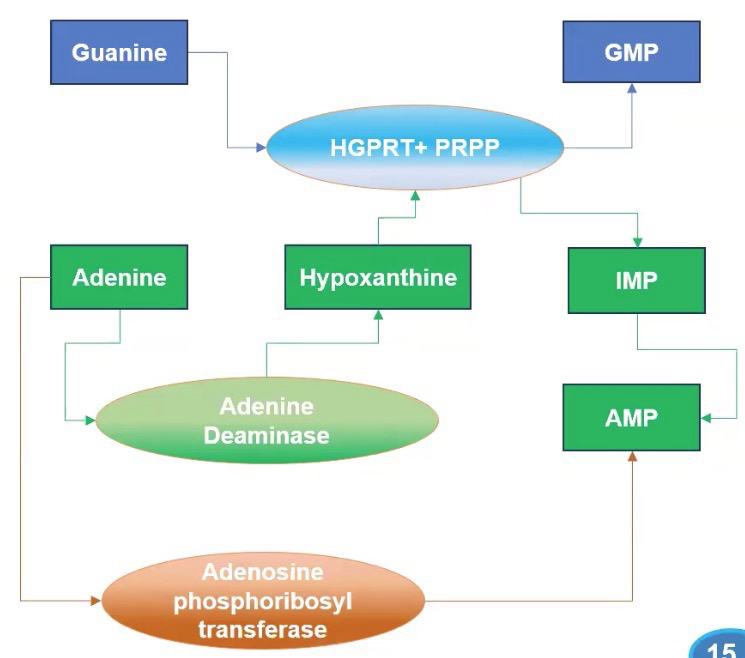
Purine Salvage Pathway
We want to do this because nuc base biosynthesis is very expensive (Especially for purines)
Free purines can be salvaged into new nucleotides: Begins with a free nitrogenous base
Hypoxanthine-guanine phosphoribosyltransferase (HGPRT): Catalyzes salvage of guanine and hypoxanthine (deamination product of adenine via adenine deaminase) to from GMP or IMP
Adenosine phosphoribosyltransferase (APRT): Catalyzes reaction of adenine + PRPP to yield adenine nucleotide (Ex. Adenine + PRPP → AMP + PPi)
Deoxyribonucleotides
Main Idea: Ribonucleotide reductase enzymes convert ribose to deoxyribose
Thioredoxin: Intermediate H-carrying protein
Glutaredoxin: Transfers reducing power from glutathione (GHS) to ribonucleotide reductase
Thioredoxin reductase: Catalyzes reduction of oxidized form of thioredoxin by NADPH

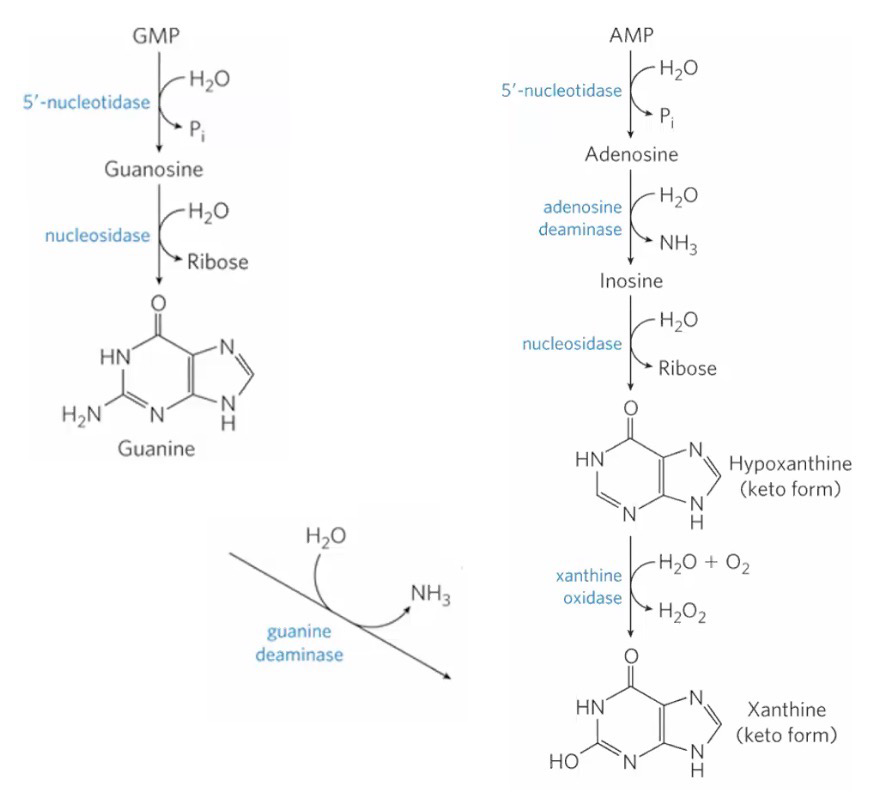
Purine Degradation Pathway
Purine degradation produces Urea
GMP
5’-Nucleotidase removes Pi group
Nucleosidase removes ribose from guanosine; Guanine deaminase removes an amino group and turns guanine to xanthine
AMP
Nucleotidase removes Pi group
Adenosine deaminase removes amino group (Makes inosine); 5’-Nucleosidase removes ribose
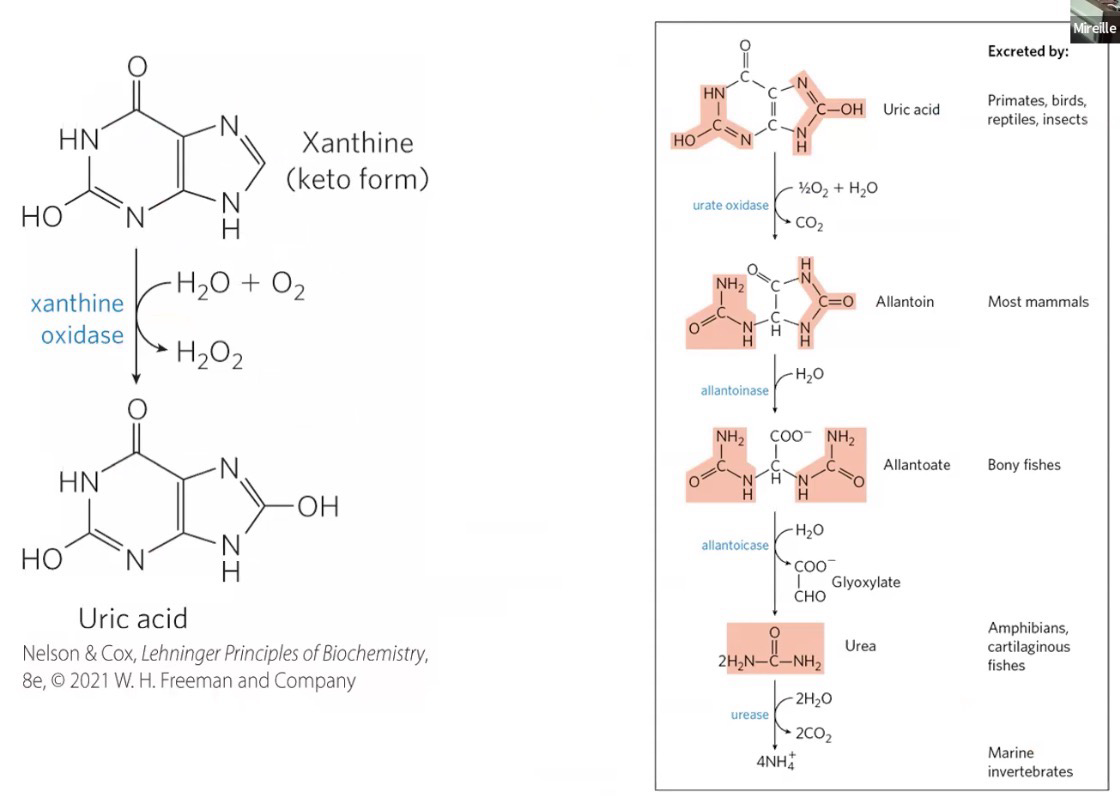
Hypoxanthine is oxidized via xanthine oxidase to make xanthine
Organism organization for what form of Uric acid they can get rid of
Certain species can directly excrete uric acid (Humans); Others must process it down further
Important Cofactors in Purine biosynthesis
One-C transfers typically involve 1 of 3:
Biotin (Transfers CO2)
THF (Transfers intermediate oxidation states)
SAM (Transfers methyl group)
Metabolism summary
Based on tissue type