Prokaryotes vs Eukaryotes: Cell Structure, Stains, and Microscopy
 Call Kai
 Learn
Learn Practice Test
 Spaced Repetition
 Match
Match Flashcards
 Knowt Play
1/42

There's no tags or description
Looks like no tags are added yet.
Name | Mastery | Learn | Test | Matching | Spaced | Call with Kai | Chat |
|---|
No analytics yet
Send a link to your students to track their progress
43 Terms
What is a characteristic of prokaryotes regarding their nucleus?
They have no nucleus.
What type of chromosome do prokaryotes have?
Single, circular chromosome.
How do prokaryotes divide?
By binary fission, transduction, conjugation, or transformation.
What are the two main groups of prokaryotes?
Bacteria and Archaea.
Do prokaryotes have membrane-bounded organelles?
No, they do not.
How many points of DNA replication do prokaryotes have?
One point.
What are flagella in prokaryotes made of?
Two protein building blocks.
What is the composition of prokaryotic cell walls?
Complex polysaccharide peptidoglycan.
What is a common size characteristic of prokaryotes?
Typically smaller in size.
What is the typical cellular structure of prokaryotes?
Typically unicellular.
How is DNA associated in prokaryotes?
DNA is not associated with histones.
What structures do prokaryotes have for attachment?
Fimbrae and pili.
What is a characteristic of eukaryotes regarding their nucleus?
They have a nucleus.
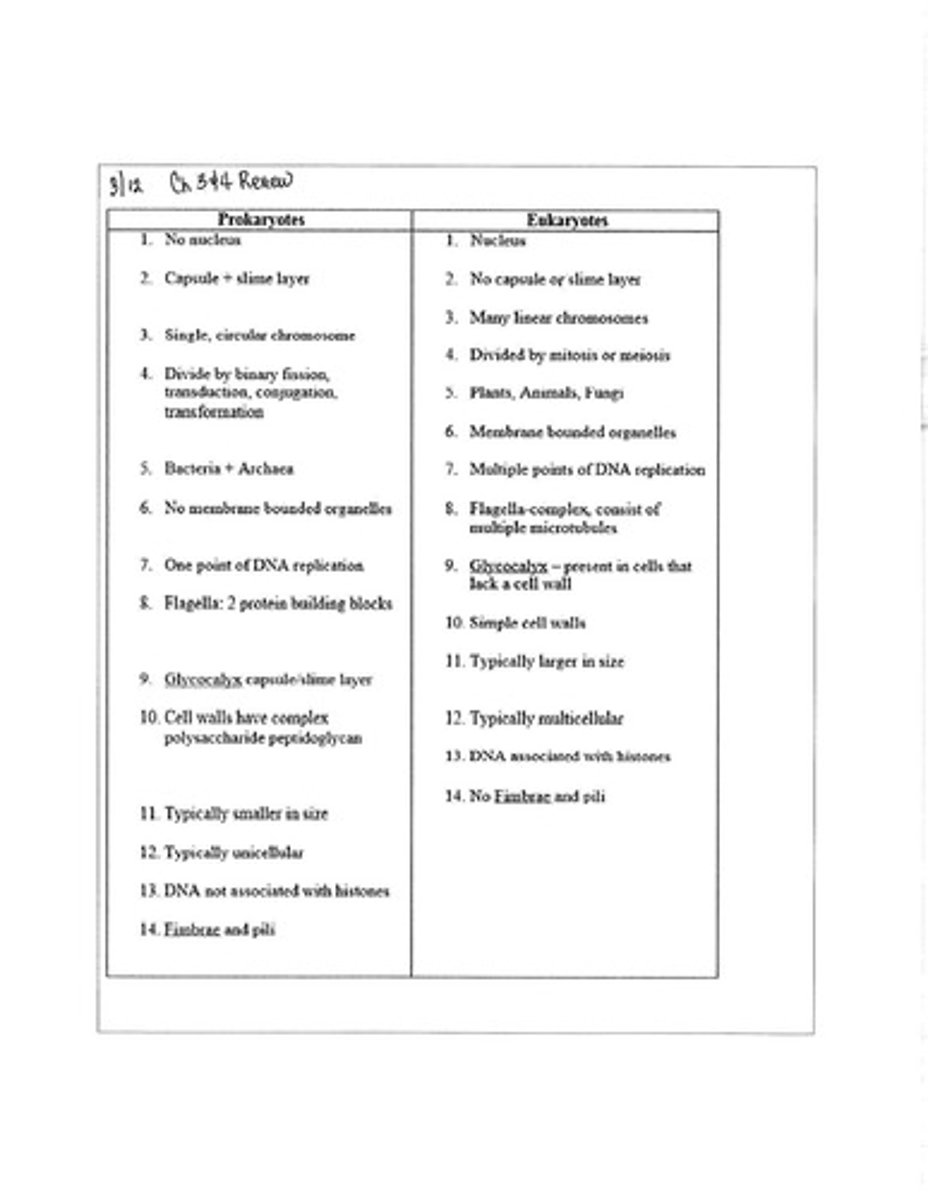
Do eukaryotes have a capsule or slime layer?
No, they do not.
How many chromosomes do eukaryotes typically have?
Many linear chromosomes.
How do eukaryotes divide?
By mitosis or meiosis.
What are the main groups of eukaryotes?
Plants, Animals, and Fungi.
Do eukaryotes have membrane-bounded organelles?
Yes, they do.
How many points of DNA replication do eukaryotes have?
Multiple points.
What is the structure of eukaryotic flagella?
Complex, consisting of multiple microtubules.
What is the glyocalyx in eukaryotes?
Present in cells that lack a cell wall.
What is the typical size of eukaryotic cells?
Typically larger in size.
What is the typical cellular structure of eukaryotes?
Typically multicellular.
How is DNA associated in eukaryotes?
DNA is associated with histones.
Do eukaryotes have fimbrae and pili?
No, they do not.
What is the function of a compound light microscope?
Uses visible light up to 2000x.
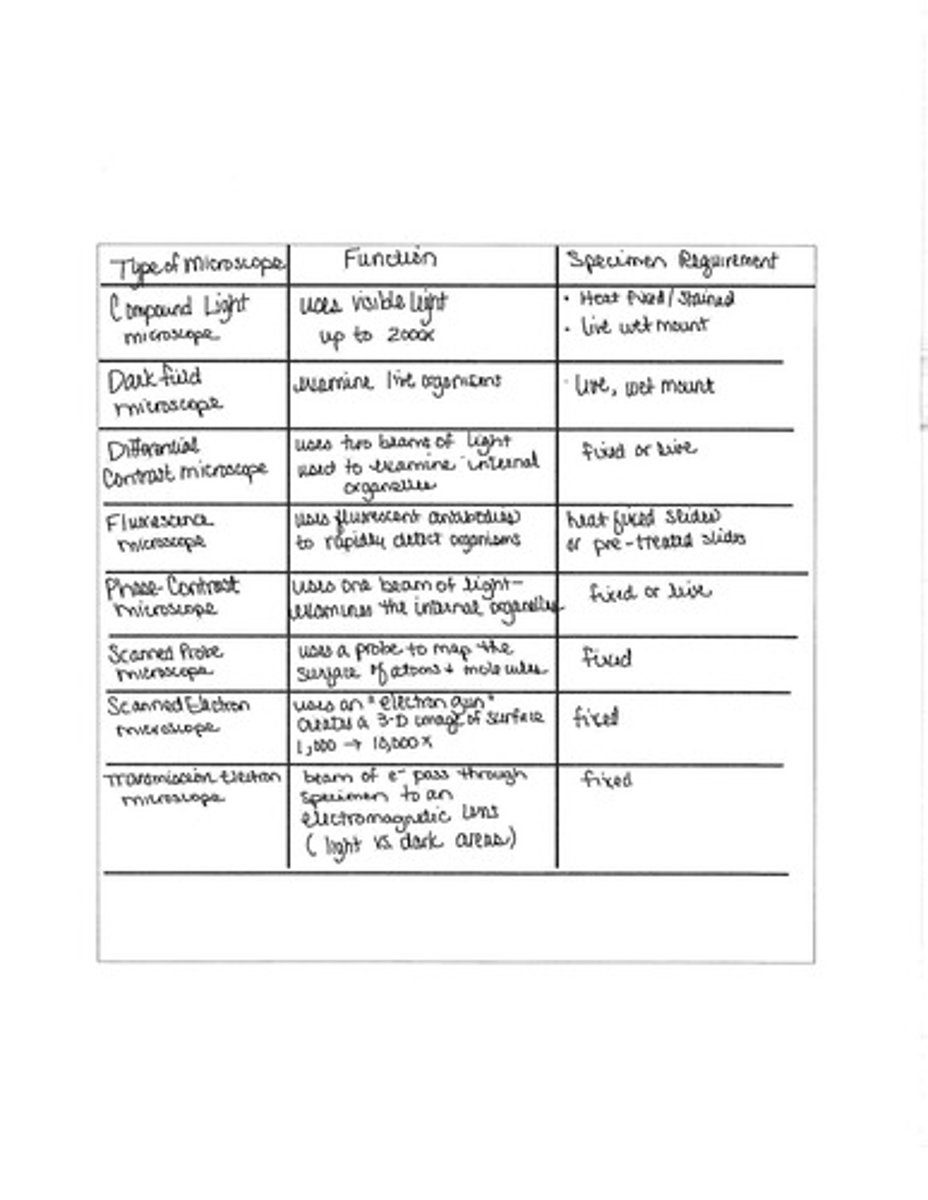
What is required for specimens in a compound light microscope?
Heat fixed or stained.
What is the function of a dark field microscope?
Used to examine live, wet organisms.
What does a fluorescence microscope use to detect organisms?
Fluorescent antibodies.
What is the function of a phase-contrast microscope?
Examines internal organelles.
What does a scanned probe microscope do?
Maps the surface of atoms and molecules.
What is the function of a transmission electron microscope?
Creates a 3-D image of the surface.
What is the primary stain in Gram staining?
Crystal violet.
What is the decolorizer used in Gram staining?
Acetone/Alcohol.
What is the counterstain in Gram staining?
Safranin.
What is endospore formation called?
Sporulation (or sporogenesis).
What triggers the germination of an endospore?
Damage to the endospore coat.
What are the shapes of bacteria?
Spiral, bacillus, cocci, spirochetes, streptobacilli, staphylococci.
What is the function of the cell wall in bacteria?
Protection from osmotic lysis.
What is the purpose of the glycocalyx?
Protection from phagocytosis.
What is the role of pili in bacteria?
Transfer of genetic material.
What is the function of ribosomes in cells?
Protein synthesis.
What is the endosymbiotic theory?
Smaller bacteria were engulfed by larger bacteria, leading to the formation of organelles like mitochondria and chloroplasts.