Equilibrium R2.3
 Call Kai
 Learn
Learn Practice Test
 Spaced Repetition
 Match
Match Flashcards
 Knowt Play
1/13

There's no tags or description
Looks like no tags are added yet.
Name | Mastery | Learn | Test | Matching | Spaced | Call with Kai | Chat |
|---|
No analytics yet
Send a link to your students to track their progress
14 Terms
Irreversible reactions
Reactions that only go to completion, they only go forward. Eg. explosions, decaying, burning
Reversible reactions
Reactions that can go forward and reverse them. Eg. ammonia production, hydration of certain things etc.
What is chemical equilibrium/dynamic equilibrium
Equilibrium is reached when the rate of the forwards and reverse reactions are equal and occuring at the same time.
The reactants and products’ concentration to remain constant over time. It is dynamic because both forward and reverse reactions are occurring simultaneously.
What happens when equilibrium is disturbed
It can be disturbed by changes in temp, pressure, or concentration of the components, the system acts to oppose the change and rebalance the system. It has to re-establish the equilibrium
Change in concentration
If you increase the reactants concentration, the forward reaction is favored to produce the least amount of concentration (particles)
If you increase product concentration, the reverse reaction is favored to produce the least amount of concentration (particles)
Increase of Pressure
Increase in P will favor the side of the reaction with the least number of moles of gasses).
For example, if N2 + 3H2 → 2NH3
There are 4 moles of gas in reactants and 2 in products.
If the pressure increases, the system will favor the reaction that produces the least amount of moles. In this case, the forward reaction will be favored.
If the pressure decreases, the system will favor the reaction that produces the most amount of moles. In this case, the reverse reaction is favored
Increase of temperature
In exothermic reactions, the heat is released meaning the delta H is a product. When temperature is added to the system, the reverse reaction is favored because it will cool down the system. Opposite goes for when the temperature in the system decreases.
The equilibrium law
Calculates constant K, products/reactants
Square brackets = concentration at equilibrium

What happens when K»1
Products/reactants, so there is a greater concentration of products than reactants.
Product is favored , so equilibrium lies on the right.
A lot of product is formed and a lot of reactant is consumed

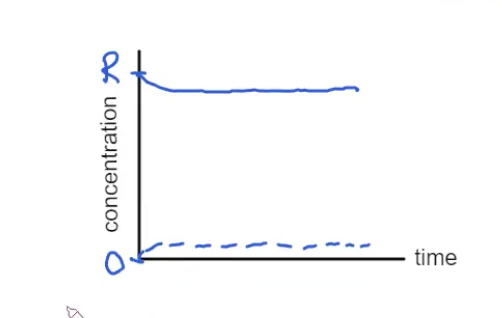
What happens when K«1
Products/reactants, so there is a greater concentration of reactants than products
Reactant is favored, so equilibrium lies on the left
Not a lot of reactant consumed so not a lot of product formed
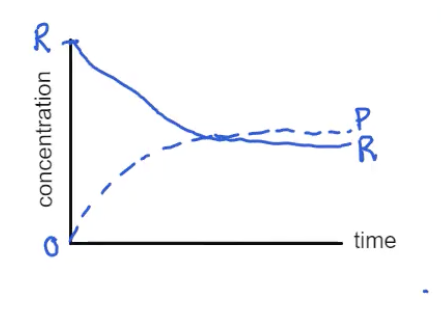
K=1
There is an equal concentration of products and reactants
No product/reactant is favored, equilibrium lies in the middle
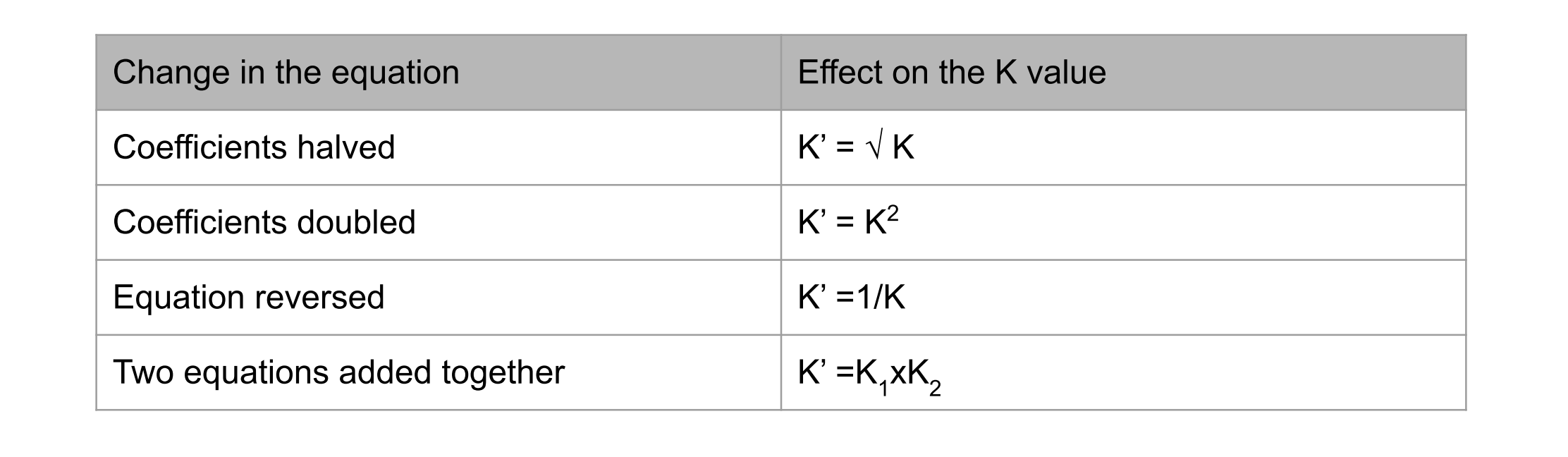
What occurs to K when there is a change in the equation/coefficients
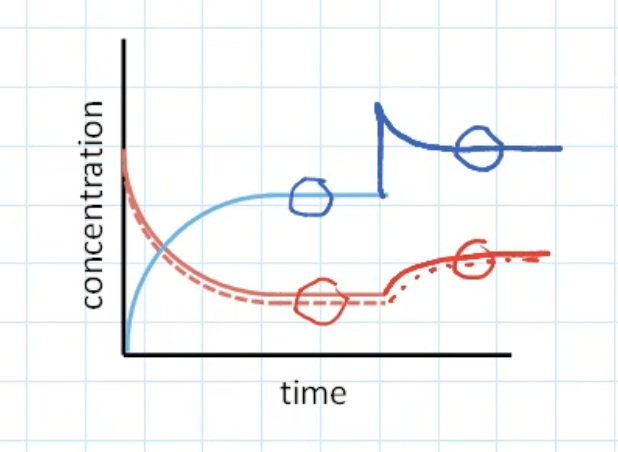
Effect of concentration on Kc
If you add more concentration (eg. to the products), the system will act to use up this product, so the reverse reaction will be favored to produce more reactants. Thus, there is an increase in both products and reactants (even though the system tries to use up all the product, it cannot use up all, and there is more reactant being produced in the process). Because both are increased, the equilibrium is not affected (Kc is not affected).
Effect of temperature on Kc