monopolistic competition
 Studied by 0 people
 Call Kai
 Learn
Learn Practice Test
 Spaced Repetition
 Match
Match Flashcards
 Knowt Play
1/19

Earn XP
Description and Tags
8 questions
Name | Mastery | Learn | Test | Matching | Spaced |
|---|
No study sessions yet.
20 Terms
Which of the following products is least likely to be sold in a monopolistically competitive market?
beer
tobacco
refrigerators
soy beans (correct)
Which of the following is true with regard to monopolistically competitive firms' scale of production and pricing decisions? Monopolistically competitive firms produce _______.
b. with excess capacity and charge a price above marginal cost |
Which of the following is true regarding the similarities and differences in monopolistic competition and monopoly?
the monopolist makes economic profits in the long run while the monopolistic competitor makes zero economic profits in the long run
When firms enter a monopolistically competitive market and the business-stealing externality is larger than the product-variety externality, then _______.
there are too many firms in the market and market efficiency could be increased if firms exited the market
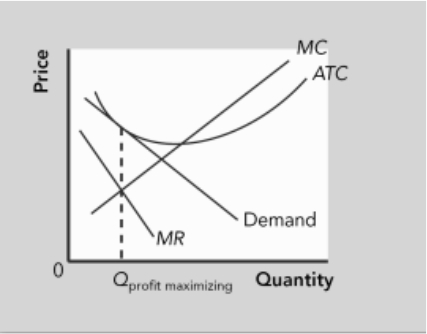
The exhibit depicts a monopolistically competitive firm _______.
generating zero profits in the long run
defenders of the use of brand names argue that brand names
provide info abt the quality of the product
give firms incentive to maintain high quality
establishes the consistency of a product across different sales locations
all of the above (correct)
which of the following firms has the least incentive to advertise
a wholesaler of crude oil
Which of the following is not put forth as a criticism of advertising and brand names?
advertising increases competition which causes unnecessary bankruptcies and layoffs
expensive television commercials during the super bowl that appear to provide no specific information about the product should be advertised
may be useful because they provide a signal to the consumer about the quality of the product
Which of the following is not a characteristic of a monopolistically competitive market?
positive economic profits in the long run
In the short run, if the price is above average total cost in a monopolistically competitive market, the firm makes _______.
profits and firms enter the market
Which of the following is true regarding the production and pricing decisions of monopolistically competitive firms? Monopolistically competitive firms choose the quantity at which marginal cost equals _______.
marginal revenue and then the use of the demand curve to determine the price consistent with this quantity
The use of the word "monopoly" in the name of the market structure called "monopolistic competition" refers to the fact that _______.
a monopolistically competitive firm faces a downward sloping demand curve for its differentiated product and so does a monopolist
Which of the following is not an argument put forth by economists in support of the use of advertising?
advertising provides a creative outlet for artists and writers
One source of inefficiency in monopolistic competition is that _______.
because prie is above marginal cost some units are not produced that buyers value in excess of the cost of product and this causes a deadweight loss
the use of the word competition in the name of the market structure called monopolistic competition refers to the fact that
in a monopolistically competitive market there are many sellers and there is free entry and exit just like in a competitive market
For the economy as a whole, what percentage of firm revenue is spent on advertising?
2 percent
Which of the following firms is most likely to spend a large percentage of their revenue on advertising?
the producer of a highly differentiated consumer product
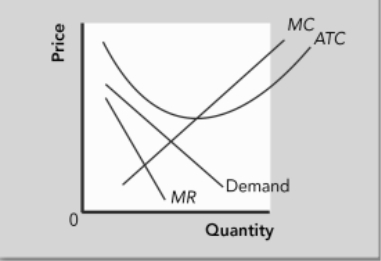
The monopolistically competitive market shown in the exhibit will, in the long run, _______.
cause producers to exit the market which will shift the demand faces by incumbent firms to the right
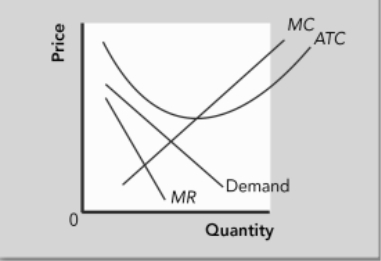
If the monopolistic competitor described by the exhibit is producing at the profit-maximizing (loss-minimizing) level of output, it _______.
is generating losses