8/27 Chapter 1: Intro
 Call Kai
 Learn
Learn Practice Test
 Spaced Repetition
 Match
Match Flashcards
 Knowt Play
1/51

There's no tags or description
Looks like no tags are added yet.
Name | Mastery | Learn | Test | Matching | Spaced | Call with Kai | Chat |
|---|
No analytics yet
Send a link to your students to track their progress
52 Terms
pharmacokinetics
how the body deals with this drug in order to eliminate or remove the drug
pharmodynamics
how drug affects the living body → therapeutic side effects
medical pharmacology
medication that is prescribed for diseases and disorders
-environmental toxicology
pharmacotherapeutics
use of drugs in the treatment of diseases and disorders
receptors can be
proteins (usually), DNA, RNA, and lipids
agonist
binds to receptor through an attraction to form an effect
-low conc.=little effect, high conc.=high effect
competitive inhibitor/antagonist
competes with agonist to bind to same spot
-need increase a dose to have effect
allosteric activator
binds to different site, reach maximum effect
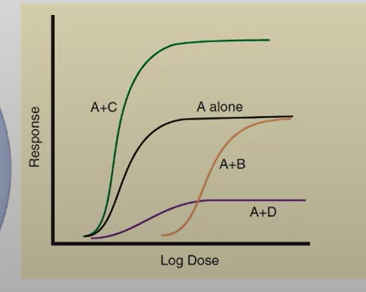
allosteric inhibitor
binds to different site, decreases max effort
agonist + allosteric activator
highest response per dose
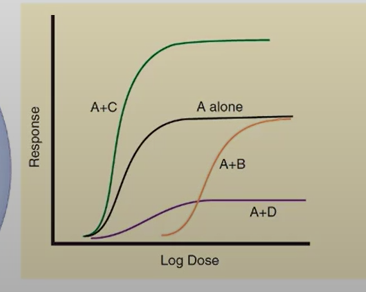
agonist (graph)
second highest response per dose
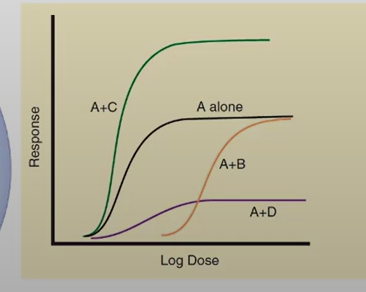
agonist + allosteric inhibitor
needs more of dose to reach response

agonist + allosteric inhibitor
lowest response
binding affinity
how well a compounds are attracted to those different areas on a receptor
Kd
concentration for 50% saturation of the receptors and is inversely proportionate to the affinity of the drugs for the receptors
low concentration of Kd
high binding affinity → needs less of drug to bind to receptor

full agonist
prefers/stabilizes the active receptor state
receptor is pushed to active state → response increases → reaches max effect

Partial agonist
also favors receptor activation, but it doesn't activate the receptor as strongly as a full agonist → lower max effect
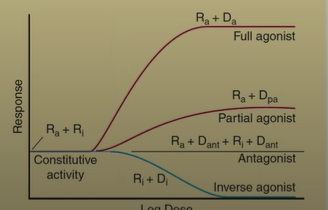
Antagonist
no preference for the active vs. inactive receptor state
-alone → no change in constitutive activity

inverse agonist
prefers/stabilizes the inactive receptor, pushes system to inactive state
pharmacology
study of substance that interact w/ living systems thru chemicals processes
two branches of pharmacology
medical pharmacology and environmental toxicology
medical pharmacology
science of substances used to prevent, diagnose, and treat diseases (includes toxic effects)
-pharmacokinetics and pharmacodynamics
environmental toxicology
effects of chemicals on all organism and their survival in groups and as species
translational research
taking discoveries from basic science/laboratory research and figuring out how to use them to improve patient care
pharmacologic profile
summary of how a drug behaves and what it does in the body
drug class, mechanism, effects, pharmacokinetics, ADRs
Whole animal studies
necessary to determine the effect of the drug on organ systems and disease models
-cardiovascular and renal function studies of new drugs
desired result of this screening procedure
lead compound
lead compound
leading candidate for a successful new drug
preclinical toxicity testing
testing a potential new drug for harmful or toxic effects before it is tested in humans
no-effect dose
maximum dose at which a specified toxic effect is not seen
minimum lethal dose
smallest dose that is observed to kill any experimental animal
median lethal dose (LD50)
the dose that kills approximately 50% of the animals in a test group
limitations of preclinical testing
toxicity testing is time consuming
large amount of animals need to be obtained
sometimes toxic in animals but not humans
rare adr usually dont show in testing
crossover design
the same participants receive more than one treatment at different times (alternating periods)
placebo response
when a patient experiences a real change in symptoms after receiving an inactive treatment
single-blind design
clinical trial where one side does not know which treatment the participant is receiving
double-blind design
clinical trial where both the participants and the researchers interacting with/evaluating them do not know who is receiving the actual treatment versus the placebo/control
FDA
administrative body that oversees the drug evaluation process in the USA and grants approval for marketing of new drug products
Notice of Claimed Investigational Exemption for a New Drug (IND)
FDA application that allows a company/researcher to begin testing a new drug in humans
interdisciplinary institutional review board (IRB)
committee that reviews research involving human participants to make sure the study is ethical and protects the participants
Phase 1
are done to determine the probable limits of the safe clinical dosage range
-effects of the drug as a function of dosage are established in a small number (20–100) of healthy volunteers
Phase 2
drug is studied in patients with the target disease to determine its efficacy, has the highest rate of drug failures, and only 25% of innovative drugs move on to next phase
Phase 3
drug is evaluated in much larger numbers—usually thousands—of patients with the target disease to further establish and confirm safety and efficacy
New Drug Application (NDA)
formal application submitted to the FDA asking for permission to market and sell a new drug in the United States (new brand name drug)
Phase 4
monitoring the safety of the new drug under actual conditions of use in large numbers of patients, drug is approved to market a drug
abbreviated new drug application (ANDA)
application submitted to the FDA to get approval for a generic version of an already-approved brand-name drug
trademark
drug’s proprietary trade name and is usually registered
Adverse drug reactions are
fourth leading cause of death, higher than pulmonary disease, AIDS, accidents, and automobile deaths
Orphan drugs
medications developed to treat rare diseases or conditions that affect relatively small numbers of people
Why are they called “orphan” drugs?
If a disease affects only a small number of patients, pharmaceutical companies may have less financial incentive to develop a treatment because there are fewer potential customers
Orphan Drug Amendment of 1983
provides incentives for the development of drugs for treatment of a rare disease or condition defined as “any disease or condition