History of Health Care
 View linked note
 Call Kai
 Learn
Learn Practice Test
 Spaced Repetition
 Match
Match Flashcards
 Knowt Play
1/74

There's no tags or description
Looks like no tags are added yet.
Name | Mastery | Learn | Test | Matching | Spaced | Call with Kai | Chat |
|---|
No analytics yet
Send a link to your students to track their progress
75 Terms
Primitive Era
Time period from 4000-3000 BC when people believed illness was caused by supernatural beings and used herbs/ plants as medicine.
Imhotep
The first physician known from ancient Egypt.
Hippocrates
Known as the 'Father of Medicine', he emphasized observation and note-taking.
Disease was a result of natural causes not gods
Created Hippocratic oath/ code of behavior
Bubonic Plague
A deadly epidemic that first occurred in 543 AD and significantly impacted health practices.
Black Death
The second episode of the bubonic plague that occurred from 1347 to 1352 AD, killing over 1/3 of Europe's population.
Andreas Vesalius
Published the first human anatomy book during the Renaissance period.
Louis Pasteur
Developed pasteurization during the Industrial Revolution.
Edward Jenner
Administered the first vaccine in 1796.
Ancient Egyptians
Magic and religion
Conservative Physicians
Punishment if patient is harmed
Babylonians
2000 BC
Similar to Egyptians
Physicians are paid for service
What did both the ancient Egyptians and Babylonians have in common
Poor sanitation and hygiene
What was the average life span for ancient Egyptians and Babylonians
30 years old
Hindus
1500 BC
Hospitals and nurses
Many types of surgeries
Knowledge of drugs (anestesia)
Created sewers
Chinese
3000 BC
Documented over 1000 medical herbs
Acupuncture
Ancient Greeks
2000-400 BC Hospitals
Hippocrates
Aristotle
Aristotle
Created anatomy
Ancient Romans
200 BC - 500 AD
Claudius Galen
Established superior drainage systems and set up public hospitals
Claudius Galen
Ignored practice of patient observation
Found 4 body fluids
Had many flawed theories because he took notes off of pigs
Epidemic
A greater number of cases of an infectious disease than normal in a population or area
Pandemic
An epidemic that spreads to a significantly larger population on several continents or countries
Dark Ages
543 AD - First episode of the bubonic plague
Rome is overthrown by Barbarians and the study of medicine became forbidden
People returned to region, magic and folklore to cure disease
The end of the Ancient Times
Era ended as it began
Most believed sickness directly linked to supernatural being
Cure only possible through obedience prayer and religious rites
Middle Ages
800-1300 AD
Muslim and Arab empire
First Medical School
Common people are treated by barber surgeons since they couldn’t afford to pay for doctors
What did the Muslim and Arab empire bring
Pharmacology
Rhazes (Heir of pocratees)
Where was the first medical school
Salerno Italy
Black Death
1347-1352 AD
Second episode of the bubonic plague Rome
Over 1/3 of Europes population died
Caused by bacteria from fleas on infected rats
Many Europeans challenged the belief that religion is the cure for disease
The Renissance
1350- 1700 AD
Many Europeans rejected their commitment to religion
First anatomy book
People would steal bodies to do dissections
Microscope was invented
Who invented the microscope
Anton Van Leeuwenhoek
Robert Hook developed a better one with numerous lens
What did Robert hook prove with his multi lensed microscope
all living things are made of cells
What was the result of the Middle Ages and the renissance
reason and intellect had replace religion and superstition in the medical field
Cause of disease was still a mystery
Average life span was 40
Industrial Revolution
1700s-1800s
Advances in chem and physics
Louis Pasteur
Joseph Lister
Louis Pasteur
Develops pasteurization
Joseph Lister
Develops methods of medical asepsis
Cleaning products to kill microorganisms
John Hunter
inserts a feeding tube into a patient
1778
William Beaumont
Fully Describes the digestive system
1822
What discovery was made in the mid 1800s
anestheics are being used on surgeries
Elie Metchnickoff
Explains the function of white blood cells
Early 1900s
What did the Industrial Revolution pave the way for
all medical discoveries
Modern era
1900- present
Discovery of penicillin
X-Ray machine
Sir Alexander Fleming
penicillin
1928
Wilhem Von Roentgen
X-Ray machine
Early 1900s
What were some technological advancements that happened in the modern era
Francis cricket and James Watson discover DNA
Organ transplants become successful
Infertile couple have children through Vitro Fertilization
Childhood Vaccinations eliminate many viral diseases
Health insurance
Plans developed in the 1920s
Medicare and Medicaid made for elderly and low income families
Hospitals were organized into specialized units
The future of medicine
Full of promise
Medical innovations should be explored with caution but healthcare workers should stay open minded and flexible
The scientific method should be applied to medical research and problem solving
Scientific method steps
Observation question
Research
Hypothesis
Experiment
Collect data
Analysis
Conclusion
System
A group of individual parts that work together to form a unified whole
Systems theory
A way of studying a system as one unit instead of individual parts
What are the parts of the systems theory and what do they mean
input- anything that goes in
Throughput- process that converts input into final product
Output- the final product
Feedback loop- way to see if there needs to be changes
Controls- ways to prevent a problem before they occur
Environment- your surroundings
Goals- measurable increments that ensure the mission will be achieved
Mission- specific stated purpose
How should you evaluate a system
determine if the mission was fulfilled
Look at the big picture
What are the two ways that healthcare systems can be funded
privately or publicly
Public
funded by taxes and social security insurance
Every citizen is guaranteed healthcare
Not always comprehensive and taxes may by higher
Norway, France, untied kingdom, Canada
Private
funded by private insurance agencies and out of pocket
Coverage is often comprehensive taxes are lower and economic growth is stimulated
Not ever citizen is guarantee
USA Switzerland
Mixed systems
mix between private and public
Most countries use it
USA(mostly private) Canada
What are the 3 goals for every health care system
1. to provide quality healthcare to the entire population
Be responsive to the citizens
Ensure financial protection and fair distribution of financing
Health care delivery system
a facility or organization that provides healthcare services
Hospitals, medical, offices, laboratories and non profits
Components of a delivery system
Services
Consumers
Healthcare personnel
Payment for services
hospitals
can vary in size
Owned by proprietary, nonprofit, government, religious
Service can be general or specialty
Long term facilities
provide care for elderly patient and patient in rehab
Care for those who can’t care for themselves
Independent living facilities (only uses services they need like transportation and housekeeping)
Medical Offices
Some medical offices have one or two doctors while others have large groups of healthcare professionals
Can treat a wide range of conditions or can be for specifics
Behavioral Health Services
A healthy mind is just as important has a health body
Treats and counsels patients with a variety of conditions
Specialty medical and dental services
cosmetic surgery
Pulmonology
Chiropractic
Orthodontics
Surgical
Palliative care
What are some other health care systems
emergency care
Acute care facilities
Ambulatory/outpatient care center
Dental clinics
Hospice
Laboratories
Home healthcare agencies
Government facilities
exists at the international, national, state , and local level
Supported by taxes
What are some government facilities
WHO
OSHA
Department of health and human services
VA
Non Profit Agencies
World Health Organization
international agency sponsored by the UN
192 member countries
Goal is the obtain the highest level possible of health including physical mental and social well being
Department of health and human service
goal is to protect the health of American citizens and to provide essential human services especially to those who cannot help themselves
Broken into the national institute of health, CDC, FDA and agency of healthcare policy and research
United States department of veteran affairs
Provides healthcare services to military vets
Disability compensation
Vocational rehab
Educational assistance
Home loans
Life insurance
Burial and memorial benefits
Non profit agencies
focus on one disease or group of diseases
Rehearse for a cure, promote public awareness and proves service to victims
Supported by donation, membership fees, fundraisers and government grants
Ex: American cancer society, American Red Cross, march of dimes
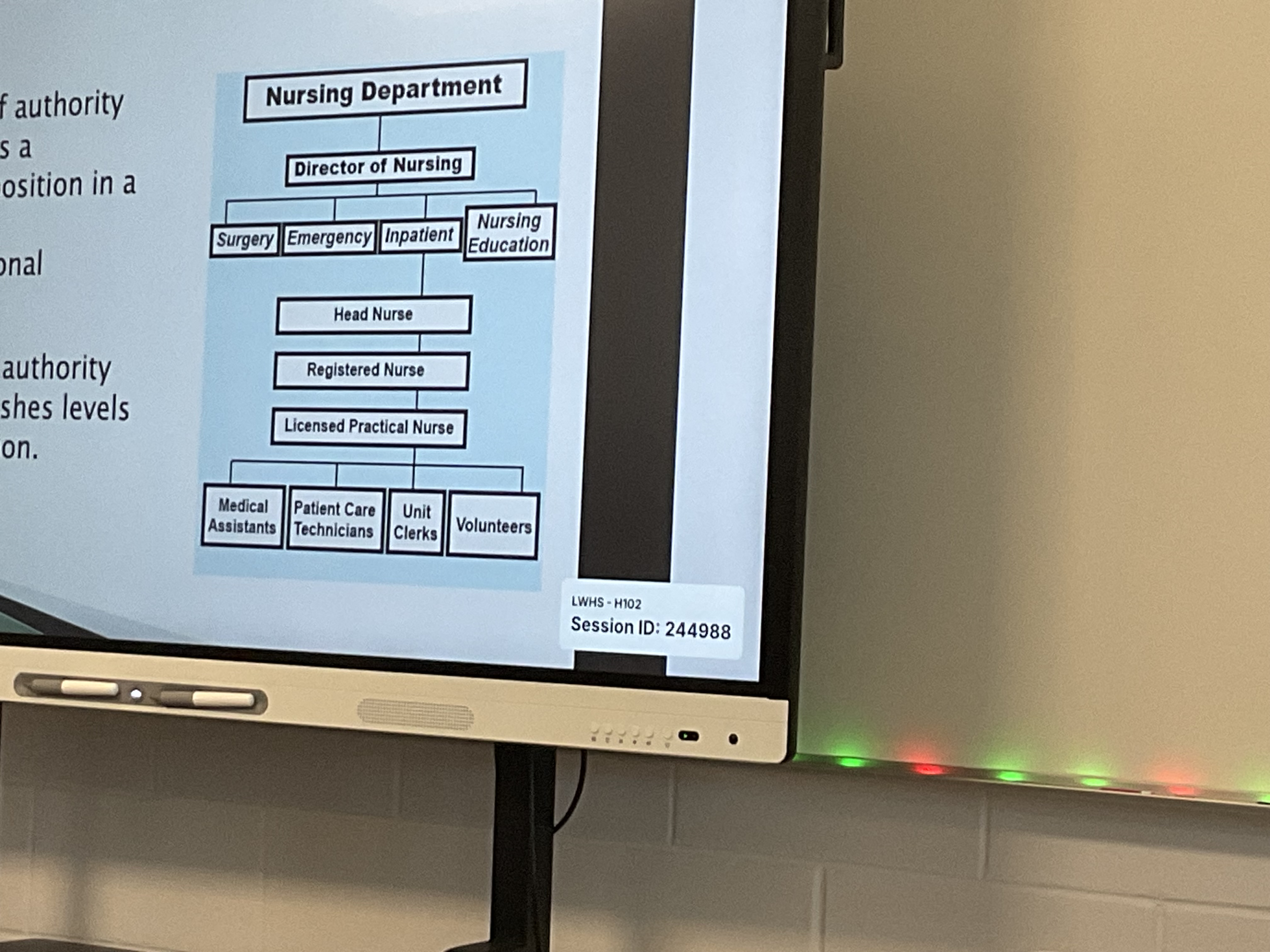
organization Structure
Helps a facility run smoothly by outlining the responsibilities by employees
Divided into informational supports diagnostics and therapeutic
Line of authority
determines a workers position in a facility’s organizational structure
Establishes levels of supervision
Medical office structure
the organizational structure and line of authority at a community medical office is different from a large medical office
Doctor is the primary supervisor
Respecting the chain of command
following a chain of command reinforces organization structure and provides strength, efficiency and focus
When should you escalate a problem
every facility should have a process in place that helps healthcare workers determine when to apply problem solving skills independently and when to escalate the issue to someone above them in accordance with the chain of command
When reporting an issue follow what guidelines
Follow your facilities process for reporting issues
Research the existing process
Develop a thoughtful plan for how you’d address the problem
Explain you concern to your supervisor and share you idea for resolving the issue
Be tactful and confident
Interdependence
All members of healthcare teams are dependent on one another
If one worker does not full fill the required duties the entire team is hindered