Digoxin PKs
 Call Kai
 Learn
Learn Practice Test
 Spaced Repetition
 Match
Match Flashcards
 Knowt Play
1/18

There's no tags or description
Looks like no tags are added yet.
Name | Mastery | Learn | Test | Matching | Spaced | Call with Kai | Chat |
|---|
No analytics yet
Send a link to your students to track their progress
19 Terms
What are the different formulas and doses of digoxin?
parenteral
0.25mg/mL, 0.05mg/mL
usually IV for loading doses
oral liquid
0.05mg/mL
tablet
0.0625mg, 0.125mg, 0.25mg
What is the oral bioavailability of digoxin?
tablets → 0.7-0.75
Elixir → 0.8
Why is there less than complete bioavailability?
P-glycoprotein (PGP) is involved in limiting digoxin absorption and enhancing elimination.
What is the interaction between PGP and digoxin?
digoxin is a substrate for PGP
PGP is a transmembrane protein involved in efflux of drugs from cells
found in liver, kidney and small intestine
limits drug bioavailability
45-80% reach portal circulation
can differ through drug interactions that induce or limit PGP in the enterocyte
What is the interaction between digoxin and lapatinib?
lapatinib inhibits PGP activity
significantly increases digoxin absorption
What is the distribution of digoxin?
volume of distribution is ~ 7L/kg (5-9 L/kg)
decreased in renal disease/failure
significant binding to muscle tissue
little distribution into adipose tissue → so no increase in obesity
minimal plasma protein binding
use ideal body weight for dosing calculations
What do you see in terms of concentration changes due to distribution?
biphasic decline in concentrations
initial rapid decrease due to distribution to tissues
slower terminal elimination phase → 6-12h
What does elimination look like for digoxin?
mostly renally cleared, unchanged → 75%
filtration and tubular secretion
renal clearance slightly above ClCr
PGP involved with secretion
non-renal clearance
healthy patients → 40mL/min
HF patients → 20mL/min
not due to metabolism, but PGP secretion into bile (which is decreased into HF patients)
What is the half-life of digoxin?
long half-life 36-48 hours good renal function
increased to 4-6 days in poor renal function
can be dosed infrequently
hard for adherence, so dose once daily
can take several weeks to reach steady state
What are pharmacokinetic drug interactions with digoxin?
Inhibitors of PGP → increase plasma conc and toxicity (increase F and decrease Cl)
clarithromycin - 10x more likely to cause toxicity
azole antifungals
verapamil
amiodarone
ritonavir - longer elimination and half-life
Inducers of PGP → lower digoxin concentration
phenytoin
rifampin - no effect in IV b/c PGP in enterocyte
St. Johns Wort
What are pharmacodynamic drug interactions with digoxin?
occurs with drugs that have similar effects on inotropic or AV conduction
BBs, amiodarone, verapamil, diltiazem
diuretics may increase the risk of hypokalemia resulting in digoxin toxicity
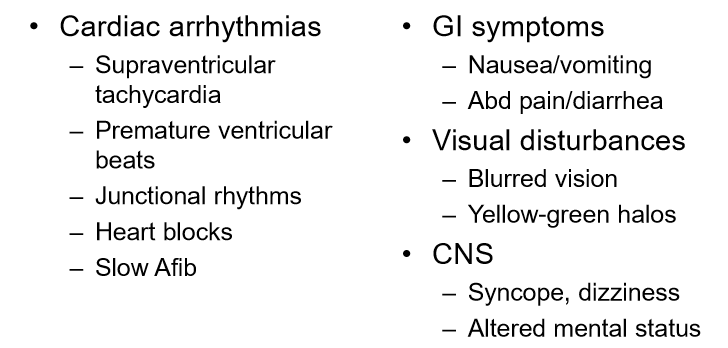
What are symptoms of digoxin toxicity?
Are concentration related and can occur when concentrations reach > 2mcg/L .
What are the digoxin dosing guidelines for CKD patients?
standard dose was historically 0.25mg once daily
doses should be reduced based on renal function
doses should be reduced for 65y+
only larger patients with CrCl > 70-80mL/min should be on this dose
patients with reduced renal function that got > 0.125mg increase risk of toxicity 6x
*be cautious if see older, smaller or CKD patient started on this dose
What is the therapeutic range for Afib with reduced ejection fraction?
reduce AV nodal conduction
rage: 0.8-2mcg/L
target → 1.2-1.5 mcg/L
What is the therapeutic range for heart failure?
range: 0.5-1 mcg/L
target → 0.8 mcg/L
When do you want to take measured concentrations?
samples should be collected at:
steady-state → 4-5 half-lives = 1-2 weeks
post-distribution phase → ideally a trough
concentration over dosing interval tend not to fluctuate since half-life is longer than dosing interval
How is the loading dose given?
need to know indication so know what to target
loading mainly for AF patients
separated into 3 divided doses
50% initially, 25% at 6h and 25% at 12h
How to change dosing based on digoxin’s kinetics?
exhibits first-order kinetics
dose changes produce proportional changes in steady state concentrations
50% reduction in dose → decreases steady state plasma conc by 50%
What is DigiFab?
digoxin-specific antibodies that bind to digoxin and prevent the drug from binding to tissues
each vial contains 40mg → that can bind 0.5mg digoxin