Chem Set A - Assesed Chemistry
 Call Kai
 Learn
Learn Practice Test
 Spaced Repetition
 Match
Match Flashcards
 Knowt Play
1/156

There's no tags or description
Looks like no tags are added yet.
Name | Mastery | Learn | Test | Matching | Spaced | Call with Kai | Chat |
|---|
No analytics yet
Send a link to your students to track their progress
157 Terms
What does a coefficient show?
The number of whole particles or formula units. It multiplies every atom in the formula that follows.
What does a subscript show?
The number of atoms or ions inside one chemical formula.
What does a superscript show?
The electrical charge on an ion.
How many atoms are in 2H₂O?
4 hydrogen atoms and 2 oxygen atoms.
How many atoms are in 3Ca(OH)₂?
3 calcium atoms, 6 oxygen atoms and 6 hydrogen atoms.
What is a particle?
A general term for an atom, ion or molecule.
What is an atom?
The smallest unit of an element that retains the properties of that element.
What is a molecule?
Two or more atoms joined by covalent bonds.
What is a diatomic molecule?
A molecule containing exactly two atoms such as H₂ or O₂.
What is an ion?
An atom or group of atoms with an electrical charge after gaining or losing electrons.
What is a cation?
A positively charged ion formed by losing electrons.
What is an anion?
A negatively charged ion formed by gaining electrons.
What happens when an atom loses electrons?
It becomes positively charged.
What happens when an atom gains electrons?
It becomes negatively charged.
What is an ionic bond?
The electrostatic attraction between oppositely charged ions.
What is a covalent bond?
A shared pair of electrons between atoms (two non-metals)
How can an ionic compound usually be identified?
It contains a metal and a non-metal. Electrons are transferred and oppositely charged ions form.
How can a covalent compound usually be identified?
It contains only non-metals. Electrons are shared and molecules form.
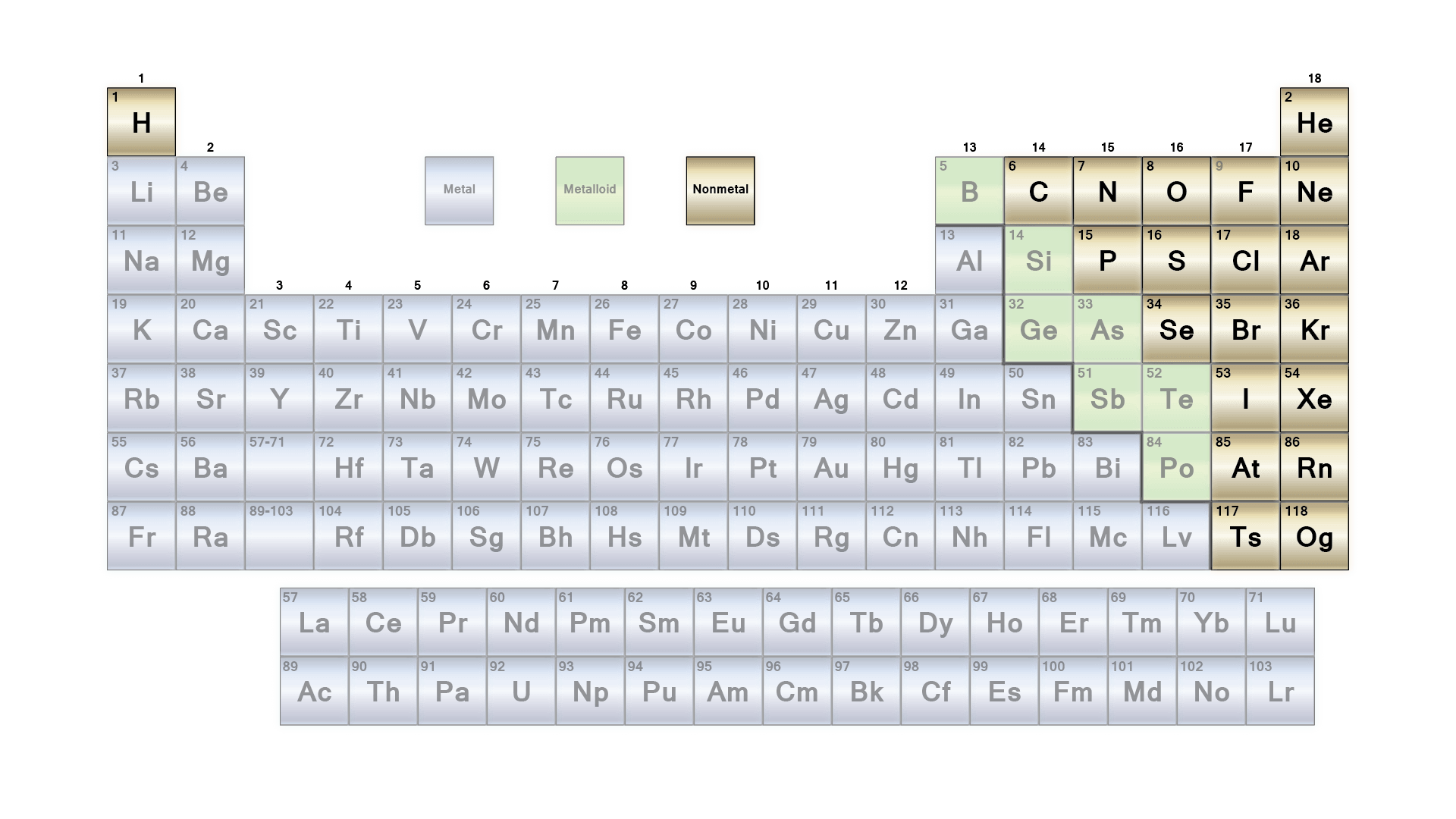
Where are metals on the periodic table?
On the left and centre.
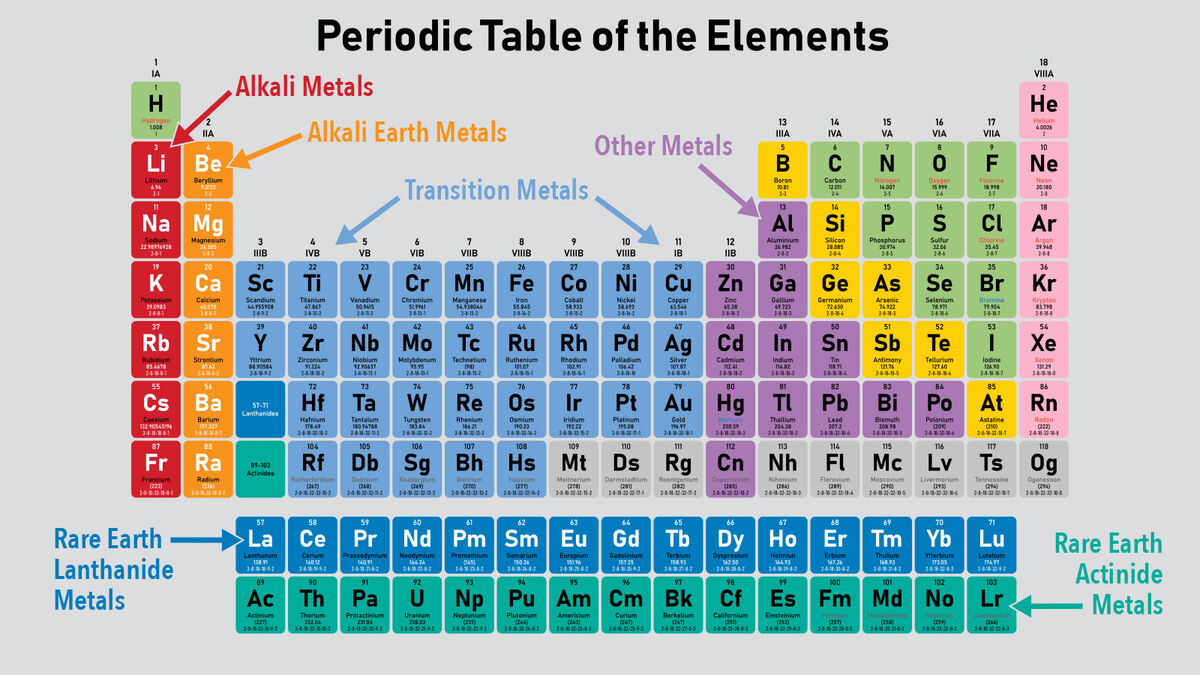
Where are non-metals on the periodic table?
On the upper-right. Hydrogen is a non-metal exception on the left.
Metal plus non-metal usually forms what?
An ionic compound.
Non-metal plus non-metal usually forms what?
A covalent compound.
Positive-ion charge chant
Na and K are 1+, Mg and Ca are 2+, Al is 3+.
Polyatomic-ion charge chant
Hydroxide and nitrate are 1−, carbonate and sulfate are 2−.
Hydrogen ion
H⁺
Sodium ion
Na⁺
Potassium ion
K⁺
Magnesium ion
Mg²⁺
Calcium ion
Ca²⁺
Aluminium ion
Al³⁺
Chloride ion
Cl⁻
Oxide ion
O²⁻
Hydroxide ion
OH⁻
Nitrate ion
NO₃⁻
Carbonate ion
CO₃²⁻
Sulfate ion
SO₄²⁻
What overall charge must an ionic compound have?
Zero. Its positive and negative charges must cancel.
Steps for constructing an ionic formula
Write the ions and charges, find the smallest ratio that totals zero, keep polyatomic ions unchanged, use brackets if needed, then remove the charges.
What is the locked-block rule?
Never change anything inside a polyatomic ion such as NO₃⁻ or SO₄²⁻.
When are brackets used in an ionic formula?
When more than one complete polyatomic ion is required.
What happens to a subscript of 1?
It is not written.
What if every subscript in an ionic formula has a common factor?
Simplify to the smallest whole-number ratio.
Why is sodium oxide Na₂O?
Two Na⁺ ions are needed to balance one O²⁻ ion.
Why is calcium chloride CaCl₂?
Two Cl⁻ ions are needed to balance one Ca²⁺ ion.
Why is calcium nitrate Ca(NO₃)₂?
Two NO₃⁻ ions are needed to balance one Ca²⁺ ion.
Formula and name of Na₂O
Sodium oxide.
Formula and name of MgO
Magnesium oxide.
Formula and name of CaCl₂
Calcium chloride.
Formula and name of Al₂O₃
Aluminium oxide.
Formula and name of NaOH
Sodium hydroxide.
Formula and name of KOH
Potassium hydroxide.
Formula and name of Ca(OH)₂
Calcium hydroxide.
Formula and name of Na₂CO₃
Sodium carbonate.
Formula and name of CaCO₃
Calcium carbonate.
Formula and name of NaNO₃
Sodium nitrate.
Formula and name of Ca(NO₃)₂
Calcium nitrate.
Formula and name of Na₂SO₄
Sodium sulfate.
Formula and name of Al(NO₃)₃
Aluminium nitrate.
Formula and name of Al₂(SO₄)₃
Aluminium sulfate.
How are ionic compounds named?
Name the positive ion first and the negative ion second.
How do single non-metal names change in ionic compounds?
Their ending changes to -ide such as chlorine to chloride and oxygen to oxide.
Do polyatomic-ion names change inside compounds?
No. Hydroxide, nitrate, carbonate and sulfate retain their names.
What does mono- mean?
1
What does di- mean?
2
What does tri- mean?
3
What does tetra- mean?
4
What does penta- mean?
5
What does hexa- mean?
6
How are covalent compounds named?
Use prefixes for atom numbers, usually omit mono- on the first element and change the second element’s ending to -ide.
Are covalent formulas charge-balanced?
No. Prefixes and subscripts directly show the numbers of atoms.
Formula and name of CO
Carbon monoxide.
Formula and name of CO₂
Carbon dioxide.
Formula and name of N₂O₃
Dinitrogen trioxide.
Formula and name of N₂O₄
Dinitrogen tetroxide.
Formula and name of SO₃
Sulfur trioxide.
Formula and name of H₂O
Water.
Formula and name of NH₃
Ammonia.
Formula and name of CH₄
Methane.
Seven diatomic elements
H₂, N₂, O₂, F₂, Cl₂, Br₂ and I₂.
Mnemonic for the diatomic elements
Have: Hydrogen (H₂)
No: Nitrogen (N₂)
Fear: Fluorine (F₂)
Of: Oxygen (O₂)
Ice: Iodine (I₂)
Cold: Chlorine (Cl₂)
Beer: Bromine (Br₂) [1]
Formula and name of hydrochloric acid
HCl.
Formula and name of nitric acid
HNO₃.
Formula and name of sulfuric acid
H₂SO₄.
Hydrochloric acid produces which salts?
Chlorides.
Nitric acid produces which salts?
Nitrates.
Sulfuric acid produces which salts?
Sulfates.
Acid-to-salt memory links
HCl gives chloride, HNO₃ gives nitrate, H₂SO₄ gives sulfate.
What is an acid?
A substance that produces H⁺ ions in water.
What is a base?
A substance that reacts with and neutralises an acid.
What is an alkali?
A base that dissolves in water.
What is a salt?
An ionic compound formed when an acid’s hydrogen is replaced by a metal or ammonium ion.
What is neutralisation?
A reaction between an acid and a base.
How can a metal hydroxide be recognised?
It contains a metal followed by OH such as NaOH.
How can a metal oxide be recognised?
It contains a metal combined with oxygen such as MgO.
How can a carbonate be recognised?
It contains the CO₃ group such as CaCO₃.
Acid plus metal hydroxide
Salt plus water.
Acid plus metal oxide
Salt plus water.
Acid plus carbonate
Salt plus water plus carbon dioxide.
Which neutralisation pattern produces carbon dioxide?
Acid plus carbonate.
How is the salt in a neutralisation reaction predicted?
Combine the metal from the base with the negative ion from the acid.