Organic Oxidations and Reductions
 Call Kai
 Learn
Learn Practice Test
 Spaced Repetition
 Match
Match Flashcards
 Knowt Play
1/74

There's no tags or description
Looks like no tags are added yet.
Name | Mastery | Learn | Test | Matching | Spaced | Call with Kai | Chat |
|---|
No analytics yet
Send a link to your students to track their progress
75 Terms
what is oxidation
increasing oxygen content/decreasing the hydrogen content of a compounds
what is reduction
decreasing the oxygen content/increasing hydrogen content of a compound
If a reaction occurs in which there is a net addition or net elimination of hydrogen and oxygen
the reaction is not oxidation or reduction
What are examples of reactions involving hydrogen and oxygen that are not oxidation/reduction reactions
dehydration of alcohol, hydration of alkene
Converting ethanol to ethanal is
oxidation
Converting ethanal to ethanoic acid is
oxidation
Hydrogenation of a double or triple bond is
reduction
What are the most widely used types of oxidation reagents?
chromium (VI) and manganese (VII)
What are the chromium oxidation reagents
CrO3, K2Cr2O7, K2CrO4
what are the manganese oxidation reagents
KMnO4
Chromium reagents for oxidation are normally used under BLANK conditions, where all are converted into the active oxidant BLANK
acidic, H2CrO4
Manganese oxidation reagents are used under BLANK conditions
basic
What happens when chromic acid or hot basic permanganate are used in an oxidation reaction
they do not stop until all hydrogen atoms attached to the carbon atoms undergoing oxidation have been removed
What type of reagents allows oxidation to stop at the aldehyde stage in the oxidation primary alcohols
anhydrous chromium (IV) reagents
What are the anhydrous chromium reagents
chromium trioxide-pyridine complex (CrO3-2 pyridine), pyridinium chlorochromate (PCC), and pyridinium dichromate (PDC)
chromium anhydrous reagents are all soluble in
organic solvents
Hot chromic acid and hot basic permanganate react with BLANK to give oxidative cleavage products
alkenes, alkynes, and alkylbenzenes
Oxidation begins on the BLANK atom of alkylbenzenes, only when is has one or more BLANK, to produce benzoic acids
benzylic carbon, benzylic hydrogen atoms
Cleavage of vicinal diols happens via
periodic acid (HIO4)
Cleavage of alkenes happens via
ozone
Cleavage of methyl ketones happens via
alkaline solutions of halogens (haloform reaction)
What reagents react with alkenes and alkynes to give oxidative addition products
Cold alkaline permanganate, osmium tetroxide, peroxy acids
Reductions of carbonyl compounds are usually performed with
complex metal hydrides
Reductions of alkenes are performed with
catalytic hydrogenation
Reductions of alkynes are performed with either
catalytic hydrogenation or alkali metals in ammonia
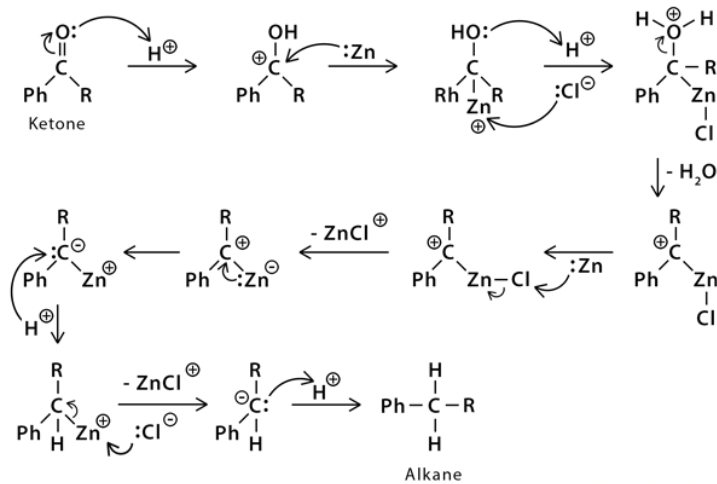
Identify the mechanism
Clemmensen Reduction
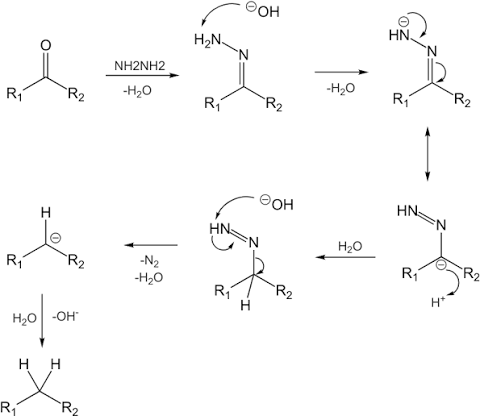
Identify the mechanism
Wolff-Kishner Reduction
What type of reagent is LiAlH4
reducing agent
alkaline oxidizing agents react with secondary alcohols to produce BLANK but also react rapidly with BLANK
ketones, double bonds
when will HIO4 react with an alcohol to perform oxidative cleavage of a C-C bond
when they are 1,2 diols or alpha to a carbonyl group
What is the structure of PCC?
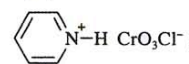
What does PCC do to primary alcohols?
convert to aldehyde
What does PCC do to secondary alcohols?
convert to ketone
What is not affected by PCC?
C-C double or triple bonds
NaBH4 is what kind of reagent?
reducing agent
What does K2Cr2O7 and H2SO4 do to primary alcohols
convert to carboxylic acid
What does hot KMnO4 do to primary alcohols
converts to carboxylic acid (via aldehyde intermediate)
Chromic acid does not oxidize BLANK, but can oxidize C-C bonds
ketones
basic KMnO4 reacts rapidly with C-C double bonds to give what product
vicinal diols or oxidative cleavage products
What type of reaction is polyphosphoric acid (P2O5/H3PO4) used in?
dehydration
What type of reaction converts methyl ketones to carboxylic acids?
haloform (treated with alkaline I2, Br2, or bleach/NaOCl, followed by neutralization)
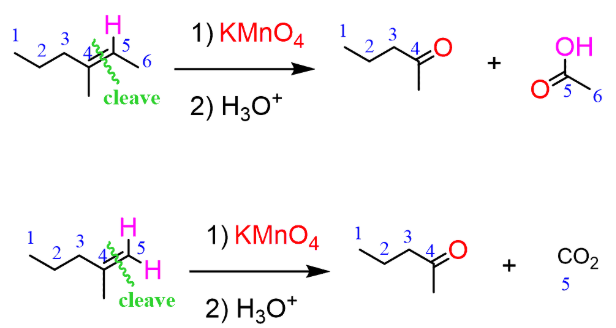
Identify the mechanism
oxidative cleavage of alkenes with KMnO4
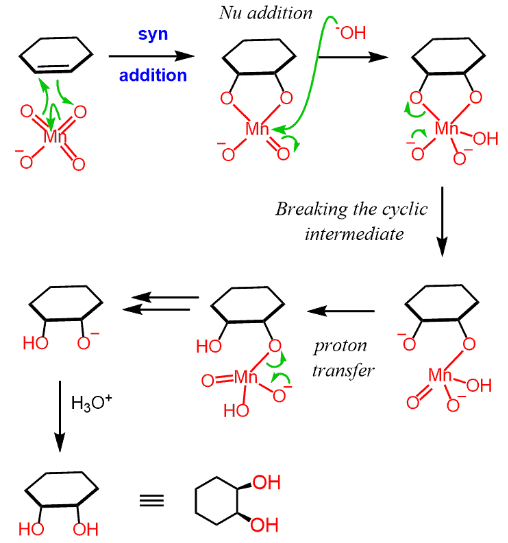
Identify the mechanism
Syn dihydroxylation of alkenes with cold KMnO4
Terminal alkenes when oxidized by KMnO4
=CH2 group is oxidized to CO2
Monosubstituted carbon atoms (=CHR) when oxidized by KMnO4 produce what
carboxylic acid
Disubstituted carbon atoms (=CRR’) produce what when oxidized by KMnO4?
ketones
If the alkene being oxidized by KMnO4 is a part of a chain
two separate molecules form
If the alkene being oxidized by KMnO4 is a part of a ring
the ring is broken
A vinyl carbon atom containing a hydrogen atom will convert to what after oxidation via KMnO4
carboxylic acid
A vinyl carbon with a methyl group will convert to what when oxidized via KMnO4
ketone
All C-H bonds are converted into what during alkene oxidative cleavage
carboxylic acid
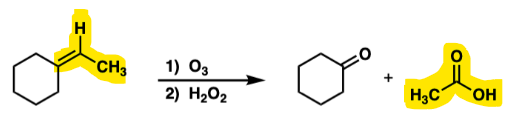
methyl groups attached to an alkene during oxidative cleavage produce what
ketones
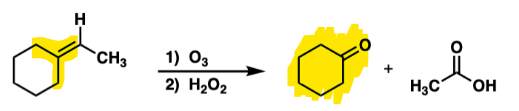
C=C is oxidatively cleaved to what
C=O O=C
What is the best stereochemical arrangement of hydroxyl groups in order for periodic acid to cleave it
cis
What reagent will convert an alkene into a cis 1,2-diol
OsO4 (and a hydrolyzing agent)
What reagent will convert an alkene into a trans 1,2-diol
Peracid (HCO3H in acidic conditions)
What reagent can produce a cis 1,2-diol from an alkene but in low yield due to its oxidative cleavage abilities?
cold alkaline KMnO4
What reagent can be used to reduce an alkyne to a Z-alkene
H2 and a Lindlar catalyst
What is a Lindar catalyst
Pd and a deactivating agent (BaSO4, BaCO3/quinoline)
What reagent can be used to reduce an alkyne to an E-alkene
Na (or Li), NH3
Hydrogenation of an alkene always happens via
syn addition
What do the reagents H2, Pd/C do
hydrogenation of an alkene
what reagent can reduce a ketone, but will leave alkenes unaffected
NaBH4 or LiAlH4
What reagent can reduce carboxylic acids and ketones?
LiAlH4
What reagent cannot reduce carboxylic acids but can reduce ketones?
NaBH4
What does LiAlH4 reduce carboxylic acids to?
primary alcohols
What reagent reduces ketones to a secondary alcohol?
H2, Pd
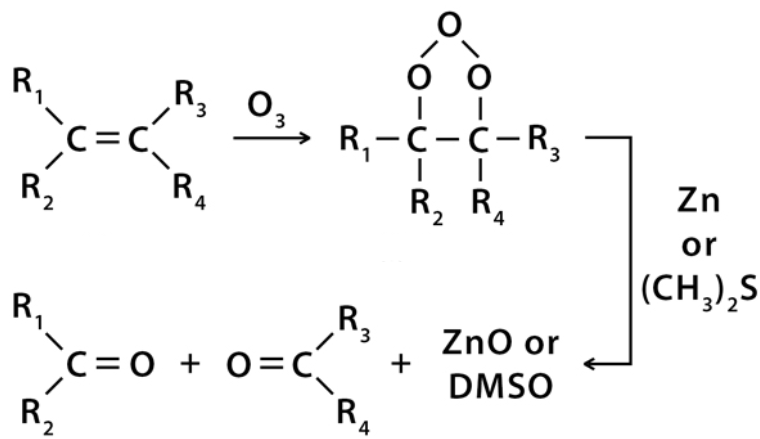
Identify the mechanism
ozonolysis
How do alkylbenzenes (aromatic alkanes) react with KMnO4
oxidizes benzylic carbon to make benzoic acid
what molecules does K2Cr2O7 oxidize best?
aldehydes and alcohols
what reagent cannot oxidize carboxylic acids
K2Cr2O7
What is the product of the oxidation of primary alcohols with K2Cr2O7
aldehydes => carboxylic acids
what is the product of the oxidations of secondary alcohols with K2Cr2O7
ketones
what is the product of a reduction of a ketone, and the product of reduction of an aldehyde, via NaBH4
secondary alcohol, primary alcohol
what are the reagents of a clemmenson reduction
Zn(Hg), acidic workup