Physics - Electric Circuits
 Call Kai
 Learn
Learn Practice Test
 Spaced Repetition
 Match
Match Flashcards
 Knowt Play
1/24

Earn XP
Description and Tags
25 Terms
Current (I)
Ampere (A)
Charge (Q)
Coulumb (C)
Energy (E)
Joule (J)
Resistance (R)
Ohm (Ω)
Time (t)
Second (s)
Voltage / potential difference (V)
Volt (V)
Power (P)
Watt (W)
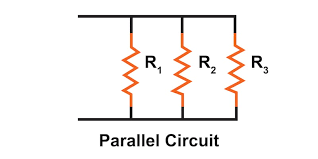
Parallel circuit
A closed circuit where electrical components are connected along multiple, separate branches, allowing the current to take different paths
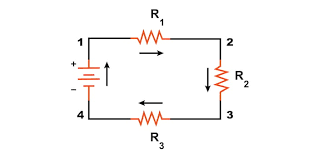
Series circuit
An electrical circuit where components are connected end-to-end in a single path, providing only one route for current to flow
Investigation to test how current varies with voltage
Set a circuit up for each component plus and ammeter and voltmeter, set the voltage to the same for each and measure how the amps differ for each component
What happens when you increase the resistance of a circuit?
The current of the circuit decreases
What can be used to indicate the presences of current in a circuit?
Lamps and LEDs
Equation for voltage
voltage = current x resistance V = I x R
Current
The rate of flow of charge
Equation for charge
Charge = current x time Q = I x T
What is the electric current in solid metallic conductors?
A flow of negatively charged ions
Where is current conserved and why?
At a junction because charge is conserved
Rule of voltage in parallel
Voltage of across two components connected in parallel is the same
What is Voltage?
The energy transferred per unit charge passed
Equation for energy transferred
Energy transferred = charge x voltage E = Q x V
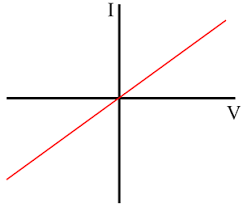
Resistor
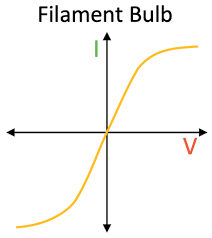
Bulb
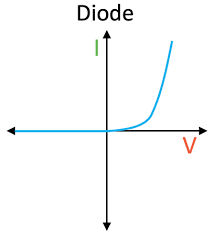
Diode
Temperature
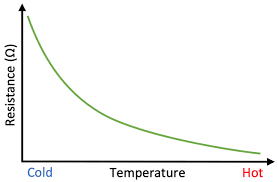
As temperature increase,
Resistance of the thermistor decreases. TURD. (Same for light intensity. LURD)