C5, C6, C7, C8
 Call Kai
 Learn
Learn Practice Test
 Spaced Repetition
 Match
Match Flashcards
 Knowt Play
1/38

Earn XP
Description and Tags
Redox, chemical bonding, group chemistry and separation techniques
Name | Mastery | Learn | Test | Matching | Spaced | Call with Kai | Chat |
|---|
No analytics yet
Send a link to your students to track their progress
39 Terms
C5 - REDOX
X
Redox
Oxidation is loss of electrons and gain of oxygen
Reduction is gain of electrons and loss of oxygen
When this happens at once, this is redox (OIL RIG)
Oxidising vs reducing agent
Oxidising agent
Accepts electrons and undergoes reduction
Reducing agent
Donates electrons and undergoes oxidation
Oxidation number rules
Un-combined elements have an oxidation number of 0
Atoms in molecules bonded to identical atoms (diatomic molecules) have oxidation number of 0
Monatomic ion's ON is same as its charge (Fe3+ has ON of +3)
In molecular ion, sum of ON is equal to overall charge
Neutral compounds have ON sum of 0
Combined oxygen has ON of -2 except in peroxides where its -1
In OF2 its +2
Combined hydrogen usually has an ON of +1 except in metal hydrides where its -1
Oxidation number of compound containing 2 non-metals is given to more electronegative element
Roman numerals
Roman numerals are used after element's name to specify its oxidation number
Iron (II) has ON of +2
Iron (III) has ON of +3
-ate compounds
Ions ending in -ate are made up of oxygen and another element
Element bonding to oxygen has variable oxidation number
Roman numerals are used after compound's name to differentiate between these numbers
Oxidation numbers
Oxidation
Increase of oxidation numbers
Reduction
Decrease of oxidation number
E.G. Na + 1/2 Cl2 ---> NaCl2
Sodium is oxidised because oxidation number increases from 0 to +1
Chlorine is reduced because oxidation number decreases from 0 to -1
Disproportionation
When single element is both oxidised and reduced
e.g. in Cl2 + 2OH- ----> ClO- + Cl- + H2O
Cl is both oxidised (increase in ON)
Cl is both reduced (decrease in ON)
C6 - CHEMICAL BONDING, STRUCTURE AND PROPERTIES
X
Element, compound and mixture
Element
Pure substance that have the same proton number and cannot be broken into simpler substances
Compound
Pure substance made of two or more different elements chemically bonded
Mixture
Two or more different substances not joined together
Ionic bond
Ion
Atom with a negative or positive charge
Ide
2 elements
Ate
3 elements
Ionic bonding
Oppositely charged ion (cations + anions) are attracted to each other and held together by strong electrostatic forces of attraction
Formation of ions
Group no --> loses/gains an electron for a full outer shell
Means it has pos/neg charge
More protons than electrons/ more electrons than protons
Structure of ionic compound
Alternating regular arrangement of ions in a lattice held together by ESFA between oppositely charged ions
Properties of ions
High BP/MP
Strong electrostatic forces of attraction
More energy needed to break them
Intermolecular forces between molecules that must be overcome
Conductive
When aqueous or molten
Ions are unable to move when in lattice
ESFA
Unable to conduct charge
When liquid, ions are free to move
Can conduct charge
Strength of ionic bond
Ionic charge
Higher charge greater strength
Ionic size
Smaller ions have greater attraction
Common ions
OH-
SO42-
NO3-
CO32-
NH4+
HCO3-
Covalent molecules
Covalent bonding
Shared pair of electrons between non-metals on the outer shell
Molecules
Group of covalently bonded atoms
Bonding
Group no --> need certain no of electrons for full outer shell
Share pairs of electrons to get full outer shell
Typically water, methane, ammonia
1 pair = 1 bond
Covalent properties
Low BP/MP
Weak intermolecular forces of attraction
Less energy needed to overcome it
Poor conductor
No charged particles
Nothing to conduct charge
Giant covalent: diamond and graphene
Diamond
Strong
4 covalent bonds per carbon atom
Rigid and hard
Good for cutting tools
High BP/MP
Because of strong bonds
More energy required
Poor conductor
No delocalised electrons
Graphene
Regular shape (3 covalent bonds per carbon atom)
1 free/spare electron (delocalised e-)
Good conductor
High BP/MP
3 strong bonds
Light and strong
Giant covalent: graphite and fullerene
Fullerene
Simple covalent (has discreet formula)
3 bonds per carbon atom (delocalised e-)
Conductor
Low BP/MP
Less energy is required to overcome intermolecular forces of attraction
Hollow + ball shape
Transporting medicine
Graphite
Weak intermolecular forces of attraction between LAYERS
Layers can slide over each other
Slippery --> lubricant
Covalent bonds between carbon atoms
Delocalised e- (3 bonds per atoms)
Can conduct electricity (electrodes)
Metallic bonding
Giant lattice of atoms
Give up the shell and share the electrons
Forms a sea of delocalised electrons
Electrostatic attraction between e- and newly made cations
Metallic properties
Malleability
Arranged in lattice
Force applied means layers can slide over each other
Conductivity
Delocalised electrons can conduct charge
Free to move in lattice
High BP/MP
Strong electrostatic forces of attraction between delocalised electrons and cations
More energy needed to overcome it
C7 - GROUP CHEMISTRY
X
Group 1 physical properties
Alkali metals
Physical properties
Soft
Low density
Low melting points
Group 1 Chemical: reaction with water
They all have 1 electron in outer shell
Will react similarly
Reaction with water
Produce metal hydroxide and hydrogen
Energy of reaction can sometimes make hydrogen burn
Reaction of lithium = fizzes steadily
Reaction of sodium = melts to form a ball, fizzes
Reaction of potassium, quickly melts to form a ball,
Group 1 Chemical: reaction with oxygen
Form metal oxides
Potassium is either metal peroxide (two oxygen) or superoxide (1 oxygen)
Chlorine is oxide
Sodium is oxide or peroxide
Group 1 reactivity
Further from nucleus easier to lose electron
Less electrons easier to lose
Halogen physical properties
Live as molecules
Melting and boiling points increase as you go down
Molecules become larger
More intermolecular forces
Harder to overcome
Colour and states
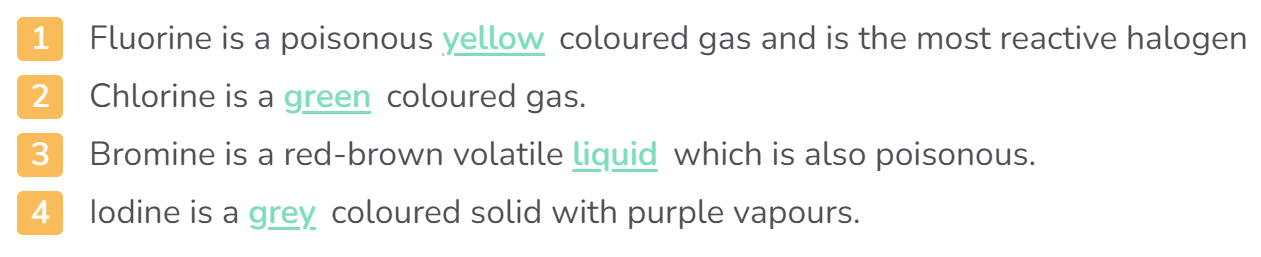
Chlorine: green, gas
Bromine: brown, liquid
Iodine: purple/black, solid
Halogen chemical properties
Reaction with metals
Form salts
Less reactive as you go down table
Atoms larger
More shells further from nucleus
Reaction with hydrogen
Form hydrogen HALIDE
e.g. chlorine --> chloride
Dissolve in water to form acidic solution
High reaction = explosion
Halogen displacement
A more reactive halogen replaces a less reactive halide ion
Chlorine displaces bromide ions
Cl2 (aq) + 2Br-(aq) ---> 2Cl-(aq) + Br2 (aq)
Noble gases physical properties
Exist as single atoms
Low boiling points
Increase due to more covalently bonded molecules
Low densities
Gases
Noble gases chemical properties
Inert
When element reacts, they lose/gain electron
They already have full outer shell anyways
Noble gases uses
Helium
Less dense than air
Used for balloons
Non flammable
Argon
Shield gas for welding
Denser than air so oxidation does not occur at weld
C8 - SEPARATION TECHNIQUES
X
Chemical processes
Needed to displace constituent elements from compounds
Physical processes
Used to separate mixtures
Including dissolved/insoluble solids
Miscible/immiscible liquids
When to use: distillation, crystallisation, chromatography, filtration and fractional distillation
Distillation
Solid + liquid w VERY different BP
Crystallisation
Impure solid from dissolved solvent
Chromatography
Separates coloured chemicals
Filtration
Insoluble solid from solution
Fractional distillation
Mixture
Similar BP
When to use: centrifugation, evaporation, dissolving and separating funnel
Separating funnel
Two immiscible liquids that can be separated based on their densities
Centrifugation
Based on density of centrifugal forces
Less dense stay in the middle
Evaporation
Separate soluble solid from liquid
Dissolving
Used when soluble solid is present in mixture
Solute can then be filtered out
Chromatography
Separation of mixtures of soluble substances by running a solvent through the mixture on paper - one spot if pure
Mobile phase:
Solvent
Stationary phase
Paper
Rf value
distance travelled by spot/ solvent front