šŸ„ Allele Variation

0.0(0)
Studied by 1 person
call kaiCall Kai
learnLearn
examPractice Test
spaced repetitionSpaced Repetition
heart puzzleMatch
flashcardsFlashcards
GameKnowt Play
Card Sorting

1/17

encourage image

There's no tags or description

Looks like no tags are added yet.

Last updated 3:18 AM on 3/30/26
Name
Mastery
Learn
Test
Matching
Spaced
Call with Kai

No analytics yet

Send a link to your students to track their progress

18 Terms

1
New cards

Possibilities Outside of Mendel’s Crosses

  • Genes can (and usually do) have more than 2 alleles

  • Different alleles affect phenotype differently

  • Additional factors at a single locus can affect phenotype

2
New cards

Genes Usually have 2+ Alleles

  • Most common allele is called ā€œwild typeā€

    • Designated with superscript + (e.g. A+ or c+)

  • All other alleles are considered mutants (e.g. cch, ch, c)

  • Any allele found at appreciable frequencies (at least 1%) is considered to be a polymorphism/variant

  • Note: Diploid organisms can only ever have 2 alleles in there genome at one time

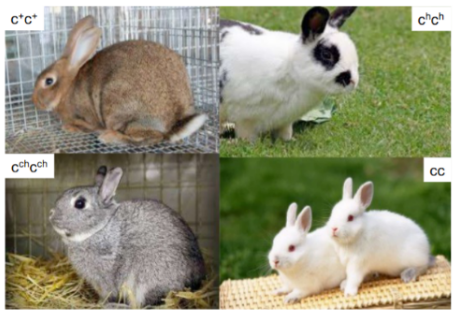
  • e.g. Each of four different alles of ā€œcā€ gene in rabbits affects coat color differently

    • c+c+ -Ā  Wild type (most common)

    • chch - Himalayan (h)Ā 

    • cchcch - Chinchilla (ch)

    • cc - No pigmentation

<ul><li><p><span style="font-family: &quot;Helvetica Neue&quot;, sans-serif">Most common allele is called ā€œwild typeā€</span></p><ul><li><p><span style="font-family: &quot;Helvetica Neue&quot;, sans-serif">Designated with superscript + (e.g. A</span><span><sup>+</sup></span><span style="font-family: &quot;Helvetica Neue&quot;, sans-serif"> or c</span><span><sup>+</sup></span><span style="font-family: &quot;Helvetica Neue&quot;, sans-serif">)</span></p></li></ul></li><li><p><span style="font-family: &quot;Helvetica Neue&quot;, sans-serif">All other alleles are considered mutants (e.g. c</span><span><sup>ch</sup></span><span style="font-family: &quot;Helvetica Neue&quot;, sans-serif">, c</span><span><sup>h</sup></span><span style="font-family: &quot;Helvetica Neue&quot;, sans-serif">, c)</span></p></li><li><p><span style="font-family: &quot;Helvetica Neue&quot;, sans-serif">Any allele found at appreciable frequencies (at least 1%) is considered to be a polymorphism/variant</span></p></li><li><p><span style="font-family: &quot;Helvetica Neue&quot;, sans-serif">Note: Diploid organisms can only ever have 2 alleles in there genome <strong>at one time</strong></span></p></li><li><p><span style="font-family: &quot;Helvetica Neue&quot;, sans-serif">e.g. Each of four different alles of ā€œcā€ gene in rabbits affects coat color differently</span></p><ul><li><p><span style="font-family: &quot;Helvetica Neue&quot;, sans-serif">c</span><span><sup>+</sup></span><span style="font-family: &quot;Helvetica Neue&quot;, sans-serif">c</span><span><sup>+</sup></span><span style="font-family: &quot;Helvetica Neue&quot;, sans-serif"> -&nbsp; Wild type (most common)</span></p></li><li><p><span style="font-family: &quot;Helvetica Neue&quot;, sans-serif">c</span><span><sup>h</sup></span><span style="font-family: &quot;Helvetica Neue&quot;, sans-serif">c</span><span><sup>h</sup></span><span style="font-family: &quot;Helvetica Neue&quot;, sans-serif"> - Himalayan (h)&nbsp;</span></p></li><li><p><span style="font-family: &quot;Helvetica Neue&quot;, sans-serif">c</span><span><sup>ch</sup></span><span style="font-family: &quot;Helvetica Neue&quot;, sans-serif">c</span><span><sup>ch</sup></span><span style="font-family: &quot;Helvetica Neue&quot;, sans-serif"> - Chinchilla (ch)</span></p></li><li><p><span style="font-family: &quot;Helvetica Neue&quot;, sans-serif">cc - No pigmentation</span></p></li></ul></li></ul><p></p>
3
New cards

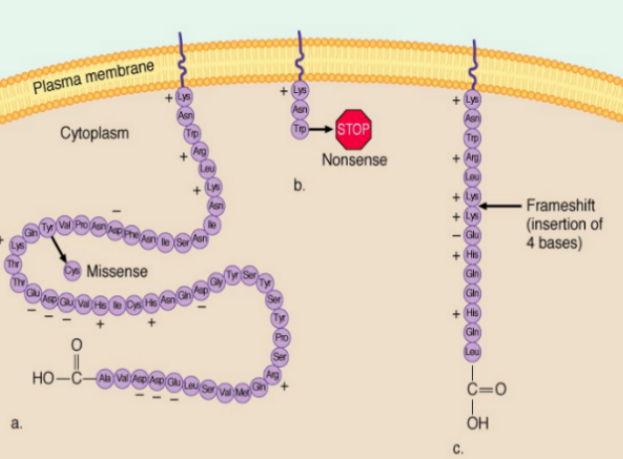
Gene Mutations

  • Different mutations in a gene can cause the same disorder but different phenotypes

  • Missense

    • One amino acid is replaced with another

    • Changes function of protein

  • Nonsense

    • Results in premature stop codon

  • Frameshift

    • Deletion

    • Insertion

<ul><li><p><span style="font-family: &quot;Helvetica Neue&quot;, sans-serif">Different mutations in a gene can cause the same disorder <strong>but</strong> different phenotypes</span></p></li><li><p><span style="font-family: &quot;Helvetica Neue&quot;, sans-serif">Missense</span></p><ul><li><p><span style="font-family: &quot;Helvetica Neue&quot;, sans-serif">One amino acid is replaced with another</span></p></li><li><p><span style="font-family: &quot;Helvetica Neue&quot;, sans-serif">Changes function of protein</span></p></li></ul></li><li><p><span style="font-family: &quot;Helvetica Neue&quot;, sans-serif">Nonsense</span></p><ul><li><p><span style="font-family: &quot;Helvetica Neue&quot;, sans-serif">Results in premature stop codon</span></p></li></ul></li><li><p><span style="font-family: &quot;Helvetica Neue&quot;, sans-serif">Frameshift</span></p><ul><li><p><span style="font-family: &quot;Helvetica Neue&quot;, sans-serif">Deletion</span></p></li><li><p><span style="font-family: &quot;Helvetica Neue&quot;, sans-serif">Insertion</span></p></li></ul></li></ul><p></p>
4
New cards

What Makes an Allele Dominant/Recessive

  • When only one good copy (e.g. R in Rr) of an allele is sufficient to make the protein required for the biological process to occur (e.g. make round seeds in Rr)

    • R would dominant

    • r would recessive

  • Recessive mutations almost always involve mutation in gene that results in some loss of protein function:

    • DNA mutations would create recessive alleles (e.g. nonsense mutation leads to null recessive allele, missense mutation leads to hypomorphic recessive allele)

    • Null allele: Complete loss of function

    • Hypomorphic allele: Partial loss of function

      • Hypo = Beneath, Morphic = Morphology/phenotype

5
New cards

Types of Dominance

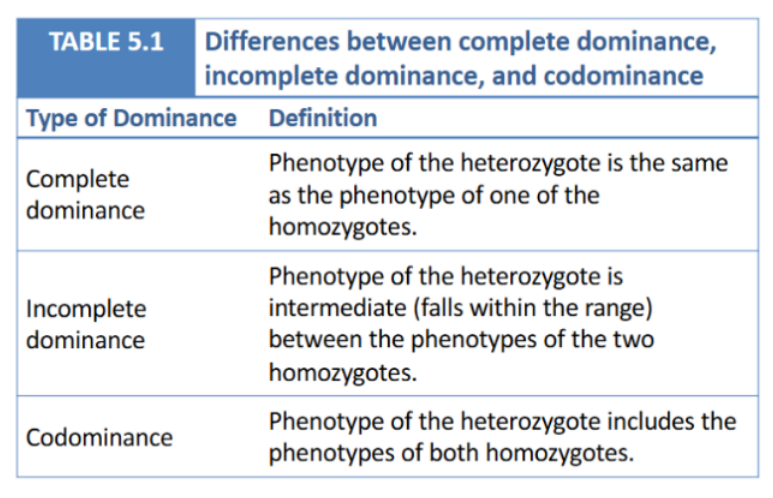
  • Each version of a gene at a particular locus is defined as an allele

    • Not as simple as ā€œdominantā€ or ā€œrecessiveā€

  • Different types of dominance

    • Complete (AA phenotype = Aa phenotype ≠ aa phenotype)

    • Incomplete (Aa = black, Aa = grey, aa = white)

    • Codominance (AA = black, Aa = black with white spots, aa = white

6
New cards

Antennapedia (Antp) Mutation

  • Dominant gain-of-function mutation

  • Causes Antp gene to be expressed in wrong place (a regulatory mutation)

  • Normally, Antp controls leg development in thorax, but in this mutation it is misexpressed in head, leading to legs growing where antennae should be

  • Dominant: A single mutated allele is enough to cause the phenotype. (Aa)

  • Gain of function: The gene is still active but in the wrong place or at the wrong time

  • Regulatory mutation: The mutation affects when and where the gene is turned on, not the protein itself

7
New cards

Complete Dominance

  • Heterozygous phenotype is same as homozygous dominant (AA = Black, Aa = Black)

8
New cards

Complete Dominant Mutations

  • Phenotype of AA is same as Aa - Just one mutated allele (Aa) is enough to cause effect

    • Gain-of-Function mutation - Mutation adds new function (e.g. gene being expressed in wrong place, leg where antenna should be)

    • Loss-of-Function mutation - Mutation disrupts normal function of gene (e.g. stops protein from working, no antennas at all)

  • Phenotype is wild type: aa leads to both antennae

9
New cards

Incomplete Dominance

  • Neither A or a is dominant or recessive

  • When alleles mix, their traits also mix (e.g. color)

    • Dominance of each trait is incomplete, not fully red or white

  • AA = Red

  • Aa = Pink

  • aa = White

  • Phenotype ratio is 1:2:1 (allele 1 : mix : allele 2)

    • Normal dominant/recessive phenotype ratio is 3:1 (dominant : recessive)

10
New cards

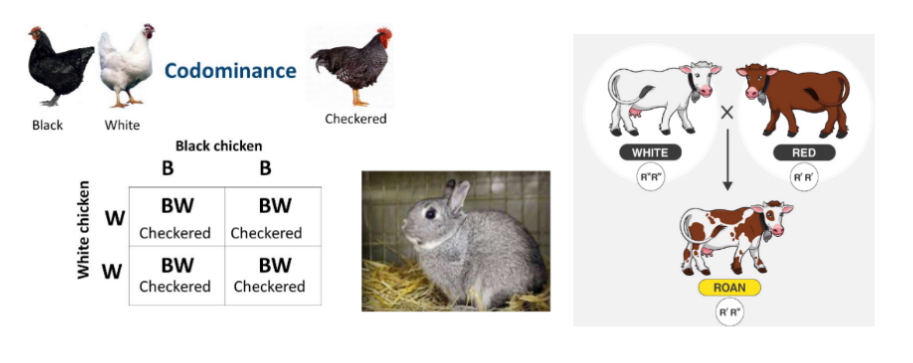
Codominance

  • Heterozygous phenotype expresses traits form both AA and aa phenotypes

  • e.g. BB = Black, WW = White, BW = Black with white spots

    • BW will sometimes be expressed as BB and sometimes as WW, leading to both being expressed in the entire coat/skin
<ul><li><p><span style="font-family: &quot;Helvetica Neue&quot;, sans-serif">Heterozygous phenotype expresses traits form both AA and aa phenotypes</span></p></li><li><p><span style="font-family: &quot;Helvetica Neue&quot;, sans-serif">e.g. BB = Black, WW = White, BW = Black with white spots</span></p><ul><li><p><span style="font-family: &quot;Helvetica Neue&quot;, sans-serif">BW will sometimes be expressed as BB and sometimes as WW, leading to both being expressed in the entire coat/skin</span></p></li></ul></li></ul><p></p>
11
New cards

Comparing Types of Dominance

knowt flashcard image
12
New cards

Blood Types

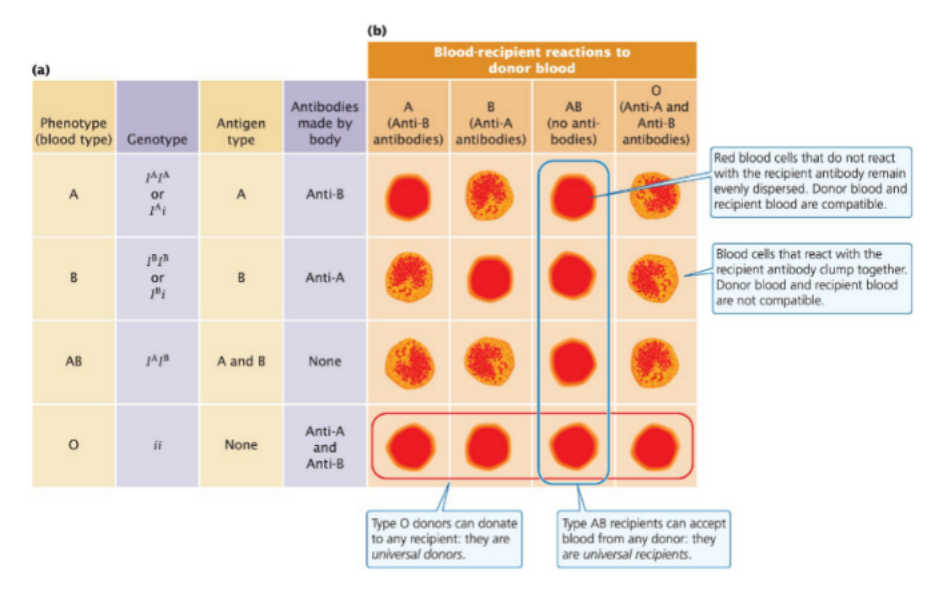
  • ABO blood group in humans has a multi-allelic system AND codominance

    • IA is dominant over i

    • IB is dominant over i

    • IA and IB are codominant

  • Expressed using I

  • Blood type (phenotype)

    • A - IAIA or IAi

    • B - IBIB or IBi

    • AB - IAIB

    • O - ii

  • Antigens (think: same as phenotype name, identifies blood type)

    • A - A antigens

    • B - B antigens

    • AB - A and B antigens

    • O - no antigens

  • Antibodies (think: fight off what they aren’t)

    • A - Anti-B

    • B - Anti-A

    • AB - None

    • O - Anti-A and Anti-B

  • Compatibility

    • A can receive A and O, since it has anti-B antibodies (it will recognize the B antigens on the B and AB blood cells)

    • B can receive B and O, since it has anti-A antibodies (it will recognize the A antigens on A and AB blood cells)

    • AB can receive any, since it has no antibodies (it won’t detect antigens on A, B, or O cells)

    • O can receive only O, since it has anti-A AND anti-B antibodies (it will recognize A and B antigens on A, B, and AB cells)
<ul><li><p><span style="font-family: &quot;Helvetica Neue&quot;, sans-serif">ABO blood group in humans has a multi-allelic system <strong>AND</strong> codominance</span></p><ul><li><p><span style="font-family: &quot;Helvetica Neue&quot;, sans-serif">I</span><sup>A</sup><span style="font-family: &quot;Helvetica Neue&quot;, sans-serif"> is dominant over i</span></p></li><li><p><span style="font-family: &quot;Helvetica Neue&quot;, sans-serif">I</span><sup>B</sup><span style="font-family: &quot;Helvetica Neue&quot;, sans-serif"> is dominant over i</span></p></li><li><p><span style="font-family: &quot;Helvetica Neue&quot;, sans-serif">I</span><sup>A</sup><span style="font-family: &quot;Helvetica Neue&quot;, sans-serif"> and I</span><sup>B</sup><span style="font-family: &quot;Helvetica Neue&quot;, sans-serif"> are codominant</span></p></li></ul></li><li><p><span style="font-family: &quot;Helvetica Neue&quot;, sans-serif">Expressed using I</span></p></li><li><p><span style="font-family: &quot;Helvetica Neue&quot;, sans-serif">Blood type (phenotype)</span></p><ul><li><p><span style="font-family: &quot;Helvetica Neue&quot;, sans-serif">A - I</span><sup>A</sup><span style="font-family: &quot;Helvetica Neue&quot;, sans-serif">I</span><sup>A</sup><span style="font-family: &quot;Helvetica Neue&quot;, sans-serif"> or I</span><sup>A</sup><span style="font-family: &quot;Helvetica Neue&quot;, sans-serif">i</span></p></li><li><p><span style="font-family: &quot;Helvetica Neue&quot;, sans-serif">B - I</span><sup>B</sup><span style="font-family: &quot;Helvetica Neue&quot;, sans-serif">I</span><sup>B</sup><span style="font-family: &quot;Helvetica Neue&quot;, sans-serif"> or I</span><sup>B</sup><span style="font-family: &quot;Helvetica Neue&quot;, sans-serif">i</span></p></li><li><p><span style="font-family: &quot;Helvetica Neue&quot;, sans-serif">AB - I</span><sup>A</sup><span style="font-family: &quot;Helvetica Neue&quot;, sans-serif">I</span><sup>B</sup></p></li><li><p><span style="font-family: &quot;Helvetica Neue&quot;, sans-serif">O - ii</span></p></li></ul></li><li><p><span style="font-family: &quot;Helvetica Neue&quot;, sans-serif">Antigens (think: same as phenotype name, identifies blood type)</span></p><ul><li><p><span style="font-family: &quot;Helvetica Neue&quot;, sans-serif">A - A antigens</span></p></li><li><p><span style="font-family: &quot;Helvetica Neue&quot;, sans-serif">B - B antigens</span></p></li><li><p><span style="font-family: &quot;Helvetica Neue&quot;, sans-serif">AB - A and B antigens</span></p></li><li><p><span style="font-family: &quot;Helvetica Neue&quot;, sans-serif">O - no antigens</span></p></li></ul></li><li><p><span style="font-family: &quot;Helvetica Neue&quot;, sans-serif">Antibodies (think: fight off what they aren’t)</span></p><ul><li><p><span style="font-family: &quot;Helvetica Neue&quot;, sans-serif">A - Anti-B</span></p></li><li><p><span style="font-family: &quot;Helvetica Neue&quot;, sans-serif">B - Anti-A</span></p></li><li><p><span style="font-family: &quot;Helvetica Neue&quot;, sans-serif">AB - None</span></p></li><li><p><span style="font-family: &quot;Helvetica Neue&quot;, sans-serif">O - Anti-A and Anti-B</span></p></li></ul></li><li><p><span style="font-family: &quot;Helvetica Neue&quot;, sans-serif">Compatibility</span></p><ul><li><p><span style="font-family: &quot;Helvetica Neue&quot;, sans-serif">A can receive A and O, since it has anti-B antibodies (it will recognize the B antigens on the B and AB blood cells)</span></p></li><li><p><span style="font-family: &quot;Helvetica Neue&quot;, sans-serif">B can receive B and O, since it has anti-A antibodies (it will recognize the A antigens on A and AB blood cells)</span></p></li><li><p><span style="font-family: &quot;Helvetica Neue&quot;, sans-serif">AB can receive any, since it has no antibodies (it won’t detect antigens on A, B, or O cells)</span></p></li><li><p><span style="font-family: &quot;Helvetica Neue&quot;, sans-serif">O can receive only O, since it has anti-A <strong>AND</strong> anti-B antibodies (it will recognize A and B antigens on A, B, and AB cells)</span></p></li></ul></li></ul><p></p>
13
New cards

Additional Factors at Single Locus Can Affect Phenotype

  • Penetrance: Percentage of individuals having a particular genotype that express expected phenotype

    • Complete = 100% of individuals with genotype express phenotype

    • Incomplete < 100% of individuals with genotype actually express phenotype

    • e.g. Person has polydactyly allele but doesn't have extra fingers, trait has incomplete penetrance

  • Expressivity: Degree to which character is expressed

    • Phenotype is present, but expression varies between individuals

    • e.g. One person with polydactyly allele has full extra finger, another person with the same apple only has a small extra finger

14
New cards

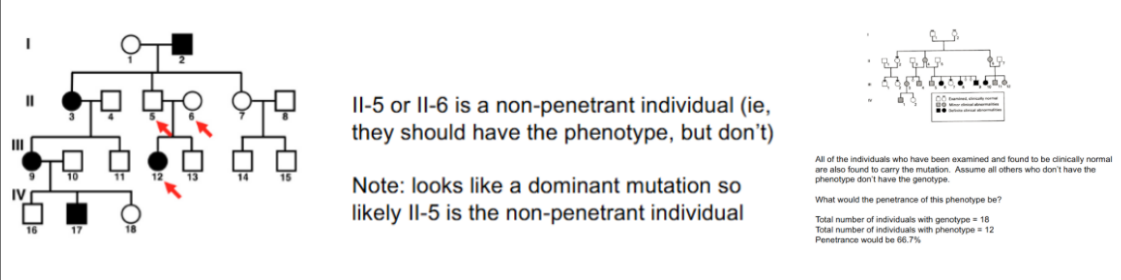
Incomplete Penetrance in Polydactyly

  • Individuals do not express trait even though they have the appropriate genotype

  • 100% penetrant trait = All affected have it

  • Non-penetrant trait = None that are affected have it
<ul><li><p><span style="font-family: &quot;Helvetica Neue&quot;, sans-serif">Individuals do not express trait even though they have the appropriate genotype</span></p></li><li><p><span style="font-family: &quot;Helvetica Neue&quot;, sans-serif">100% penetrant trait = All affected have it</span></p></li><li><p><span style="font-family: &quot;Helvetica Neue&quot;, sans-serif">Non-penetrant trait = None that are affected have it</span></p></li></ul><p></p>
15
New cards

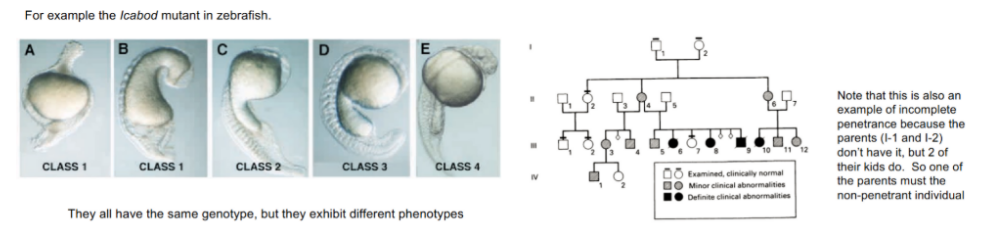
Variable Expressivity

  • Not all Individuals express a trait at the same level even though they have the same genotype

  • Minor abnormality: Minor extra digit, non-functional

  • Definite abnormality: Fully functional extra digit
<ul><li><p><span style="font-family: &quot;Helvetica Neue&quot;, sans-serif">Not all Individuals express a trait at the same level even though they have the same genotype</span></p></li><li><p><span style="font-family: &quot;Helvetica Neue&quot;, sans-serif">Minor abnormality: Minor extra digit, non-functional</span></p></li><li><p><span style="font-family: &quot;Helvetica Neue&quot;, sans-serif">Definite abnormality: Fully functional extra digit</span></p></li></ul><p></p>
16
New cards

Incomplete Penetrance and Variable Expressibility Causes

  • Unclear, possibilities:

    • Environment (temperature during development, diet)

    • Epigenetics (changes in genotype of mutant offspring is less severe in older female parents expressions, but not due to mutations)

    • Maternal age (e.g. Icabod mutation. Older female fish = Milder phenotype)

17
New cards

Gene Expression May be Affected by Maternal Age

  • Phenotype of mutant offspring is less severe in older female parents

18
New cards

Gene Expression May be Affected by Environmental Effects

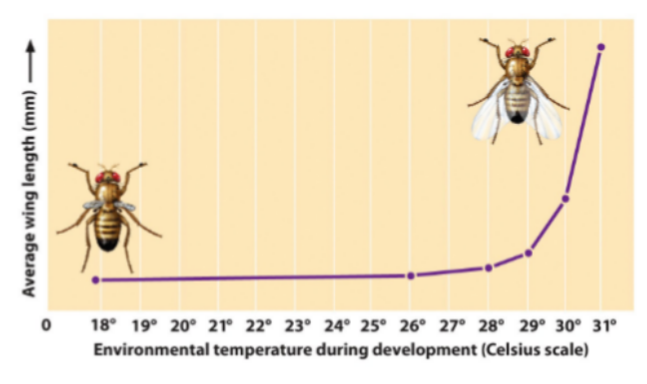
  • Temperature-sensitive allele: Allele whose product is functional only at certain temperature

  • Image: Fruit fly has mutation in wing-development gene

    • At low temps, protein is non-functional

    • Protein is functional at warmer temps

    • This would be a cold-sensitive mutation (only mutates at cold temps, normal at warm temps)

  • e.g. Expression of Himalayan allele in rabbitsĀ is temperature-dependent

  • Rabbit in image was reared below 25 degrees C

  • Its pigment is restricted to extremities where body temp falls below 25 degrees C and enzyme that produces pigment is functional

  • This would be a heat-sensitive mutation (only mutates at warm temps, normal at cold temps)
<ul><li><p><span style="font-family: &quot;Helvetica Neue&quot;, sans-serif">Temperature-sensitive allele: Allele whose product is functional only at certain temperature</span></p></li><li><p><span style="font-family: &quot;Helvetica Neue&quot;, sans-serif">Image: Fruit fly has mutation in wing-development gene</span></p><ul><li><p><span style="font-family: &quot;Helvetica Neue&quot;, sans-serif">At low temps, protein is non-functional</span></p></li><li><p><span style="font-family: &quot;Helvetica Neue&quot;, sans-serif">Protein <strong>is</strong> functional at warmer temps</span></p></li><li><p><span style="font-family: &quot;Helvetica Neue&quot;, sans-serif">This would be a cold-sensitive mutation (only mutates at cold temps, normal at warm temps)</span></p></li></ul></li><li><p><span style="font-family: &quot;Helvetica Neue&quot;, sans-serif">e.g. Expression of Himalayan allele in rabbits&nbsp;is temperature-dependent</span></p></li><li><p><span style="font-family: &quot;Helvetica Neue&quot;, sans-serif">Rabbit in image was reared below 25 degrees C</span></p></li><li><p><span style="font-family: &quot;Helvetica Neue&quot;, sans-serif">Its pigment is restricted to extremities where body temp falls below 25 degrees C and enzyme that produces pigment is functional</span></p></li><li><p><span style="font-family: &quot;Helvetica Neue&quot;, sans-serif">This would be a heat-sensitive mutation (only mutates at warm temps, normal at cold temps)</span></p></li></ul><p></p>

Explore top notes

note
Microorganisms
Updated 1047d ago
0.0(0)
note
3.4 Quantum Numbers
Updated 1103d ago
0.0(0)
note
Using the Periodic Table
Updated 354d ago
0.0(0)
note
CAPITULO 1
Updated 1160d ago
0.0(0)
note
Pancoast’s Tumor Syndrome
Updated 1143d ago
0.0(0)
note
Viruses, Viroids, AND Lichens
Updated 902d ago
0.0(0)
note
Chapter 8 - Hypothesis Testing
Updated 1455d ago
0.0(0)
note
Chapter 9: Nanoparticles
Updated 1073d ago
0.0(0)
note
Microorganisms
Updated 1047d ago
0.0(0)
note
3.4 Quantum Numbers
Updated 1103d ago
0.0(0)
note
Using the Periodic Table
Updated 354d ago
0.0(0)
note
CAPITULO 1
Updated 1160d ago
0.0(0)
note
Pancoast’s Tumor Syndrome
Updated 1143d ago
0.0(0)
note
Viruses, Viroids, AND Lichens
Updated 902d ago
0.0(0)
note
Chapter 8 - Hypothesis Testing
Updated 1455d ago
0.0(0)
note
Chapter 9: Nanoparticles
Updated 1073d ago
0.0(0)

Explore top flashcards

flashcards
ART 149 FINAL EXAM STUDY GUIDE
145
Updated 482d ago
0.0(0)
flashcards
abeka biology 10 section 5.1
31
Updated 920d ago
0.0(0)
flashcards
TFN 3 - ORPEZA
161
Updated 696d ago
0.0(0)
flashcards
434 Unit 2 Lec 9-10
28
Updated 1121d ago
0.0(0)
flashcards
Vocab Unit 5
25
Updated 1173d ago
0.0(0)
flashcards
(cz. 2) Historyzm, realizm
28
Updated 400d ago
0.0(0)
flashcards
T2 - Full Exam Prep
53
Updated 198d ago
0.0(0)
flashcards
Government
71
Updated 1117d ago
0.0(0)
flashcards
ART 149 FINAL EXAM STUDY GUIDE
145
Updated 482d ago
0.0(0)
flashcards
abeka biology 10 section 5.1
31
Updated 920d ago
0.0(0)
flashcards
TFN 3 - ORPEZA
161
Updated 696d ago
0.0(0)
flashcards
434 Unit 2 Lec 9-10
28
Updated 1121d ago
0.0(0)
flashcards
Vocab Unit 5
25
Updated 1173d ago
0.0(0)
flashcards
(cz. 2) Historyzm, realizm
28
Updated 400d ago
0.0(0)
flashcards
T2 - Full Exam Prep
53
Updated 198d ago
0.0(0)
flashcards
Government
71
Updated 1117d ago
0.0(0)