bio 7.2
 Call Kai
 Learn
Learn Practice Test
 Spaced Repetition
 Match
Match Flashcards
 Knowt Play
1/23

There's no tags or description
Looks like no tags are added yet.
Name | Mastery | Learn | Test | Matching | Spaced | Call with Kai | Chat |
|---|
No analytics yet
Send a link to your students to track their progress
24 Terms
plant fungal infections sign and symptoms
Signs:
Leaf rust, Stem rust
White mould
Powdery mildew
Symptoms:
Birdseye spot on berries
Damp seeds
Brown leaf spots
Yellowing leaves
plant bacterial infections signs and sympotoms
Signs:
Ooze
Water-soaked lesions
Bacteria stream in water from stem cut
Symptoms:
Fruit spot
Canker, crown gall
Fruit spot
Shepherd’s crook stem ends in woody plants
plants viral infection signs and symptoms
No signs - pathogens cannot be directly observed
passsive (innate) plant defences : physical
passsive (innate) plant defences : physical
passsive (innate) plant defences : chemical
Defensins: block pathogen growth in seeds
Resins and Tannins: antimicrobial agents
Oils repel pests
Gum seals area
Active (Induced) Plant Defences
Thickened cell wall: cytoplasm accumulates around invasion site to isolate
Hypersensitive reaction/ Programming cell death :
Rapid cell death initiated by plant OR
Endophyte assistance: roots release chemical to attract beneficial bacteria to fight infection
Loacalsied responde activnared so taht eh painft does tn respond
Plants cells in that region
Active (Induced) Plant Defences
Abscission layer: hormones trigger formation of a layer around infection to separate infected tissue and cause it to drop off
Fungal Case Study - Phytophthora
Fungus that infects banksias, eucalyptus and camellias
Attacks the roots and stems of plants & destroys the root system which reduces the plants ability to absorb water and nutrients
Above the ground symptoms include yellowing, wilting, dried foliage.
World Heritage sites have been alerted, including; Barrington Tops NP, Wollemi NP, southern NSW Eden NP.
This fungus increases rapidly when conditions are moist and warm within the root system
what is the first line of defence
Innate is non specific it provide the first and second line of defence form pathogens form birth
nonspecific : response does not change to the pathogen
types of first line of defence
physical and chemical
physical first line of defence
Physical : blocking you pathogens from getting in
Skin: Thick layer of dead cells, periodic shedding to remove microbes, acidic → slowing the growth of the bacteria and good bacteria compete with bad bacteria, sebum → fatty acid
sweat: through a constant outward flow that pushes microbes away from pores and a unique chemical makeup that physically breaks down germs.
Hair: Filters air that contains dust, microbes, pollutants in nose
Cilia: hairs that line upper respiratory tract, traps and propels droplets, mucus → sweep pathogens to exist
Mucus and earwax: trap pathogens
Urine: flushes microbes through urethra
excretion :
vomiting, urine → expels microorganisms
saliva tears → chemicals that kill pathogens → lysozyme, dilutes/ washes
Microbiome: beneficial microorganisms on skin and intestines compete with pathogens
Chemicals
Chemicals on skin surface or internal epithelium minimise pathogenic growth
Acidity of skin: inhibits bacterial growth
Gastric acid: acidity of stomach (pH 2-3) destroys bacteria/toxins
Lysozymes: enzyme produced in tears, saliva, sweat. Breaks down cell walls
Saliva: contains lysosomes, dilutes number of organisms and washes teeth/mouth
Sebum: fatty acids provide protective film on skin to inhibit bacterial growth
Hyaluronic acid: gelatinous substances that slows spread of toxins
chemical second line of defence
Chemicals
Chemicals on skin surface or internal epithelium minimise pathogenic growth
Acidity of skin: inhibits bacterial growth
Gastric acid: acidity of stomach (pH 2-3) destroys bacteria/toxins
Lysozymes: enzyme produced in tears, saliva, sweat. Breaks down cell walls
Saliva: contains lysosomes, dilutes number of organisms and washes teeth/mouth
Sebum: fatty acids provide protective film on skin to inhibit bacterial growth
Hyaluronic acid: gelatinous substances that slows spread of toxins
what is the second line of defence
When pathogens break through the first line of defence, a non-specific innate response is triggered.
Phagocytosis
Inflammation
Antimicrobial proteins
what is phagocytosis
Target smaller pathogens
Act more quickly but live for 1-2 days
Fight short-term acute infections
what are neutrophils ( non specific)
Target smaller pathogens
Act more quickly but live for 1-2 days
Fight short-term acute infections
what is a macrophafge
Target smaller pathogens
Act more quickly but live for 1-2 days
Fight short-term acute infections
what is inflammation
Target smaller pathogens
Act more quickly but live for 1-2 days
Fight short-term acute infections
explain the whole 3 line of defence
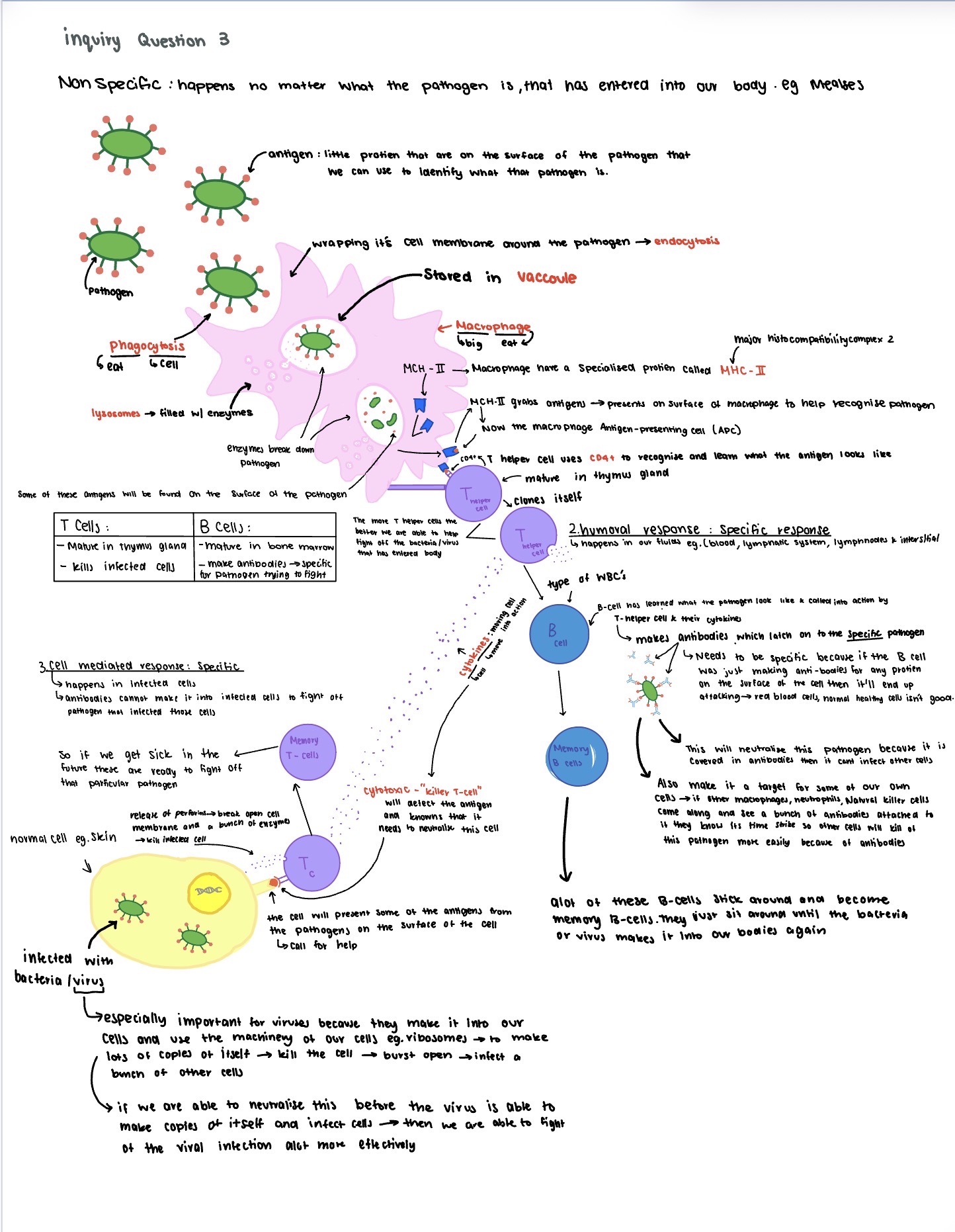
what are the 2 types of immunity
Active immunity:involves the production of antibodies by the body itself and the subsequent development of memory cells.
Passive Immunity: acquisition of antibodies from another source and memory cells are not developed.
Case study: HPV
Human papillomavirus is a STD which can lead to cervical cancers.
Vaccine incorporated into Australia’s National Immunisation Programme (NIP)
>50% of females under 30 are vaccinated
Evidence shows school-based immunisation has significantly lowered rates of cervical abnormalities
Side effects are predominantly mild, safety records like other well-established vaccines.
Types of vaccines
Viral
1. Purified/Disabled Virus – Polio, Rabies, Hep A
2. Weakened virus - measles, mumps, chicken pox
3. Inject a protein from the virus – HPV, Hep B, Influenza
●Bacterial
1. Inject Polysaccharide (sugar) coating of bacteria - meningococcal
2. Inject proteins from the bacteria - Whooping cough
3. Inject a toxin (protein) from bacteria – Tetanus, Diphtheria
●New Methods
1. Inject mRNA – inoculate people with a gene to create proteins to produce antibodies - Covid-19
2. Replicate a Defective Virus (one that can not reproduce once inside the body) – created in vitro and inserted into humans