Lecture 5 in-class notes
 View linked note
 Call Kai
 Learn
Learn Practice Test
 Spaced Repetition
 Match
Match Flashcards
 Knowt Play
1/21

There's no tags or description
Looks like no tags are added yet.
Name | Mastery | Learn | Test | Matching | Spaced | Call with Kai | Chat |
|---|
No analytics yet
Send a link to your students to track their progress
22 Terms
What are the three approaches on how industires change & evolve?
Industry dynamics
Industry life cycle
Evolution of industris & sectoral systems
(in order of ascending complexity)
Industry dynamics focus (3 aspects)
Entry of new firms
Exit of existing firms
Firms’ growth
(in a quantitative matter)
Industry dynamics stylized facts
Entry and exit are common
Entry and exit are mostly by small firms
Entry and exit are correlated (Revolving door)
Exit commonly occurs quite soon
The new firms that survive grow
Why do firms enter?
Opportunity of profit! Cycle:
In perfect competition market:
Why are there profits if there is perfect competition?
Shock in demand, supply, change in technology that reduces the cost.
If profits increase:
Outsiders will want to enter
This will cause the price to reduce
Market goes back to equilibrium
Repeat
Factors Affecting Entry
The industry's high profits
Demand growth
Low barriers to entry
Low switch costs for consumers
Availability of financial resources
Level of regulation
Scientific and technological opportunities
New Innovative Firms
Firms that enter a technology or sector for the first time with an innovation, measured by patenting.
SCH I industries > technological entrants than SCH II industries
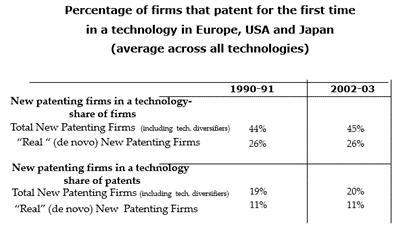
New patenting firms vs “de novo” new patenting firms
“de novo” new patenting firms = those who have NEVER EVER patented before, in any technology
New patenting firms = those who have patented before, but in a different technology
Main Obstacles to Innovation for new innovative firms
No economies of scale
Troubles regarding organizational aspect
Lack of strong relationship with suppliers
Less access to specialists in the field
Lack of reputation
Lack of financial availability
Exit (3 basic forms)
Relocation & restructuring:
E.g. close a plant in USA and open in Italy instead
Business closure
Voluntary liquidation or bankruptcy
Mergers and acquisitions
Transfer of ownership, but production capacity remains within the industry.
Modes of exit (2)
Revolving door
Liability of newness, small new firms
Creative destruction
More evenly distributed - can be small, large, new or old firms
Types of entrants (2)
Start-up
Spin-off
Spin-offs
Independent start-ups that originate from existing firms within the same industry.
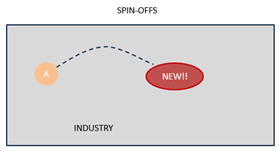
Types of Spin-offs
Intra-industry spin-offs, corporate spin-offs, and academic spin-offs
Stylized Facts of Spin-offs (4)
Spinoffs have better performance than other de novo entrants
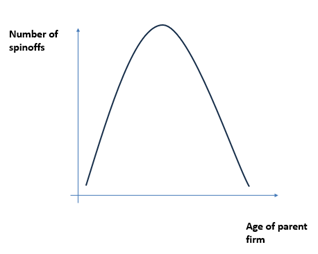
The relation between the age of parents and their spinoff generation rate has an inverted U-shape (see graph below)
High-performing parents have higher spinoff generation rates
High-performing parents generate high-performing spinoffs
Explain inverted U-shape relation between age of parent firm & amount of spin-offs
At the beginning, the firm is new and there aren’t many employees in the first place for anyone to spin off.
Increase of age = + employees = + spinoffs
But it goes back down. why?
Market saturation. More mature market, so there is less incentive to create something new.
Company could become less innovative, more routinized.
Employee loyalty = if you’ve been an employee for long, you tend to be more loyal
Loss of employees and knowledge.
Motivations Behind Innovative Spin-offs
Cannibalization
Non-receptive, non-attentive organizational culture
Principal Agent: I want to profit fully from my idea, rather than just getting a small promotion!!
Different views, cognitive frames, perceptions, etc.
What I want to make is out of the scope of the firm!
Different expectations
Reasons for a Spinoff (parent firm’s pov)
Agency Theory:
Cannibalization:
Rejected - may cannibalize an existing product
Disagreement:
Learning in Rigid Organizations:
Inventor learned skills within company, then moves since the firm is rigid
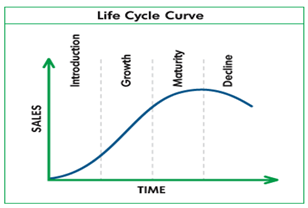
Industry Life Cycle
Start/emergence
Growth
Maturity
Discontinuity in technology, markets or industrial actors
Possible Trigger Event of a New Industry (4) (Agarwal, Moeen and Shah, 2017)
RADICAL PRODUCT INNOVATION
SCIENTIFIC OR TECHNOLOGICAL DISCOVERY
UNMET USER NEEDS
MISSION ORIENTED GRAND CHALLENGES
Incubation Stage
Period between the introduction of a discontinuous change & the first instance of commercialization.
Usually 26-28 years
Coevoluation (Nelson 1994)
Affect the evolution of an industry
E.g.; Technology affects firms’ capabilities & strategies, but at the same time firms affect technological change
Feedback very important!!
Evolution of Sectoral Systems
The evolution of industry sectors and the interplay between technologies, firms, and markets within these sectors. It involves the emergence of new technologies, technological and market discontinuities, and the formation of related industries and value networks.