Lecture 5 in-class notes
INNOVATION, ENTRY AND INDUSTRIAL DYNAMICS
Three approaches for how industries change + evolve:
Industry dynamics
Simplest & oldest. Very used nowadays
Industry life cycle
More complex
Evolution of industries & sectoral systems
MUCH more complex. Focus on evolution, not so mechanic but more complex with feedback, etc.
1 - INDUSTRY DYNAMICS, ENTRY AND EXIT
Industry dynamics focuses on 3 aspects:
Entry of new firms
Exit of existing firms
Firm’s growth
In a QUANTITATIVE way!! How many new firms enter, in which way, how many existing firms exit and in which way, and what is the rate of growth of existing firms. Extremely used way!! Because nowadays, we have enormously large databases!! With census and research and everything. So we have lots of detailed stats that we can use. The problem is that each country does it in a different way.
1.1 - 5 STYLIZED FACTS
(Global study)
Entry and exit are common
Around 15-20% enter and exit the industry each year
Entry and exit are mostly by small firms
(smaller than those in the market)
Entry and exit are correlated
Revolving door concept:
If you’re an entrant, you’re usually a small inexperienced firm (liability of newness), with the wrong products, the wrong managerial system, etc.
It is highly probable that, after some years, a good part of entrants exit, due to their above-mentioned characteristics
Exit commonly occurs quite soon
After 2 years = common exit
After 4 years = more chances to survive in industry
After 7 years = much lower chances of exiting
The new firms that survive grow
If you’re able to survive, you’ll grow fast
1.2 - INNOVATION & INDUSTRY DYNAMICS - WHAT DO WE KNOW?
Persistent differences in innovativeness & technological capabilities among new firms
This is why some new firms are great innovators, and some aren’t
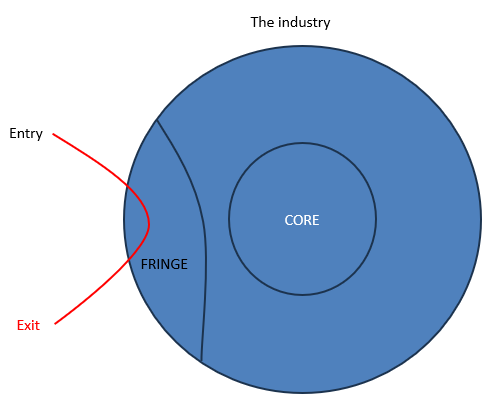
There is the “Core” and “Fringe” of innovators (see image below)
Fringe: the firms that enter and exit, that are subject to the revolving door
Core: part of the industry that is rather stable, with persistent innovators.
Differences across sectors & technologies
1.3 - ENTRY
THE ROLE OF ENTRY IN MICROECONOMICS (discussion)
Why do they enter?
Opportunity of profit!
As long as there is opportunity of profit, firms will enter until there is no longer any opportunity.
Why?
If price is greater than marginal cost, firms know that they can profit
In perfect competition market:
All firms are the same, cannot distinguish them!!!
So why are there profits if there is perfect competition?
Shock in demand,
Shock in supply,
Change in technology that reduces the cost,
Bref, there is some shock that abruptly increases demand or reduces the cost. This makes the price go over the marginal cost
Therefore, firms get profit (over regular compensation), even though they are in a perfect competition.
If profits increase:
Outsiders will want to enter
Of course, there are no barriers to entry in a perfect competition, so they enter
This will cause the price to reduce
And then the market goes back to equilibrium! Until a new shock takes place eventually. This is the basic role of entry in microeconomics.
SIMPLIFIED:
++ demand = price ++ = extra profit == ++ entries == ++ supply == -- price
New technology = -- production cost == extra profit == ++ entries == ++ supply == -- price
THE ENTRY IS A RE-EQUILIBRATING FORCE!!!
Entry re-equilibrates the market.
It’s off equilibrium because SOMETHING happened, which gives signals to firms outside, who flock in with no barriers to entry, and the market returns to equilibrium.
Price goes back to be == to marginal cost, and we’re all happy
WHAT DO WE KNOW ABOUT ENTRY?
Does entry have an equilibrating function?
Does entry eliminate over-profits/extra profits?
No (for both)
Through empirical analysis, one can see that, particularly in med-high tech sectors… (P. Geroski)
Entrants introduce innovations & new strategies, organizational forms and approachs
There are differences among entrants in terms of capabilities
(opposed to the theory of perfect competition. IRL entrants are different than incumbents)
WHAT FACTORS AFFECT ENTRY?
The industry yields high profits
You perceive / expect that demand will grow
Room for new entrants because demand is / is expected to grow
Low barriers to entry (capital requirements, etc.)
In order to be active you don’t need high-skill specialized labor!
Consumers have a low switch in cost!
If you enter with a new product, you expect that consumers will move to your product (they’re not locked in to a certain product and are able to move to you)
Availability to financial resources
Level of regulation in the industry (high = difficult, low = easy entry)
Scientific and technological opportunities (SCH I)
1.4 - NEW INNOVATIVE FIRMS
THEIR KEY ROLE
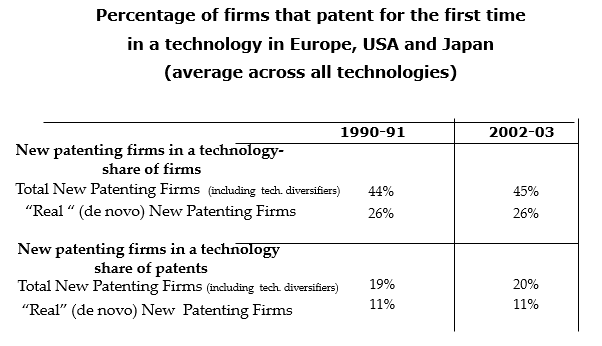
New innovative firms: firms that enter a technology/sector for the first time with an innovation.
How to measure that?
With patents. New innovative firms are firms that patent for the first time in a specific technology. They can be called TECHNOLOGICAL ENTRANTS
Calculate the share of technological entrants on total innovators
SCH I industries > technological entrants than SCH II industries
Keep in mind that patents do not measure all the innovations !
 (example)
What is the difference between total amount of new patenting firms and REAL new patenting firms.
Total amount new patenting firms = REAL + those who have patented before, but in a different technology
REAL new patenting firms = those who have NEVER EVER patented before, in any technology
You see big difference in new innovators/patentors between then and now
Why is the share of patents so different of that of the firms?
Because the new entrants are usually ones that only do ONE patent, while there are persistent innovators (big firms), that patent a lot.
Aka smaller nominator, bigger denominator = smaller fraction
MAIN OBSTACLES TO INNOVATION
No economies of scale, if innovation has to be produced at large scale
Troubles regarding organizational aspect (if you need to hire lots of people)
But you could license your organization to another firm.
Lack of strong relationship with suppliers (think of specialized suppliers)
Less access to specialists in the field (not inserted to networks)
Lack of reputation, need to build one up (depends on market)
Lack of financial availability
1.5 - EXIT
Three basic forms of exit:
Relocation & restructuring:
Part of the dynamic process
Involves modification of firms’ products + processes
E.g. close a plant in USA and open in Italy instead
Business closure
Voluntary liquidation or bankruptcy
Mergers and acquisitions
Transfer of ownership, but production capacity remains within the industry.
Often take place to seize growth opportunities
TWO MODES OF EXIT
Revolving door
Liability of newness, small new firms
Schumpeterian Gale of creative destruction
More evenly distributed - can be small, large, new or old firms
1.6 - FIRMS’ GROWTH
In general, there are two theories to explain the growth of firms:
Persistence of growth
Once you start growing, you’ll continue to do so
Random walk
Today you could grow, but tomorrow there may be uncertainty.
Dosi et al. (2019);
Found positive autocorrelation in firms’ growth rates. But…
There is heterogeneity in autocorrelation coefficients…
Effect: maybe the company Is delulu and thinks they’re growing faster/slower than they actually are.
Larger values of autocorrelation are for the leaders in industries such as semiconductors, computer, etc.
2 - SPIN-OFFS
2.1 - TYPES OF ENTRANTS (KLEPPER 2001)
Start-up: a new firm that enters an industry
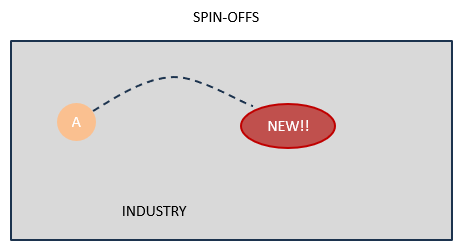
Spinoff: an independent start-up that comes from an existing firm within the same industry.
Therefore entrepreneurs who open a spinoff have previous experience in the industry
They are intra-industry spinoffs
New firm, independent, from an ex-employee of an existing firm FROM SAME INDUSTRY.
 Other types of spinoffs
Corporate spinoffs: a spinoffs started by a corporation
Academic spinoffs
2.2 - SPINOFFS
Present in all industries
In some industries more numerous (example ICT in US)
Possess technology, operations and market knowledge
Can do product & process innovations
Enter in the growth & mature stages of an industry’s life cycle
Advantage:
You don’t have the liability of newness! You know the industry, you know the product, etc.! You have experience since you come from the industry
4 STYLIZED FACTS
Spinoffs have better performance than other de novo entrants
Because they have experience and knowledge
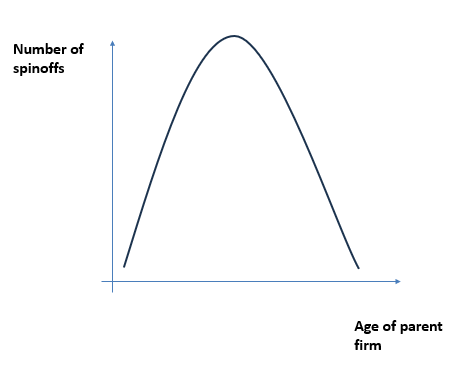
The relation between the age of parents and their spinoff generation rate has an inverted U-shape (see graph below)
At the beginning, the firm is new and there aren’t many employees in the first place for anyone to spin off.
Increase of age = + employees = + spinoffs
But it goes back down. why?
Market saturation. More mature market, so there is less incentive to create something new.
Company could become less innovative, more routinized.
Employee loyalty = if you’ve been an employee for long, you tend to be more loyal
Loss of employees and knowledge.
High-performing parents have higher spinoff generation rates
High-performing parents generate high-performing spinoffs
Is this due to the company or the people spinning off?
Both. A highly dynamic organization of the firm + a highly performing human capital = ideas flow
 What do these stylized facts tell us?
Spinoffs usually come from successful firms
Spinoffs are more rare when the firm is very young or old
Spinoffs are associated to organizational changes
MOTIVATIONS BEHIND AN INNOVATIVE SPINOFF
Situation: I’m an employee at Apple and get a great idea. Why would I want to leave and create my own firm, rather than to stay, share my idea and get promoted?? A lot of companies stimulate intrapreneurship!!
Cannibalization
If you create a new firm, you can take market shares from the parent company!!
E.g. my product may take customers away from Apple
In very large companies, the company MAY be less receptive to ideas of a new employee
Non-receptive, non-attentive organizational culture
I want to profit fully from my idea, rather than just getting a small promotion!!
This is called the Principal Agent. Let’s say I hate my manager. Why would I share my great idea and profits with her, when she’s not even nice to me??
Not good communication, I keep my idea secret and leave.
Different views, cognitive frames, perceptions, etc.
I want my idea to be exactly the way I imagine it!! But the company may want to make changes to it that I won’t agree on.
What I want to make is out of the scope of the firm!
Different expectations
POSSIBLE REASONS FOR A SPINOFF (discussion)
Agency Theory:
Information asymmetry - inventor does not want to share idea and leaves
Cannibalization:
Management rejects idea because it may cannibalize an existing product of the firm
(information sharing present)
Disagreement:
Disagreement regarding importance of idea.
(information sharing present)
Learning in Rigid Organizations:
The inventor learned and developed the necessary skills within the company, then moves out since the firm is rigid
3 - INDUSTRY LIFE CYCLE
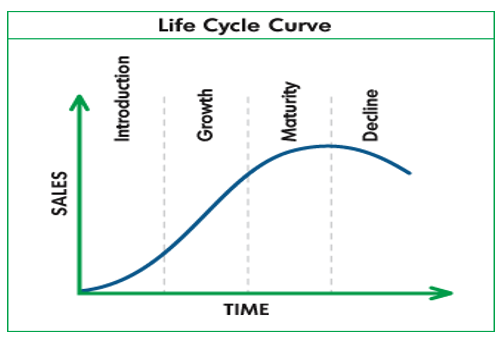 Same variables we saw, PLUS…
Whether I have product and process innovation
What kind of competition there is between entrants and incumbents
The concentration of the industry
Pros: richer framework. Cons: not easily available information
3.1 - “STANDARD” LIFE CYCLE REPRESENTATION
Start/emergence
Radical product innovation, which generates other products, and new firms enter
Growth
A product that becomes dominant!
Firms try to do process innovation, and over time there is the exit of established firms
Maturity
Increase in concentration and capital intensity.
Discontinuity in technology, markets or industrial actors
For a radical innovation, specifically:
Start/emergence
Uncertainty about preferences and techniques
Variety of products
Low barrier to entry/turnover in leadership
Growth
Uncertainty is in resolution
-- variety, ++ efficiency
Shakeout, barriers ot entry
Maturity
No uncertainty
-- level of innovation
++ concentration, stable market shares
Discontinuity in technology, markets or industrial actors
3.2 - UNCERTAINTY + DOMINANT DESIGN (ABERNATHY & UTTERBACK, 1978)
When a new industry emerges, there is a lot of uncertainty in both technology and demand.
As a consequence, firms try different solutions (product variants) that have different technological requirements and satisfy different demand needs.
The incentives to invest in process innovations are low because they need to be tailored to the specific product variant, whose demand is highly uncertain.
At a certain point, a dominant design – a successful product configuration – emerges
Once a dominant design emerges, uncertainty is reduced.
It is now convenient to invest in process R&D, because it is not very risky to tailor the new production processes to the dominant design.
Instead, it is very risky to keep engaging in product innovation, because these innovations will be discarded if not compatible with the dominant design.
Then, why there is a shakeout?
Because only firms that are good in doing process innovations related to the dominant design will be able to survive.
3.3 - INNOVATION + INDUSTRY LIFE CYCLE (KLEPPER, 1996)
There is a standard product and there are distinctive products, which are the result of product R&D.
Process R&D lowers the average cost of the standard products.
There are potential entrants with distinctive competences.
Entrants are randomly endowed with innovative expertise which cannot be modified.
New entrants: information on their expertise prior to entry, and on the number of incumbents.
Distinctive competences influence the success of product R&D. Firms with successful product innovations grow.
Last period product innovations are incorporated into the standard product
Only winning products have the incentive of introducing process innovation, because the costs will be able to be repaid with the profits made
Incentive for firms that have a large market share to move to process innovations: this lowers costs and prices
The decrease in prices provokes the exit of the less innovative firms
Therefore, over time in the industry there is a decrease in the number of entering firms and an increase in concentration
There is also a reduction in product diversity related to the appearance of a dominant design
Key results of model:
The first result is that if firms grow over time, process R&D will increase in importance and product R&D will decline.
Do firms grow over time? Yes, because firms that enter early have more incentives to invest in production capacity. These incentives in fact depend on past quantities.
Why is there a shakeout?
The number of firms will start decreasing, because firms that are not big enough shrink more and more, and eventually exit
In this model the emergence of a dominant design and the decline in production costs are endogenous to the model.
3.4 - ALTERNATIVE LIFE CYCLE PATTERNS
In some industries, you could have process innovation before product innovation (reverse life-cycle)
Specialization can take place very early on. A firm can be specialized since the beginning!
Joining product and process innovations together (e.g. new drug)
No process innovation in some industries
Relevance of several segments & specialization in submarkets== leaders in each market (not much concentration, but have firms that are specialized in each segment).
In some industries (most popular being; mainframes and semiconductors), you need the big guys (IBM, AT&T, etc.)
Concentration exists at the beginning!
4 - INDUSTRY EVOLUTION
Aspects:
The origin of new industries
The transformation of products and technologies
The development and change in firms’ competences
The change in firms’ boundaries
The rise and development of networks of firms
The role of institutions
Sectoral systems are a good starting point for looking at industry evolution
4.1 - TRIGGER EVENT OF A NEW INDUSTRY
The initial even of a new industry
RADICAL PRODUCT INNOVATION
Auto
SCIENTIFIC OR TECHNOLOGICAL DISCOVERY
Recombinant DNA & biotechnology
Nanotechnology
Substantial technological and market uncertainty
UNMET USER NEEDS
Users can be consumers, professionals or firms.
E.g.;
Clean dirty dishes and the dish-washing machine industry
Enthusiast kayaker and the specialized sport equipment industry
Academics and probe microscopy
The user is the inventor. Technological and demand uncertainty; role of user community
MISSION ORIENTED GRAND CHALLENGES
US Office of scientific research and development (OSRD), the need to treat infections and the Penicillin industry
Extensive partnership between the public sector and the private sector
(Agarwal, Moeen and Shah, 2017)
4.2 - INCUBATION STAGE
Period between the introduction of a discontinuous change & the first instance of commercialization
Average between 26-28 years of the industry
Heterogeneous actors = active using diverse knowledge bases
Continuous attempts to reduce technological & demand uncertainty
Lots of experimentation
Knowledge sharing through formal & informal interactions
Incubation stage shapes industry structure & firm strategy in the stages of commercialization
4.3 - COEVOLUTION OF KNOWLEDGE, TECHNOLOGY, FIRMS AND USERS
Coevolutionary processes affect the evolution of an industry
Example;
Technology affects firms’ capabilities & strategies, but at the same time firms affect technological change
The same coevolutionary process takes place between firms, technology and demand
Feedback very important!!
(Nelson, 1994)
4.4 - EVOLUTION OF SECTORAL SYSTEMS
4.4.1 - EMERGENCE OF NEW TECHNOLOGIES
The evolution of pharmaceuticals-biotech
From random screening => science driven search
Before biotech revolution, science was not as important and NBF (new biotech firms) were not present
Now: dynamic interaction between large pharma, uni labs, NBFs and VCs
Other example: internet
4.4.2 - TECHNOLOGICAL & MARKET DISCONTINUITIES. DISRUPTIVE/COMPETENCE DESTROYING INNOVATIONS
Music industry
Analog
Gramaphone
Cassette
Digital compact disk
Internet
MP3
iTunes
Spotify
(Co-existence of SCH I and II)
4.4.3 - RELATED INDUSTRIES AND VALUE NETWORKS
Computers
Computer hardware:
Mainframe
Mini
PC
Workstations
Demand:
Mainframe: large firms
Mini: research labs, etc.
PCs: individuals