Economics - Economic growth, unemployment & inflation
 Call Kai
 Learn
Learn Practice Test
 Spaced Repetition
 Match
Match Flashcards
 Knowt Play
1/64

Earn XP
Description and Tags
Year 11, Task 5
Name | Mastery | Learn | Test | Matching | Spaced | Call with Kai | Chat |
|---|
No analytics yet
Send a link to your students to track their progress
65 Terms
What is the concept of macroeconomics?
Macroeconomics is the branch of economics that studies the economy as a whole. It focuses on large-scale factors such as inflation, unemployment, economic growth, national income, and government policies.
What is total spending? (aggregate expenditure)
The total amount spent on goods and services in an economy.
What is total output? (aggregate production)
The total value of goods and services produced in an economy.
What is total income?
The total income earned by households and businesses from producing goods and services.
What is the relationship between total spending, total output, and total income?
These three are equal in value because one person’s spending becomes another person’s income, while spending on goods and services corresponds to the value of the output produced.
What is the five-sector circular flow of income?
It shows how money, income, and spending move around an economy between five sectors
Households
Firms
Financial sector
Government sector
Overseas sector
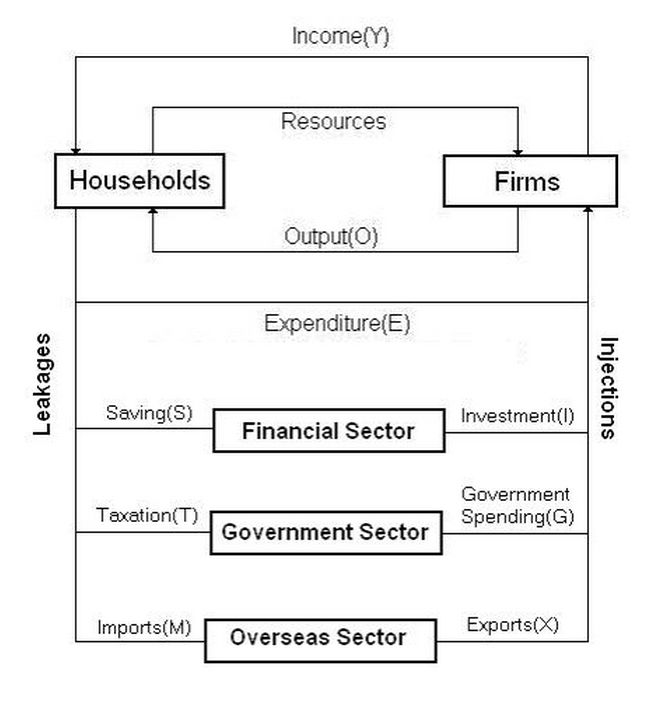
What is equilibrium in the circular flow of income?
Equilibrium occurs when total leakages equal total injections. This means the level of income in the economy remains stable.
S + T + M = I + G + X
What are leakages in the circular flow of income?
Leakages are money that leaves the circular flow, reducing spending in the economy.
Savings (S)
Taxation (T)
Imports (M)
Leakages = S + T + M
What are injections in the circular flow of income?
Injections are money that enters the circular flow, increasing spending in the economy.
Investment (I)
Government spending (G)
Exports (X)
Injections = I + G + X
What is the effect of changes in leakages and injections on the level of equilibrium in the circular flow of income model?
Situation | Effect on spending | Effect on national income | Equilibrium |
|---|---|---|---|
Injections > Leakages | Spending increases | Income rises | Moves to a higher level |
Injections < Leakages | Spending decreases | Income falls | Moves to a lower level |
Injections = Leakages | Spending is stable | Income remains stable | Equilibrium |
What is GDP?
The total monetary value of all final goods and services produced within a country’s borders during a specific period of time.
What is the expenditure approach to measuring GDP?
The expenditure approach measures GDP by adding up total spending on final goods and services in an economy.
GDP = C + I + G + (X − M)
C = Consumption — household spending
I = Investment — business spending on capital goods
G = Government spending — government expenditure on goods and services
X = Exports — goods and services sold overseas
M = Imports — goods and services bought from overseas
What is economic growth and how is it measured?
Economic growth is an increase in the productive capacity of an economy, resulting in an increase in the amount of goods and services it can produce over time.
How is economic growth measured?
By the percentage change in real GDP over time.

What is nominal GDP?
Nominal GDP is the value of goods and services produced in an economy measured using current prices.
It can increase because of higher production, higher prices, or both.
What is real GDP?
Real GDP is the value of goods and services produced in an economy adjusted for changes in prices (inflation).
It is used to measure changes in actual economic output over time.
What is real GDP per capita?
It measures real economic output per person and is useful for comparing changes in average material living standards over time.
Real GDP per capita = Real GDP ÷ Population
How can GDP be used as a measure of economic welfare?
GDP measures the value of goods and services produced in an economy. A higher GDP generally indicates higher material living standards and greater economic activity.
Why is GDP not a complete measure of economic welfare?
GDP does not account for factors such as:
Income inequality
Environmental damage
Leisure time
Quality of life
Unpaid household work
How is economic growth demonstrated using the Production Possibility Frontier (PPF)?
Economic growth is shown by an outward shift of the PPF. This represents an increase in an economy’s productive capacity, meaning it can produce more goods and services than before.
How is economic growth demonstrated using the AWhat is the difference between the APF and PPF?APF)?
Economic growth is shown by an upward shift of the Aggregate Production Function (APF). This means that, for a given amount of inputs, the economy can produce more output due to improvements such as better technology, increased productivity, or more efficient production.
What is the difference between the APF and PPF?
PPF (Production Possibility Frontier):
Shows the maximum combinations of two different goods/services an economy can produce.
Demonstrates scarcity, choice, opportunity cost, and productive capacity.
Economic growth → PPF shifts outward.
APF (Aggregate Production Function):
Shows the relationship between inputs used in production and total output.
Focuses on how efficiently an economy turns resources into output.
Economic growth → APF shifts upward.
What are the main determinants of economic growth?
The main determinants of economic growth are factors that increase an economy’s productive capacity:
Labour: A larger or more productive workforce.
Capital: Increases in machinery, buildings, infrastructure and equipment.
Technology: Improvements in technology and production methods.
Human capital: Improvements in education, skills and training.
Natural resources: Greater availability or improved use of natural resources.
Entrepreneurship: Innovation, investment and better organisation of resources.
What are the benefits of economic growth?
Higher incomes and material living standards
Lower unemployment as firms produce more and hire more workers
Higher government tax revenue, allowing more spending on public services
Improved access to goods and services
Greater investment in infrastructure and businesses
Economic growth can increase material living standards and economic opportunities.
What are the costs of economic growth?
Environmental damage from increased production and consumption
Resource depletion
Inflationary pressure if demand grows faster than productive capacity
Income inequality if the benefits of growth are unevenly distributed
Reduced leisure time if people work more to increase income
Economic growth can create environmental, social and economic costs.
What is the Rule of 70?
A simple way to estimate how long it takes for real GFP to double.
Years to double = 70 ÷ Annual growth rate (%)
What have been the trends in economic growth in Australia over the last five years?
Australia’s economic growth has slowed significantly since the strong post-pandemic recovery.
Strong recovery → slowing growth → weak growth → signs of recovery.
What is inflation?
Inflation is a sustained increase in the general price level of goods and services in an economy over time. It reduces the purchasing power of money.
How is inflation measured?
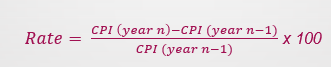
Inflation is commonly measured using the Consumer Price Index (CPI), which measures changes in the prices of a basket of goods and services typically purchased by households.
What is deflation?
Deflation is a sustained decrease in the general price level of goods and services.
What is disinflation?
Disinflation is a decrease in the rate of inflation.
Why is the CPI weighted?
The CPI is weighted because households spend different amounts on different goods and services.
Items that make up a larger share of household spending are given a larger weight, while items that make up a smaller share receive a smaller weight. CPI weights reflect the importance of different goods and services in household spending.
What are the 11 CPI categories?
Housing
Food and non-alcoholic beverages
Transport
Recreation and culture
Furnishings, household equipment and services
Insurance and financial services
Alcohol and tobacco
Clothing and footwear
Health
Communication
Education
What is headline inflation
The overall rate of increase in prices of goods and services in an economy, including volatile items such as food and fuel.
What is underlying inflation?
A measure of inflation that removes or reduces the effect of temporary and volatile price changes to show the underlying trend in inflation.
What is demand-pull inflation?
When the total demand for goods and services in an economy grows faster than the economy's ability to make them
What is cost-push inflation?
Inflation caused by rising costs of production, such as higher wages, energy prices, or raw material costs.
What are the main effects of inflation?
Inflation can reduce purchasing power, create uncertainty, discourage saving and investment, and reduce a country's international competitiveness.
How does inflation create uncertainty?
It makes it harder for households and businesses to predict future prices, costs, and incomes, making financial decisions more difficult.
What events affected inflation in Australia over the last five years?
COVID-19 caused supply shortages, while the Russia–Ukraine war increased food and energy prices. These events pushed inflation up, especially in 2022. As supply problems eased and interest rates increased, inflation gradually fell.
What is unemployment?
The percentage of people in the labour force who do not have a job but are actively looking for work.
What is full employment?
When everyone who wants and is able to work at the current wage rate can find a job, apart from normal frictional unemployment.
What is NAIRU?
Non-Accelerating Inflation Rate of Unemployment. The lowest level of unemployment an economy can sustain without causing inflation to rise.
• Below NAIRU: High labor demand → Higher wages → Higher inflation.
• Above NAIRU: Labor market slack → Slower wage growth → Falling inflation.
• At NAIRU: Inflation remains steady and predictable

What is the labour market?
The labour market is where the supply of labour (workers) meets the demand for labour (employers).
What are the impacts of unemployement?
On Individuals:
Loss of primary income source
Reduced economic wellbeing
Loss of skills and confidence
On the Economy:
Lower household consumption (GPD drops)
Slower economic growth
Operating inside the PPF
What is the working age population?
The working-age population is the total number of people in a country who are within the age range typically considered able to work, 15 in Australia.
Who is in the labour force?
Employed: Working at least 1 hour in the reference week.
Unemployed: No job, but actively seeking and available for work.
Who is not in the labour force?
Many people choose not to participate in the labour market. They are not 'unemployed' because they aren't looking for work.
Retirees
Full-time students
Stay-at-home parents
Discouraged job seekers (those who gave up looking)
What is the flow of labour?
The labour market is dynamic. Every month, thousands move between categories.
Inflows: Leaving school, migration, or returning to work.
Outflows: Retirement, health reasons, or becoming ‘discouraged’.
What is the participation rate?
The percentage of the working-age population that is in the labour force (employed + unemployed).
What is underemployment?
When people have a job but want and are available to work more hours.
How is unemployment measured?
Unemployment rate = unemployed people ÷ labour force × 100.
What is cyclical unemployment?
Unemployment caused by a downturn in the economy, when demand and production fall.
What is structural unemployment?
Unemployment caused by a mismatch between workers' skills and the jobs available.
What is frictional unemployment?
Short-term unemployment that occurs when people are between jobs or looking for their first job.
What are the effects of unemployment?
: It can cause lower incomes, lower spending, reduced government tax revenue, increased welfare payments and lost economic output.
What is the GDP Gap?
The difference between actual GDP and potential GDP. High unemployment can cause a negative GDP gap because the economy is producing below its potential.
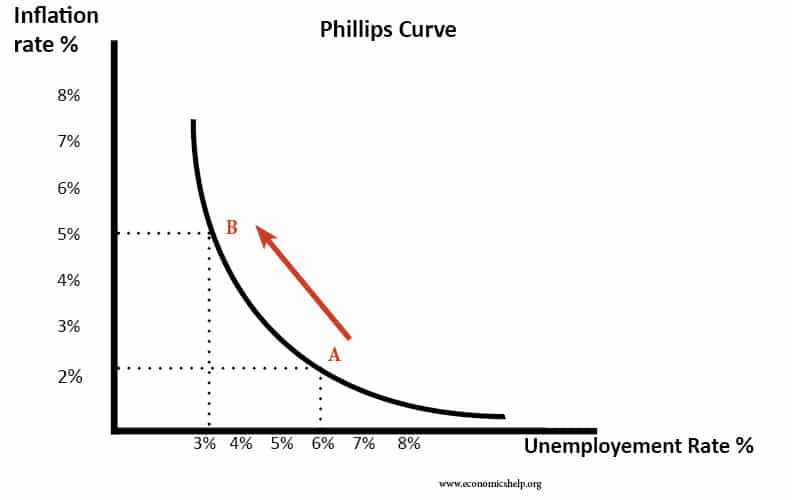
What is the Phillips Curve?
It shows an inverse relationship between unemployment and inflation in the short run: lower unemployment can be associated with higher inflation.
What is the natural rate of unemployment?
The level of unemployment that exists when there is no cyclical unemployment. When economy is at its natural rate, it is operating at its potential GDP.
Natural Rate of Unemployment = Frictional Unemployment Rate + Structural Unemployment Rate
What is potential GDP?
The maximum level of output an economy can produce sustainably when its resources are being used efficiently, without causing excessive inflation.
What events affected unemployment in Australia over the last five years?
COVID-19 caused unemployment to rise sharply. As restrictions ended, the economy reopened and unemployment fell. More recently, slower economic growth and higher interest rates contributed to unemployment rising again.
Why does the natural rate persist?
Job Search Time: Matching workers to vacancies takes time.
Skills Mismatch: Automation makes old roles obsolete faster than retraining.
Mobility: Jobs may open in Perth while workers remain in Sydney.
What is Australia’s current unemployment rate?
4.5%
What is Australia’s current Inflation rate?
3.8%
What is Australia’s current economic growth rate?
2.5%