Biology Chapter 6
 Call Kai
 Learn
Learn Practice Test
 Spaced Repetition
 Match
Match Flashcards
 Knowt Play
1/69

There's no tags or description
Looks like no tags are added yet.
Name | Mastery | Learn | Test | Matching | Spaced | Call with Kai | Chat |
|---|
No analytics yet
Send a link to your students to track their progress
70 Terms
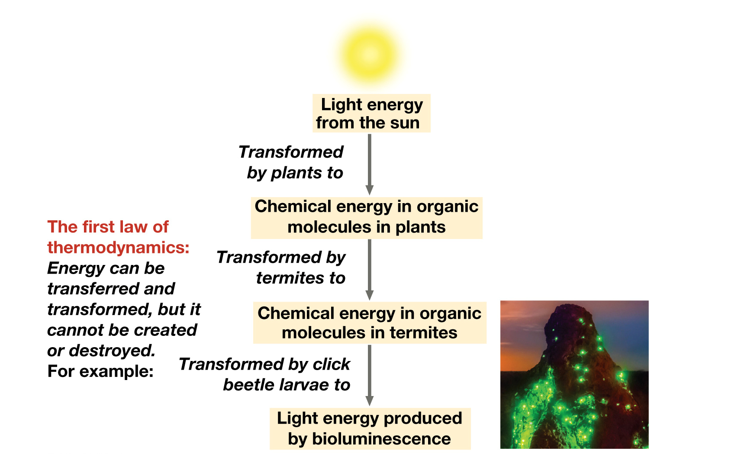
First law of thermodynamics (principle of conservation of energy)
Energy can be transferred or transformed, but not created or destroyed
Second Law of thermodynamics
Every energy transfer or transformation increases entropy (disorder) of the universe
How do the laws of thermodynamics relate to biological processes? (1st law)
Light energy → Chemical energy in organic molecules.
Metabolism
Defined by the totality of an organism’s chemical reactions.
Is an emergent property that arises from orderly interactions between molecules.
Metabolic Pathway
Begins with a specific molecule and ends with a product
each step is catalyzed by a specific enzyme.

Catabolic pathways
Releases energy by breaking down complex molecules into simpler compounds
Energy is then available to do cellular work
EX: Cellular respiration, where glucose and other organic fuels are broken down into carbon dioxide and water.
Anabolic pathways
Also called biosynthetic pathways
Consume energy to build complex molecules from simpler ones.
Example: proteins are synthesized from simpler molecules called amino acids.
Bioenergetics
The study of how energy flows through living organisms.
Energy
Capacity to cause change
Work
The movement of matter against opposing forces, such as gravity and friction.
Kinetic energy
Energy associated with motion
Thermal energy
Kinetic energy associated with random movement of atoms or molecules
Heat
Thermal energy in transfer from one object to another
Potential energy
Energy that matter possesses because of its location or structure
Chemical energy
potential energy available for release in a chemical reaction.
Potential vs KE

Catabolic reactions and biological systems
The catabolic reaction of food molecules with oxygen provides chemical energy to power life processes in biological systems
This transformation can be compared to that observed when hydrocarbons in gasoline react with oxygen in the engine of a car to power the pistons
Thermodynamics
Study of energy transformations
Entropy
Measure of molecular disorder, or randomness
The more randomly arranged a collection of matter is, the greater its entropy
Energy transfers does what to entropy?
increases entropy because some energy is always lost ot the surroundings as heat.
Heat does what to the surroundings?
Heat increases the disorder of the surroundings
Spontaneous processes
Occurs without energy input; it can happen quickly or slowly
For a process to occur spontaneously, it must increase the entropy of the universe
Nonspontaneous processes does what to entropy
Leads to a decrease in entropy; energy must be supplied
Evolution and organisms and thermodynamics
• The evolution of complex organisms does not violate the second law of thermodynamics
• Entropy (disorder) may decrease in a system, but the total entropy of the universe increases
• Organisms are islands of low entropy in an increasingly random universe
Free energy
Portion of a system’s energy that can do work when temperature and pressure are uniform throughout, as in a living cell.
Change in free energy
ΔG = G final state — G initial state
Spontaneous reactions can be harnessed to perform cellular work
ΔG → when does it show reaction is spontaneous
Only reactions with a negative ΔG are spontaneous
What can spontaneous reactions be used for
Spontaneous reactions can be harnessed to perform cellular work
What does free energy measure?
Free energy is a measure of a system’s instability, its tendency to change to a more stable state
Spontaneous change → what effect on stability?
During a spontaneous change, free energy decreases and the stability of a system increases
High G and low G systems -→ what tends to happen?
Unstable systems (higher G) tend to change such that they become more stable (lower G)
When is a process spontaneous and can perform work?
A process is spontaneous and can perform work only when it is moving toward equilibrium
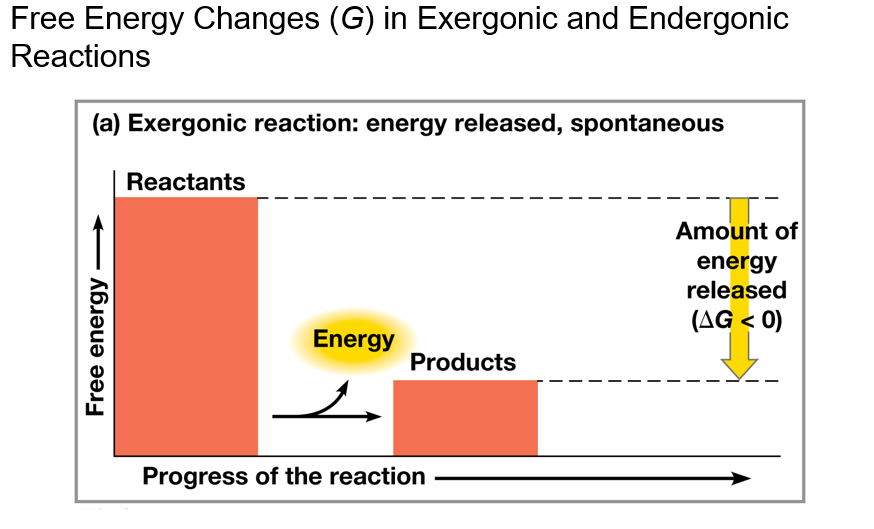
Exergonic reaction
An exergonic reaction proceeds with a net release of free energy and is spontaneous; ΔG is negative.
Ex: Overall reaction for cellular respiration:
C6H12O6 + 6O2 → 6CO2 + 6H2O; ΔG = —686 kcal/mol
What does the magnitude of ΔG represent?
The maximum amount of work the reaction can perform.
Free energy changes (G) in exergonic and endergonic reactions

Endergonic reaction
Absorbs free energy from its surroundings and is nonspontaneous; ΔG is positive
The magnitude of ΔG is the quantity of energy required to drive the reaction
EX: Photosynthesis, the reverse process of cellular respiration, is an example of an endergonic reaction → Energy is consumed to convert carbon dioxide and water to glucose and oxygen

Are cells in equilibrium?
Cells are not in equilibrium; Cells are open systems experiencing a constant flow of materials in and out.
What about metabolism is one of the defining features of life?
The fact that metabolism as a whole is never at equilibrium is one of the defining features of life.
Equilibrium and metabolism
A catabolic pathway in a cell releases free energy in a series of reactions.
Each reaction's product becomes the next reaction's reactant, preventing the system from reaching equilibrium.
ATP
Adenosine triphosphate is composed of a ribose (a sugar) adenine (a nitrogenous base) and a chain of three phosphate groups
ATP also used to make RNA
ATP and hydrolysis
Bonds between phosphate groups in ATP can be broken by hydrolysis, the addition of a water molecule
ATP hydrolysis releases energy and produces ADP (adenosine diphosphate) and inorganic phosphate
Energy released comes from the chemical change to a state of lower free energy, not from the phosphate bonds themselves.
Why does ATP hydrolysis release a lot of energy?
•A T P hydrolysis releases a lot of energy due to the repulsive force of the three negatively charged phosphate groups
•The triphosphate tail of A T P is the chemical equivalent of a compressed spring
How is the chemical work in a cell powered?
The chemical work in a cell is powered by A T P hydrolysis
The energy released by the exergonic reaction of A T P hydrolysis is used to power endergonic reactions
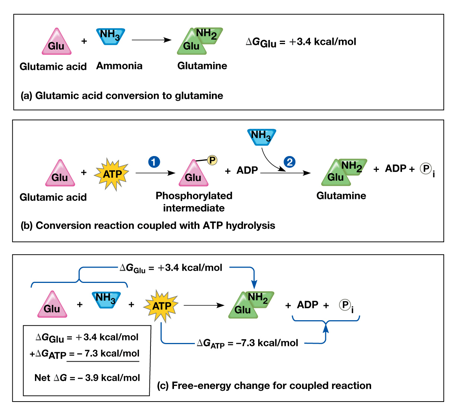
Phosphorylated Intermediate
•A T P hydrolysis is coupled to endergonic reactions by phosphorylation, the transfer of a phosphate group from A T P to another molecule, such as a reactant
•The recipient molecule, now called a phosphorylated intermediate, is more reactive than the original unphosphorylated molecule
Overall, the coupled reactions are exergonic
ATP and proteins
Transport and mechanical work in the cell are also powered by A T P hydrolysis
ATP hydrolysis leads to a change in a protein’s shape and often its ability to bind to other molecules
This can occur via a phosphorylated intermediate or noncovalent bonding between A T P and a protein

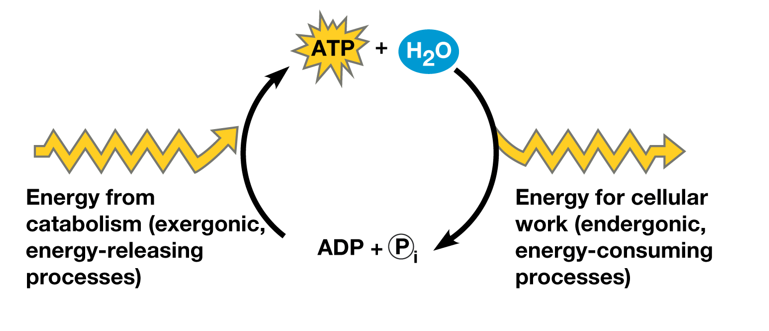
Regeneration of ATP
Body needs a HUGE amount of ATP that cells can’t keep on producing, therefore ATP gets regenerated
ATP is a renewable resource that is regenerated by addition of a phosphate group to ADP
The A T P cycle functions as a revolving door through which energy passes during its transfer from catabolic to anabolic pathways
Enzyme
An enzyme is a macromolecule that acts as a catalyst; most enzymes are proteins
For example, the enzyme sucrase catalyzes the hydrolysis of sucrose

Catalyst
A catalyst is a chemical agent that speeds up a reaction without being consumed by the reaction
Activation Energy
(EA ) The energy required to start a reaction by contorting reactant molecules so the bonds can break
Activation energy is often supplied by heat that reactant molecules absorb from the surroundings
Activation energy - processes
When reactant molecules have absorbed enough energy to break chemical bonds, they are in an unstable condition called the transition state
After the bonds are broken, new, more stable bonds form and energy is released
The activation energy provides a barrier that determines the rate of reactions
Energy profile of an exergonic reaction
Products - reactants = ΔG < 0

How Enzymes catalyze reactions
Enzymes catalyze reactions by lowering the EA barrier
This enables reactant molecules to reach the transition state at moderate temperatures
Enzymes do not affect the change in free energy ΔG for a reaction; they only speed up reactions that would eventually occur without them.

Substrate
The substrate is the reactant molecule on which an enzyme acts
Enzyme-substrate complex
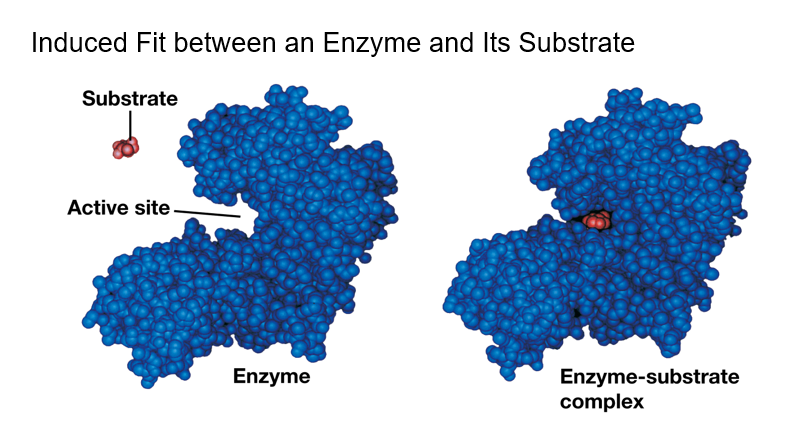
The enzyme binds to its substrate, forming an enzyme-substrate complex
Enzyme suffix
The enzyme binds to its substrate, forming an enzyme-substrate complex
Most enzyme names end in -ase
For example, the enzyme sucrase catalyzes the hydrolysis of sucroe
Active site
The region on the enzyme to which the substrate binds
Induced fit
Enzymes change shape due to chemical interactions with the substrate
This induced fit of the enzyme to the substrate brings chemical groups of the active site together
Active site and substrates
Substrates are held to an enzyme’s active site by weak interactions, such as hydrogen bonds and ionic bonds
•The active site lowers the activation energy (EA) and convert substrate to products
After releasing the products, the active site is available to bind with more substrate molecules.

Four fundamental contributions by the active site
Orienting substrates correctly
Straining substrate bonds
Providing a favorable microenvironment
Covalently bonding to the substrate
How to speed up enzyme catalysis
The rate of enzyme catalysis can usually be sped up by increasing the substrate concentration
When all enzyme molecules in a solution are bonded with substrate, the enzyme is saturated
At enzyme saturation, reaction speed can only be increased by adding more enzyme
Two things an enzyme’s activity can be affected by
General environmental factors, such as temperature and p H
Chemicals that specifically influence the enzyme
Enzymes and temperatures
Each enzyme has an optimal temperature and p H at which its reaction rate is the greatest
The reaction rate increases with increasing temperature until the optimal temperature is reached
Beyond the optimal temperature, the reaction rate drops and the enzyme will eventually begin to denature
Optimal temperature depends on
•The optimal temperature of an enzyme is dependent on the environment in which it typically functions
–For example, the optimal temperature for human enzymes is typically 37 degrees C, whereas the optimal temperature for thermophilic bacteria is 75 degrees C.
Optimal pH of an enzyme is dependent on?
The optimal temperature of an enzyme is dependent on the environment in which it typically functions
For example, the optimal temperature for human

Cofactors
• Cofactors are nonprotein molecules that help carry out processes that are difficult for amino acids
Coenzyme
Cofactors may be inorganic (such as a metal in ionic form) or organic
An organic cofactor is called a coenzyme
Most vitamins act as coenzymes or as the raw materials from which coenzymes are made
Competitive inhibitors
Bind to the active site of an enzyme and prevent the substrate from binding
Noncompetitive inhibitors
Bind to an alternate site on the enzyme, causing the active site to change shape and become less effective
Different types on enzyme inhibitors
Reversible enzyme inhibitors bind to enzymes by weak interactions; irreversible inhibitors form covalent bonds
Toxins and poisons are often irreversible enzyme inhibitors
Many antibiotics function as enzyme inhibitors in bacteria
— For example, penicillin blocks the active site of an enzyme many bacteria use to make cell walls