Ch. 4: Tissue Level of Organization
 Call Kai
 Learn
Learn Practice Test
 Spaced Repetition
 Match
Match Flashcards
 Knowt Play
1/37

There's no tags or description
Looks like no tags are added yet.
Name | Mastery | Learn | Test | Matching | Spaced | Call with Kai | Chat |
|---|
No analytics yet
Send a link to your students to track their progress
38 Terms
What are the 4 primary tissue classes?
Epithelial, connective, muscle, nervous
(multiple layers): Barrier for protection
Stratified epithelia
(single layer): Control transport/ absorption across membranes
Simple epithelia

Epithelial tissue

From left to right
Simple, pseudostratified, stratified
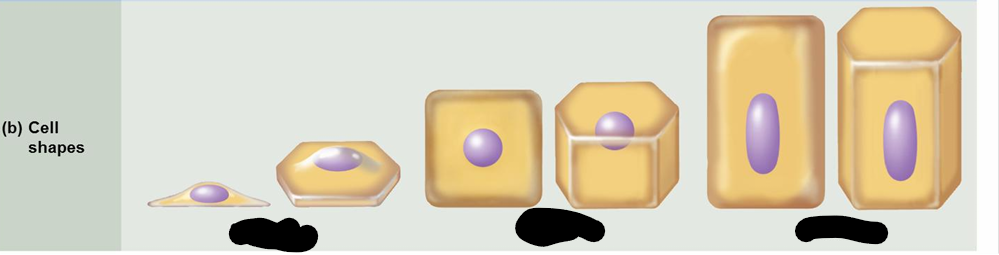
Shapes of epithelial tissue from left to right
squamous, cuboidal, columnar
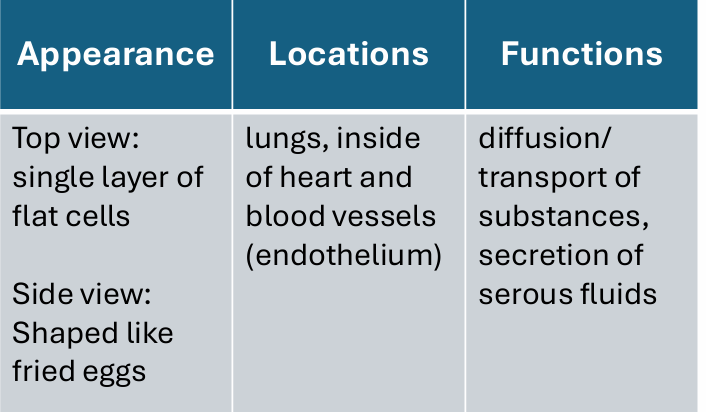
Simple squamous epithelium

Muscle tissue

Skeletal muscle tissue

Nervous tissue

Nervous system
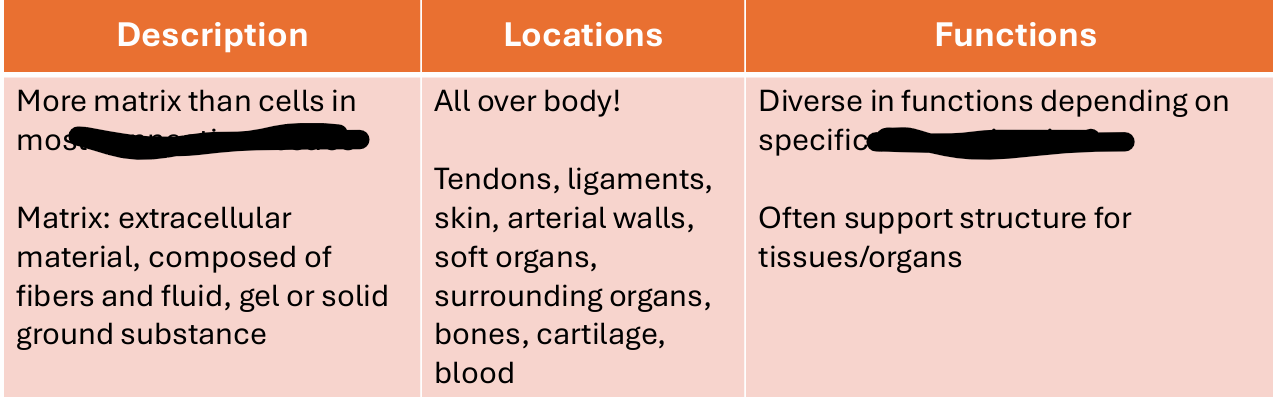
Connective tissue

Elastic connective tissue
form a tight seal between cells in a layer→ fluid/substances cannot leak between cells (epithelial cells)
Tight junction
hold cells together, fluid leaks around it (like snaps) (transitional epithelia)
Anchoring junction
channels connect cells together and allow ions and other solutes to pass between cells (cardiac myocytes)
Gap junction
Cells or organs that secrete substances for use elsewhere in the body (secretion) or release them for elimination from the body (excretion). Composed of epithelial tissue in a connective tissue framework
Glands
Gland that has no contact with the surface and has no ducts
Secrete (hormones) directly into blood
(ex) Thyroid, adrenal, and pituitary glands
Endocrine glands
Gland that maintains their contact with the body surface by way of a duct
(ex) Sweat glands, mammary glands, tear glands
Exocrine glands
Which organs have endo and exocrine functions?
liver, pancreas, gonads
Two structures of exocrine glands
Simple (single duct) and branched (multiple)
Two shapes of exocrine glands
Tubular & acinar (forms sac)
Exocrine gland modes of secretion:
Merocrine, apocrine, holocrine
Mode of secretion that has vesicles that release their secretion by exocytosis
• Cells remain intact
• Sweat glands, tear glands, pancreas, gastric glands
merocrine glands
Mode of secretion thicker, milkier secretion, containing fats
• Apical portion pinches off cell
• Sweat glands that develop with armpit and groin hair after puberty • In a few other places, including mammary glands
Apocrine glands
Mode of secretion where Cells accumulate a product, entire cell disintegrates
• Secretion is thick and oily→ cell fragments and synthesized substance
• Sebaceous glands of the skin and oil glands of scalp
• Oily secretion(sebum )coats hair shaft to protect it
holocrine glands
two ways tissues grow:
Increase # of cells (hyperplasia) or size of cells (hypertrophy)
Unspecialized tissues become specialized mature types
Differentiation
Changing from one type of mature tissue to another
Metaplasia
Uncontrolled tissue growth
• Composed of abnormal, nonfunctional tissue
- Tumor (benign or malignant)
Neoplasia
Damaged tissues can be repaired in two ways:
Regeneration & fibrosis
replacement of damaged cells by the same type of cells
• Restores normal function
• Skin injuries, liver generation
Regeneration
replacement of damaged cells with scar tissue
• Holds organs together
• Does not restore normal function
• Severe cuts and burns, healing of muscle injuries, scarring of lungs
Fibrosis
undifferentiated cells that are not yet performing any specialized function. Have potential to differentiate into one or more types of mature functional cell
Stem cells
a embryonic stem cell that can develop into any type of cell of the embryo plus the placenta and amniotic sac
totipotent
a embryonic stem cell that can develop into any type of cell of the embryo
pluripotent
an adult stem cell. bone marrow producing several blood cell types
multipotent
an adult stem cell where only one mature cell type produced (stem cells in epidermis)
unipotent