Simple harmonic motion
 Call Kai
 Learn
Learn Practice Test
 Spaced Repetition
 Match
Match Flashcards
 Knowt Play
1/18

There's no tags or description
Looks like no tags are added yet.
19 Terms
conditions for simple harmonic motion
oscillations
same time period for each complete oscillation - independent to amplitude (for small angles)
restoring force responsible for the motion is always directed towards the equilibrium position
restoring force is directly proportional to diplacement
the acceleration is directly proportional to the displacement and in the opposite direction to displacement
acceleration of an object oscillating in simple harmonic motion
a=−ω2x
acceleration is at a maximum when displacement is at a maximum
acceleration at a minimum at equilibrium
SHM displacement equation for oscillations from equailibrium
x=Asin(ωt)
SHM displacement equation for oscillation from amplitude
x=Acos(ωt)
Free Oscillations
freely oscillating object oscillates with a constant amplitude because there is no friction acting on it
only forces acting on it is the restoring force
with friction, amplitude of oscillations would gradually decrease over many cycles to 0
shm displacement, velocity and acceleration graphs
velocity time graph is pi/2 out of phase with displacement graph and acceleration graph
displacement graph is pi rad out of phase with acceleration graph
Energy of an object in shm
energy of the system changes from kinetic energy to potential energy and back again every half cycle after passing through equilibrium (by restoring force)
energy diplacement graph
potential energy curve is parabolic Ep = ½ kx²
kinetic energy curve is an inverted parabola Ek = Et-Ep = ½k(A²-x²)
ETotal = Ek + Ep = 1/2 kA² which is the potential energy at the maximum displacement and the kinetic energy at 0 displacement
two curves add together to give a horizontal line for the total energy
50% of max kinetic energy occurs at x = sqrt(0.5)A
to find displacement at any percentage of ke, set that percentage of total energy equal to ke.
that percentage of ke + pe = total energy
damped oscillations
oscillations in which dissipating forces cause the amplitude to decrease - transfer energy to the surroundings as thermal energy
light damping
time period is independent of the amplitude
each cycle takes the same length of time as the oscillations die away
amplitude of oscillations gradually reduces by the same fraction each cycle
critical damping
just enough to stop the system oscillating after it has been displaced from equilibrium and released
system returns to equilibrium in the shortest possible time
heavy damping
so strong that the displaced object returns to equilibrium much more slowly than if critically damped - no oscillating motion occurs
natural frequency
frequency at which system oscillates without a periodic force being applied
forced vibrations
periodic force applied to oscillating system
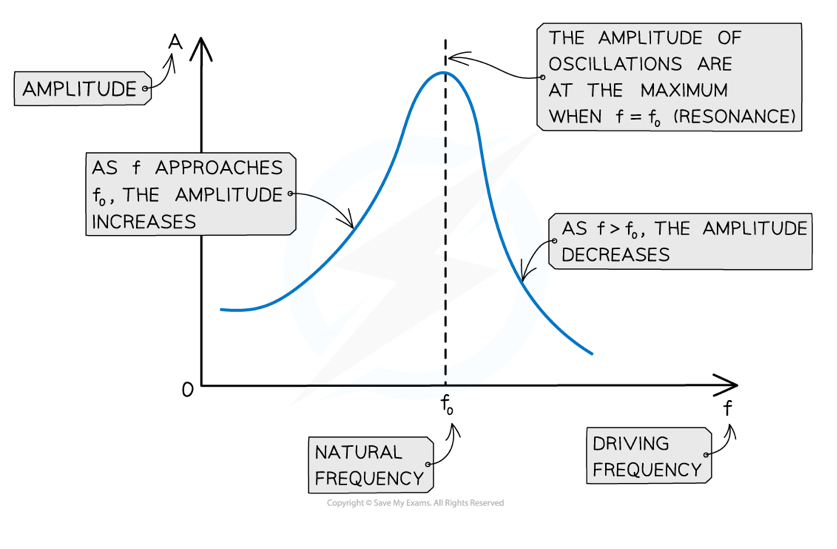
effect of changing frequency of periodic force on amplitude of oscillations
amplitude depends on the frequency of the applied force
as the applied frequency increases, the amplitude of the oscillations increases until it reaches a maximum amplitude at a particular frequency
then the amplitude decreases again
phase difference between displacement and periodic force as frequency increases
increases from 0 to 2π rad at maximum amplitude
increases from 2π rad to π rad as frequency increases further
Resonance
system oscillating at max amplitude - limited only by damping - energy supplied by the periodic force is lost at the same rate due to damping when at a constant max amplitude
at resonance, energy is transferred most efficiently from driver to oscillating system - maximum kinetic energy transferred into it
periodic force is 2π rad out of phase with displacement
periodic force is in phase with velocity
frequency at which this occurs is resonant frequency
at equilibrium (max velocity) P=fv so most power transferred out of system by damping - most power can also be transferred into system by driving force on- most efficient
effect of damping on resonant frequency
the heavier the damping, the smaller the maximum amplitude becomes at resonance (reduces amplitude of all frequencies) due to energy losses out of the system
resonance peak broadens (max amplitudes more significantly reduced around peak)
the further (and smaller) the resonant frequency is compared to the natural frequency of the system - damping slows the oscillations, increasing time period and decreasing frequency - resonant frequency must also lower to be in phase with velocity
for an oscillating system with little or no damping, at resonance, the applied frequency of the periodic force being = the natural frequency of the system (resonant frquency)
when the damping is not light, resonance occurs at a slightly lower frequency than the natural frequency
oscillating surface with object on it
object remains in contact with surface when the vibrating surface accelerates down with an acceleration less than g
above a specific frequency, the downwards acceleration of the surface becomes greater than g, meaning that the surface will move back down with a greater acceleration from max amplitude than the object can reach
so object no longer in contact with surface as it moves down
two oscillators of different time periods in sm. time at which they will be in phase and number of full oscillations of each until they are in phase
A: T=1.98
B: T=2
1.98 × 100 = 198 so in phase after 100 oscillations of A
2 × 99 = 198 so in phase after 99 oscillations of B
in phase at 198 seconds