2.1 - Vertebral Column and Back Musculature
 Call Kai
 Learn
Learn Practice Test
 Spaced Repetition
 Match
Match Flashcards
 Knowt Play
1/60

There's no tags or description
Looks like no tags are added yet.
Name | Mastery | Learn | Test | Matching | Spaced | Call with Kai | Chat |
|---|
No analytics yet
Send a link to your students to track their progress
61 Terms
Skeleton
Structural support that provides system of levels for muscular movement as well as protects soft tissue organs
Appendicular skeleton
Consists of the limbs and girdles, pelvis, scapula, and clavicle
Axial skeleton
Consists of the skull, vertebral column, ribs, and sternum
spinous process
Identify
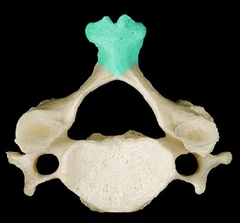
Lamina
Identify

Transverse process
Identify

Pedicle
Identify

body
Identify

Neural arch
Identify

Transverse and caudal foveae

Cervical
Which region of the vertebral column

Thoracic
Which region of the vertebral column
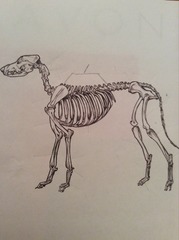
Lumbar
Which region of the vertebral column

Sacral
Which region of the vertebral column

Ligaments
Fibrous connective tissue that connects bone to bone
Limits excessive movement across joints
What is the main function of ligaments
Supraspinous ligament
Ligament that connects spinous processes of vertebra and limits excessive flexion
Interspinous ligament
Ligament that connects the spinous processes of adjacent vertebrae located in-between the spinous processes
Dorsal longitudinal ligament
Ligament locates dorsally on the vertebral bodies within the vertebral canal and connects vertebral bodies and limits disk herniation
Ventral longitudinal ligament
Ligament locates ventrally on the vertebral bodies within the vertebral canal and connects vertebral bodies and limits disk herniation
Nuchal ligament
specialized part of the supraspinous ligament that supports much of the mass of the head without muscular effort
True
T/F - cats lack the supraspinous and nuchal ligaments
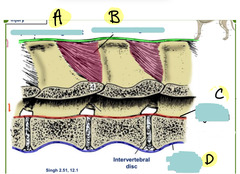
Supraspinous ligament
A

Interspinous ligament
B

Dorsal longitudinal ligament
C

Ventral longitudinal ligament
D
Joints
A point where two bones articulate and can firmly unite bone or allow for specific (sterotypical and predicable) movements between bones
Intervertebral discs
Located between vertebral bodies and is compressible, able to absorb shock, and allows movement in different axes
Vertebral foramen
Large opening within each vertebra of the spinal column which collectively form the vertebral canal

Intervertebral foramen
Smaller openings located between adjacent vertebrae formed by the notches on the superior and inferior surfaces of the vertebral bodies and pedicles

Annulus fibrosis
Concentric rings of fibrocartilage that lines the outer layer of an intervertebral disc
Nucleus pulposis
Central core of the intervertebral disc that is semifluid at birth but becomes jelly like
Annulus fibrosis
Identify

nucleus pulposus
Identify (red arrow)

Dorsal and ventral roots
join to form spinal nerves
Dorsal rami
Branch of the spinal nerve that travels dorsally and applies innervation to the intrinsic back muscles
Ventral rami
Branch of the spinal nerve that travels ventrally
Dorsal root ganglion
A cluster of sensory neurons located outside the CNS
Epaxial muscles
Muscles dorsal to the spinal cord that are responsible for posture, stabalizing the trunk, and locomotion
Hypaxial muscles
Muscles ventral to the spinal cord and contribute to limb movement
Origin
The proximal end of a muscle that is fixed during contraction
Insertion
The distal end of a muscle that attaches to the mobile part of the bone
Cutaneous trunci
A thin superficial sheet of skeletal muscle that lies just beneath the skin and twitches the skin
Cutaneous trunci
Identify

Trapezius
Identify

Latissimus dorsi
Identify

Serratus dorsalis
Identify

Iliocostalis
identify

Iliocostalis
Which of the major intrinsic back muscles is most lateral to the spine
Longissimus
Identify

Spinalis
Identify

Semispinalis
Identify
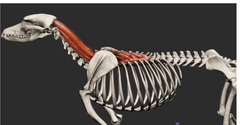
Splenius
Identify

Thoracolumbar fascia
Deep and dense fascia that give attachment to multiple muscle groups and provide stability and support to the caudal lumbar region
Thoracolumbar fascia
Identify

The muscles of the limbs and the ventral trunk
What fundamental muscles group is innervated by the ventral rami
Intrinsic back muscles
What fundamental muscles group is innervated by the dorsal rami
Extension and lateral flexion of the vertebral column
Which movements are generated by the errector spinae muscles
Hyperextension
The ventral longitudinal ligament prevents excessive movement of what type?
Spinal nerve
What would be found in the intervertebral foramen
Cutaneous trunci
What muscle is innervated by the lateral thoracic nerve