HHS CPO Pacing
 Call Kai
 Learn
Learn Practice Test
 Spaced Repetition
 Match
Match Flashcards
 Knowt Play
1/37

There's no tags or description
Looks like no tags are added yet.
Name | Mastery | Learn | Test | Matching | Spaced | Call with Kai | Chat |
|---|
No analytics yet
Send a link to your students to track their progress
38 Terms
Pacing Indications
Symptomatic Bradycardia/block
Sinus node dysfunction
Witnessed asystole
Post-op open heart sx
Overdrive pacing
Temporary Pacemaker Methods
Transcutaneous
Transvenous
Epicardial
Transcutaneous Pacing
Emergent for severe symptomatic bradycardia as a bridge to transvenous pacing
Transvenous Pacing
Tip of pacing catheter is wedged in trabeculae of RV
Epicardial Pacing
Postop cardiac surgery patients only
Pacemaker Components
Pacing generator
Bridging cable
Leads/wires
Cable Connector Polarity
Distal → Negative
Proximal → Positive
Output
Energy delivered to myocardium (mA)
Stimualation Threshold
Minimum amount of energy (mA) needed to consistently depolarize the myocardium
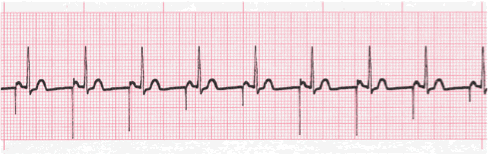
Atrial Pacing

Ventricular Pacing

Atrioventricular Pacing
Capture
Myocardial depolarization with enough energy from the pacemaker

Fusion Beat
Sensing/Sensitivity
Set parameter allowing the pacemaker to “see” intrinsic events (mV)
Defines height of P or R wave to be detected by the pacemaker lead
Lower value → higher sensitivity
Synchronous Pacing
Pacemaker only paces when necessary, able to sense intrinsic beats and will not fire
Asynchronous Pacing
Constant pacing at set rate, no ability to sense intrinsic heart activity
Paced Interval (PI)
Length of time between a paced event and the next paced event
Automatic with a set rate - should not change
Escape Interval (EI)
Distance from an appropriately senesed event to the next paced event without intervening sensed events
EI should be equal to PI
Intrinsic Interval (II)
Measurement of how long it takes the heart to generate its own electrical impulse (from paced beat to next intrinsic depolarization)
Intrinsic Rate below Paced Rate
Inappropriately sensing intrinsic activity or loss of output
Types of Pacemaker Malfunctions
Loss of Output
Loss of Capture
Oversensing
Undersensing
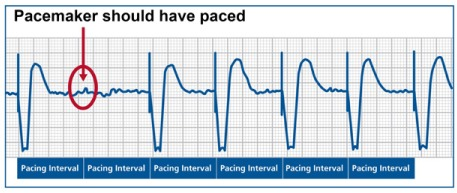
Loss of Output
No energy from pacemaker generator, can be intermittent or continuous
EI>PI
Loss of Output Causes
Battery Depletion
Generator turned off
Faulty cable connection
Dislodged/fractured lead (XR)
Oversensing
Loss of Output Interventions (Transcutaneous)
Reestablish skin contact
Monitor turned on and in pacing mode
Change pads or generator
Reestablish pacing
Loss of Output Interventions (Transvenous/Epicardial)
Ensure generator is on
Reconnect broken connections
Replace generator or bridging cable
Initiate TCP
Loss of Capture
Pacemaker fires, but is unable to stimulate myocardium
Pacer spike seen but does not cause depolarization

Loss of Capture Causes
Increased threshold
Faulty cable connection
Dislodged/fractured lead
Lead tip against infarcted tissue
Tissue is refractory
Battery depletion
Fibrin or clot on lead tip
Loss of Capture Interventions (Transcutaneous)
Increase mA
Change pacer pads
Change TCP unit
Loss of Capture Interventions (Transvenous/Epicardial)
Replace generator or bridging cable
Reconnect broken or loose connection
Increase mA
Reverse lead polarity
Initiation of TCP
Oversensing
Oversensitive to electrical artifact, pacemaker misinterprets muscle artifact or P/T waves as intrisic activity and doesn’t fire
Pacemaker can fire irregularly or not at all
EI>PI
Oversensing Causes
Physiological:
Myopotential inhibition (i.e. pec contraction)
Electromagnetic interference
Peaked T waves
Lead/Systems:
Dislodged/fractured lead
Lead/pad contact
mV set too low
Oversensing Interventions (Transcutaneous)
Change pacer pads
Change generator
Oversensing Interventions (Transvenous/Epicardial)
Under direct order → turn sensitivity dial to decrease sensitivity until normal pacing occurs
Initiate TCP
Undersensing
Pacemaker fires despite intrinsic activity being present
EI<PI
Undersensing Causes
mV threshold set too high
Battery depletion
Dislodged/fractured elad
Ventricular ectopic activity
Change in native signal (i.e. antiarrythmatic meds)
Fibrin/clot formation at lead tip
Undersensing Interventions (Transcutaneous)
Change pacer pads
Change out TCP unit
Undersensing Interventions (Transvenous/Epicardial)
Replace generator, bridging cable
Reverse lead polarity
Turn sensitivity dial to lower mV and increase sensitivity