Ch 2: Protein Composition and Structure
 Call Kai
 Learn
Learn Practice Test
 Spaced Repetition
 Match
Match Flashcards
 Knowt Play
1/32

There's no tags or description
Looks like no tags are added yet.
Name | Mastery | Learn | Test | Matching | Spaced | Call with Kai | Chat |
|---|
No analytics yet
Send a link to your students to track their progress
33 Terms
What is an enzyme?
A biological macromolecule that acts as a catalyst for a biochemical reaction;
What do amino acids consist of?
an amino group, a carboxyl group, and a unique functional group that are each bonded to a common carbon atom
What is a side chain?
The distinctive variable group bonded to the α-carbon atom of an amino acid.
What do amino acids predominantly exist as at a neutral pH?
dipolar ions that carry both a positive and negative charge
What four categories can amino acids be sorted into based on thier R groups?
Hydrophobic amino acids with nonpolar R groups
Polar amino acids with neutral R groups but the charge is not evenly distributed
Positively charged amino acids with R groups that have a positive charge at physiological pH
Negatively charged amino acids with R groups that have a negative charge at physiological pH
When is a solution at physiological pH?
around 7.4
What is a common tendency of hydrophobic groups?
To cluster together
Are amino acids with complete positive charges highly hydrophilic or hydrophobic?
hydrophilic
How are amino acids typically named?
By the first three letters of their names or the first letter of their name.
Why are some animo acids not found in protiens?
They are too reactive
What is the primary structure of proteins?
The linear sequence of linked amino acids
What type of bond links the monomers of proteins together?
Peptide bonds (aka amide bonds)
What is a peptide bond?
A covalent linkage formed between the α-carboxyl group of one amino acid and the α-amino group of another.
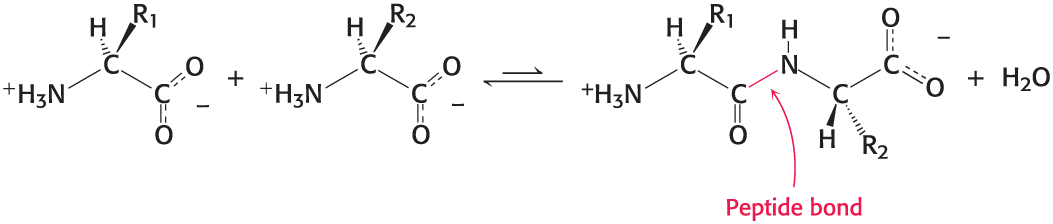
The formation of the peptide bond linking two amino acids is accompanied by what?
the loss of a molecule of water
Are peptide bonds stable or unstable? Why is this?
stable because the rate of hydrolysis is extremely slow
What is a polypeptide chain?
A series of amino acids joined by peptide bonds
What is unit in a polypeptide chain called?
a residue
What do all amino acid sequences have and why?
directionallity because its ends are different with an α-amino group at one end and a α-carboxyl group at the other
What two parts does a polypeptide chain consist of?
the main chain (or backbone) and a variable part that makes the side chains
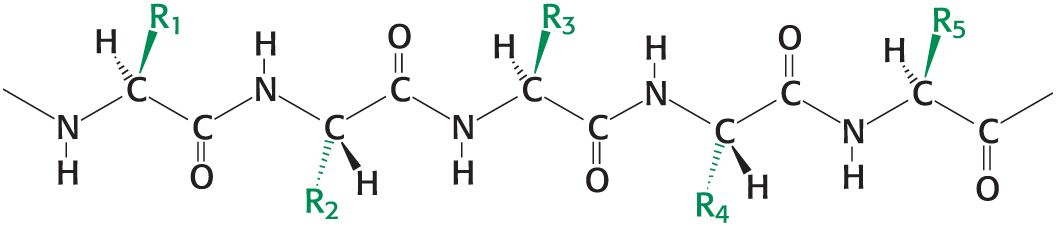
What is the main chain (or backbone)?
The regularly repeating part of a polypeptide, including the amino group, α-carbon, and carbonyl groups.
What are polypeptide chains made of small numbers of amino acids called?
oligopeptides (or simply peptides)
What are the most common cross-links in polypeptide chains found in proteins?
disulfide bonds
What are disulfide bonds?
A covalent bond formed by the oxidation of two sulfhydryl groups (R-SH), in this case, cysteine residues
The forming of a disulfide bond between two cysteine bonds forms what?
cystine
The peptide bond is essentially planar or non-planar
planar
Describe the characteristics of a peptide bond
It resonates between a single bond and a double bond preventing rotation
Almost all peptide bonds have a trans or cis configuration? What does this mean?
trans. he two α-carbon atoms are on opposite sides of the peptide bond
Why do most peptide bonds have a trans configuration?
Sterric repulsion between the groups attatched to the α-carbon atoms
The main chain bonds connected to the α carbon have…
rotational flexibility
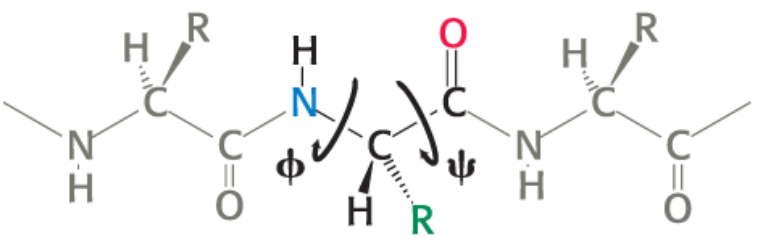
What are torsion angles?
A measure of the rotation about a bond, usually taken to lie between -180 and +180 degrees.
What is the angle of rotation about the bond between the nitrogen and the α-carbon atom called?
phi (ϕ)
What is the angle of rotation about the bond between the α-carbon and the carbonyl carbon atoms called?
psi (ψ)
Why are phi (ϕ) and psi (ψ) important?
Their angles determine the path of the polypeptide chain.