Biomechanics of Resistance Training
 Call Kai
 Learn
Learn Practice Test
 Spaced Repetition
 Match
Match Flashcards
 Knowt Play
1/35

There's no tags or description
Looks like no tags are added yet.
Name | Mastery | Learn | Test | Matching | Spaced | Call with Kai | Chat |
|---|
No analytics yet
Send a link to your students to track their progress
36 Terms
Concentric muscle action
muscle shortens because the contractile force is greater than the resistive force
the forces generated within the muscle and acting to shorten it are greater than the external forces acting at its tendons to stretch it
eccentric muscle action
muscle lengthens because the contractile force is less than the resistive force
forces generated within the muscle and acting to shorten it are less than external forces acting at its tendons to stretch it
isometric muscle action
muscle length does not change because the contractile force is equal to the resistive force
sagittal plane
left and right
frontal plane
front and back
transverse plane
upper and lower
agonist
most directly involved in bringing about movement
prime mover
antagonist
muscle that can slow down or stop movement
mechanical advantage
ratio of moment arm through which an applied force acts to that through which a resistive force acts
greater than 1 = applied muscle force less than resistive force
less than 1 = disadvantage
first class lever
muscle force and resistive force act on opposite sides of fulcrum

second-class lever
muscle force and resistive force act on the same side of fulcrum
muscle force acting through longer moment arm than resistive arm
req. muscle force is smaller than the resistive force

third-class lever
muscle force and resistive force on same side of fulcrum
muscle force moment is shorter than resistive force
mechanical disadvantage

mechanical advantage of the patella
patella maintains the quad tendon’s distance from the knee’s axis of rotation
without the patella, the tendon would be closer to the knee’s center of rotation —> shortening the moment arm through which the muscle force acts —> reduced mechanical advantage
mechanical advantage can change through ROM
elbow flexion:
when the moment arm is shorter, there is less mechanical advantage
at full extension and full flexion the perpendicular distance from the joint axis of rotation to tendon’s line of action is shorter/smaller
as weight is lifted, the weight moment arm (M) — that resistive torque acts through — changes with horizontal distance from weight to hinge
many injuries happen due to exceeding force capacity for a give _____ state
for a given lengthened state
Biomechanical factors in strength & power: Neural Control
affects max force output by determining number of motor units involved in contraction
Biomechanical factors in strength & power: Muscle cross sectional area
force a muscle can exert is related to its cross-sectional area (not volume)
this is because there is increased # of sarcomeres arranged in parallel
Biomechanical factors in strength & power: Arrangement of fibers
increases cross sectional area can change angle of pennation, increasing more force
Increased pennation angle → allows more fibers to be packed into the same muscle volume → increases physiological cross-sectional area → increases maximal force-generating capacity (despite the cosine reduction per fiber).
pennate muscle
muscle with fibers aligned obliquely with the tendon
unipennate: tibialis posterior
bipennate: rectus femoris
multipennate: deltoid
angle of pennation
angle between muscle fibers and an imaginary line between muscles origin and insertion
0 degrees means no pennation
Biomechanical factors in strength & power: Muscle length
at resting length: actin and myosin filaments next to each other, max # of cross bridges available
contracted: actin filaments overlap, reduced cross-bridge sites available, decreased force generation capacity
stretched: smaller proportion of the actin and myosin filaments next to each other, fewer cross-bridge sites available, can’t generate as much force
front squat vs backsquat: mechanical advantage
front squat: shifting weight/center of gravity to the anterior aspect lengthens the moment arm at the knee, forcing the knee extensors (quads) to generate more torque to control/produce the movement
back squat: shifting weight/center of gravity to the posterior aspect (more forward flex), mechanically advantages the hip muscles by lengthening the hip moment arm
the knee moment arm is shortened, thus hip extensors (glutes/hamstrings) must produce more torque → more glute/hamstring activity
leg press mechanical advantage
seatback support removes the need for spinal stabilizer muscles to help stabilize the core/trunk
Biomechanical factors in strength & power: Contraction velocity
nonlinear — but in general, force capability of muscle decreases as contraction velo increases
Biomechanical factors in strength & power: joint angular velocity
muscle pulling on bone at a distance from axis of rotation
produces torque when attempting angular motion @ bones
produced by eccentric and concentric actions
strength
ability to generate the greatest force
power
force production * velocity = watts
force at a given speed
stretch shortening cycle
rapid stretch triggers neuromuscular response, muscle spindles help generate an elastic response
series elastic component + stretch reflex —> maximal increase in muscle recruitment over small amount of time
3 phases: eccentric, amortization, concentric
eccentric phase SSC
stretch of agonist muscle
elastic energy is stored in series elastic component
muscle spindles are stimulated
amortization phase ssc
pause phase
should be fast - must transition quickly to not lose energy
Type 1a afferent nerves synapse with alpha motor neurons
alpha motor neurons transmit signals to agonist muscle group
concentric phase ssc
shortening of agonist muscle fibers
elastic energy is released from the series elastic component
alpha motor neurons stimulate the agonist muscle group
relationship between force and velocity during eccentric muscle action
direct relationship
with a heavier weight, more force is needed to control
lighter weight requires less force and thus slower speed
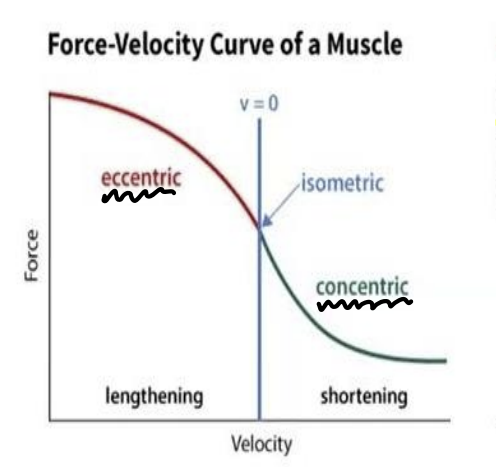
relationship between force and velocity for concentric muscle action is
inverse
more weight, more force, slower speed
less weight, less force, faster speed

For concentric contraction: As velocity increases, the maximum force the muscle can produce _______
decreases

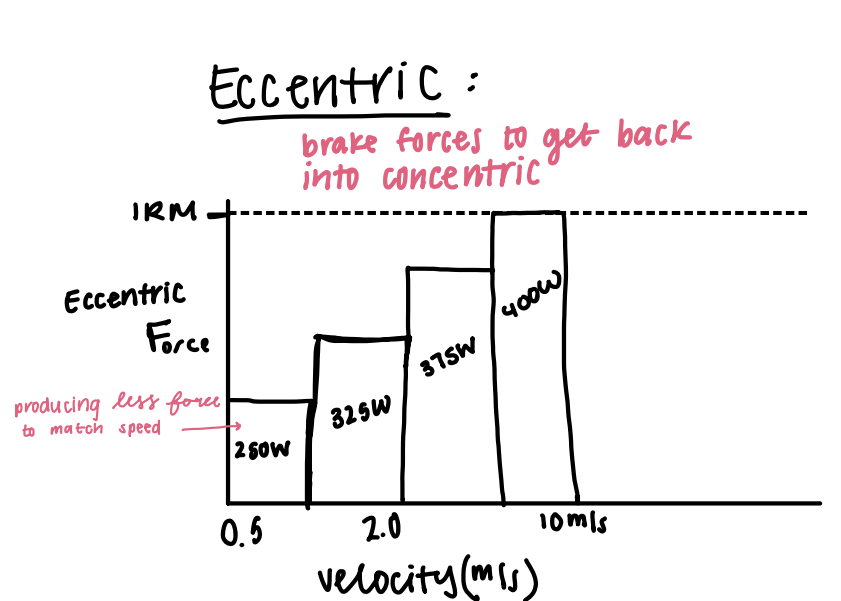
Eccentric muscle contraction: as velocity increases, eccentric force capability _____.
increases, eventually plateauing at/near 1RM
eccentrically, the muscle is acting as a brake — resisting and controlling a load moving faster than it's or lengthening
faster the load is moving, the more "braking force" is needed to control/decelerate it and transition back into the concentric phase
training + SAID principle
Specific Adaptations to Imposed Demands — force drops with speed concentrically; force rises with speed eccentrically
if you want to train force production at high velocities, you need to train specifically at that contraction type and speed — improving slow concentric strength won't automatically transfer to fast eccentric braking ability, and vice versa
the nervous system adapts to the speed and contraction type it is exposed to