American Patriot - Bundys; Restore Late Pleistocene Function - Reading
 Call Kai
 Learn
Learn Practice Test
 Spaced Repetition
 Match
Match Flashcards
 Knowt Play
1/31

There's no tags or description
Looks like no tags are added yet.
Name | Mastery | Learn | Test | Matching | Spaced | Call with Kai | Chat |
|---|
No analytics yet
Send a link to your students to track their progress
32 Terms
Who are the Bundys?
an LDS (Mormon) family that grazed cattle on federal lands by permit in the Gold Butte area for generations
In 1989 USFWS Emergency listed the Mojave population of the desert tortoise as?
endangered under the ESA
In 1990, USFWS converted desert tortoise to?
threatened
What USFWS decision did they issue?
required BLM to reduce or revoke ranchers' grazing rights on public lands in desert tortoise habitat
When were ephemeral grazing permits were allowed?
only in years with above average rainfall and thus, annual plant growth
In 1993, what did BLM do?
lowered the number of cattle that Bundy was allowed to graze and limited when and how grazing could occur
In protest, what did Bundy do in response to BLM lowering the number of cattle allowed to graze, and how much could it occur?
stops paying grazing fees, but continued grazing
What were some fermentation traits?
Large-bodied hindgut grazers
Large-bodied ruminants
Large-bodied hindgut grazers:
Fermentation in the large intestine
Large-bodied ruminants:
Fermentation in the rumen (foregut)
What were some advantages of hindgut fermentation?
Fast passage of food, able to eat large amounts quickly
Better at handling diets that vary widely in quality
Better suited to environments where forage is abundant, and intake rate is more important than extracting every possible nutrient
What were some advantages of ruminants?
More efficient digestion of low-quality fibrous plants
Recover most microbial protein, providing a lot of amino acids
Can survive on poor quality forage
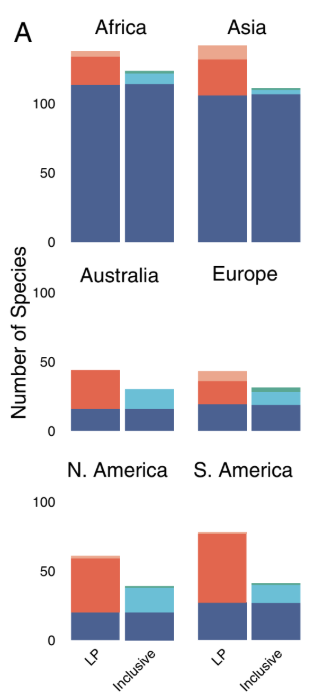
What did figure 1A describe?
Species richness per continent
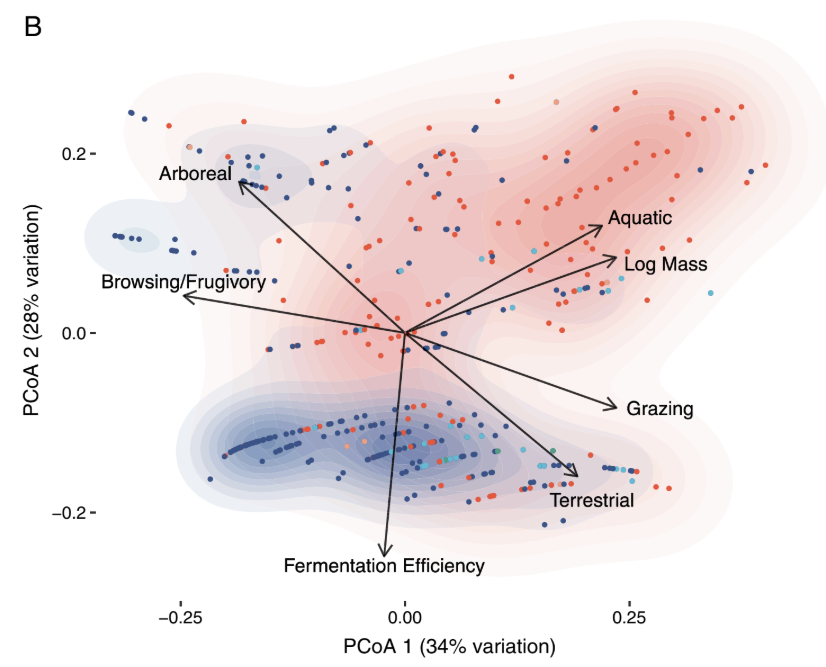
What did figure 1B describe?
Global herbivore trait space
Arrows indicate how particular traits shape trait space axes
Points indicate species
fill density indicates their density distribution
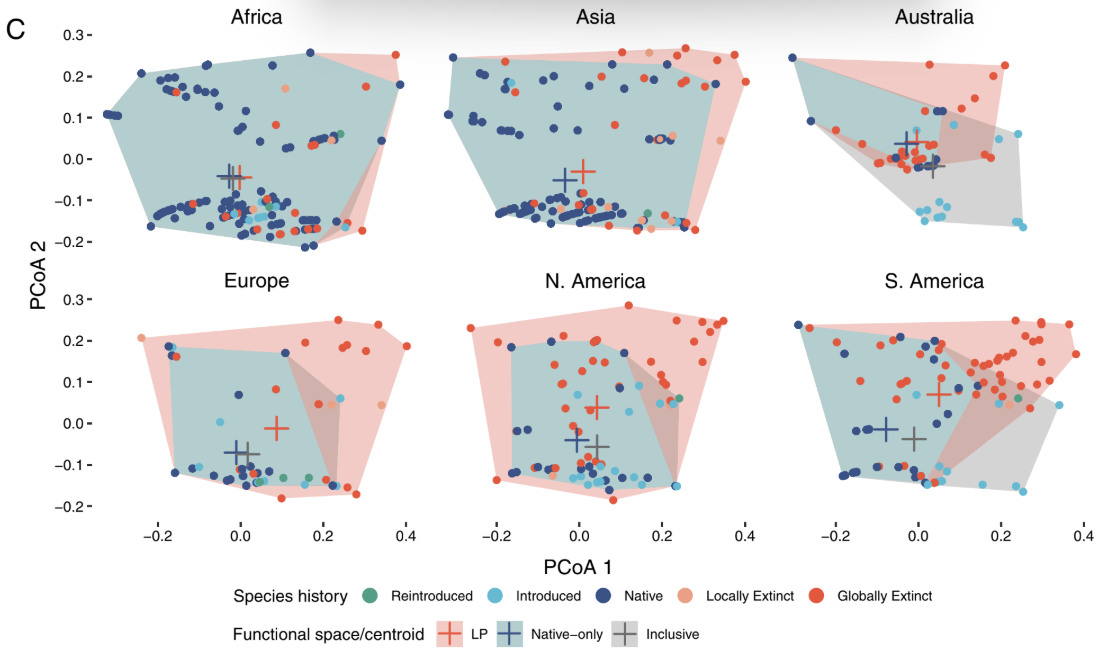
What did figure 1C describe?
Changes in continental trait space from extinctions and introductions
More functional groups/ecosystem function in the Late Pleistocene than today
Implies loss of ecosystem functionality between LP and now
Not just loss in species richness
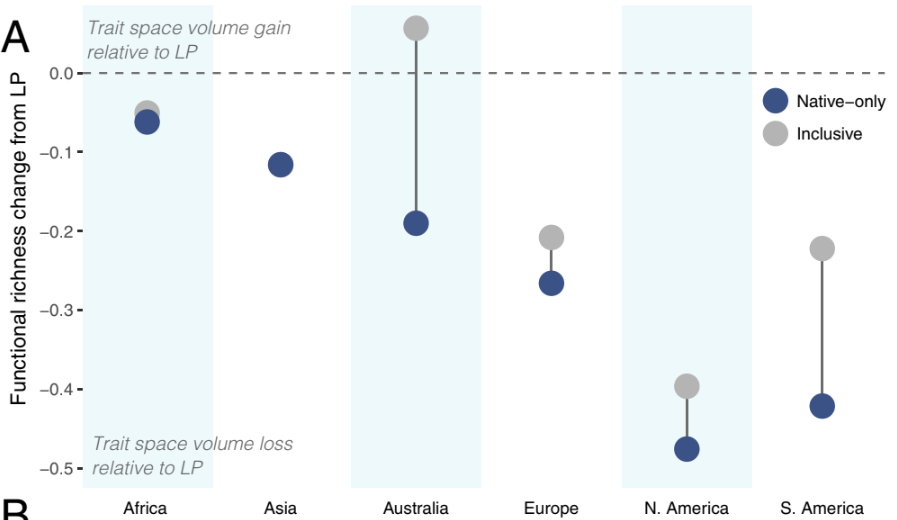
What did figure 2A describe?
Change in trait space volume and functional dissimilarity
All depict a loss, looking at just the native species
Trait space is a metric of functional diversity (= functional richness)
Turnover = unique space trait
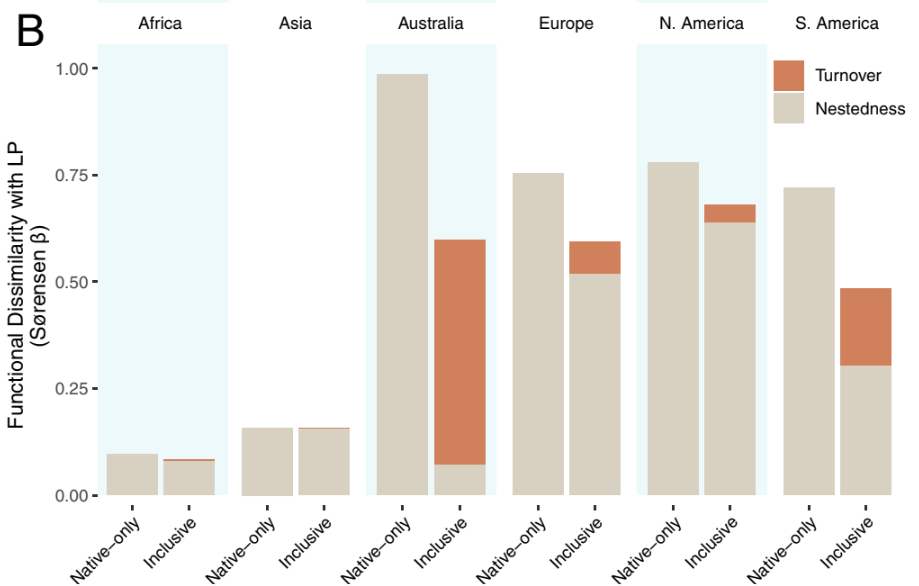
What did figure 2B describe?
Total functional dissimilarity patterns to the late Pleistocene
calculated from the overlap of four-dimensional trait space
New species = new function?
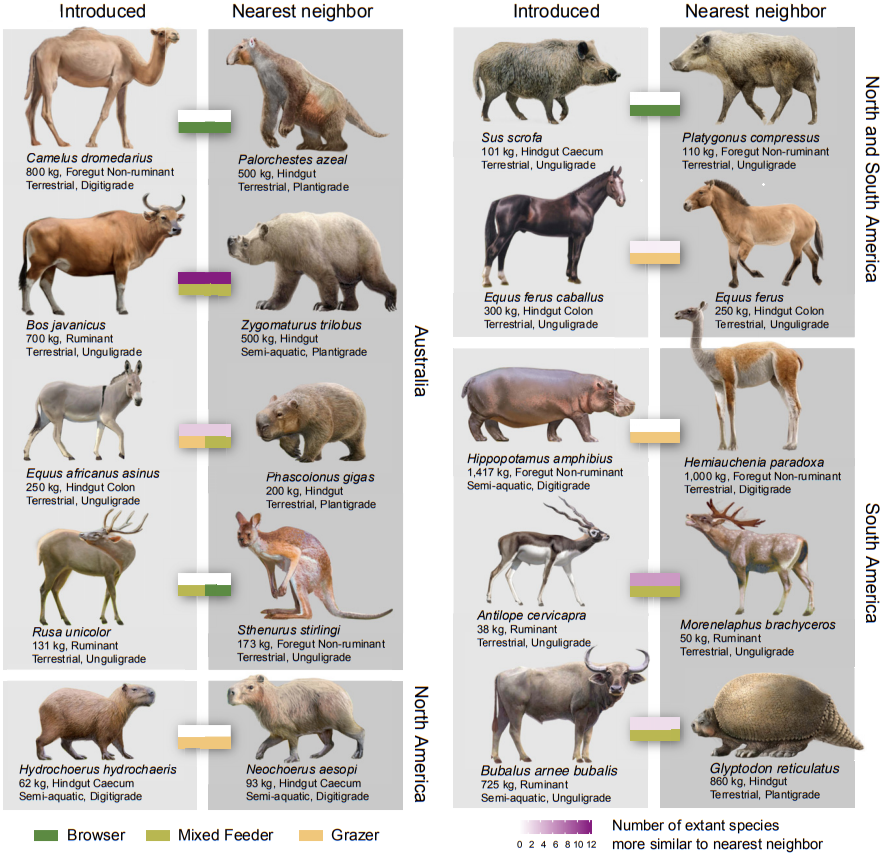
What did figure 3 describe?
Select introduced herbivores and their extinct nearest neighbors in those continents most impacted by extinctions and introductions
By body mass and dietary guild
Restricted by climate zone and continent
Functions interchangeable
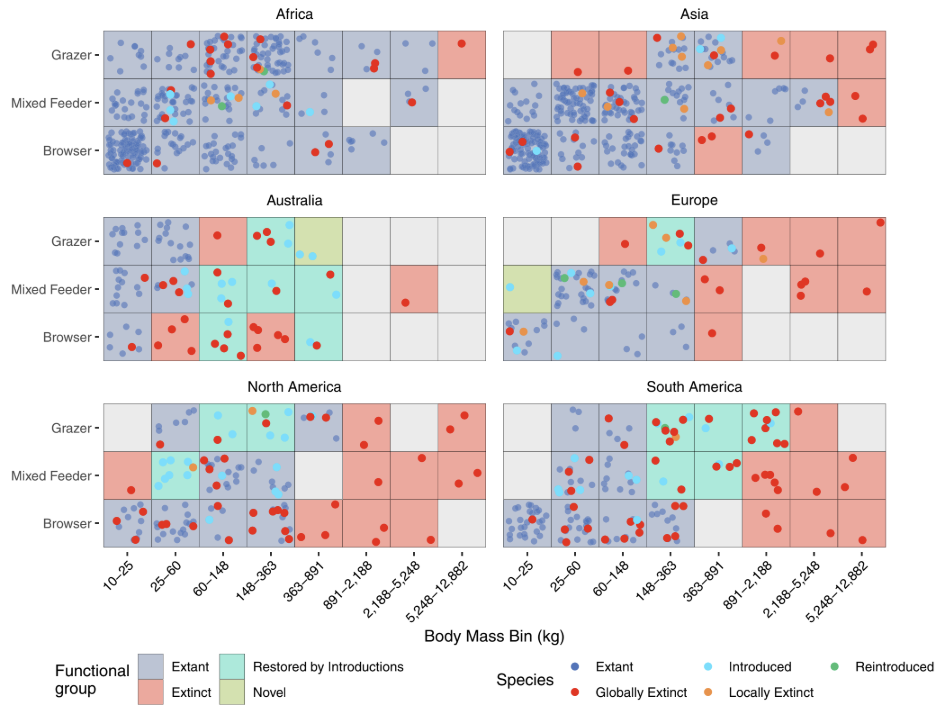
What did figure 4 describe?
The loss and restoration of key metabolic ecosystem functions
Forty-four percent of introductions restore extinct functional groups, restoring 14 of 51 extinct dietary body mass groups across continents
What is Conservation Biology?
an applied multidisciplinary field of science that seeks to understand human-caused changes to biodiversity and the impact of these changes on natural systems, and to investigate responses to mitigate these challenges
What is Conservationist?
one who advocates or practices the sensible and careful (sustainable) use of natural resources
What is a Preservationist?
one who advocates for land, natural systems, and organisms to exist without significant human interaction
What are the three main goals of Conservation Biology?
All of the above
What is the biological species concept?
species are groups of actually or potentially interbreeding populations which are reproductively isolated from other such groups
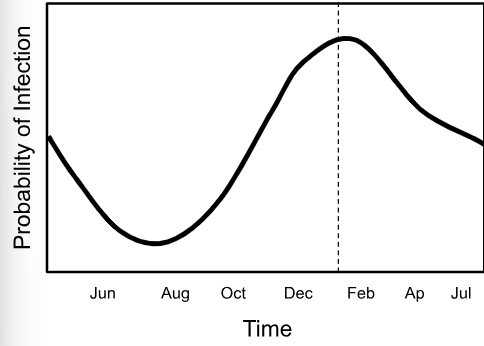
Infection prevalence at Lower Blue Point Spring
Bd is extremely temperature sensitive
In summer, confidence level is 0: no frogs sampled at this time have this fungus
As temperatures cool, more animals are infected with fungus - hammered in the winter
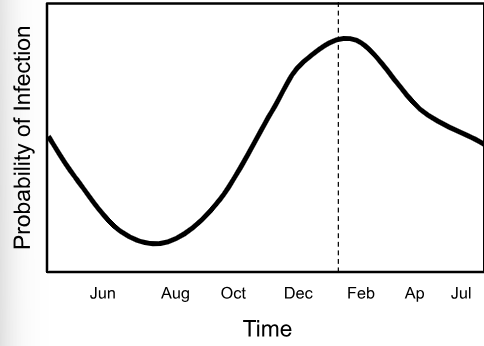
In summer, confidence level is 0:
no frogs sampled at this time have this fungus
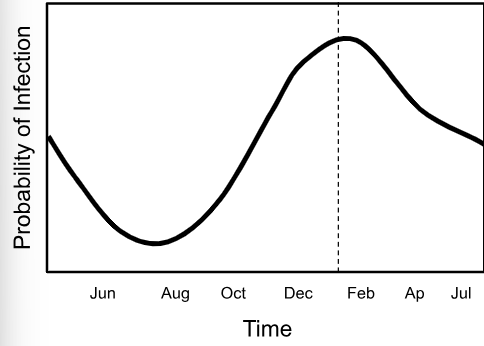
As temperatures cool, confidence level is 1:
more animals are infected with fungus - hammered in the winter
How did Resident frogs survive against the chytrid pathogen?
Potentially exposed to small levels of infection and can build resistance to it, adapt over time
Later sampling results found that Bd had disappeared from the site Oct-Nov 2021,2022, 2023
Assumed two things occurred:
Really hot summer
A pool that was created that was fish-free, favored by frogs, water stayed cooler, and frogs stayed there. When the water dried out, no frogs remained there to maintain the fungus (small change in environment)
What was the Younger Dryas 14-12.9 ka?
Climatic pattern at the end of the last glacial period may have been different than earlier glacial-interglacial transitions
Northern Hemisphere plunged back into and then out of glacial conditions within decades
A climatic period where the Earth plummeted to really cold temperatures
During the Younger Dryas, the Northern Hemisphere plunged:
back into and then out of glacial conditions within decades
Why was the Younger Dryas important?
hypothesized that it was an unusual event that had a part in the mass extinction of animals