Ch. 8 Fluids and Elasticity of Solids
 Call Kai
 Learn
Learn Practice Test
 Spaced Repetition
 Match
Match Flashcards
 Knowt Play
1/12

There's no tags or description
Looks like no tags are added yet.
Name | Mastery | Learn | Test | Matching | Spaced | Call with Kai | Chat |
|---|
No analytics yet
Send a link to your students to track their progress
13 Terms
Hydrostatics: Fluids at Rest
Density and Specific Gravity
(I was filling out all the topics in the chapter, fill this out later)
Hydrostatics: fluid at rest
In this section, and the next, we’ll discuss some of the fundamental concepts dealing with substances that can flow, known as fluids. Both liquids and gases are fluids, but there are distinctions between them. At the molecular level, a substance in the liquid phase is similar to one in the solid phase in that the molecules are close to, and interact with, one another. The molecules in a liquid are able to move around a little bit more freely than those in a solid, in which the molecules typically only vibrate around relatively fixed positions. By contrast, the molecules of a gas are not constrained and fly around in a chaotic swarm with hardly any interaction. On a macroscopic level, there is another distinction between liquids and gases. If you pour a certain volume of a liquid into a container of a greater volume, the liquid will occupy its original volume, whatever the shape and size of the container. However, if you introduce a sample of gas into a container, the molecules will fly around and fill the entire container.
Density and Specific Gravity
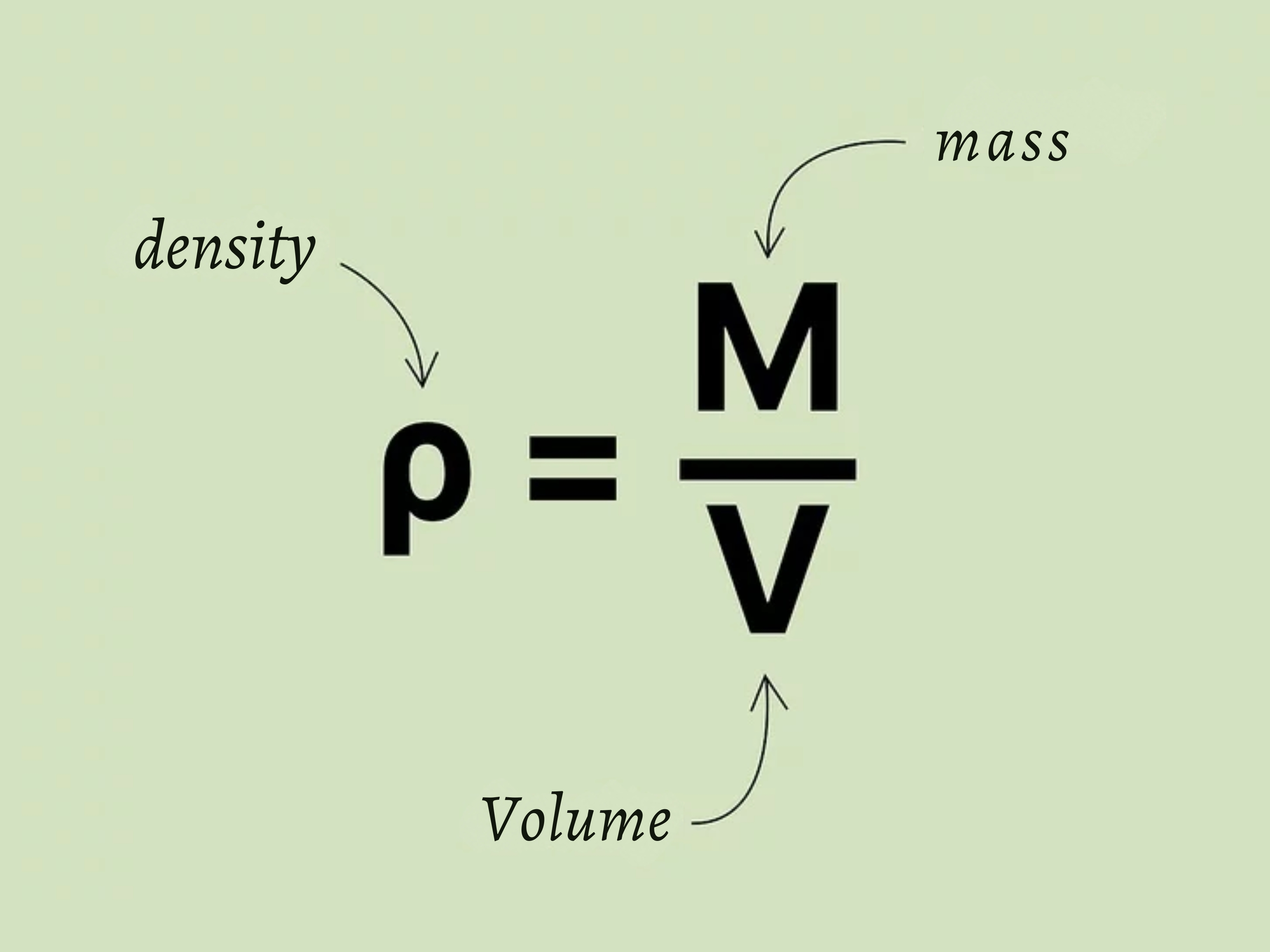
The density of a substance is the amount of mass contained in a unit of a volume. In SI units, density is usually expressed in kg/m3 or g/cm3.
density= mass/volume
Density (ρ) equals mass (m) divided by volume (V)
There is one substance whose density you should memorize: The density of liquid water is taken to be 1000 kg/m3 or 1 g/cm3. (Another useful version of the same value: 1 kg/L, where L stands for a liter; a liter is 1000 cm3.
Sometimes the MCAT mentions specific gravity. This (poorly named) unitless number tells us how dense something is compared to water:
specific gravity= density of substance/density of water
sp. gr.= ρ/ρH2O
stopped on 219.
Force of Gravity for Fluids
When solving questions involving fluids, it is often handy to know how to find the force of gravity acting on the fluid itself or objects that are immersed in the fluid. In the previous chapters, we have used Fgrav=mg without too much difficulty. However, with fluids, it is more difficult to remove a portion of fluid from a tank, place it on a scale, and find its mass. using the relationship between mass, volume, and density, we can redefine the magnitude of Fgrav for fluids questions:
ρ= m/V → m=ρV → Fgrav=mg= pVg
With this new formula Fgrav= ρVg, it is important to make sure that the density (ρ) and the volume (V) describe the properties of the correct object of a fluid.
Pressure
If we place an object in a fluid,
the fluid exerts a force on an object.
If we look at how that force is distributed over any small area of the object’s surface, we have the concept of pressure.
P= force/area= F⟂/ A
The subscript ⟂ (which means “perpendicular) indicates that pressure is defined as the magnitude of the force acting perpendicular to the surface, divided by the area. We don’t need to worry very much about this, because (for MCAT purposes) at any given point in a fluid the pressure is the same in all directions, which means that the force does not depend on the orientation of the force.
Although the formula for pressure involves “force”, pressure is actually a scalar quantity, because the perpendicular force is the same for all orientations of surface. The unit of pressure is the N/m2, which is called a pascal (abbreviated Pa). stopped here
A scalar quantity is a physical measurement that has magnitude (size or numerical value) and a unit, but no direction.
stopped on page 220.
Hydrostatic gauge pressure
Pgauge= ρfluidgD
This formula gives the pressure due only to the fluid (in this case, the water) in the tank. This is called hydrostatic gauge pressure. It’s called hydrostatic, because the fluid is at rest, and the gauge pressure means that we don’t take the pressure due to the atmosphere into account. If there were no lid on the water tank, then the water would be exposed to the atmosphere, and the total pressure at any point in the water would be equal to the atmospheric pressure pushing down on the surface plus the pressure due to the water (that is, the gauge pressure). So, below the surface, we’d have
Ptotal= Patm+ Pgauge
If the tank were closed to the atmosphere, but there were a layer of gas above the surface of the water, then the total pressure at a point below the surface would be the pressure of the gas pushing down at the surface of plus the gauge pressure: Ptotal=Pgas+Pgauge. In general, we’ll have
Ptotal= Pat surface+ Pgauge
stopped on page 222.
Buoyancy and Archimedes Principle
Let’s place a large wooden block in our tank of water. Since the pressure on each side of the block depends on it’s average depth, we see that there’s more pressure on the bottom of the block than there is on the top of it. Therefore, there’s a greater force pushing up on the bottom of the black than there is pushing down on the top. The forces due to the pressure on the other four sides (left and right, front and back) cancel out, so the net fluid force on the block is upward. This net upward fluid force is called the buoyant force (or just buoyancy for short), which we’ll denote by Fbuoy (or FB).
Buoy: Spanish boyante (floating).
Suffix: The ending -ancy acts as a noun suffix showing a quality or state.
We can can calculate the magnitude of the buoyant force using Archimede’s principle:
The magnitude of the buoyant force is equal to the weight of the fluid displaced by the object.
When an object is partially or completely submerged in a fluid, the volume of the object that’s submerged, which we called Vsub, is the volume of the fluid displaced.
look at the flashcard to see the tank of fluid
By multiplying Vsub by the density of the fluid, we get the mass of the fluid displaced; then, multiplying this mass by g gives us the wight of the fluid displaced. So, here’s the Archimedes’ principle as a mathematical equation:
Archimede’s Principle
Fbuoy= ρfluidVsubg
When an object floats, its submerged volume is just enough to make the buoyant force it feels balance its weight. That is, for a floating object, we always have wobject=Fbuoy. If an object’s density is ρobject and its volume is V, its weight will be ρobjectVobjectg. The buoyant force it feels its ρfluidVsubg. Setting these equal to each other, we find that
Floating Object in Equilibrium on Surface
wobject=Fbuoy
Vsub/ V= ρobject/ ρfluid
stopped on page 226
Pascal’s Law
Pascal’s Law is a statement about fluid pressure. It says that a confined fluid will transmit an externally applied pressure changed to all parts of the fluid and the walls of the container without loss of magnitude. In less formal language, if you squeeze a container of fluid, the fluid will transmit your squeeze perfectly throughout the container. The most important application of Pascal’s law is hydraulics
Consider a simple hydraulic jack consisting of two pistons resting above two cylindrical vessels of fluid that are connected by a pipe. If you push down on one piston, the other one will rise. Let’s make this more precise. Let F1 be the magnitude of the force you exert down on one piston (whose cross-sectional area is A1) and let F2 be the magnitude of the force that the other piston (cross sectional area A2) exerts upward as a result
there is a picture on page 230
Pushing down on the left-hand piston with a force F1 introduces a pressure increase of F1/A.
stopped on page 230
Surface Tension
To complete our section on fluids at rest, we introduce the phenomenon of surface tension. We have all seen long-legged bugs that can walk on the surface of a pond or have watched a slowly-leaking faucet from a drop of water that grows until it finally drops into the sink. Both of these are illustrations of surface tension. The surface of a fluid can behave like an elastic membrane or thin sheet of rubber. A liquid will form a drop because the surface tends to contract into a sphere (to minimize surface area); however, when you see a drop hanging precariously from a faucet, its spherical shape is distorted by the pull of gravity. In fact, the reason it eventually falls into the sink is the the force due to surface tension causing the drop to cling to the head of the faucet is overwhelmed by the increasing weight of the drop. It can’t hang on, and away it goes.
stopped on page 232
Hydrodynamics: fluid in motion
Flow rate and continuity equation
Consider a pipe through which fluid is flowing: the flow rate, f, is the volume of fluid that passes a particular point per unit time, like how many liters of water per hour per minute are coming out a faucet. In SI units, flow rate is expressed in m3/s. To find the flow rate, all we need to do is multiply the cross-sectional area of the pipe at any point, A, by the average speed of the flow, v, at that point.
Flow rate formula: f=Av
Be careful not to confuse flow rate with flow speed; flow rate tells us how much fluid flows per unit time; flow speed tells us how fast the fluid moves. There’s a difference between saying that a hose ejects 4 liters of water every second (that’s flow rate) and saying that the water leaves the hose at a speed of 4m/s (that’s flow speed).
stopped on page 233.
Continuity Equation: A1v1=A2v2
Bernoulli’s Equation
The most important equation in fluid dynamics is Bernoulli’s equation, but before we state it, it’s important to know under what conditions it applies. Bernoulli’s equation applies to ideal fluid flow. A fluid must satisfy the following four requirements in order to be considered an ideal fluid:
the fluid is incompressible: this works very well for liquids; gases are quite compressible, but it turns out that we can use the Bernoulli Equation for gases provided the pressure changes are small
There is negligible viscosity: viscosity is the force of cohesion between molecules… stopped on page 235.
The Bernoulli Effect
Consider the two points labeled in the pipe shown below:
there is a picture on page 239. ]
Since the heights y1 and y2 are equal in this case, the terms in Bernoulli’s equation that involve the heights will cancel, leaving us with P1+1/2 ρv12=P2+1/2ρv22
We already know from the continuity equation (f=Av) that the speed increases as the cross-sectional
stopped on page 240
The Elasticity of Solids
Support beams for a building are compressed slightly under the heavy load they support: thick steel cables may be stretched in the construction of a bridge; and the ends of a connecting rod in a strcture can be pushed or pulled in opposite directions, causing the rod to bend. These are some examples of the type of problem we’ll look at in this section: the relationship between the forces applies to a solid object and the resulting change in the object’s shape.
Stress
We’ll look at three ways forces can be applied to an object: tension (Stretching) forces, compression (squeezing) forces, and sheat (bending) forces:
There is a picture on page 242
The magnitude of the force at either end, F, divided by area over which it acts is called the stress:
stress=force/area=F/A
Stress is much like pressure, but they’re not the same, because the force in the stress equation doesn’t have to be perpendicular to the area over which it acts. For example, a shear force acts parallel, not perpendicular, to the areas at the ends. Nevertheless, we’re still dividing a force by an area, so the unit of stress is the N/m2, or pascal (Pa). It’s very important to notice that stress is inversely proportional to the cross-sectional area, or, for an object with circular cross sections, inversely proportional to the square of the cross-sectional radius or diameter.
Strain
As a result of these forces, the object’s shape will change. The ratio of the appropriate change in the length to the object’s length (see the figure below) is called the strain.
-there is a picture on page 242.
Hooke’s Law
The idea is simple: stress causes strain. As long as the stress isn’t too large- so that we don’t permanently deform the object once the stress is removed (that is, allowing the object to display some elasticity)- then stress and strain are proportional. This is known as Hooke’s Law. For a tensile or compressive stress, the constant of proportionality is called Young’s modulus; for a shear stress, it’s called (what else?) the shear modulus.
look at page 243